Whitehall paving prices by scope — 2026
In Whitehall, where 63.5% of homes are single-family and the homeownership rate stands at 74.2% (U.S. Census Bureau, ACS 2024), driveways are an out-of-pocket homeowner expense, not bundled into rent or association dues. Most driveways in this market need to handle the region’s heavy freeze-thaw cycles and clay-and-shale subgrade — both hard on surfacing materials and base stability. These are not luxuries; they’re basic conditions for driveways to survive southwestern Pennsylvania winters.
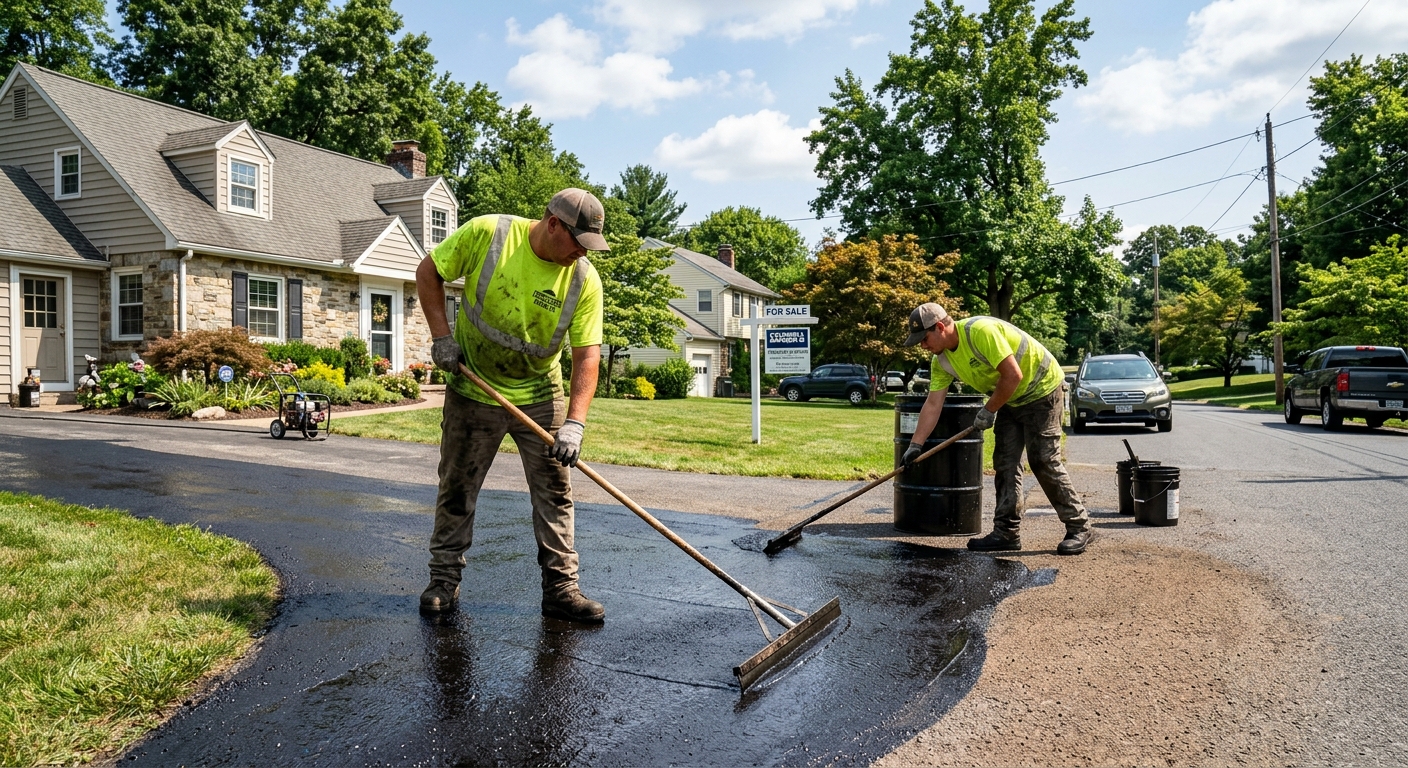
Driveway paving costs in Whitehall, like most of Allegheny County, reflect more than the surface you see. With asphalt, especially, most of the price difference between quotes is buried under the surface. A cheap price often skips the gravel base, compaction, or drainage layers you cannot inspect once the job is done. Given the hilly terrain and known subgrade issues, skimping here means cracks, heaves, and sinking in just a few years — while a properly prepared base might last decades. The chart below shows realistic 2026 price bands for common driveway choices in Whitehall. Square footage and site access also affect cost, but these figures give a good planning range for nearly all local homes.
| Service |
Best for |
Lifespan |
Price range |
| Asphalt — full replacement with new base |
failed base, structural cracking |
20–30 yrs |
$3,500–$8,900 |
| Asphalt overlay / resurfacing |
sound base, surface cracking only |
8–15 yrs |
$1,500–$4,500 |
| Sealcoating — single application |
preventive maintenance on sound asphalt |
2–4 yrs |
$200–$700 |
| Concrete — new installation |
long service life, low maintenance |
30–50 yrs |
$5,000–$12,000 |
| Crack filling and patching |
isolated cracks under a quarter inch |
1–3 yrs |
$200–$800 |
| Gravel driveway |
rural, budget, long runs |
5–10 yrs with upkeep |
$900–$3,500 |
Estimates for a typical Whitehall driveway. Square footage and base condition drive these figures more than material choice.
The paving season in southwestern Pennsylvania
Paving in Whitehall is strictly a fair-weather job — and not just because crews don’t want to be out in the cold. The region’s winter design temperature is 8 °F, and local hot-mix asphalt plants shut down for the winter. With no material available, asphalt jobs simply can’t be done between late November and early April. Even when there is sun, the mix needs to be laid and compacted while it’s hot; cold air saps heat too quickly, making the surface porous and short-lived. It’s not just preference — a driveway paved outside the recommended temperature window will not hold up, and those failures aren’t visible right away.
Concrete has similar limits. While it is available year round, concrete needs several days above freezing to cure. Pouring any flatwork when nighttime temperatures drop below freezing risks surface scaling, poor finish, and early cracking.
For these reasons, the heart of paving season in Allegheny County runs from late April to October. Crews are busiest and prices highest in peak summer when pent-up demand meets limited sunny weeks. Shoulder seasons — May, June, and September — are when established contractors catch up and fill schedules. If someone offers to pave your driveway in December or March, in Whitehall, they are either not busy (for a reason) or cutting corners. Always ask how the crew is getting around the region’s well-known temperature limits — if they can’t answer convincingly, don’t hire.
Asphalt or concrete for a Whitehall driveway?
Choosing between asphalt and concrete for a driveway in Whitehall isn’t just a matter of looks or cost. This part of Allegheny County sees repeated freeze-thaw cycles and heavy de-icing salt use. Asphalt handles these cycles well because it’s flexible; it can move as the clay and shale soil expands and contracts, absorbing shifts without cracking. Asphalt’s downside is it’s a bit softer in summer heat and needs periodic sealcoating to maximize its lifespan — but with upkeep you’ll get 20–30 years out of a new install.
Concrete lasts far longer if it survives, but it is rigid and doesn’t flex with ground heaving. Its Achilles’ heel isn’t the cold itself, but the use of de-icing salt: salt gets into the surface, and as freeze-thaw attacks the pores, the slab spalls and scales. That’s the most common way concrete driveways fail here. You have to avoid using salt-based de-icers on concrete — and most homeowners don’t or can’t stick to that. Concrete is more expensive up front, but can outlast asphalt by 10–20 years if respected.
For long gravel runs or rural lots, a gravel drive is legitimate; it drains well and is forgiving with our terrain, but it is dusty and needs top-dressing. Pavers are rare in Whitehall but have their place — individual bricks can be reset as the ground moves, making patch repairs easy, but they are the most costly and need a solid aggregate base, just like the others.
| Option |
Installed cost |
Maintenance |
Freeze-thaw performance |
Lifespan |
| Asphalt — new install |
$3,500–$8,900 |
sealcoat every 3–4 yrs |
excellent, flexes |
20–30 yrs |
| Asphalt — overlay |
$1,500–$4,500 |
same |
good if base is sound |
+8–15 yrs |
| Concrete |
$5,000–$12,000 |
low, avoid de-icing salt |
fair, spalls with salt |
30–50 yrs |
| Pavers |
$7,900–$12,000 |
individual units replaceable |
good, settles gradually |
25–50 yrs |
| Gravel |
$900–$3,500 |
top-dress every 2–3 yrs |
excellent drainage |
indefinite with upkeep |
The driveway scams that work in Whitehall
Driveway paving brings out “here today, gone tomorrow” operators — and Whitehall is a popular target. Our driveways are visible from the street, but the quality of the base work is invisible until long after the truck is gone. In a high-density market like Allegheny County, it is easy for a new outfit to slip in, especially among neighbors who don’t compare notes until after the fact.
Common pitches include: “leftover asphalt from a job down the road,” unmarked trucks with out-of-area plates, a “today-only special price,” and demands for large cash or check deposits up front. High-pressure tactics to sign immediately, or a refusal to put details in writing, are both giant red flags. The fastest-growing scam is a drive-by oil-based spray billed as “sealcoating” — it leaves the surface black for a month, then flakes off, with no real protection.
Pennsylvania law requires a written contract for any home improvement over $500; you have a 3-business-day right of cancellation after signing. No legitimate contractor will rush you through a verbal-only deal on any driveway work in Whitehall. If a company won’t provide proof of HIC registration or proof of workers’ compensation, walk away: the state makes checking both free and public. A reputable contractor will expect you to verify.
Five-minute checks defeat every driveway scam: (1) confirm HIC registration at hic.attorneygeneral.gov, (2) get the contract in writing, (3) check compensation coverage at WCAIS, (4) never pay large cash deposits up front, and (5) never sign away your right to cancel.
Whitehall's ground and what it means for paving
Whitehall, like much of Allegheny County, is built on a base of clay and shale soils. Clay holds water and heaves dramatically during freeze-thaw cycles; shale layers provide uneven drainage and create pockets where water gets trapped below the pavement. The subgrade is not forgiving, and that translates directly to how a driveway must be designed and installed. If the base isn’t thick enough, or isn’t compacted rigorously, you’ll get bumps, dips, or even major settlement within just a few years.
The region’s frost depth is 36 inches. Heaving from freeze-thaw is the dominant threat to driveways here, and any job that skimps on base prep is going to fail early. Postwar 1945–1975 subdivision growth in nearby townships means many Whitehall driveways are now 50 or 60 years old — long past the expected service life for basic asphalt, especially if local standards at the time were minimal or the original base was thin. It’s common for a surface to look “tired” when the real problem is below, making overlays a mistake if the base is already compromised. If the service life and look are both gone, don’t waste money on patching or sealcoating. It’s time for a rebuild from the ground up.
Driveway permits, approaches and stormwater rules
Most driveway repaving jobs in Whitehall — if the footprint is unchanged and all work is on private property — do not require a building permit from the municipality. The exception is the driveway approach: where it meets the street. If your driveway connects to a state-maintained route, a Highway Occupancy Permit from PennDOT District 11-0 is required. For municipal roads (not state routes), each Allegheny County municipality — including Whitehall — will have its own process, usually independent from home improvement codes. Remember, expanding your driveway or altering an apron, curb, or sidewalk may trigger local right-of-way review, especially in or near Pittsburgh.
Any increase in impervious surface — widening, lengthening, or paving over previously unpaved areas — can also trigger local stormwater management rules. In all cases, you are liable if your new paving causes water to run onto a neighbor’s property. Just because a permit isn’t required for resurfacing doesn’t mean there’s a free pass for runoff.
Before hiring, verify your contractor’s Home Improvement Contractor registration at hic.attorneygeneral.gov, and confirm they carry valid workers’ compensation insurance through the WCAIS site. Pennsylvania law requires both for any paving job over $500, and written contracts are mandatory under the Home Improvement Consumer Protection Act.
Beyond replacement: layout changes
Some of the most valuable driveway improvements in Whitehall involve layout changes — driveway widening for a second vehicle, extending to reach a detached garage, adding a turnaround, or trading a gravel run for new asphalt. Each of these goes beyond a simple resurface, so the rules and installation details change.
A new layout means new base must be built where there wasn’t any before, over soil that’s never been driven over or compacted. The join between the old and new work will always be the weak point and will need extra attention during prep. Most layout changes increase the total impervious square footage, which brings up stormwater management requirements — both for protection of local streams and your own yard drainage.
You’ll likely need an approach permit if your changes expand or shift where the driveway meets public roads, especially if the state or borough maintains your street. Setback rules may also restrict how close to the property line you can pave. It’s wise to review both zoning setbacks and local stormwater rules with your contractor before finalizing plans.
Frequently asked questions — driveway paving in Whitehall
How far ahead should I book a paver in Whitehall?
In Whitehall, it’s smart to book at least two to three months ahead if you want your driveway paved in peak season (July to early September). Allegheny County’s paving schedule gets packed quickly due to the region’s limited warm months and heavy homeowner demand, with over 63.5% of homes being single-family (U.S. Census Bureau, ACS 2024). Quality contractors fill up their calendars first, and waiting until May or June to call usually means you’ll land a spot late in the fall — and you don’t want to be the last job squeezed in before winter. Emergency overlays or small patch jobs can sometimes be worked in faster, but for a complete driveway replacement priced between $3,500–$8,900, early planning is almost always rewarded with better results and more reputable options.
Why are my driveway edges crumbling?
Driveway edge failure is especially common in Whitehall’s older asphalt driveways, mainly due to the region’s clay-to-shale subgrade. Asphalt laid thin at the edges, or with insufficient crushed stone base extending the full width, will shear and unravel as tires, water, and freeze-thaw cycles attack the unsupported edge. In driveways installed during the postwar building boom, a common shortcut was to feather the edge rather than build it up strong, which leads to exactly this problem. Once the edge starts breaking away, patching temporarily slows things down but won’t restore structure. If the crumbling is confined and the base is otherwise solid, a patch job in the $200–$800 range can buy a year or two. If multiple areas are unraveling, expect to need a new install.
Why are paving quotes in Whitehall so different from each other?
You’ll see a big spread in paving quotes in Whitehall because most of what you’re paying for is buried — the thickness and quality of the stone base, proper compaction, and attention to drainage. The region’s clay and shale subgrade requires extra prep to prevent heaving and water damage. Some crews bid low by skimping on base or cutting corners on material thickness; the difference may be invisible until the first bad winter. On a typical replacement job in the $3,500–$8,900 range, the cheapest bid often means the contractor is not spending on what counts. Always ask what’s included in the base and get it in writing. A reputable Whitehall contractor knows this ground and prices accordingly.
What is the difference between crack filling and sealcoating?
Crack filling and sealcoating do two different things for an asphalt driveway. Crack filling is targeted: it injects hot rubberized material into cracks, typically under a quarter inch wide, to keep water from working its way down through the surface and attacking the base. Sealcoating is a thin surface treatment that refreshes the top layer and blocks UV and rain, but does not stop water from entering through existing cracks. In Whitehall’s climate, it’s common to combine both as part of a maintenance cycle. Crack filling alone can run $200–$800 depending on the area, while sealcoating will be in the $200–$700 range for a standard driveway. Do the cracks first, then sealcoat for best results.
How deep should the aggregate base be here?
In Whitehall and the rest of Allegheny County, a proper driveway demands at least 6–8 inches of compacted crushed stone base (more if the soil is extremely soft or if heavy vehicles will use the surface). That extra thickness is not overkill: it is insurance against our freeze-thaw cycle and the way water sits in the clay and shale subgrade here. Skimping leads to the surface flexing, cracking, or even settling unevenly, especially in older developments where subgrade compaction was minimal. Most paving failures are traced back to a thin or poorly compacted base, so it’s one area where cutting corners is expensive later. Total replacement jobs in the $3,500–$8,900 range include this step — overlays do not.
What kind of soil is under Whitehall driveways?
Whitehall, along with much of southern Allegheny County, sits on a subgrade made up of clay and shale. Clay retains water and expands during freeze-thaw, while shale creates uneven drainage channels and air pockets. This combination is hard for driveways — it means the crushed stone base must be thicker and compacted better compared to areas with sandier or rocky subsoils. When rebuilding or expanding, experienced contractors will plan for these conditions and may even add geotextile fabric or install extra drainage. Not understanding what’s beneath the surface has led to more than one failed paving job, so always ask how your paving contractor plans to handle our local soil before spending $3,500–$8,900 on a full install.
How much does it cost to widen a driveway?
Widening a driveway is a common project in Whitehall, especially on homes with single-width asphalt poured during the postwar years. You’ll be paying for excavation, new base over soil that’s never been driven on, and a careful seam where new paving meets old. Total costs can range from $1,500–$4,500 for a basic overlay-style widening (when the base is already strong and only the new strip is added) to $3,500–$8,900 when the old and new sections must both be reconstructed for a strong joint. Extra width also increases impervious surface, so local stormwater rules may require basic runoff management if you add significantly to your driveway’s footprint.
Is an overlay worth it or should I start over?
An asphalt overlay is only as good as the base beneath it. In Whitehall, if your driveway base is still firm and the main issues are cracks or surface wear, putting an overlay on top can add 8–15 years to its life for $1,500–$4,500. But if the surface is alligator-cracked, riddled with dips and soft spots, or edges are unraveling, an overlay is throwing good money after bad. Older driveways installed on clay or shale can fail from the subgrade up, making new asphalt over a bad base a risk. True value is in the prep — always have the base condition checked before committing. Sometimes the honest answer is to remove and replace.
Are there stormwater rules on paving in Whitehall?
Yes, stormwater rules apply to paving projects in Whitehall, as with everywhere in Allegheny County. Any time you increase the amount of pavement — by widening, lengthening, or converting gravel to hard surface — you add to the impervious area and must manage runoff on your own lot. Even if no municipal permit is required for resurfacing, you are liable if runoff ends up flooding your neighbor or entering the street. Sometimes, for bigger expansions, the borough may require a basic drainage plan or on-site stormwater retention. On cost: smaller widening projects still run $1,500–$4,500, so make sure the job does not create water problems for anyone downstream or you could be forced to correct it at your expense.