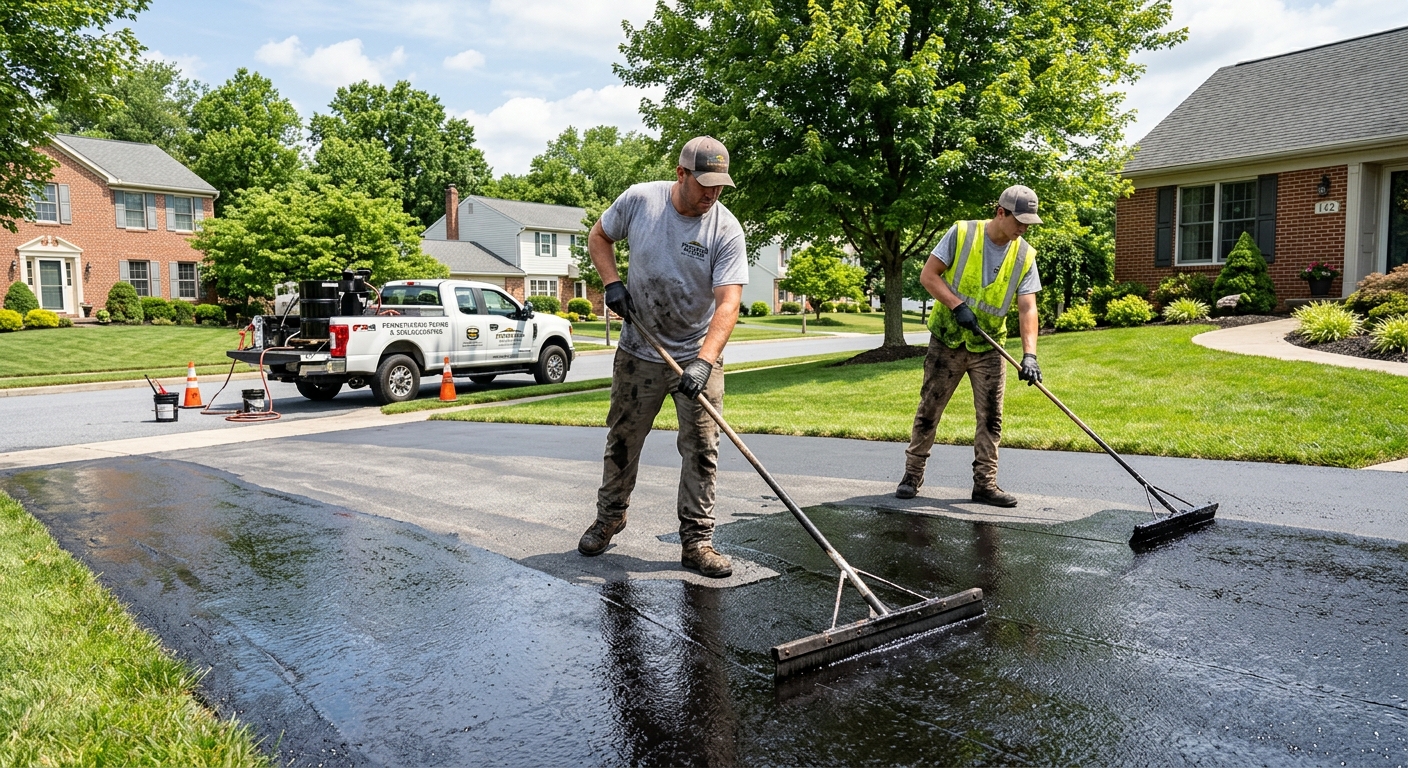
Turtle Creek paving prices by scope — 2026
In Turtle Creek, where just 47.9% of homes are single-family and the homeownership rate sits at only 36.8% (U.S. Census Bureau, ACS 2024), driveway paving isn’t something everyone faces—but if you own, it’s an outsized, visible expense. With nearly all housing built before 1980, many driveways are decades past their prime. Costs here are driven much less by surface material than by what’s below the surface and whether the subgrade is properly prepared. In this part of Allegheny County, the combination of harsh freeze-thaw cycles and heavy clay and shale soil means skimping on the base is the number one cause of premature failure—most of the real price difference between quotes hides under the driveway, not in the top layer.
Expect prices to reflect extensive prep and base building, especially given how local hills can focus drainage into concentrated spots. A cut-rate bid almost always means corners cut on excavation, base thickness, or compaction—the difference isn’t visible until frost leaves you with alligator cracks and heaving.
| Service |
Best for |
Lifespan |
Price range |
| Asphalt — full replacement with new base |
failed base, structural cracking |
20–30 yrs |
$3,300–$8,500 |
| Asphalt overlay / resurfacing |
sound base, surface cracking only |
8–15 yrs |
$1,400–$4,200 |
| Sealcoating — single application |
preventive maintenance on sound asphalt |
2–4 yrs |
$200–$650 |
| Concrete — new installation |
long service life, low maintenance |
30–50 yrs |
$4,700–$11,500 |
| Crack filling and patching |
isolated cracks under a quarter inch |
1–3 yrs |
$200–$800 |
| Gravel driveway |
rural, budget, long runs |
5–10 yrs with upkeep |
$900–$3,500 |
Estimates for a typical Turtle Creek driveway. Square footage and base condition drive these figures more than material choice.
Permits and approvals for paving in Turtle Creek
Most driveway repaving projects in Turtle Creek do not require a building permit if you’re working within the existing driveway footprint, saving homeowners the trouble and delay of permit paperwork. However, changes to the driveway’s approach—where it meets a public road—are another matter. Any new or replaced approach connecting to a state road requires a Highway Occupancy Permit from PennDOT District 11-0. This catches many by surprise, because even minor curb or apron work at the public right-of-way is regulated at the state level, not by the borough.
Stormwater is the other critical concern: expanding or altering your driveway can increase runoff, potentially requiring additional drainage measures under Allegheny County norms. Regardless of paperwork, if your paving changes direct water onto a neighbor’s property, you can be held liable for damage. Turtle Creek’s hilly terrain and heavy clay subgrade only magnify the risk of improper drainage.
Before hiring, verify that your contractor holds a current Pennsylvania Home Improvement Contractor registration for any job over $500. This can be checked at hic.attorneygeneral.gov. Workers’ compensation is mandatory for any employer; you can confirm coverage status through the state’s WCAIS system at wcais.pa.gov. Proper paperwork is your only defense if something goes wrong or if enforcement happens.
Finding a legitimate paver in Allegheny County
A legitimate paving contractor in Allegheny County will have more than a cell number and a pickup truck. The main registry to check is the state Home Improvement Contractor directory at hic.attorneygeneral.gov. Make sure the name, address, and registration number on your estimate match what’s listed. For any crew on your property, workers’ comp coverage is both law and protection. Ask for a WCAIS certificate if in doubt.
A paver who won’t say which asphalt plant supplies them is likely a broker—or worse, a fly-by-night. In Allegheny County, with several local plants and quarries, there is no reason a real contractor won’t be able to name their supplier. You want to see invoices to a local business address, not jobs subcontracted out or rented gear dropped off for a weekend.
- Check contractor at hic.attorneygeneral.gov for registration
- Ask for a local business address, not just a mobile number
- Verify workers' comp insurance at wcais.pa.gov
- Get references from jobs at least 3 years old in Allegheny County
- Insist on the name of their main asphalt supplier—local plants only
- Ask if all equipment shown belongs to the company or is rented
- See proof of liability insurance and check the named insured
- Visit a completed driveway, preferably after a winter season
- Get a written contract with Pennsylvania's three-day right to cancel
- Clarify cleanup, lawn restoration, and traffic ramping in the quote
- Confirm compliance with any needed PennDOT approach permit
- Never pay in cash, and never more than a modest deposit up front
Red flags: out-of-state plates, vague references, equipment on temporary lease, uninsured labor, or any contractor who doesn’t put everything in writing. Cheap jobs almost always reveal themselves in shallow base prep and shortcuts you won’t see until the next hard winter.
Drainage: the failure nobody plans for
In Turtle Creek, driveway drainage isn’t a detail—it’s the difference between a driveway that lasts and one that buckles in three winters. Minimum slope for surface runoff should be at least 2% (a quarter-inch per foot), whether crowning a long drive or running a cross-slope off to the lawn. When grade forces water toward the garage or house, no surface alone will solve it: this needs either corrective grading, or a trench or channel drain installed at the low point, tied to a daylight outlet or (if there’s nowhere to run) a dry well sized for storm events.
Freeze-thaw cycles compound every drainage mistake. In a climate like Turtle Creek, ponded water soaks into the sub-base, then swells into ice come the first hard freeze—heaving the pavement and launching the cracking you see in March. Clay subgrade here is slow-draining and holds water tight to the base, so it demands thicker aggregate and careful attention to moving water down-slope and off-pavement.
Redirecting runoff onto a neighbor’s property is a liability even if you have a permit. Any changes, even if they improve the surface, must handle water lawfully and sensibly. Most long-term failures in driveway paving around Turtle Creek can be traced back to shortcuts in grading or draining, not to the quality of the blacktop or concrete itself.
Comparing paving estimates in Turtle Creek
When you compare paving quotes in Turtle Creek, don’t just focus on the overall price. Every detail matters—especially in a region where freeze-thaw cycles and clay subgrade put hidden stress on your driveway’s structure. A clear estimate should list measured square footage (not just "large driveway" or "two-car"), excavation depth and whether disposal is included, type and depth of aggregate base (in inches), and compaction method (preferably specified as done in lifts, not just rolled once at the end). Asphalt should be quoted in layers with compacted thickness stated plainly.
Drainage should be addressed—if the estimate doesn’t specify slope, water direction, or any necessary drains, you’re left with hope as a strategy. Cleanup and lawn restoration details matter more than you’d think; paving is a messy job. Payment terms should never demand more than a modest deposit. Finally, nail down what the warranty covers—in this area, most exclude cracking, settling, and heaving, which are the exact failures that drive replacements.
A one-line “$X for paving” estimate is garbage; it cannot be compared and is usually how people get sold a driveway with no prep and minimal lifespan.
| Line item |
What to look for |
Red flag if… |
| Area |
measured square footage stated |
eyeballed or absent |
| Excavation |
depth and disposal included |
'we'll pave over it' |
| Base |
aggregate type and depth in inches |
'proper base' |
| Compaction |
method, and done in lifts |
not mentioned |
| Asphalt |
courses and compacted depth |
'3 inches' unqualified |
| Drainage |
slope and water direction stated |
silent |
| Warranty |
what is covered and what is excluded |
verbal only |
| Payment |
modest deposit, balance on completion |
full cash up front |
Changing the footprint of a Turtle Creek driveway
Any project in Turtle Creek that changes your driveway’s footprint—such as widening for a second vehicle, adding a turnaround, extending to a detached garage, or replacing a gravel section with asphalt—is a very different job from simply resurfacing. A new section requires a new, deep base over undisturbed clay or shale, with all the drainage challenges that come with it. The seam where new meets old will always be more vulnerable to cracking and movement, even if properly built.
Expanding your driveway can also run up against Turtle Creek’s impervious-surface limits and setback rules, especially if you are near a property line. You may need to show where stormwater will go, not just to get approval, but to avoid drainage disputes with neighbors. If the new section ties into a public road, PennDOT District 11-0 will likely require a Highway Occupancy Permit before any work starts. It’s smart to verify this up front to avoid expensive surprises after the fact.
Expect the cost for expansion to start at $3,300–$8,500 for new base work using asphalt, and higher if you’re adding features like a parking pad or turnaround that requires more square footage or complex grading.
The honest case for and against sealcoating
Sealcoating is widely sold in Turtle Creek as the essential “asphalt maintenance,” but it’s often oversold for what it can actually deliver. Here’s the honest case: sealcoating protects the asphalt binder from sun, air, gasoline, and motor oil, all of which can break down pavement in Allegheny County’s mix of weather extremes. It also instantly improves driveway appearance—useful if you want it to look fresh for a few years. But sealcoating does not add structural strength, fix base problems, stop serious cracks, or extend the life of a failing driveway any more than paint fixes rotten wood.
Apply sealer too often and you’ll end up with a patchy, brittle surface that starts to peel. Putting sealer on new asphalt before it’s cured traps volatiles under a film and can even cause premature flaking. In most Turtle Creek driveways, an honest interval is every 2–4 years, not every season. The first application should wait a full season—at least three months—for the pavement to fully oxidize and harden.
Crack filling is critically more important than regular sealcoating—stop water from getting into the base and freeze-thaw will do less harm. A good sealcoat, done right, uses two squeegee coats, not one thin spray. If someone offers to "seal" your driveway for under $200–$650 for an average drive, expect a splash-and-dash that doesn’t last through the first winter.
Frequently asked questions — driveway paving in Turtle Creek
Does road salt damage driveways in Turtle Creek?
Salt is unavoidable in southwestern Pennsylvania winters, and in Turtle Creek, folks use plenty to keep hills and driveways from icing over. On asphalt, salt doesn’t react chemically the way it does with concrete, but the bigger issue is the freeze-thaw cycle it enables—meltwater soaks into cracks and base, refreezes, and accelerates failure. Concrete is chemically vulnerable: salt corrodes its structure, leading to scaling and surface flaking. Both surfaces last longer if you limit salt use or switch to calcium chloride in extreme cold, but reality is, after three tough winters you may see early edge breakdown especially on older driveways. If the damage is isolated, patching or crack filling at $200–$800 is a practical fix.
Does sealcoating fix cracks?
Sealcoating is not a crack repair—it’s a surface treatment to slow oxidation and water penetration. In Turtle Creek, where most driveways are aging and see significant freeze-thaw, cracks are almost always a sign that water is getting into the base or that past repairs didn’t address underlying compaction. Good sealcoating might fill tiny surface hairlines, but anything over an eighth of an inch needs crack filling first or the sealer will just cap over the problem. Expect to pay $200–$800 for professional crack filling, while a standalone sealcoat application runs $200–$650. Always ask your contractor to fill cracks before sealing for real longevity.
Do I need a permit to repave a driveway in Turtle Creek?
If you’re just resurfacing or repaving your existing driveway—without touching curbs, sidewalks, or the approach—most Turtle Creek homeowners do not need a building permit, saving you an extra step. If you’ll be altering your driveway’s entry to a public or state road, though, you will need a Highway Occupancy Permit from PennDOT District 11-0. No contractor should start work without confirming this. Internal work on private property typically flies under the radar, but always check municipal requirements for major grading or expansion. For an overlay or replacement, plan for a budget of $1,400–$8,500 depending on site conditions.
How deep should the aggregate base be here?
In Turtle Creek, the local hills and frequent freeze-thaw cycles put pressure on driveway bases, especially with the heavy clay and shale soils found through much of Allegheny County. A skimpy base leads to heaving, settlement, and rapid failure. For asphalt, local contractors recommend at least 6–8 inches of compacted crushed stone for residential driveways, with deeper bases (10 inches or more) for sloped sites or heavy vehicle use. Concrete drives need both a solid base and, ideally, steel reinforcement to avoid cracking as clay moves below. Skipping base depth is a false economy—cutting corners here won’t save you anything compared to the $3,300–$8,500 cost of a full replacement.
How much does it cost to widen a driveway?
Expanding your driveway in Turtle Creek to add a parking pad, second car width, or a turnaround costs about the same per square foot as a full replacement—sometimes higher, depending on access and necessary drainage work. For most homes, widening with excavation, new base, and asphalt top runs $3,300–$8,500 for a standard double width or modest extension. If you're paving out to the street or near a property line, you may need a Highway Occupancy Permit and possibly a stormwater plan, which can add both cost and lead time. Always get a site visit and ask for a detailed, by-the-foot estimate up front.
How far ahead should I book a paver in Turtle Creek?
In the busy spring and summer paving season, reputable contractors around Turtle Creek are often booked out four to eight weeks, especially during dry spells. Waiting until September or October means you might miss the window for a quality install—cool weather limits asphalt working time, and frost can come early in Allegheny County’s valleys. For best selection and fair pricing (avoiding the summer rush), start getting quotes in late winter or early spring. If a contractor is “available tomorrow” during peak season, be very wary—quality crews are never idle. Current prices for full replacement start at $3,300–$8,500, and the best work requires planning, not a rushed schedule.
Why are my driveway edges crumbling?
Crumbling edges are a classic problem in Turtle Creek, especially with older driveways installed flush to the lawn with no proper edge support. Water from grass and snowmelt soaks under those edges, weakening the base, and repeated freeze-thaw cycles chip and break off unsupported material. Driving or parking near the very edge amplifies the problem. Repair might mean edge patching or a partial rebuild—budget for $200–$800 if caught early. For chronic issues, only a full replacement with new, well-compacted base and supported asphalt or concrete apron (possibly at $3,300–$8,500) truly solves it. Ask for edge stabilization details in your next quote.
Why are paving quotes in Turtle Creek so different from each other?
The spread in paving bids around Turtle Creek almost always comes down to thickness of the base and asphalt, compaction quality, and how well drainage is handled—not so much the material cost. Some quotes skip excavation, or plan to lay asphalt over existing, unstable surfaces. Others quote for the minimum base and one thin layer. Detailed quotes listing square footage, base depth, and slope requirements are worth every penny: what looks cheaper up front leads to early failure and the need for expensive fixes later. For full replacement, expect honest quotes to range from $3,300–$8,500—if you see bids much lower, something critical is being left out.
Asphalt or concrete for a Turtle Creek driveway?
Asphalt remains the most common choice in Turtle Creek, largely due to its lower upfront cost ($3,300–$8,500 for a replacement) and flexibility with local freeze-thaw cycles. Asphalt flexes as the clay base shifts, resists salt better, and is easy to patch or resurface later. Concrete lasts longer—30 to 50 years typically, at a cost of $4,700–$11,500—and requires less ongoing maintenance, but is more prone to cracking if not installed over a deep, well-prepared base. If you need a long-term, low-maintenance solution and don’t mind a higher price, concrete is practical. If quick repairs and a lower bill matter most, asphalt wins.