What a new driveway costs in Exeter
Exeter, with its high rate of owner-occupied, single-family homes (86.5% and 74.0%, U.S. Census Bureau, ACS 2024), sees most driveway work as an investment in curb appeal and home value—not just a temporary fix. Most driveways here date to the 1950–1980 building boom, and they are now reaching the end of their useful lives. When it comes time to replace or resurface, the cost differences in quotes nearly always reflect things you can't see: the layers below the surface, the materials used in the base, and how thoroughly the site is prepared for Berks County’s freeze-thaw cycles.
South-central Pennsylvania’s pronounced freeze-thaw swings, along with local shale and limestone subgrade, mean the best-built driveways have thicker aggregate bases than elsewhere. That’s why an honest bid can sound more expensive, but pays off in longevity. Homeowners should know that shortcuts underground can mean saving hundreds now but losing thousands later to heaving and cracking. The true cost of your new driveway depends far less on whether it’s concrete or asphalt than on how well the groundwork is done—most of that work is buried and invisible.
| Service |
Best for |
Lifespan |
Price range |
| Asphalt — full replacement with new base |
failed base, structural cracking |
20–30 yrs |
$3,600–$9,300 |
| Asphalt overlay / resurfacing |
sound base, surface cracking only |
8–15 yrs |
$1,550–$4,700 |
| Sealcoating — single application |
preventive maintenance on sound asphalt |
2–4 yrs |
$200–$750 |
| Concrete — new installation |
long service life, low maintenance |
30–50 yrs |
$5,200–$12,500 |
| Crack filling and patching |
isolated cracks under a quarter inch |
1–3 yrs |
$200–$800 |
| Gravel driveway |
rural, budget, long runs |
5–10 yrs with upkeep |
$900–$3,500 |
Estimates for a typical Exeter driveway. Square footage and base condition drive these figures more than material choice.
Reading a driveway proposal
In Exeter, the difference between a lasting driveway and a heartbreak often comes down to the details in your quote. A good proposal starts with the measured square footage, so you know exactly what’s being paved. It specifies how deep the old material will be excavated, where it’s going, and what kind of aggregate base will be used. In Berks County, a reliable base often means using a thicker layer due to our local shale and limestone, which resists heaving better during freeze-thaw cycles. Compaction method—usually in multiple lifts—is a must, but you only know it’ll be done if it’s spelled out. Asphalt courses should be named with compacted depths, not just “three inches.” Edge treatment keeps asphalt from unraveling at the sides, while grading and drainage determine whether water leaves or invades your driveway. Restoration—like reseeding the lawn edge—should be included. A fair contract splits payment, typically a small deposit and the rest on completion, and warranties should be in writing. Most warranties specifically exclude surface cracking, even though that’s what homeowners expect to be covered.
If the proposal is a single line with a lump sum and no specifications, you have nothing to compare. This is the single most common reason homeowners in Exeter pay full price for underbuilt work.
| Line item |
What to look for |
Red flag if… |
| Area |
measured square footage stated |
eyeballed or absent |
| Excavation |
depth and disposal included |
'we'll pave over it' |
| Base |
aggregate type and depth in inches |
'proper base' |
| Compaction |
method, and done in lifts |
not mentioned |
| Asphalt |
courses and compacted depth |
'3 inches' unqualified |
| Drainage |
slope and water direction stated |
silent |
| Warranty |
what is covered and what is excluded |
verbal only |
| Payment |
modest deposit, balance on completion |
full cash up front |
Which surface survives Exeter winters
For south-central Pennsylvania, and especially Exeter, freeze-thaw cycling is the silent killer of driveways. Asphalt is designed to flex and move with the ground, making it well-suited to a winter design temperature down to 12 °F and 30-inch frost depth. When the ground under your driveway swells and shrinks, asphalt absorbs the movement with minor deformation instead of cracking outright.
Concrete lasts longer, in theory—30 to 50 years—but it’s rigid and prone to spalling and scaling, especially under regular salt use. Berks County sees moderate snowfall and lots of salt. Most concrete driveways fail from salt attack, not cracks, no matter how well poured. Concrete also costs more upfront.
For most Exeter homes, asphalt is the best buy if you want predictability. Concrete is worth it only if you never use de-icing salts, a promise few really keep. Pavers cost more but can be reset if they shift—best for prestige or decorative applications, not lower maintenance. Gravel, with our local supply and ground conditions, is a practical choice for rural or longer driveways and can last indefinitely with regular top-dressing and regrading.
| Option |
Installed cost |
Maintenance |
Freeze-thaw performance |
Lifespan |
| Asphalt — new install |
$3,600–$9,300 |
sealcoat every 3–4 yrs |
excellent, flexes |
20–30 yrs |
| Asphalt — overlay |
$1,550–$4,700 |
same |
good if base is sound |
+8–15 yrs |
| Concrete |
$5,200–$12,500 |
low, avoid de-icing salt |
fair, spalls with salt |
30–50 yrs |
| Pavers |
$8,300–$12,500 |
individual units replaceable |
good, settles gradually |
25–50 yrs |
| Gravel |
$900–$3,500 |
top-dress every 2–3 yrs |
excellent drainage |
indefinite with upkeep |
What you need before paving in Exeter
In Exeter and most Berks County townships, you can usually repave or resurface an existing residential driveway—without changing its footprint—without any township permit. This saves time and eliminates a layer of paperwork for most projects. However, the area where your driveway meets the public road (the approach or apron) is a different matter. If your driveway connects to a state route, you need a Highway Occupancy permit from PennDOT; for local roads, Exeter Township handles these permits. Expanding your driveway or increasing the footprint, especially if it adds more than 5,000 square feet of new impervious surface or disturbs over an acre, does trigger permits and sometimes stormwater controls. Stormwater is local liability: draining water across your property line can leave you responsible for runoff issues even if your project has permits.
Before hiring, verify the contractor’s Home Improvement Contractor registration at hic.attorneygeneral.gov—this is required for contracts over $500. Also check that their workers’ compensation coverage is current through Pennsylvania’s WCAIS system (wcais.pa.gov) if they have employees. Written contracts are mandatory for jobs over $500, with a three business-day right of cancellation under state law.
Why you can't pave in February
Central Pennsylvania’s winter design temperature of 12 °F means you simply cannot get a driveway properly paved between December and March. Hot-mix asphalt must be laid and compacted before it cools, which the cold ground here makes impossible. The local asphalt plants near Reading that supply Exeter driveways shut down for the winter—if material isn’t available, no real paving is happening. Concrete has similar limits; it will not cure correctly below freezing, so cold-weather pours often end up weak and prone to scaling or spalling in their first spring cycle.
This isn’t just a technicality: outside the May–October season, you cannot get quality work, regardless of what anyone says. Schedules fill up fast for late spring and summer. Shoulder seasons—April to early May, September to October—are when reputable contractors have more flexibility and pricing can be more competitive. If a crew is offering to pave your Exeter driveway in late November, you should be skeptical—they’re either cutting corners or using leftovers, since the plants and quarries near Reading don’t run full-time in cold weather, and material is not available.
Where the water goes
Water is the enemy of every driveway in Exeter. The slope of your driveway is not just for appearance—it determines how well your investment resists Berks County’s freeze-thaw damage. As a rule, you need at least a 2% slope (a quarter inch per foot) to shed water. Crowning the surface makes water run off both sides, while cross-slope pushes runoff to one edge. If your driveway pitches toward your house or garage, you’re inviting water into your foundation. Where grade cannot be changed, a trench or channel drain can intercept and redirect water, and sometimes you need to daylight that outlet or use a dry well. Shale and limestone subgrade drain better than clay, but ponding anywhere above or below the base layer will eventually freeze, expand, and break apart even the best-poured material. Directing water off your land and onto a neighbor’s is a liability risk, regardless of what building permits allow, so it pays to get drainage right on day one.
How often should a Exeter driveway be sealed?
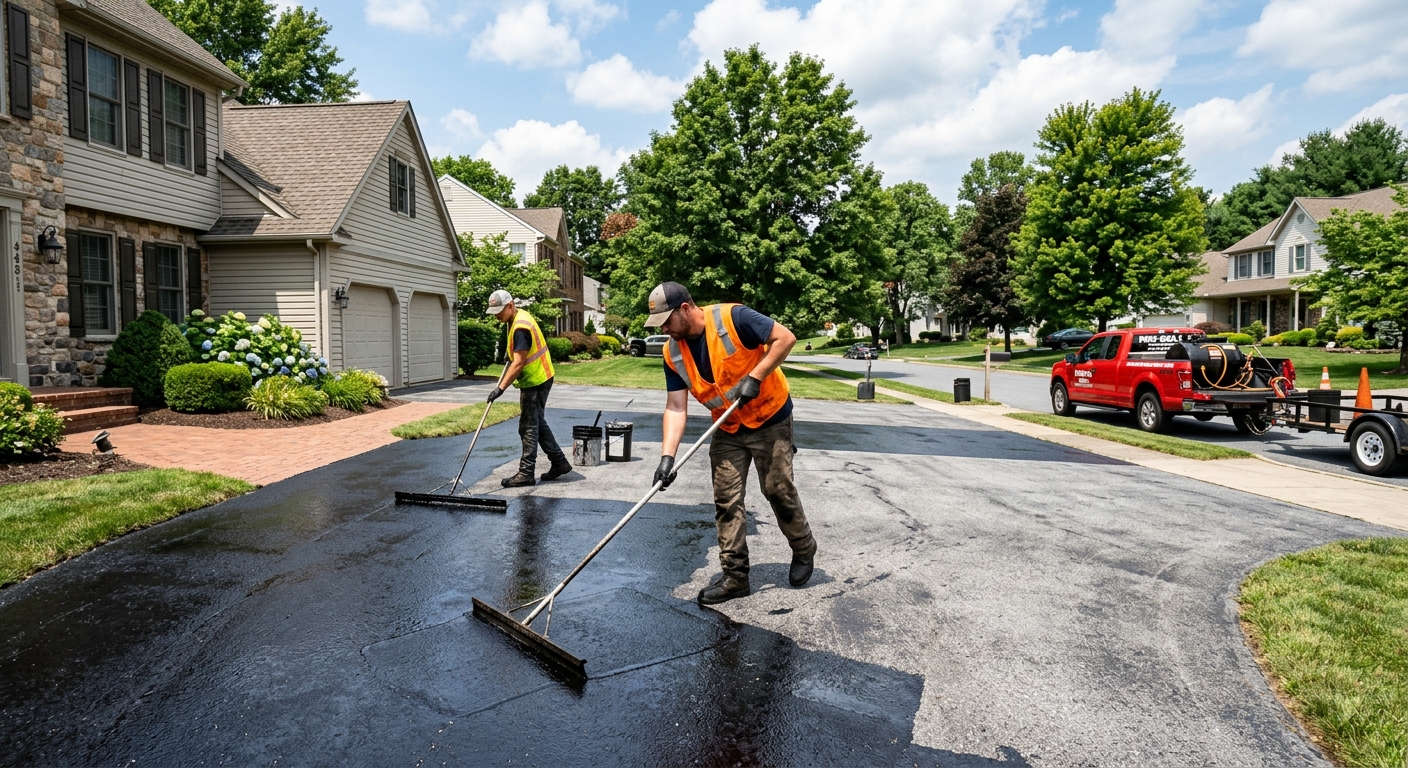
Sealcoating is more about protection than about repair. In Exeter, where freeze-thaw cycles attack uncovered asphalt, a good sealcoat shields your pavement from oxidation and slows down damage from oil and gasoline. It also makes older pavement look newer, which can be important in a well-kept neighborhood. But it’s not a fix for cracks, potholes, or failing bases—and anyone telling you otherwise is selling, not advising.
Over-sealing is a real problem. If you apply sealcoat too soon after new asphalt (before it fully cures) or too often (every year, rather than every two to four years), you get peeling, flaking layers that actually trap moisture. For a typical Exeter driveway, every two to four years is about right, depending on exposure and traffic. The first application should wait a full season, sometimes up to 18 months.
Crack filling is the essential maintenance most homeowners overlook. Keeping cracks sealed, especially before winter, prevents water from getting under the surface and damaging the base—the real source of most failures here. Done properly, with routing and a hot-applied patch, it lasts far longer than a cheap spray-and-go job.
The going rate for a single good application in Exeter is $200–$750. If you’re quoted much less, expect a thin, watered-down coat that’s cosmetic only and may track onto your walks and floors.
Frequently asked questions — driveway paving in Exeter
Can I cancel a paving contract I signed at my door?
Pennsylvania’s Home Improvement Consumer Protection Act (HICPA) gives you a clear, three business-day right to cancel any home improvement contract over $500 signed at your home in Exeter. This is true regardless of what the contractor says or whether work has started. You must cancel in writing within the three-day window. Reputable contractors know and respect this law, and you should be wary of anyone who pressures you to waive your rights or claims you’ll lose your deposit. If you need to confirm your contractor’s registration, use hic.attorneygeneral.gov. For reference, the typical cost to replace an entire asphalt driveway here runs $3,600–$9,300, so most jobs fall under these legal protections.
Does Exeter have local asphalt plants?
Yes, Exeter and the rest of Berks County benefit from local aggregate and asphalt supply. Production is centered around the Reading area—plants here are within a short haul of almost any property in Exeter Township. This means material availability is rarely an issue in paving season, and haul costs don’t drive up your price the way they might in more remote counties. A typical overlay or resurfacing job costs $1,550–$4,700 here and benefits from consistent material quality. During winter, though, those plants shut down, making paving impossible until spring.
What are the signs of a failing driveway base?
The base is the layer that supports your entire driveway, and its failure shows up in ways only some notice. Common signs in Exeter include widespread alligator (blocky) cracking, deep sunken areas, and edge crumbling that doesn’t improve after patching or filling. You might see standing water that doesn’t drain away, heaving after a winter thaw, or sections that shift under vehicle weight. These problems are much more than skin deep—a resurfacing or overlay won’t last when the stone or soil beneath is compromised. Full reconstruction usually runs $3,600–$9,300 for asphalt, but shortcutting the base is never a good savings.
How long does a driveway installation take?
In Exeter, most typical asphalt driveway installations—including full removal of the old surface and a new stone base—take 2 to 4 days, depending on weather and site conditions. Smaller overlays or resurfacing jobs can sometimes be completed in a single day, especially if the base needs no repair. Concrete driveways require more time: after forming and pouring, you must wait several days for curing before vehicles can use it. For reference, a concrete install here costs $5,200–$12,500 and may be out of service for up to a week.
How much does a concrete driveway cost in Exeter?
A new concrete driveway in Exeter typically costs between $5,200–$12,500. The final price depends on the total area, the depth of stone and concrete (important because of local freeze-thaw), and any features like decorative edges or colored finishes. Since over 40% of Exeter’s homes were built before 1980, it’s common for homeowners to need a complete tear-out to correct base or drainage issues. Concrete is more expensive than asphalt upfront, but can last much longer—if maintained and not exposed to de-icing salts.
What slope does a driveway need for drainage?
For effective drainage in Exeter, your driveway should have a minimum 2% slope—about a quarter inch per foot—moving water away from garages and the house foundation. Cross-slope or crowning is sometimes used to shed water to one or both sides. With south-central Pennsylvania’s freeze-thaw cycles, any low spot that ponds water will eventually cause heaving and failure below the surface. Fixing slope requires proper grading during base installation; overlays or cosmetic repairs rarely fix drainage problems. The cost to correct significant drainage issues as part of a driveway rebuild is typically bundled into overall pricing: full asphalt replacement runs $3,600–$9,300.
How much does it cost to widen a driveway?
Widening a driveway in Exeter often requires excavation, new stone base, and careful matching of the existing surface. The price depends on the added square footage, but as a rule, small widening projects—just enough for an extra car—might start at $1,550–$4,700 (overlay pricing) if the base is solid, and can run up to full replacement rates if there’s subgrade or drainage work involved. Permits may be necessary if you expand the impervious area or alter the driveway approach onto a public road.
Does sealcoating fix cracks?
Sealcoating does not fix cracks in driveways. In Exeter, sealcoating is intended to protect the asphalt’s surface from oxidation, moisture, and spills—not to repair structural problems or fill gaps. Cracks must be cleaned, routed, and professionally filled before any sealing is done. If you simply seal over cracks, water will penetrate and continue to damage the base during freeze-thaw cycles, requiring earlier—and costlier—repairs. Professional crack filling and patching typically cost $200–$800 and make a much bigger difference to the lifespan of your drive than sealcoating alone.
Are pavers worth the cost in south-central Pennsylvania?
Pavers are the highest cost option (usually $8,300–$12,500 for a standard drive in Exeter), but they have legitimate advantages. The biggest is flexibility: if a section heaves or settles after a hard winter, you can lift and reset the affected pavers without tearing up the whole surface. Pavers offer excellent drainage, can be highly decorative, and are individually replaceable. The downside is up-front investment and occasional weed growth between joints. For busy families in Exeter, pavers make sense where looks, longevity, and easy repair are priorities—and if a premium cost fits the plan.