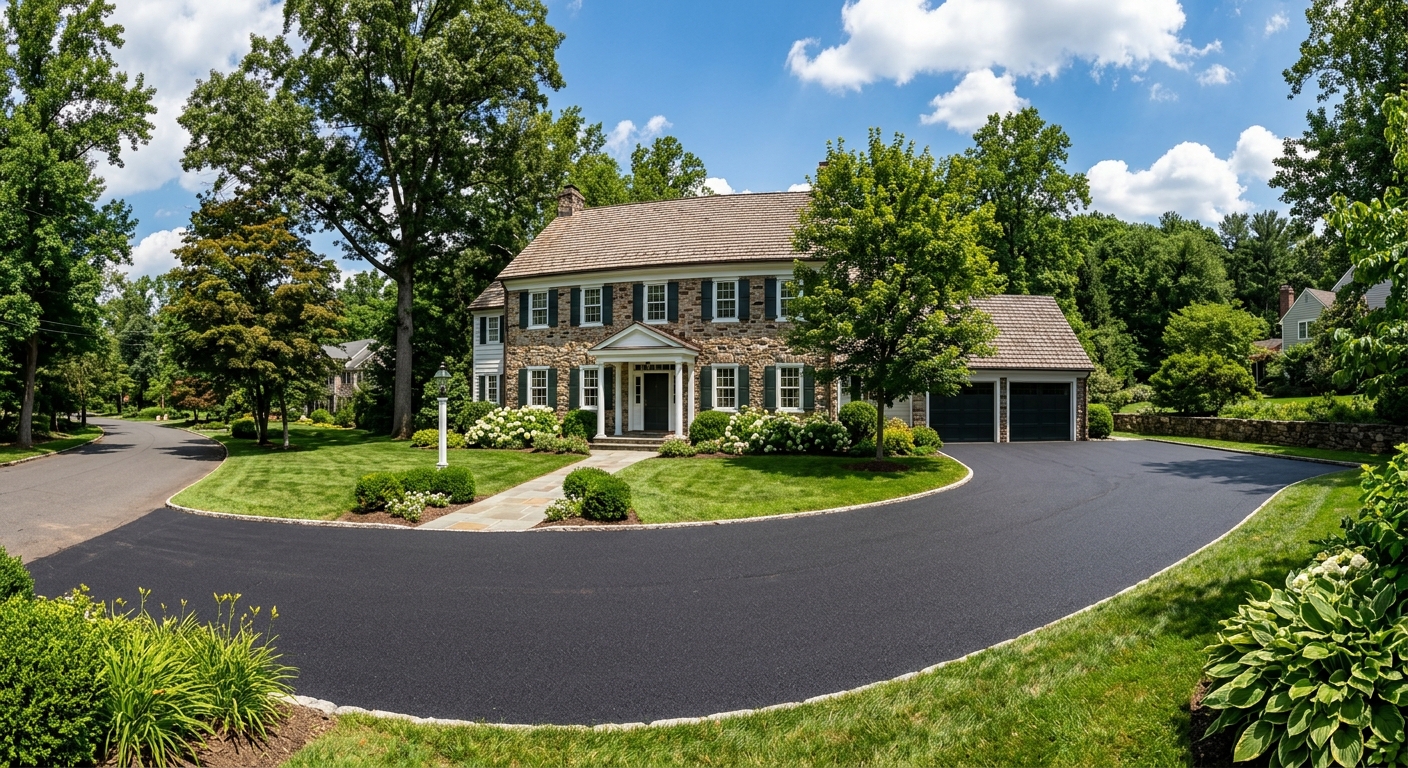
Oxford paving prices by scope — 2026
In Oxford, where about 66.7% of homes are single-family and the homeownership rate reaches 70.6% (U.S. Census Bureau, ACS 2024), driveway paving is a widespread homeowner responsibility. When you weigh bids, remember: the difference between a long-lasting job and a surface-level patch is found under the drive, not on top of it. Central Adams County’s limestone karst subgrade and our region’s aggressive freeze-thaw cycling mean the strength of your new driveway depends heavily on excavation depth, base material, and drainage—none of which you can judge once it’s covered up. If you see two quotes with a wide price gap, it’s almost never a bargain—it’s a shortcut.”
| Service |
Best for |
Lifespan |
Price range |
| Asphalt — full replacement with new base |
failed base, structural cracking |
20–30 yrs |
$3,400–$8,800 |
| Asphalt overlay / resurfacing |
sound base, surface cracking only |
8–15 yrs |
$1,450–$4,400 |
| Sealcoating — single application |
preventive maintenance on sound asphalt |
2–4 yrs |
$200–$700 |
| Concrete — new installation |
long service life, low maintenance |
30–50 yrs |
$4,900–$11,500 |
| Crack filling and patching |
isolated cracks under a quarter inch |
1–3 yrs |
$200–$800 |
| Gravel driveway |
rural, budget, long runs |
5–10 yrs with upkeep |
$900–$3,500 |
Estimates for a typical Oxford driveway. Square footage and base condition drive these figures more than material choice.
Permits and approvals for paving in Oxford
In Oxford, repaving an existing driveway in the same location does not generally require a building permit, which means you can usually avoid extra permit costs if you’re not altering the footprint. However, the driveway approach—the section where your driveway ties into the public road—is a different matter. On state routes, PennDOT District 8-0 issues the approach permit, while local township offices handle permitting for township-managed roads. This is commonly overlooked, but you’ll be required to obtain approval before starting any approach work, and a failed inspection can stop the job cold.
If you expand your driveway or add impervious area (like concrete or asphalt), stormwater management may come into play. Runoff controls often apply, and shunting water toward your neighbor’s land could leave you with liability, whether you have a permit or not.
Pennsylvania requires Home Improvement Contractor (HIC) registration for any paving contract over $500—verify your contractor at hic.attorneygeneral.gov. Workers’ compensation coverage is mandatory for employers; you can confirm current coverage through WCAIS (wcais.pa.gov). Every contract must be in writing for jobs over $500, and you have a three business-day right of cancellation by state law.
Caring for a new Oxford driveway
Driveway longevity in Oxford is mostly about vigilance and upkeep, not just what you spend up front. The first and cheapest habit: fix cracks before water can filter down through them to the base. Once water gets below, freeze-thaw cycles in our area’s winters (design temperature 12°F, regular freeze-thaw swings) can heave and break even a freshly-paved drive. Keep driveway edges supported—the unsupported edge is typically the first failure point. Always keep the path clear for water so it drains away—pooling nearly always leads back to base and subgrade trouble.
For new asphalt, don’t park or turn your wheels in place for at least a week. Full curing takes months, but the first days are most critical. Avoid letting jack stands, dumpsters, or heavy trucks stay in one spot—it’ll rut or depress even a brand new surface.
De-icing is different by material. Salt will attack concrete and drastically shorten its life; calcium chloride can be used, though it’s pricier. For asphalt, the main risk isn’t chemical but extra freeze-thaw cycling: the melt-refreeze effect opens cracks, speed-aging the surface. Sand may be your safest winter traction aid overall, and it won’t hurt either surface.
Oxford's ground and what it means for paving
Central Adams County, including Oxford, features a limestone karst subgrade—a condition not found just one township over. Karst means sections of fractured limestone below ground, which drains quickly but also settles without warning, and sometimes creates sinkholes. Paving in this soil never means “just throw down blacktop.” You need a thicker stone base than elsewhere, with a focus on drainage and compaction, to protect against ground movement beneath the pavement. Even if costlier up front, it spares you sinkholes opening under the driveway five years down the road.
Combine that with a regional frost depth of 30 inches and regular freeze-thaw cycles: it’s essential that the base extends well below reached frost, and that additional drainage layers are used if water collects. Many older homes from the 1960–1980 era—common in Adams County—have driveways that started as little more than widened gravel tracks. If you’ve never had your full base excavated and rebuilt, it’s safe to suspect you don’t have enough beneath you for a modern asphalt or concrete drive.
The specifications to demand in writing
Specs are how you avoid disappointment in Oxford—not price alone. Any real quote should spell out how far they’ll excavate, how thick the new compacted stone base will be, whether the stone is clean or recycled, how compaction will be done (and in how many “lifts”), the actual thickness of both binder and surface asphalt courses as compacted (not just thickness “as laid,” which compresses by about a third), the paving mix to be used, and what will stop the edges from breaking off.
The difference between “three inches” as promised and as compacted is enormous. If it’s measured only before rolling, you may end up with less than you paid for after the compactor passes. Oxford’s freeze-thaw cycles and possible ground settlement from karst demand more care, with base depths here often exceeding those in milder climates.
- Excavation depth (inches below finished grade)
- Aggregate base stone type and depth (compacted, in inches)
- Compaction method (roller, plate compactor) and number of passes
- If base is built in lifts, state how many inches per lift
- Binder course thickness (compacted)
- Surface course thickness (compacted)
- Asphalt mix type (PennDOT/mix code)
- Edge support method (shoulder, block edging, curb)
- Pitch for drainage (percent slope)
- Joint or seam treatment plan (transition to old sections)
Widening, extending or adding a parking pad
When you decide to widen your Oxford driveway for a second vehicle, add a turnaround, run all the way back to a detached garage, or finally replace that old gravel stretch out to the pole barn, you face a new set of considerations. Any new footprint means you’re building atop untouched subgrade—which can be unpredictable. The seam where old and new paving meet is always a risk for future cracks and differential settling, so a good contractor will plan strong edge support and tie-ins.
Expanding a driveway also increases impervious surface: in Oxford Township, that means you may trigger additional stormwater control requirements. The same goes for compliance with local setback rules, which limit how close you can pave to a property line. Permitting for the new approach (where your new pad or extension meets the public road) may fall under PennDOT District 8-0 if the road is state-maintained, or under the township office for other roads.
Budget extra time and funds for these steps—not every paving contractor will warn you, but a missed permit or setback violation can cost even more in forced removals or fines.
How to tell if the base is gone
You don’t need to rely on guesswork to judge whether your Oxford driveway’s base has failed—there are real tells you can check yourself before calling anyone. If you see widespread alligator cracking (blocks of interconnected cracks), there’s nearly always a failed or thin base underneath, and just resurfacing is throwing money away. Long, isolated cracks generally point to surface aging, which can be fixed with crack filling and sealcoating. Birdbath depressions and uneven spots are signs of subgrade movement, often from our local limestone settling in wet years. Crumbling driveway edges mean there was never enough support placed at installation; that risk is heightened where old gravel driveways were hastily widened in earlier decades. Potholes are the final sign—water has broken through the surface and is destroying the base below.
Never accept a recommendation to overlay a badly alligatored or uneven drive unless you see clear evidence the base is sound; otherwise you’ll be paying to do the job again within a few years.
| What you see |
Likely cause |
Right fix |
Cost |
| Isolated cracks under 1/4 inch |
surface aging |
crack fill and seal |
$200–$700 |
| Alligator cracking over a wide area |
base failure |
full replacement |
$3,400–$8,800 |
| Depressions holding water |
subgrade movement |
excavate and rebuild that area |
$3,400–$5,400 |
| Crumbling edges |
no edge support |
edge repair, consider curbing |
$400–$1,500 |
| Potholes |
water into the base |
full-depth patch, then assess |
$250–$900 |
| Faded but sound surface |
oxidation only |
sealcoat |
$200–$700 |
Frequently asked questions — driveway paving in Oxford
What does an asphalt overlay cost in Oxford?
An asphalt overlay, sometimes called resurfacing, involves paving a new layer of asphalt over your existing driveway, provided the base is still solid. In Oxford, you’re typically looking at $1,450–$4,400 for this work, depending on the driveway’s size and condition. Keep in mind, overlays only make sense if your current asphalt is stable with no serious cracks or base movement. Because Oxford’s freeze-thaw cycles and local limestone karst can cause hidden base issues, make sure your contractor inspects for soft spots or subgrade movement before recommending an overlay. Don’t overspend on an overlay if your base is compromised, because it won’t last.
What causes driveway cracks in Oxford?
In Oxford, cracking happens due to the pronounced freeze-thaw cycle—water gets into little weaknesses, freezes, and acts like a wedge. Our limestone karst subgrade can settle in unexpected spots, creating movement below your driveway. Narrow cracks (under 1/4 inch) often result from surface aging, which occurs as the asphalt oxidizes, especially in driveways older than 15 years. Wide, block-like cracks usually point to a failed base. Often, timely crack filling ($200–$800) is enough if you catch it early, but ignore the issue and you’re looking at much more costly repairs.
What kind of soil is under Oxford driveways?
The predominant subgrade around Oxford is limestone karst. This condition is unique for Central Adams County and makes paving more complex than in nearby regions. Limestone karst drains quickly but is prone to settling and even sinkholes when water flow patterns change underground. That’s why digging out more soil and adding a thicker, well-compacted stone base are standard here, driving up the initial cost a bit—expect installation in the $3,400–$8,800 range for asphalt with proper base work. Having the wrong design for our soil guarantees trouble.
How thick should asphalt be for a residential driveway in Oxford?
For Oxford, don’t accept less than 4–6 inches of compacted base stone, topped by at least 2.5 inches of compacted asphalt (binder and surface combined). Both base and surface thickness are vital due to our deep frost—30 inches here—and the settling tendencies of limestone karst. Beware bids that cite only “thickness as laid”; you want compacted thickness in your contract. Thinner jobs save money upfront but almost always fail early, so insist on specs in writing. A full base rebuild and proper thickness will fall in the $3,400–$8,800 band for most homes.
Is gravel a cheaper option in Oxford?
Yes, gravel is often the least expensive approach for long or rural driveways in Oxford. Most gravel installs land in the $900–$3,500 range, which is far below the cost of full asphalt or concrete. That said, our region’s limestone karst can cause settlement over time, so annual maintenance—like regrading and adding more stone—becomes part of the package. Gravel is best for long, rural runs or secondary drives, not for a main parking area at a home where appearance or snow removal is a concern.
Is sealcoating a scam?
Done appropriately, and only on a sound driveway, sealcoating is a sound investment in Oxford and extends the life of your asphalt. It seals hairline cracks that the freeze-thaw cycle would otherwise exploit. However, sealcoating alone will not “fix” a failing or badly cracked surface; it’s a preventive maintenance, not a cure. It typically runs $200–$700 per application. Beware of anyone pushing yearly sealcoating or making claims that it restores strength to failing pavement—doing it too often can do more harm than good.
How long does a driveway installation take?
Most residential driveway replacements in Oxford are wrapped in two to four days—one day for excavation and base prep, another for paving, plus any needed curing time. Weather sometimes stretches this, especially during our freeze-thaw season or after a heavy rain (which can happen with our local soil). Concrete work takes longer, needing several days before driving on it. Factor in extra time for inspections and approach permits if you’re tying into a public road. For a typical asphalt replacement costing $3,400–$8,800, two to three visits is standard.
Should I repair or replace my Oxford driveway?
If your driveway has isolated cracks under 1/4 inch and no deep depressions or widespread cracking, you’re a good candidate for repairs—like crack filling and sealcoating, costing $200–$800. But if you see alligator cracking, sinking sections, or chronic potholes, all signs point to base failure, and a full replacement is next ($3,400–$8,800). Oxford’s settlement-prone limestone makes regular inspection and proactive repairs even more important than other areas. Don’t overlay a drive that’s shot underneath—you’ll spend more in the long run.
How do I verify a paving contractor in Pennsylvania?
In Pennsylvania, including Oxford, any paving contractor doing work over $500 must have a Home Improvement Contractor (HIC) registration number. You can confirm this free online at hic.attorneygeneral.gov. For companies with employees, workers’ compensation insurance is also mandatory (verify at the WCAIS system: wcais.pa.gov). The law also requires a written contract and gives you three business days to cancel after signing. Don’t be shy asking for proof—legitimate local contractors expect it, especially on jobs ranging from $200–$8,800 or higher.