Driveway paving costs in Exeter — 2026
Exeter, nestled in Luzerne County, is a market where driveway paving feels like a rite of passage for most homeowners. With 67.6% of Exeter’s homes being single-family dwellings and a homeownership rate of 80.7% (U.S. Census Bureau, ACS 2024), most driveways here are privately maintained. Paving, resurfacing, or maintaining a driveway is a top-line expense that you’ll face several times if you stay in your home long enough.
Northeastern Pennsylvania’s climate is defined by freeze-thaw cycles and a frost depth of 36 inches. Combine that with local subsoils — mostly glacial till and shale, both subject to uneven heave and drainage — and you have ground rules that make robust construction essential. Almost all visible price differences between quotes—often hundreds or thousands of dollars—hide in what you’ll never see: excavation, base preparation, and how thoroughly the invisible layers below the surface are installed and compacted. Mistakes here don’t show until after one or two winters pass.
The proper driveway for Exeter is one built for both frost and time. There’s a spectrum of solutions—from basic asphalt overlays for driveways with a sound base, to full excavations where the old base has failed and frost damage has taken hold. What you’re really buying, more than just “blacktop,” is layer-by-layer resilience against the region’s deep frost and wet ground.
| Service | Best for | Lifespan | Price range |
| Asphalt — full replacement with new base |
failed base, structural cracking |
20–30 yrs |
$3,300–$8,400 |
| Asphalt overlay / resurfacing |
sound base, surface cracking only |
8–15 yrs |
$1,400–$4,200 |
| Sealcoating — single application |
preventive maintenance on sound asphalt |
2–4 yrs |
$175–$650 |
| Concrete — new installation |
long service life, low maintenance |
30–50 yrs |
$4,700–$11,000 |
| Crack filling and patching |
isolated cracks under a quarter inch |
1–3 yrs |
$200–$800 |
| Gravel driveway |
rural, budget, long runs |
5–10 yrs with upkeep |
$900–$3,500 |
Estimates for a typical Exeter driveway. Square footage and base condition drive these figures more than material choice.
The specifications to demand in writing
A driveway paving quote in Exeter is only as good as the fine print. The worst way to buy paving is to shop just on price, because the structural work you’re really paying for vanishes beneath the finished surface. In a climate like ours—6100 heating degree days, deep frost, and regular snow loads—pavement spec matters more than in most of Pennsylvania. Soil here (mainly glacial till and shale) moves with every freeze-thaw, so the base and thicknesses must be sized for penalty-free winters.
If a paver tells you “it’ll be three inches,” pin them down: is that compacted thickness or as laid? Un-compacted, three inches could easily compress to two, and that thinner slab will not last. Writing compaction and base specs into your contract is your only recourse if corners are cut—after the crew leaves, there’s nothing to see until your driveway starts to rut and crack.
- Excavation depth below finished grade—minimum in inches.
- Aggregate base depth as compacted — at least 6–8" for glacial till or shale soils; more for poor drainage areas.
- Aggregate type and gradation — request 2A modified stone or approved equivalent.
- Base compaction method — powered roller or plate, not truck tires. State how many lifts (layers) and inches per lift.
- Asphalt binder course compacted thickness — typically 2–2.5".
- Asphalt surface course compacted thickness — typically 1–1.5".
- PA or PennDOT mix designation for both binder and surface layers.
- Edge treatment — hand-tamped, with angle or containment, especially on open sides.
- Slope/grade for drainage — state in percent or inch-per-foot fall.
- Compaction of each lift verified before continuing to next layer.
Base preparation: the part you pay for and never see
The most important piece of any driveway job in Exeter is what goes under the asphalt or concrete. The assembly stacks up like this: first, subgrade (the original earth), then a compacted aggregate base, and finally your paving layer. Each spreads the weight—when done right, surface cracks and settling stay away for decades. Slap new asphalt over a bad base and you’ll see potholes and ruts by the third or fourth winter, guaranteed by Luzerne County’s freeze-thaw swings and 36” frost line.
Our ground is mainly glacial till and shale—stony, variable stuff that retains water below the surface. That water’s the enemy: as it freezes, it expands. This is frost heave. It lifts the whole base, bending and splitting slabs and asphalt from below. A thick, well-compacted stone base handles the ground’s movement and keeps the freeze from wrecking your investment. That’s not just about longevity—it’s the difference between peace of mind and constant frustration every spring.
Where quotes get “affordable” is where this process is skipped. A contractor might lay over old, failed base, skip excavation, thin out the stone, or give it a quick once-over with a truck instead of compacting, or skip compaction entirely. On the day it’s finished, you’ll never know. But by the second or third winter, the short-cuts show up: dips, cracks, edge failures, standing water, weeds poking through, and edges that crumble off.
Immune yourself by demanding these figures in writing:
- Minimum 8” compacted 2A modified stone for base on glacial till or shale
- Compacted in maximum 4" lifts — write in “each lift compacted separately”
- Document the stone type and gradation
- Identify subgrade soft spots and undercut/replace before stone goes down
- Use vibratory roller or plate for every lift, not just top layer
No money or time spent here is wasted; this is the layer that keeps everything above it lasting as long as the quote promised.
The honest case for and against sealcoating
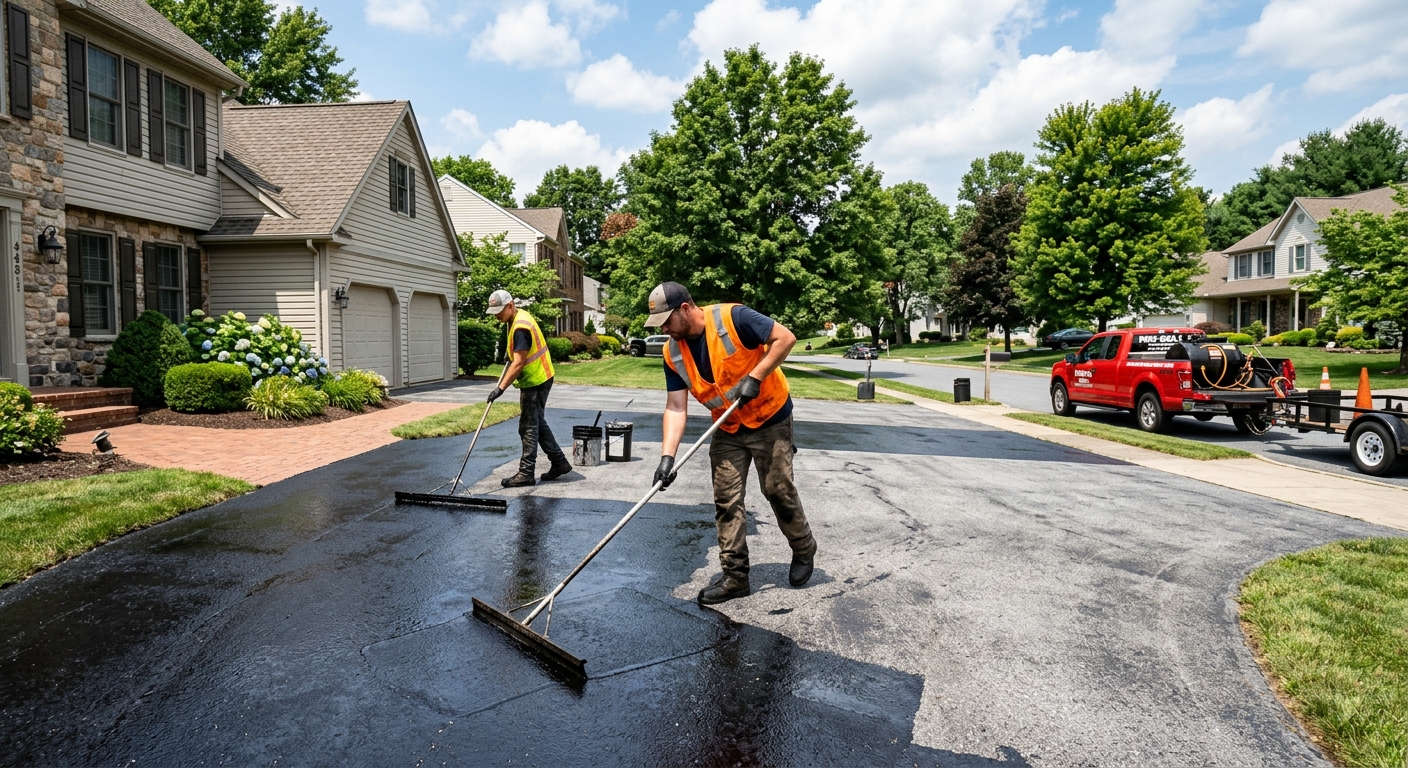
Sealcoating in Exeter is best approached with realistic expectations. The main job of sealcoating is to protect the asphalt binder from the sun and from motor oil or leaking fuel, not to add any true structural strength to the driveway. Sealers can keep your driveway looking sharp and slow oxidation—the process that makes asphalt brittle and gray in the first place.
But here is what most sales pitches won’t say: sealcoating does not fix cracks or reinforce a driveway base that’s already failing from frost or water damage. Done too often, sealcoating actually builds up a brittle crust that peels off and cracks, especially in the Lance County freeze-thaw cycle. And if you seal new asphalt before it has fully cured (usually six months to a year), you trap oils inside, which leads to soft spots and peeling. There’s no reason to do it every year—every 2–4 years is more sensible, and sometimes skipping a round is the right call if your blacktop still beads water.
Proper crack filling with quality hot-applied rubber is far more valuable for longevity than a sealer. If deep cracks are left open, water gets down to the base and frost lifts the pavement. A good sealcoat—done with a brush or squeegee to fill all pores, not just sprayed on as a quick money-maker—will cost more, but actually delivers the benefit. Expect a quality job to run $175–$650 on a typical single-family drive in Exeter. Rock-bottom prices usually buy a thin, spray-and-go coat that washes off or flakes in the first winter.
Exeter's ground and what it means for paving
Nearly all of Luzerne County, including Exeter, sits atop glacial till and shale. This is not background trivia; it’s the heart of driveway construction here. Glacial till is a crumbly mix of stone, clay, and soil that drains unevenly and holds water against the base. Shale, though stony, can trap pockets of moisture and break up under pressure.
The practical upshot: driveways in Exeter need a thicker aggregate base than what’s common one county west. On these soils, a properly compacted 8-inch (or deeper) stone base is the starting point to resist frost heave—freezing water in the soil swells with enough force every winter to snap a surface that’s not properly underlaid. This is compounded by Exeter’s deep 36-inch frost penetration and frequent freeze-thaw cycles.
Most local homes sprang up between 1900 and 1940, in narrow-lot neighborhoods. Few driveways from those eras were built for modern vehicle loads or with a frost-resistant base in mind, and their tight side yards limit how much you can widen or reroute a drive without encroaching on property lines. Replacement projects often find little more than loose gravel or fill under the old surface, making full base excavation the only sound approach.
Where the water goes
Surface water is the chief villain in driveway failures across Exeter. Every plan for a new paving job should start and end with drainage—slope is not an afterthought. To move water off reliably here, a driveway should have at least a 2% slope (a quarter inch per foot) away from structures, either as a crown or a steady cross-slope. In older Exeter lots, layout often forces drives to run right up to the house or garage—grading them flat or toward the house is asking for standing water and foundation trouble.
When grade can’t be fixed, trench or channel drains at the base of the drive can capture runoff before it enters a garage. From there, water should be piped to “daylight” (discharged to an open area that drains naturally), not trapped in a dry well unless your soil can actually percolate the water safely, which glacial till and shale usually cannot.
In Exeter, poor drainage means standing water sits against the base, especially in clay-bound glacial soils. The next hard freeze lifts the base, cracks the pavement, and leaves behind uneven sunken spots. Ensuring all water is moved away before winter saves on repairs later. One last caution: Luzerne County has tight lot lines—directing your runoff onto a neighbor’s property invites real headaches and liability, no matter what the permit inspector says.
Driveway permits, approaches and stormwater rules
In Exeter, most basic repaving projects—that is, resurfacing without changing the driveway’s size or draining—typically do not require a building permit, especially if you’re patching or recoating existing pavement. But the situation changes if you plan to enlarge the driveway or alter drainage, as that can impact stormwater runoff and may trigger a zoning or building permit, as in the City of Wilkes-Barre.
The tricky piece is the driveway approach—the first few feet that connect your drive to a state or municipal road. In Luzerne Borough (just south), this triggers a Highway Occupancy Permit with PennDOT District 4 if your approach meets a state route. Often, a separate authority (not your local building department) regulates this, so it’s worth asking your contractor before work begins.
If your paving project increases impervious surface, be aware you may also need to address stormwater management, directing runoff to an approved spot and not onto a neighbor’s land. Liability attaches if your water creates new drainage problems next door, whatever your permit situation.
To verify that your contractor is compliant, check their Home Improvement Contractor (HIC) registration at hic.attorneygeneral.gov for any contract over $500. Every employer must also carry workers’ compensation—double-check via WCAIS (wcais.pa.gov) to avoid personal risk from uninsured labor on your property.
Frequently asked questions — driveway paving in Exeter
Is gravel a cheaper option in Exeter?
Gravel is almost always the budget pick for driveways in Exeter and the broader Luzerne County area, especially for longer runs in rural spots. With local aggregate quarries close by, you benefit from relatively low trucking costs, which keeps initial installation prices down. Expect a range of $900–$3,500 depending on size and thickness. Gravel works best where maintenance isn’t an issue and heavy vehicle traffic won’t rut the surface. The trade-off is regular upkeep: grading, adding more stone, and proper drainage to stop potholes from forming. Gravel isn’t ideal where snowplowing scrapes away surface or where strict curb appeal matters, but for low-traffic side drives, it’s the dollar-stretcher Exeter’s small-lot neighborhoods and rural fringes sometimes need. Just remember, over time with regular top-ups, costs can add up compared to asphalt overlays or patching.
How far ahead should I book a paver in Exeter?
In Exeter, demand for reputable pavers is highest from late spring through early fall, so it’s smart to reach out at least 4–8 weeks ahead—sometimes longer if you want a specific contractor or if weather delays have backed up jobs. Luzerne County has plenty of crews thanks to the strong contractor market, but the busy season shrinks fast because paving is weather-sensitive. Spring rains and fall cold snap bookend a short working window. If you need a full excavation and new base (typically $3,300–$8,400), plan on more lead time since these jobs take longer. For sealcoating or small patch repairs, lead time is still at least 2–3 weeks, as many crews batch these jobs together. Booking early also lets you check registration (hic.attorneygeneral.gov), see insurance, and lock in before prices bump up late in the season.
What does sealcoating cost in Exeter?
A typical single-car driveway in Exeter will see sealcoating run from $175–$650, with most jobs for a standard home landing near $375. Your fee depends on square footage, existing surface condition, and how much cleaning and crack prep is required. If you get a quote at the basement of the price band, be wary: that usually buys the fastest possible spray application, which barely lasts one hard winter. Exeter’s freeze-thaw cycles mean only a brush or squeegee applied coat with good edgework holds up. If the price seems too good, ask what prep is included and whether cracks are cleaned and filled first—these are the jobs where corners get cut and the result flakes, peels, or fails to bead water after a year.
How long should an asphalt driveway last in Exeter?
A properly constructed asphalt driveway—full replacement with new stone base—should last 20 to 30 years in Exeter, where freeze-thaw swings stress every inch every winter. This assumes the installer specified at least 8” of compacted stone and used quality asphalt placed and compacted in two lifts. The typical price for this level of work is $3,300–$8,400. Lesser jobs, like thin overlays, might only carry you 8–15 years, especially if patching over a soft or unprepared base. Regular crack filling and sealing (every 2–4 years) stretch lifespan, but once the base is compromised, there’s no easy fix short of replacement. Older lots here, often built before robust standards, tend to need a full reconstruction for best results.
Do I need a permit to repave a driveway in Exeter?
In most cases, resurfacing or patching a driveway on the same footprint in Exeter does not require a permit, unless you’re in a municipality with stricter zoning or stormwater rules like Wilkes-Barre. Where homeowners get tripped up is with the driveway approach—the point where your drive meets a public or state road—which often requires a Highway Occupancy Permit, particularly on state routes in Luzerne Borough. Any project that enlarges the driveway or changes drainage patterns could trigger a zoning or stormwater permit, as these changes affect runoff. Basic sealcoating jobs ($175–$650) never need a permit. When in doubt, it’s smart to call your local municipal office—policies change block by block in Luzerne County.
What is the difference between binder and surface course?
Binder and surface course are the two main lifts in asphalt paving. The binder course goes down first; it’s thicker (usually 2–2.5" compacted) and made with a coarser mix to provide strength and absorb loads. The surface course is the final layer, usually 1–1.5" thick, and uses a finer aggregate for a tighter, smoother, and more water-resistant top. In Exeter, both layers need to be compacted to spec or you’ll get rutting and premature cracking. Most full replacement driveways ($3,300–$8,400) include both lifts, applied and rolled separately, not in a single thick layer—that’s critical in our climate, where frost and groundwater keep the soil moving underfoot.
Are pavers worth the cost in northeastern Pennsylvania?
Pavers (such as interlocking concrete or stone) look sharp and are low-maintenance, but in Exeter and the surrounding counties, they are seldom the most cost-effective choice. They cost more than poured concrete ($4,700–$11,000 for a typical drive), and while repairs are easier—individual pavers can be lifted and reset—you still need excellent base prep. On our glacial till, even the most expensive pavers will shift if the stone base isn’t a full 10–12 inches and perfectly compacted. Snowplows and freeze-thaw make pavers work harder here than in milder places. For value and service life, most Exeter homeowners stick with asphalt or concrete unless curb appeal is a priority or budget isn’t a factor.
Does Exeter have local asphalt plants?
Exeter itself is only a few miles from Wilkes-Barre and Hazleton, both served by multiple asphalt plants and quarries. Luzerne County’s saturated contractor market means trucking asphalt here is quick and affordable, whether you’re in Exeter proper or a nearby town. You rarely pay extra for materials to be hauled long distances—plants near Wilkes-Barre serve most jobs. This local supply keeps common jobs like overlays or full replacement within the typical price bands seen here ($1,400–$8,400), as haul time does not inflate your costs much, unlike in more remote or rural counties in Pennsylvania.
How often should I sealcoat my driveway in Exeter?
Every 2 to 4 years is the right pace for driveways in Exeter; sealing more often can layer up and cause peeling, while skipping multiple cycles lets the sun and weather age your asphalt too fast. Exeter’s winters and temperature swings mean a good sealer prevents oxidation and repels oil, but it must be applied after proper cleaning and crack filling. Wait at least 6 months—a year is better—after a fresh asphalt install before sealing. You can expect each good application to last through several winters for $175–$650. Cheap, fast jobs won’t last, but over-sealing creates its own set of headaches in our climate.