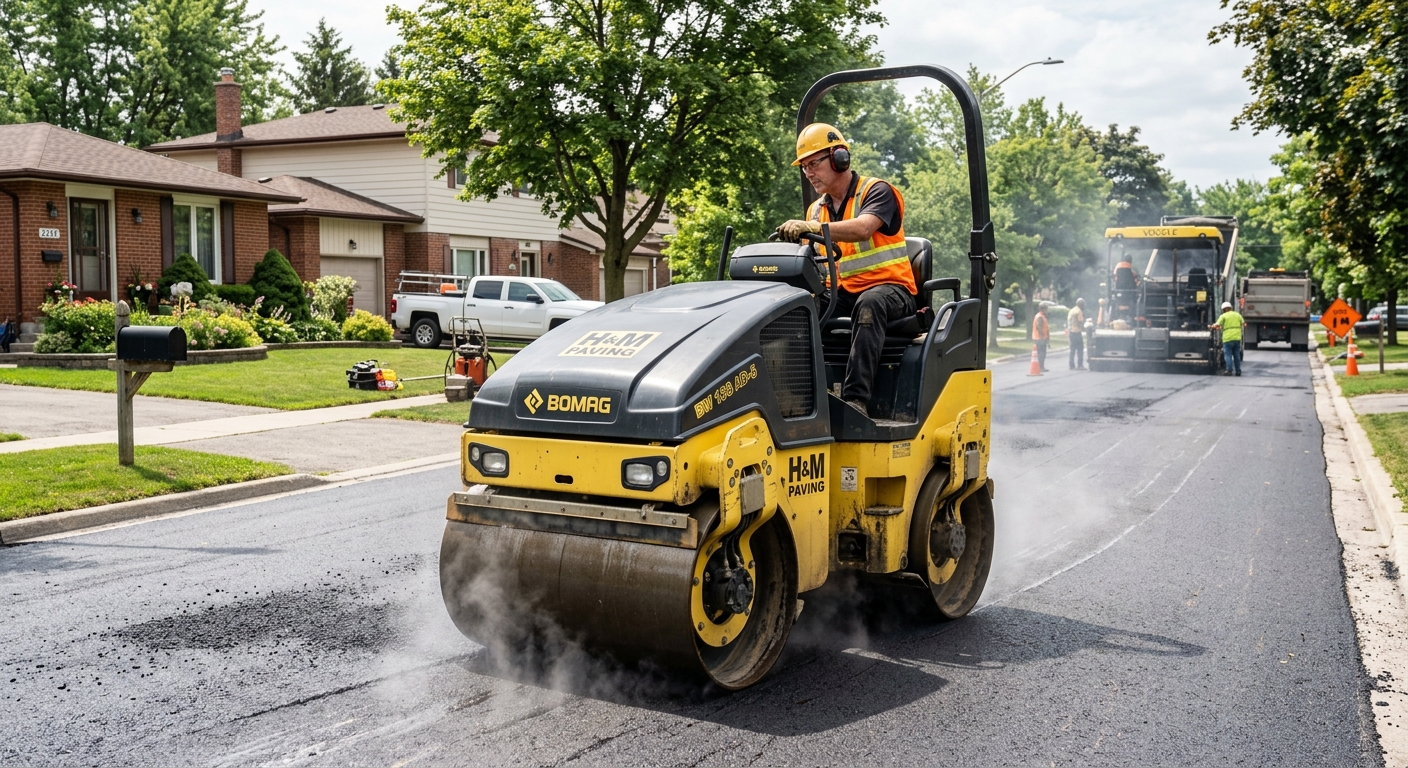
What a new driveway costs in Ferguson
In Ferguson, where nearly 60% of households own their homes and most houses are detached single-family dwellings (U.S. Census Bureau, ACS 2024), driveway paving is a major investment and not a landlord’s concern. Driveway prices here are heavily influenced by our region’s long, cold winters and characteristically limestone and shale subgrades. These factors demand more work beneath the surface than you see from the street—thicker base layers and higher trucking costs for rural properties are common issues in Centre County.
In this area, two driveways might look the same above ground, but what you pay for—and what determines how long your driveway lasts—is almost always buried: excavation depth, quality and depth of the base, and proper compaction. Don't be fooled by a low bid; most corners are cut where you can't see. When comparing prices for a new asphalt driveway or a resurfacing, realize that base preparation is where contractors save or spend your money.
| Service |
Best for |
Lifespan |
Price range |
| Asphalt — full replacement with new base |
failed base, structural cracking |
20–30 yrs |
$3,500–$8,900 |
| Asphalt overlay / resurfacing |
sound base, surface cracking only |
8–15 yrs |
$1,500–$4,500 |
| Sealcoating — single application |
preventive maintenance on sound asphalt |
2–4 yrs |
$200–$700 |
| Concrete — new installation |
long service life, low maintenance |
30–50 yrs |
$5,000–$12,000 |
| Crack filling and patching |
isolated cracks under a quarter inch |
1–3 yrs |
$200–$800 |
| Gravel driveway |
rural, budget, long runs |
5–10 yrs with upkeep |
$900–$3,500 |
Estimates for a typical Ferguson driveway. Square footage and base condition drive these figures more than material choice.
How to tell if the base is gone
If you're unsure whether your Ferguson driveway needs a full replacement or just surface work, you can diagnose a lot with your own eyes. Widespread alligator or map cracking means the base beneath the asphalt has lost its integrity—no surface overlay will last if the foundation is failing. If your cracks run more or less in straight lines or are isolated, that's usually just the aging of the asphalt, not a failed base. Depressions or “birdbaths” indicate areas where the subgrade has settled or shifted, while crumbling edges point to a lack of proper edge support, which is common here due to limestone and shale breaking away in winter.
Potholes signal that water has reached the base, and that's almost always a sign that patching alone won't resolve the underlying problem. Remember, if a contractor recommends resurfacing without probing the base—either by coring or digging a test patch—they haven’t evaluated the job properly. In Ferguson's climate, ignoring the base is just burning money. Below is a guide to what you might see and what it typically takes to fix it:
| What you see |
Likely cause |
Right fix |
Cost |
| Isolated cracks under 1/4 inch |
surface aging |
crack fill and seal |
$200–$700 |
| Alligator cracking over a wide area |
base failure |
full replacement |
$3,500–$8,900 |
| Depressions holding water |
subgrade movement |
excavate and rebuild that area |
$3,500–$5,500 |
| Crumbling edges |
no edge support |
edge repair, consider curbing |
$400–$1,500 |
| Potholes |
water into the base |
full-depth patch, then assess |
$250–$900 |
| Faded but sound surface |
oxidation only |
sealcoat |
$200–$700 |
How to vet a paving contractor in Ferguson
Choosing a paving contractor in Ferguson means more than just picking the lowest price. Only a handful of regional contractors own their equipment, understand our limestone and shale subgrade, and have verifiable jobs still holding up after several freeze-thaw cycles. Every reputable contractor in Centre County should be registered as a Home Improvement Contractor with the Pennsylvania Office of Attorney General for jobs over $500; you can verify this at hic.attorneygeneral.gov. Ask for a local business address (not just a cell phone), owned equipment (not all rental), and at least three references from driveways more than three years old—because with our winters, that's when shortcuts show.
Anyone serious can name where they buy their asphalt—for Ferguson, that’s typically a plant near Bellefonte or on College Avenue. If they can't, they're probably just hiring someone else on your dime. Reliable crews don't show up door-to-door or say “we've got extra asphalt from another job.” Here's a checklist for vetting:
- Home Improvement Contractor (HIC) registration—verify at hic.attorneygeneral.gov
- Valid business address in Centre County, not just a mobile number
- References from at least three local jobs completed 3+ years ago
- Proof of workers' compensation (verify at wcais.pa.gov)
- Owned, not rented, equipment
- Can name their asphalt and aggregate supplier near Ferguson
- Clear written contract for any job over $500 (required by HICPA)
- Line-item warranty in writing for both materials and installation
- Detailed written scope—includes base depth, type, and compaction method
- No waiving of your insurance deductible (prohibited)
- No high-pressure or same-day discount tactics
- EPA lead certification for pre-1978 homes (if disturbing existing structure)
Red flags include vague answers about their past jobs, refusal to provide real references, or changing their story about which plant supplies their asphalt. Door-to-door offers are especially suspect in this market.
Base preparation: the part you pay for and never see
Every Ferguson driveway starts with the subgrade—here, often limestone or shale—which will shift and settle if not properly handled. The next layer is a compacted aggregate base, usually crushed stone, which spreads the weight of vehicles and keeps the asphalt above from flexing and breaking. On top of that goes the asphalt or concrete slab. Each layer depends on the one below it; your finished driveway is only as good as the weakest link in this stack.
Our region deals with harsh freeze-thaw cycles and frost depths down to 36 inches. When the subgrade is damp, water in the soil freezes and expands, pushing up and cracking pavement from below—a process called frost heave. That’s why base depth and proper drainage are more important here than in much of Pennsylvania. If the base isn't deep enough or is laid on soft ground, the driveway may look fine at first but will fail fast once Centre County’s snow and rain get underneath.
This is also where a cheap quote turns out most expensive. Cutting corners here means skipping excavation, laying new asphalt over a soft or wet base, skimping on the thickness or compaction of the gravel, or not compacting in lifts—thin layers, each compacted for density. The wrong base prep may not show for a year or two, but when frost and traffic do their work, you'll pay for it all over again. After 20 years in this business, I say this: any contractor who won’t put the following numbers in writing is not serious—minimum 6 inches of compacted aggregate base, Pennsylvania #2A modified stone, compacted in lifts no thicker than 3 inches each. Get every base spec in your contract before you sign.
Permits and approvals for paving in Ferguson
For homeowners in Ferguson, repaving an existing driveway usually does not need a building permit so long as you’re staying within the same footprint; this saves you calls and paperwork. However, when it comes to the driveway approach—where your driveway meets the state or municipal road—permits are often required, and you must apply through the authority you may not expect. In Centre County, driveway approach permits for connections to Pennsylvania state highways are handled by PennDOT District 2 in Clearfield, not your local municipality. Don't skip this; it can create major hassles or fines.
If you’re expanding the driveway or changing its grade, you may trigger additional stormwater requirements because increasing impervious surface in Pennsylvania can increase runoff onto public land or a neighbor’s property, making you liable for damages even without explicit permitting.
Every contractor on your project must be registered under Pennsylvania’s Home Improvement Contractor registration for any job above $500 (check them at hic.attorneygeneral.gov). Workers’ compensation insurance is mandatory for all employers (verify coverage at wcais.pa.gov). Finally, Pennsylvania’s Home Improvement Consumer Protection Act requires a clear written contract, a three-business-day right to cancel, and a strict ban on waiving your homeowner’s insurance deductible. These basics protect you as a Ferguson homeowner.
Asphalt or concrete for a Ferguson driveway?
In Ferguson’s long, cold winters—where snow loads are among the highest in Pennsylvania and winter design temperatures can hit 2°F—asphalt remains the go-to driveway material for good reason. It is flexible, so it tolerates freeze-thaw ground movement by flexing rather than cracking, which is critical with our limestone and shale soils. Concrete, by contrast, is rigid and can last much longer when it survives—but it doesn’t stand up as well to salt and snow plowing, the biggest threats here. In Centre County, most concrete driveway failures come from spalling or scaling due to de-icing salts, not cracking. Unless you’re able to strictly avoid salt all winter, concrete’s theoretical lifespan is cut short.
If you want minimal maintenance and have a reliable plowing service that uses sand (not salt) and proper snow shoveling tools, concrete can be a good, albeit pricier, choice. For everyone else, asphalt is more forgiving and practical for our climate, though it will need sealcoating every few years. Pavers and gravel both have their uses: pavers for high-end looks with replaceable units if frost heave occurs, gravel for rural homeowners not wanting to invest heavily in a low-traffic, long drive.
| Option |
Installed cost |
Maintenance |
Freeze-thaw performance |
Lifespan |
| Asphalt — new install |
$3,500–$8,900 |
sealcoat every 3–4 yrs |
excellent, flexes |
20–30 yrs |
| Asphalt — overlay |
$1,500–$4,500 |
same |
good if base is sound |
+8–15 yrs |
| Concrete |
$5,000–$12,000 |
low, avoid de-icing salt |
fair, spalls with salt |
30–50 yrs |
| Pavers |
$7,900–$12,000 |
individual units replaceable |
good, settles gradually |
25–50 yrs |
| Gravel |
$900–$3,500 |
top-dress every 2–3 yrs |
excellent drainage |
indefinite with upkeep |
When paving can actually be done in Ferguson
In Ferguson and all of Centre County, you can’t pave just any time you like. Hot-mix asphalt must go down warm and be compacted quickly—once temperatures drop below a certain point, it cools too fast to compact properly, and then you get a driveway full of air pockets and early cracks. Local asphalt plants near Bellefonte and College Avenue close for winter, making material supply completely unavailable, not just inconvenient. Concrete also has its limits; it needs to cure above freezing, or it won't reach full strength and will crack or scale prematurely.
The paving season here typically runs from mid-April to late October, depending on the frost line and actual weather. If you get an offer to pave in late November or early March, question that contractor’s standards. In the spring and fall, you’ll usually find shorter waits and more attentive service; in midsummer, crews are stacked up with work, especially after the Fourth of July. Thanks to our long heating season and unpredictable shoulder weather, always schedule jobs well in advance and avoid rushing for so-called off-season “deals.” The truth is, there is no safe shortcut around Centre County’s freeze-thaw calendar.
Frequently asked questions — driveway paving in Ferguson
What are the signs of a failing driveway base?
If your Ferguson driveway is showing widespread “alligator” cracking—those interconnected cracks like a reptile’s back—or sections are sinking or holding water even a few days after a storm, the base is likely failing. This is especially common here because our local limestone and shale subgrade can shift or break up after hard freezes, which are routine in north-central Pennsylvania. Edge crumbling and recurring potholes are also major red flags. These signs mean water has probably infiltrated the base, and patching or sealcoating alone won’t solve the problem. In most cases, the only lasting remedy is full replacement, which runs about $3,500–$8,900 in Ferguson. It’s a significant expense, but half-measures rarely last through many of our freeze-thaw cycles.
Why are paving quotes in Ferguson so different from each other?
The main reason paving quotes vary so widely in Ferguson is what happens below the surface. Most homeowners see what’s on top—the smooth black asphalt or crisp new concrete. However, it’s the depth and compaction of the base, the quality of materials (like our local 2A modified stone), proper drainage, and honest excavation that make or break a driveway here. Some contractors skimp—less excavation, thinner base, and only a cosmetic fix on top. Others do it right, factoring in our tough freeze-thaw cycles and limestone/shale soils. Labor, trucking, and disposal can also add up, especially for homes farther from State College and Bellefonte. For a full asphalt replacement, expect to see bids between $3,500–$8,900, and always compare the base prep details in writing before deciding.
How long before I can drive on a new asphalt driveway?
In Ferguson, after a fresh asphalt installation, you generally need to wait at least 2–3 days before driving your car on it, and a full week before parking anything heavy or turning your wheels in place. Our frequent temperature swings and cool nights in Centre County can slow the asphalt’s curing process. Even after that, it’s best to avoid parking in the same spot or placing trailers and campers for the first month if you want to prevent indentations or scarring. Light foot traffic is usually fine after 24 hours. For overlays and full replacements, the same timeline applies, and the average cost for such work locally is $3,500–$8,900. Waiting a few extra days will pay off in extra years of lifespan.
What does compaction in lifts mean?
Compaction in lifts is a key concept for Ferguson driveways and one that separates good contractors from the bad. It means that, instead of dumping all the crushed stone or asphalt at once, the crew spreads it in thin layers—usually no more than 3 inches deep for aggregate—and thoroughly compacts each one before adding another. This eliminates hidden soft spots and pockets of air, which is crucial here because our limestone and shale soils will settle and shift during Centre County's long freeze-thaw season. Poor compaction is often why bargain driveways fail early. Good paving crews specify compaction in lifts in your written contract. Even if you’re just paying for a driveway overlay (typically $1,500–$4,500), this matters for patches and repairs too.
Asphalt or concrete for a Ferguson driveway?
For nearly every Ferguson homeowner, asphalt makes more sense than concrete. Our region's heavy snowfall, deep frosts, and high use of de-icing salts tend to eat away at concrete—causing spalling and surface flaking well before you hit its theoretical 30–50 year lifespan. Asphalt, being flexible, better tolerates the ground movement from freeze-thaw cycles typical in our climate, and minor cracks can be sealed rather than patched. Asphalt is also much less expensive up front—$3,500–$8,900 for a full replacement, compared to $5,000–$12,000 for concrete. Concrete works if you want a long-lasting surface and can avoid using salt, but that's a tough ask with Ferguson’s winters. For most, the honest answer is asphalt.
Is gravel a cheaper option in Ferguson?
Yes—especially in Ferguson's rural stretches, gravel can be a smart, low-cost choice for long or lightly-trafficked driveways. Installation costs are considerably lower, typically $900–$3,500 depending on length and depth. Gravel works well with local limestone and shale bases, and its excellent drainage helps avoid many of our common problems with frost heave. However, it does come with ongoing upkeep—annual grading and topping up—and is best for locations with minimal snow plowing or fast melt-off. Gravel doesn’t suit every property, especially where mud control or high-end appearance is needed, but for many rural or secondary drives in Centre County, it’s a practical solution. Just don’t expect it to be “no maintenance”—plan on re-dressing it every few years.
What is the difference between crack filling and sealcoating?
Crack filling and sealcoating are different maintenance steps that can add years to your Ferguson driveway, but they tackle different problems. Crack filling addresses specific, isolated cracks that are usually less than a quarter inch wide—these are routed out and filled with a flexible sealant that keeps water from seeping into the base, particularly important with our frequent freeze-thaw cycles. Sealcoating, on the other hand, is a thin protective layer brushed or sprayed over the entire surface. This guards against oxidation, UV rays, and minor surface wear but doesn’t fix cracks. In practical terms, crack filling might cost $200–$800 for most driveways, while sealcoating is typically $200–$700. For long-term health, do both when needed, not just one or the other.
Do I need a permit to repave a driveway in Ferguson?
Usually, if you’re simply repaving your driveway in Ferguson without changing its footprint or making major grading changes, you won’t need a building permit. That’s welcome news for most homeowners. But where your driveway meets a public or state road—the “approach”—a permit is generally required, and for many Ferguson homes, this comes from PennDOT District 2 in Clearfield rather than your township office. If you expand the driveway or redirect stormwater, you may encounter additional permitting or runoff compliance issues. No contractor should start without verifying they are registered under Pennsylvania’s Home Improvement Contractor (check hic.attorneygeneral.gov), and all crews must have workers’ compensation coverage (verify at wcais.pa.gov). Typical repaving costs start at $1,500–$4,500 for an overlay.
What kind of soil is under Ferguson driveways?
Ferguson driveways usually rest on a mix of limestone and shale subgrade. This matters because limestone compacts well but can break up with too much wet-dry and freeze-thaw cycling, while shale is prone to shifting and poor drainage if not handled with enough base depth and proper compaction. It’s why Centre County contractors who know the area always specify a thicker aggregate base—at least 6 inches of compacted crushed stone. This is particularly important in a climate that sees repeated cycles of freezing and thawing every year, which can lead to base movement and driveway settling. A solid base is the difference between needing a full replacement at $3,500–$8,900 every decade and getting a full 20–30 years out of your driveway.