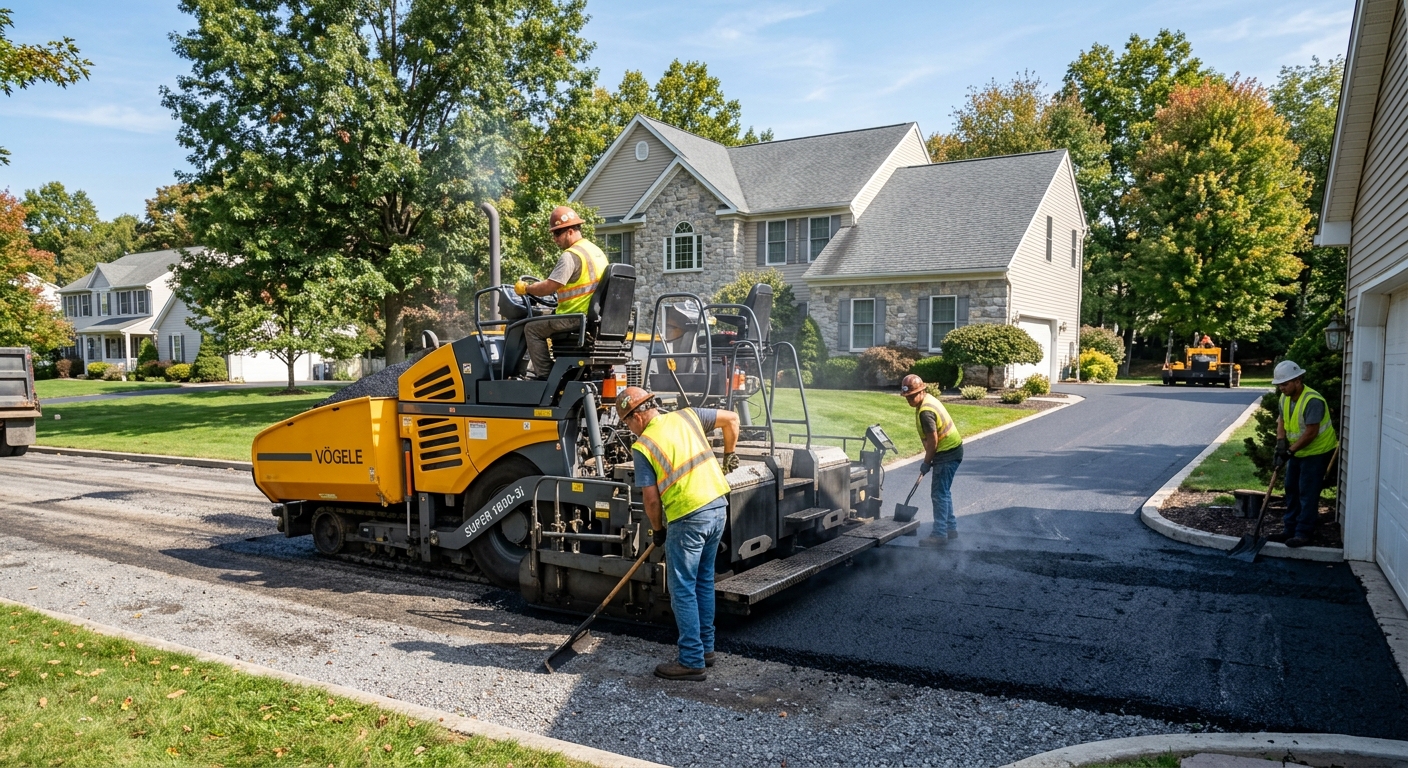
Driveway paving costs in West Earl — 2026
In West Earl, where 75.9% of homes are single-family and 78.9% of residents own their homes (U.S. Census Bureau, ACS 2024), a driveway is not a curb appeal luxury—it’s a property staple. Local conditions—multiple freeze-thaw cycles each year and moderate snowfall—mean what lies under your driveway is just as important as what’s on top. Like most of Lancaster County, contractors here deal with limestone subgrades in some townships, which call for thicker, compacted aggregate bases. While the surface material (asphalt, concrete, or gravel) gets the attention, much of the price difference between quotes comes from what happens below: how deep the old drive is removed, how well the stone base is built, and whether drainage is addressed before new paving goes down.
The prices you see below reflect real work in West Earl, not just materials but the build that will last through decades of Pennsylvania winters. Shortcuts here aren't surface-deep—they're hidden, and you only find out the cost years later. Square footage, base condition, and drainage are the real drivers of pricing—not just the top layer you see.
| Service |
Best for |
Lifespan |
Price range |
| Asphalt — full replacement with new base |
failed base, structural cracking |
20–30 yrs |
$3,600–$9,400 |
| Asphalt overlay / resurfacing |
sound base, surface cracking only |
8–15 yrs |
$1,550–$4,700 |
| Sealcoating — single application |
preventive maintenance on sound asphalt |
2–4 yrs |
$200–$750 |
| Concrete — new installation |
long service life, low maintenance |
30–50 yrs |
$5,200–$12,500 |
| Crack filling and patching |
isolated cracks under a quarter inch |
1–3 yrs |
$200–$800 |
| Gravel driveway |
rural, budget, long runs |
5–10 yrs with upkeep |
$900–$3,500 |
Estimates for a typical West Earl driveway. Square footage and base condition drive these figures more than material choice.
Changing the footprint of a West Earl driveway
If you're thinking of widening your West Earl driveway for a second car, extending it to reach a detached garage, or adding a turnaround or parking pad, the project goes beyond a standard resurface or replacement. Any time the paved area expands beyond the existing footprint, crews are building a new base over undisturbed ground—this is more involved and expensive than resurfacing what's already there. Where the old asphalt meets the new, that seam remains a future weak spot, because the subgrade under existing and new sections will never settle quite the same.
Impervious surface rules come into play when you add paving. West Earl itself doesn't have city-level permitting, but stormwater runoff rules still apply: increase the paved square footage, and you may have to manage more water on-site. Paving close to a property line isn’t always allowed, either; setback requirements can limit how near you get to a neighbor or public right-of-way.
If your driveway ties into a public road, especially for a new approach or widening, permit authority in West Earl is determined by which road you’re joining—municipal or state—and can mean paperwork with the City of Lancaster or PennDOT for new cuts. Adding paved area is an upgrade for daily life, but it comes with built-in planning, drainage review, and sometimes extra cost.
Which surface survives West Earl winters
West Earl sees harsh freeze-thaw cycles every year—ground frost to 30 inches, and temperatures dropping into the teens. Asphalt, being flexible, is built for it. When subgrade shifts with freeze-thaw, asphalt can flex slightly, absorbing stress that would crack concrete. That's why asphalt driveways, properly built and maintained, can last 20–30 years here even with plow passes and the odd thaw/refreeze.
Concrete is rigid. If it’s poured over a good base and not hit with salt, it can outlast asphalt—30–50 years is common. But here’s the catch: de-icing salt, repeatedly used through Lancaster County winters, causes spalling and surface scaling that shortens concrete’s life. Owners are often told not to use salt, but most do anyway. This isn't theory; it's what causes most concrete failures in Pennsylvania’s snowbelt counties.
Gravel works for longer rural runs and budgets in West Earl’s outlying stretches—good drainage and easy repairs, but higher upkeep. Pavers are rarely used for driveways here, but they handle freeze-thaw well, as each unit can move independently; the system settles but doesn't crack the whole surface at once.
| Option |
Installed cost |
Maintenance |
Freeze-thaw performance |
Lifespan |
| Asphalt — new install |
$3,600–$9,400 |
sealcoat every 3–4 yrs |
excellent, flexes |
20–30 yrs |
| Asphalt — overlay |
$1,550–$4,700 |
same |
good if base is sound |
+8–15 yrs |
| Concrete |
$5,200–$12,500 |
low, avoid de-icing salt |
fair, spalls with salt |
30–50 yrs |
| Pavers |
$8,300–$12,500 |
individual units replaceable |
good, settles gradually |
25–50 yrs |
| Gravel |
$900–$3,500 |
top-dress every 2–3 yrs |
excellent drainage |
indefinite with upkeep |
The paving season in south-central Pennsylvania
Paving work in West Earl runs on a strict seasonal clock. Hot-mix asphalt requires warm air and ground temperatures—usually above 50°F—so it can be spread and compacted before it cools. By late October, local asphalt plants start shutting down for the winter. You literally cannot buy fresh mix for months, making cold-weather jobs impossible here. Concrete curing also stops below freezing: if the weather stays below 32°F for days, poured drives don't set properly, leading to surface flaking and hidden strength loss.
Lancaster’s winter design temp dips to 12°F, which means crews are off driveways entirely from mid-November through March. Badge this as a plus, not a scheduling frustration—it keeps shoddy work at bay. Local limestone quarries and asphalt plants keep supply costs down, but only for the spring through fall window. During the shoulder seasons (April–early June, September–October), crews are more available and you may see better pricing and faster turnaround. June through August is peak—work is booked solid, and attempts to cut the season short are almost always at the homeowner’s expense.
If someone offers to pave in December or March “because their calendar has space,” that's a clear warning—the mix won’t last. In West Earl, stick with crews who know and respect the local calendar, even if that means waiting a few extra months.
How paving fraud actually operates
Paving draws its share of fraud because it’s a high-ticket purchase, the results are visible, and the real failures can take years to show. In rural and suburban markets like West Earl—where neighbors aren’t watching each other's drives and crews can disappear overnight—scams prey on trust and urgency. Watch for pitches claiming “leftover asphalt from a nearby job,” today-only pricing, or offers to cut you a deal because a crew “just happens” to be in the neighborhood. Other red flags: trucks with out-of-area plates, unmarked vehicles, laborers who go only by first names, requests for large cash deposits up front, and jobs that start with a handshake and end with nothing in writing.
Sealcoating scams are common: a watery oil-based spray applied in minutes and sold as high-quality protection. It leaves the surface looking black for a few weeks, but offers no actual shielding against water, salt, or sun. And once the crew is paid—sometimes in cash—they’re gone.
Pennsylvania’s Home Improvement Consumer Protection Act (HICPA) exists for a reason. On any job over $500, you have a right to a written contract spelling out the work and materials, and a full 3 business-day right of cancellation. By law, waiving your insurance deductible is prohibited. Use those rights—don’t rush, don’t pay big deposits, don’t take a verbal quote as anything binding.
Five-minute checks defeat most scams in West Earl: verify the contractor’s registration at hic.attorneygeneral.gov, make sure workers’ compensation coverage is valid at wcais.pa.gov, and insist on a written contract for any project over $500. It’s your leverage—use it.
Driveway permits, approaches and stormwater rules
If you’re repaving or resurfacing a driveway in its existing footprint in West Earl, you generally do not need a building permit—this saves a call for most township residents. But the place where your driveway meets the street, the approach or curb cut, is a different story. In the city of Lancaster, every new or modified driveway approach within the public right-of-way needs a permit from the Department of Public Works, Bureau of Engineering. For state highways, PennDOT approval applies. If your project involves a new connection, widening, or apron changes, check which authority applies before starting.
Stormwater matters county-wide. Expanding the paved area or altering where runoff goes can expose you to review—even if nobody checks at the permit desk. Directing water onto your neighbor’s property isn’t just rude, it can create legal headaches regardless of paperwork. Plan on handling your stormwater (like adding a drainage swale or dry well) if you’re adding surfacing.
Before you sign, verify that your contractor holds current Home Improvement Contractor (HIC) registration at hic.attorneygeneral.gov. For any employer, Pennsylvania requires workers’ compensation—check coverage via WCAIS at wcais.pa.gov. Skip anyone who dodges these steps.
Reading a driveway proposal
A proper driveway quote in West Earl spells out what you’re paying for down to the inch. Look for: the measured square footage (not a guess or just a length), the planned excavation depth and how old material will be removed, the type and depth of aggregate base (crucial in limestone-heavy soils), and details on compaction—done in lifts, by what machine. Asphalt thickness should mean “compacted depth,” not what’s dumped hot. Edge treatment for clean lines and preventing crumbling. Drainage: where will water go after rain or snowmelt? Cleanup matters too—restoration of lawn or landscaping is often lost in vague bids. The payment schedule should call for a modest deposit and balance on completion. Most warranties exclude cracking (the most likely failure) so don’t assume blanket coverage—read the actual exclusions.
An all-in-one number with no specs can’t be compared, and that’s how homeowners pay top dollar for a job built on thin base, weak compaction, or recycled millings. Demand detail—comparison is protection.
| Line item |
What to look for |
Red flag if… |
| Area |
measured square footage stated |
eyeballed or absent |
| Excavation |
depth and disposal included |
'we'll pave over it' |
| Base |
aggregate type and depth in inches |
'proper base' |
| Compaction |
method, and done in lifts |
not mentioned |
| Asphalt |
courses and compacted depth |
'3 inches' unqualified |
| Drainage |
slope and water direction stated |
silent |
| Warranty |
what is covered and what is excluded |
verbal only |
| Payment |
modest deposit, balance on completion |
full cash up front |
Frequently asked questions — driveway paving in West Earl
Are there stormwater rules on paving in West Earl?
In West Earl and throughout Lancaster County, increasing the size of your driveway with asphalt or concrete can trigger stormwater considerations. While most township-level repaving in your existing footprint doesn't need a permit, enlargements may require you to manage runoff on your property. This means you can't divert water onto a neighbor's land, which can cause property disputes or even legal action. The price for adding a drainage component, such as a swale or dry well, varies but often adds a few hundred to a few thousand dollars, especially if combined with a $3,600–$9,400 full asphalt replacement. It’s not just a regulatory box to check—proper drainage keeps your investment from undercutting itself every wet season.
Is an overlay worth it or should I start over?
Asphalt overlays in West Earl can be a smart investment if your existing base is sound and you’re only seeing surface cracks or aging. An overlay adds around 1.5–2 inches of new asphalt, sealing off trouble and making the drive look new for $1,550–$4,700. But overlays won’t fix deep cracks, sinkholes, or underlying base problems. If the driveway is flexing, soft after rain, or showing alligator cracking, you’re wasting money on an overlay—it will fail in a few years and you’ll still pay for a full replacement later. Have your contractor show you the base condition before you choose. In an older West Earl neighborhood, it’s often worth a full redo.
Is gravel a cheaper option in West Earl?
For rural driveways or longer private lanes in West Earl, gravel is the lowest up-front cost at $900–$3,500. It performs well on sloped lots and provides great drainage, which matters with the region’s freeze-thaw cycles. Just remember it requires regular maintenance: grading and top-dressing every couple of years to keep ruts and potholes at bay. In higher-traffic or suburban settings, the savings disappear over time as upkeep adds up and gravel migrates into the road or yard. For some properties, especially in the township outskirts, it’s still the practical choice.
Is sealcoating a scam?
Sealcoating is not a scam, but the way it's sold in West Earl sometimes can be. A single application, properly installed, costs $200–$750 and keeps water, UV, and oil from degrading the surface. The trick is that some “drive-by” crews apply watered-down or oil-only coatings that look good for a few weeks then do nothing. Sealcoating extends a good driveway’s life by 2–4 years, but won't rescue a failing drive. Don’t ever pay cash to a crew that can’t prove what they’re applying or give you a written contract. It’s worth it if you want to maintain a solid surface, but don’t expect a miracle from one quick coat.
How much does a concrete driveway cost in West Earl?
Concrete drives are more expensive to install in West Earl—expect $5,200–$12,500 for a standard single-family home project. The higher price comes from more involved prep and reinforcement. Concrete offers the longest service life (30–50 years here) but only if the base is built strong and you avoid de-icing salt, which causes surface flaking and pitting. For many homeowners, the “no salt” rule is the real deal-breaker. In exchange for higher up-front cost, you’ll save on sealcoating and most repairs for decades.
What causes driveway cracks in West Earl?
West Earl, like all of Lancaster County, sits in a freeze-thaw zone with ground frost up to 30 inches deep. The main causes of cracks are expansion and contraction—water gets into small surface imperfections, freezes, and forces the asphalt or concrete apart over time. We also see settlement issues where subgrade isn’t properly built up, especially in limestone areas. Roots from mature street trees and repeated use of de-icer on concrete also contribute. Fixing cracks when they’re small ($200–$800) prevents bigger problems—if neglected, a crack is just the start of broader failure.
What slope does a driveway need for drainage?
In West Earl, a residential driveway needs a slope of at least 2% (about a quarter inch per foot) to direct water away from structures and keep ice from forming. That means for every 10 feet, you have 2.5–3 inches of drop. This is especially critical in Lancaster County soils, where buildup of water below the pavement is the top cause of heaving and cracking. Grading is included in typical replacement jobs ($3,600–$9,400 for asphalt), but always check that your proposal details drainage. It’s the silent foundation of a long-lasting surface.
When is the best time of year to pave in West Earl?
Paving succeeds in West Earl from late April through October, when air and ground temperatures are reliably above 50°F. Asphalt plants close for winter, and local crews know that cold weather means quick-cooling mix that can't be compacted right. Scheduling in the shoulder seasons (May–June or September) often brings better availability and price. Summer is peak time—jobs stack up, so you may wait weeks. If someone offers to pave in March or November “at a deal,” walk away: the work will be short-lived, even for a $1,550–$4,700 overlay. Quality crews stick with the climate window.
Does road salt damage driveways in West Earl?
Yes—road salt is the main enemy of concrete driveways in West Earl, causing spalling (surface flaking) and scaling that shortens expected lifespan, even on brand-new concrete. Asphalt fares better, but repeated salt use along the edges can still dry out and crack the binder. For all surfaces, rinsing off salt after storms extends life. If you're considering concrete, be realistic—if you're likely to spread salt on icy mornings, you might be better off with asphalt ($3,600–$9,400) or regular sealcoating to preserve what you have. In this climate, surface care every winter makes a difference.