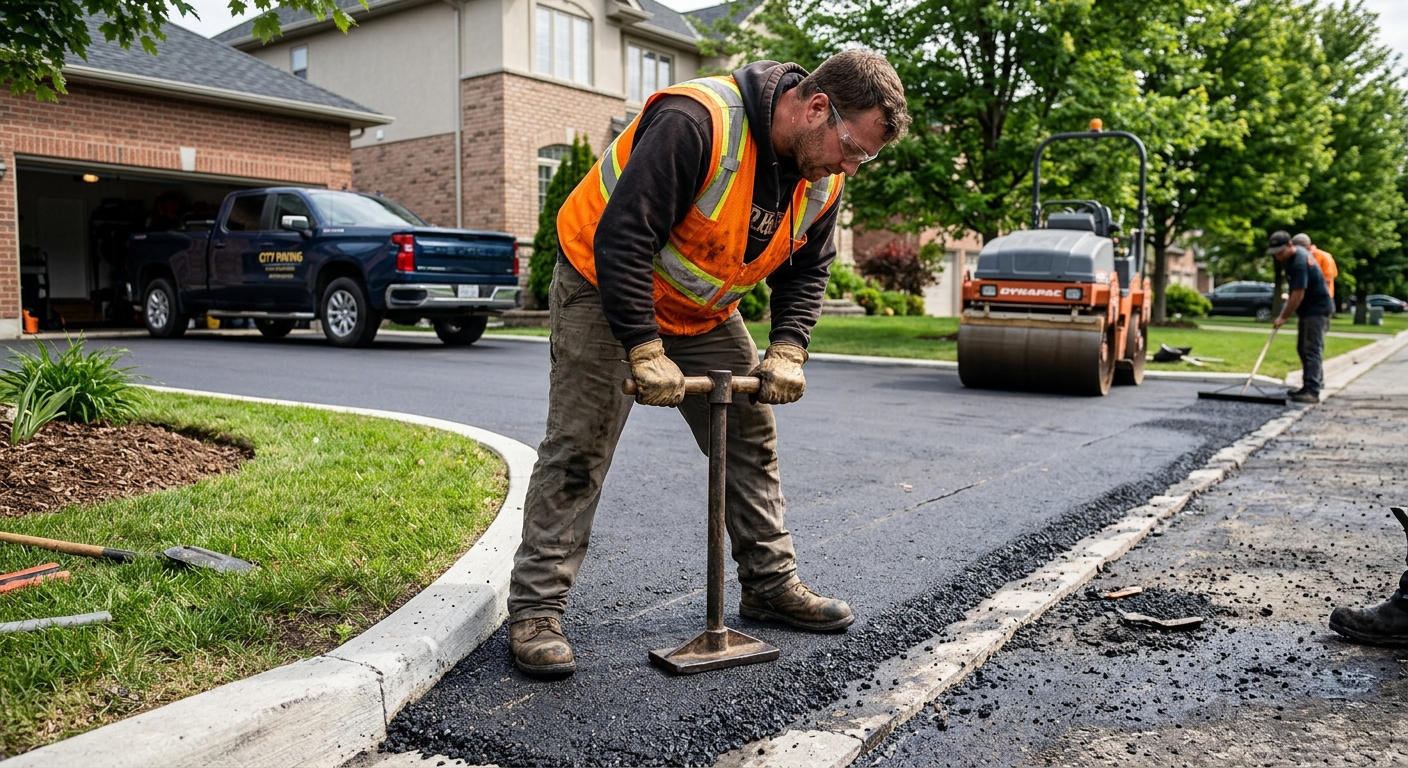
Grove City paving prices by scope — 2026
In Grove City, where 59.3% of homes are single-family and the homeownership rate is 53.5% (U.S. Census Bureau, ACS 2024), a driveway is a fixture that most owners plan to live with for decades. Northwest Pennsylvania’s freeze-thaw cycles—thanks to lake-effect snow and temperatures dropping to 5 °F—are rough on paved surfaces. Beneath your feet, glacial till soils require extra care with base preparation compared to milder regions. What homeowners rarely see is that 90% of price variation between paving quotes comes from what’s below the surface: how much excavation, how thick and well-compacted the base is, and whether proper drainage is added or ignored. Material cost and finish matter far less than what gets buried under the first load of stone.
If two estimates for your Grove City driveway differ by a lot, the most likely reason is the less expensive one is skipping, thinning, or rushing the prep—there’s no magic discount on asphalt or concrete itself. Below is a table of realistic 2026 driveway costs for Grove City homes, with range and likely lifespan for each scope of work:
| Service |
Best for |
Lifespan |
Price range |
| Asphalt — full replacement with new base |
failed base, structural cracking |
20–30 yrs |
$3,200–$8,300 |
| Asphalt overlay / resurfacing |
sound base, surface cracking only |
8–15 yrs |
$1,400–$4,200 |
| Sealcoating — single application |
preventive maintenance on sound asphalt |
2–4 yrs |
$175–$650 |
| Concrete — new installation |
long service life, low maintenance |
30–50 yrs |
$4,600–$11,000 |
| Crack filling and patching |
isolated cracks under a quarter inch |
1–3 yrs |
$200–$800 |
| Gravel driveway |
rural, budget, long runs |
5–10 yrs with upkeep |
$900–$3,500 |
Estimates for a typical Grove City driveway. Square footage and base condition drive these figures more than material choice.
What to put in a Grove City paving contract
Homeowners in Grove City should never let a paving job proceed without detailed, written specifications. Quotes that just promise “3 inches of blacktop” hide all the crucial facts. Here, northwestern Pennsylvania’s deep frost line (36 inches) and continual freeze-thaw cycles demand more robust installations than you’d get on the coast or in the south. Glacial till soils in this region often need extra shaping and drainage. In a contract, “3 inches” means nothing unless it’s clear: is that measured loose or after compaction? How deep is the base, what type of stone is used, and how was it packed down? Was the excavation deep enough to remove old, unstable subgrade?
Spec shoppers, not bargain hunters, get driveways that last—and contractors who know their stuff are always willing to write these details down. Require these items in every Grove City paving contract:
- Excavation depth in inches, with disposal location for spoil
- Aggregate base type (use local Mercer County stone) and compacted thickness—usually 6–10 inches here
- Compaction method (plate compactor, roller) and confirmation that compaction is done in lifts, not just on top
- Asphalt binder thickness (compacted), and separate surface course thickness
- All asphalt thicknesses stated as compacted, not loose
- Hot mix specification (PennDOT, District 1-0 mix, where applicable)
- Edge support—concrete or milled asphalt along the sides
- Grading plan and drainage direction, stated in percent slope
- Warranty terms, including exclusions for cracking or settlement
- Cleanup and lawn restoration included after finish
These written specs are your only protection against shortcuts made invisible by fresh asphalt.
Why you can't pave in February
Paving in Grove City is highly seasonal, and for good reason. The region’s brutal winter design temperature of 5 °F, deep frost (36 inches), and constant threat of lake-effect snow (see climate note) make winter paving a waste of money. Local asphalt plants simply close for the season—if you’re told differently, you’re being sold something that won’t last. Hot-mix asphalt must be placed and compacted while it’s hot; if outdoor temps are too low, the mix cools too fast to work it properly, leaving a brittle, porous surface. Concrete needs above-freezing weather to cure correctly; otherwise it will flake, pop, and never achieve strength.
Mercer County’s asphalt and aggregate yards are open only when temperatures allow for proper placement, which typically means late April through October. Book in the shoulder months (late spring or early fall) if possible; that’s when crews are less booked, prices can be sharper, and you’re less likely to get rushed work. If a team offers asphalt paving in late November or claims they have “special cold mix,” be skeptical. A short, northern paving season means every legitimate contractor is slammed in summer. Sometimes patience really does pay off for quality and price—wait for the right window or budget for next spring.
What's under the asphalt matters more than the asphalt
For every Grove City driveway, the assembly below the surface is what determines whether your driveway lasts 25 years or cracks up within 3. The classic section is: existing soil (subgrade), then a compacted layer of aggregate base, then asphalt. Each layer spreads the load to the next. Put thick, pretty asphalt over a thin or poorly compacted base, and you’re only hiding structural failure for a year or two. Glacial till soils common in this county are variable and often hold water, so drainage and a well-shaped base matter as much as pavement thickness.
Freeze-thaw is your enemy. Water left in the subgrade freezes, expands, and lifts the slab from below—called frost heave—which cracks and destroys pavement from the bottom up. That’s why Grove City driveways must have extra base depth and positive drainage to move water out. Skipping excavation, laying thin stone, or using the wrong aggregate can knock years off your driveway’s life. Every shortcut here is invisible the day the work is finished and painfully obvious by year three: early cracking, ruts, or settlement.
Require these figures in your quote, in writing:
- Minimum 6–10 inches of compacted Mercer County aggregate base
- No “as-is” overlays on a failed or soft base—require subgrade repair
- Base installed and compacted in 2–3 lifts, not dumped all at once
- Drainage plan to handle runoff away from the house and neighbors
If a quote skips these specifics, or the contractor shrugs when you ask, walk away.
Comparing paving estimates in Grove City
In Grove City, matching up paving quotes is only possible if you’re comparing numbers and specs, not vague promises. First: the square footage should be measured, not guessed. Excavation and disposal should be detailed. Aggregate base—type and compacted depth—must be listed in inches. Specify the compaction method and that it’s done in multiple lifts. Asphalt should be broken out into binder (base) and surface courses, always described as compacted thickness. Drainage direction, edge treatments, and lawn restoration all go on paper. A modest, legally compliant payment schedule is another mark of a professional.
Warranties matter, but most cover only gross failures like potholes—not cracks, which are almost always excluded. Beware one-line bids that say only “Install driveway $X”—that’s the most common way Grove City homeowners overpay for work with no proper foundation underneath.
| Line item |
What to look for |
Red flag if… |
| Area |
measured square footage stated |
eyeballed or absent |
| Excavation |
depth and disposal included |
'we'll pave over it' |
| Base |
aggregate type and depth in inches |
'proper base' |
| Compaction |
method, and done in lifts |
not mentioned |
| Asphalt |
courses and compacted depth |
'3 inches' unqualified |
| Drainage |
slope and water direction stated |
silent |
| Warranty |
what is covered and what is excluded |
verbal only |
| Payment |
modest deposit, balance on completion |
full cash up front |
Permits and approvals for paving in Grove City
For most homeowners in Grove City, repaving your driveway in its current footprint does not require a building permit. However, if you’re expanding the driveway or adding new site work, check with your local municipal office first. The critical spot is where your driveway meets the street—the “driveway approach.” This does require a permit, but not from the borough or township. In Mercer County, all driveway approach permits are handled by PennDOT District 1-0 if your property connects to a state road. Don’t overlook this step; skipping it can mean costly corrections later.
Even if you don’t need a permit for simple resurfacing, stormwater control is your responsibility. Expanding the impervious area can trigger runoff rules, and the law is clear: you may not direct water onto your neighbor’s property, regardless of permits.
Contractor verification matters in Pennsylvania. Anyone working on a driveway worth over $500 must have Home Improvement Contractor (HIC) registration issued by the Pennsylvania Office of Attorney General—check any contractor at hic.attorneygeneral.gov. It is illegal for a contractor to work without workers’ compensation insurance; verify their coverage on the WCAIS system (wcais.pa.gov) before you sign. For pre-1978 homes, federal EPA Lead RRP certification is required for any work disturbing painted surfaces—confirm at certifiedrenovatorsearch.epa.gov.
Maintenance that actually works
In Grove City’s climate, the simplest maintenance saves you the most over time. Top of the list: fill cracks while they’re small (under a quarter inch) to keep water from reaching the base and causing frost heave. Keep the driveway edges supported with soil or gravel—unsupported edges are the first to crack in freeze-thaw cycles. Keep water moving off your surface and away from the base; a broom, not chemicals, is half your maintenance cost.
Avoid parking dumpsters, loaded trailers, or using jack stands directly on the driveway surface—they concentrate weight and create ruts. On new asphalt, wait at least one week before parking, and several weeks before turning tires while stationary to prevent deformation.
De-icing is different for each material. Salt chews up concrete driveways in our climate, causing surface distress and flaking after a few winters; calcium chloride is a more expensive but safer alternative. On asphalt, the main risk is water seeping through cracks, then freezing and popping up chunks during refreeze. Sand can improve traction and does no harm, but must be swept up in spring.
Simple, timely crack filling and cautious snow removal will add years to a Grove City driveway.
Frequently asked questions — driveway paving in Grove City
How deep should the aggregate base be here?
In Grove City, your driveway’s base needs to be deeper than what’s common in milder climates, because of our freeze-thaw cycles and the glacial till soil found in Mercer County. For asphalt or concrete driveways, ask for a minimum of 6–10 inches of compacted aggregate—closer to 10 inches if your ground is soft or you want long-term durability. Skimping on base depth is the easiest way for a contractor to cut corners, but it’s also the fastest route to early failure from frost heave, rutting, or settlement. While the material above ground draws your eye, it’s the base below that drives both the service life and the actual value for money. Full replacement, with a proper new base, typically falls in the $3,200–$8,300 range for Grove City in 2026.
What kind of soil is under Grove City driveways?
Most Grove City driveways are underlain by glacial till—a mix of clay, sand, gravel, and rocks deposited by ancient glaciers. This soil type is common throughout Mercer County and is known for being poorly drained and variable in stability, which can be a real issue with driveways. Without proper excavation and a thick, well-compacted aggregate base, these soils will hold water, setting you up for frost heave, surface heaving, and early cracking. This is why our driveways often cost more and need more prep than in regions with drier, stable sandy soils. Asphalt resurfacing, on a stable base, is typically in the $1,400–$4,200 range, but skipping base repairs can be a false economy.
What causes concrete to spall or flake in Grove City?
Concrete spalling and flaking in Grove City is most often caused by freeze-thaw cycling and the use of de-icing salts. Here, with our heavy winter snowfall and deep frost (down to 36 inches), water gets into the concrete’s pores. When it freezes, it expands, breaking off surface layers. Using rock salt for de-icing speeds up surface breakdown, especially in the first years when concrete is most vulnerable. Poor finishing or not using an air-entrained concrete mix also makes things worse. Concrete drives here will last decades if poured with proper prep, finished well, and maintained—but if you see widespread flaking within the first five years, improper installation is likely the culprit. Expected cost for proper new concrete in Grove City runs $4,600–$11,000.
Are there stormwater rules on paving in Grove City?
Yes, and they matter even on smaller driveways. Expanding your paved area or changing the layout can trigger stormwater runoff requirements in Grove City and all of Mercer County. Legally, you are not allowed to direct runoff onto your neighbor’s property or into the public right-of-way. Even if a specific building permit isn’t needed for a simple resurfacing, changes in water drainage patterns are your responsibility. If you’re increasing impervious area, expect your local code office—or PennDOT District 1-0 for driveway approach permits—to ask about your plan for runoff. For peace of mind, discuss grading, slope, and possible drainage solutions before work starts. Crack filling and patching jobs are small maintenance tasks, running $200–$800, but new layouts almost always need a drainage conversation.
Asphalt or concrete for a Grove City driveway?
Both materials have pros and cons in Grove City’s climate. Asphalt is less expensive upfront ($3,200–$8,300 for a full replacement) and more forgiving of freeze-thaw cycles, which are brutal in this region. Asphalt is also easier to repair, resurface, and seal, plus it re-heals minor cracks better in spring and fall. Concrete costs more up front ($4,600–$11,000) and is prone to surface damage from salt, but it has a longer service life (30–50 years if installed and maintained correctly) and needs much less routine attention. For most Grove City homes, budget and willingness to maintain the surface make the call. Either way, demand proper prep—installation shortcuts kill both types.
When is the best time of year to pave in Grove City?
The best time for driveway paving in Grove City is between late April and October, when local asphalt plants are open and temperatures allow for proper placement and compaction. Trying to pave outside this window—especially during the region’s harsh winters—results in poor quality and shortened lifespan due to rapid cooling or improper concrete curing. Spring and fall are ideal because crews have a more open schedule and weather is usually milder. Summer is peak demand, which can bump prices up and lead to rushed jobs. If a contractor says they’ll pave after Thanksgiving in Mercer County, that’s a red flag. Sealcoating, which protects asphalt, is also best scheduled between late spring and early fall and typically costs $175–$650.
What does sealcoating cost in Grove City?
For Grove City homeowners, sealcoating a typical single-family asphalt driveway runs from $175–$650 per single application, with the average job near $375 as of 2026. Sealcoating is a preventive step, not a repair—it won’t fix major cracks or structural issues but will slow UV aging, keep the surface flexible, and help shed water. Because of our climate, with freeze-thaw cycles and lake-effect snow, budgeting for sealcoating every 2–4 years is smart. Done on time, it can add years before you need the much pricier overlay ($1,400–$4,200) or full replacement. Just don’t be sold on miracle claims—you still need regular crack filling and good drainage.
Does sealcoating fix cracks?
No, sealcoating alone will not fix cracks in a Grove City driveway—especially not the deeper or wider ones that signal base movement or frost heave. Sealcoat is a thin protective layer meant to block UV and water, not a gap-filler. If applied over unfilled cracks, it simply bridges the surface and may even make the problem less visible for a while, but water will still get in and cause freeze-thaw damage. To actually protect your driveway, cracks should be cleaned and filled with a hot rubberized crack sealant before any sealcoat is applied. Proper crack filling jobs typically cost $200–$800 depending on the area and the number of cracks.
How much does it cost to widen a driveway?
Widening a driveway in Grove City usually costs more per square foot than simple resurfacing or sealcoating, because it involves excavation, new base prep, and matching the existing surface. Expect to pay roughly the same per-foot rate as new installation, with total prices running from $1,400–$4,200 for an asphalt widening to $4,600–$11,000 for concrete, depending on how much extra width is needed and access for equipment. Permits may also be required for changing your driveway’s footprint, and the driveway approach will need approval from PennDOT District 1-0 if you’re altering the street entrance. Get detailed quotes that specify the new base depth and drainage plan—skimping at the edges is the most common shortcut.