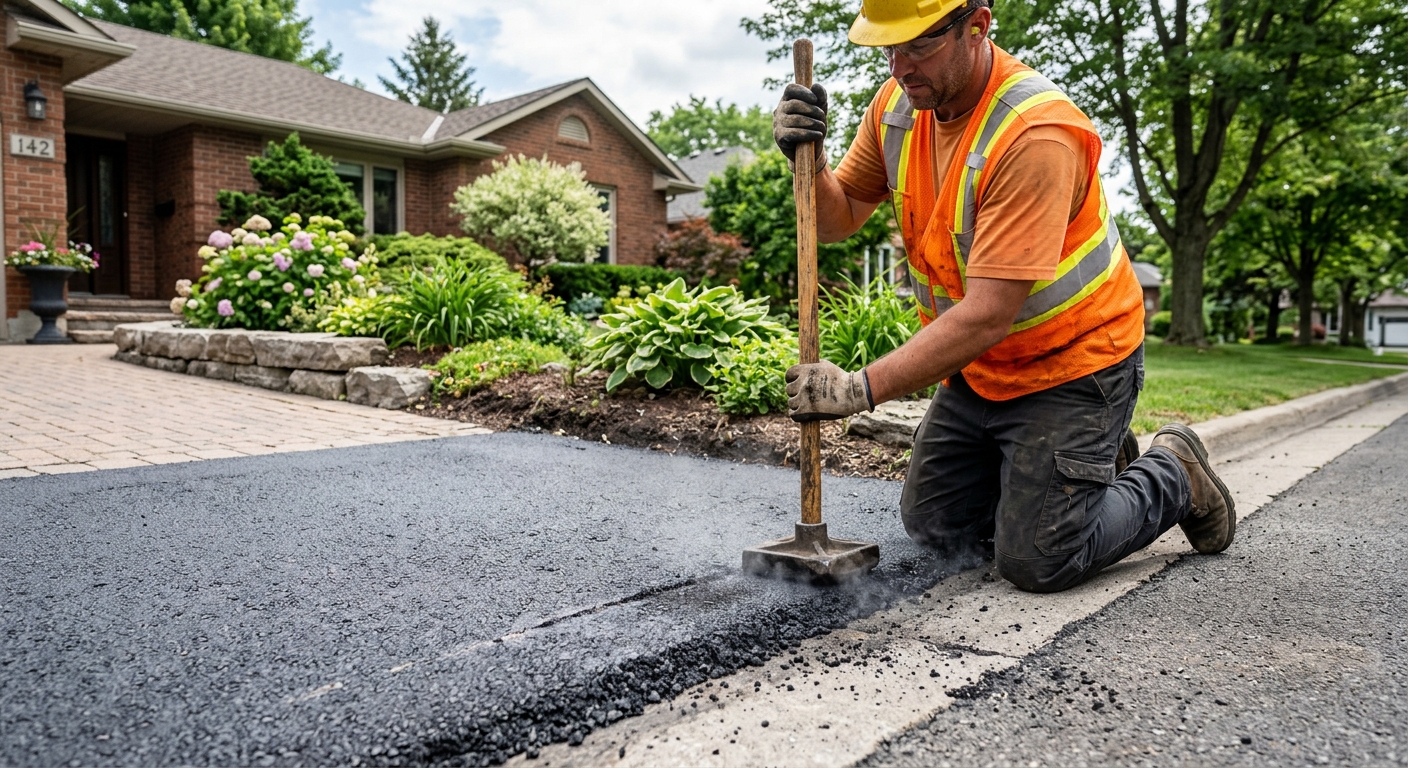
Bangor paving prices by scope — 2026
In Bangor, where 47.2% of homes are single-family and the homeownership rate is 62.3% (U.S. Census Bureau, ACS 2024), a driveway is typically a homeowner's direct responsibility. Northeast Pennsylvania’s repeated freeze-thaw cycles and Bangor’s prevalent limestone subgrade have a direct impact on both the cost and longevity of your paving job. Most cost differences between paving quotes are determined by what happens under the surface: the excavation, base grading, compaction, and drainage—details a homeowner often can’t see—but these hidden steps are what ensure a driveway in Bangor performs over decades instead of failing in just a few winters.
Given the area’s older housing stock, with nearly all homes built before 1980 (U.S. Census Bureau, ACS 2024), many driveways are due not just for repaving but for full replacement to modern base and width standards. Asphalt remains the most common surfacing material, with overlay and sealcoating as maintenance steps. Concrete costs more but may be a fit for certain owners based on priorities. Below is a summary of paving and repair options with typical Pennsylvania pricing:
| Service |
Best for |
Lifespan |
Price range |
| Asphalt — full replacement with new base |
failed base, structural cracking |
20–30 yrs |
$3,400–$8,600 |
| Asphalt overlay / resurfacing |
sound base, surface cracking only |
8–15 yrs |
$1,450–$4,300 |
| Sealcoating — single application |
preventive maintenance on sound asphalt |
2–4 yrs |
$200–$650 |
| Concrete — new installation |
long service life, low maintenance |
30–50 yrs |
$4,800–$11,500 |
| Crack filling and patching |
isolated cracks under a quarter inch |
1–3 yrs |
$200–$800 |
| Gravel driveway |
rural, budget, long runs |
5–10 yrs with upkeep |
$900–$3,500 |
Estimates for a typical Bangor driveway. Square footage and base condition drive these figures more than material choice.
What you need before paving in Bangor
For most Bangor homes, repaving an existing residential driveway in its current footprint rarely triggers a building permit. In the surrounding Northampton County townships, minor patching projects on asphalt driveways are typically done without any permits, which saves homeowners both time and permit costs. The exception is when you expand, widen, or substantially alter your driveway footprint, especially in the City of Bethlehem, where such changes require a zoning or building permit review by the local code office.
The transition where your driveway meets the public road—the approach—is another matter. If your home fronts a state route, you’ll need a driveway approach permit from PennDOT District 5-0. For homes on township roads, the local township code office handles curb cuts and driveway approaches. Homeowners often expect this to be managed by the same authority as general permits, but it is separate and not optional.
Any project that expands the impervious surface—meaning more area that sheds, rather than absorbs, rain—can trigger local stormwater or runoff requirements. Beyond that, redirecting runoff onto a neighboring property is a liability topic regardless of local permits.
The state requires any paving contract over $500 to be in writing, and all contractors must hold Pennsylvania Home Improvement Contractor registration, which you can verify at hic.attorneygeneral.gov. All employers—regardless of trade—must carry workers’ compensation insurance, which can be checked through the WCAIS database (wcais.pa.gov).
Comparing paving estimates in Bangor
A thorough paving estimate in Bangor should be more than a lump sum and a handshake. It must state the measured square footage, detailing what is to be removed, disposed of, and replaced. Expect to see clarity on the base—both aggregate type and thickness in inches—and how compaction will be handled (including the number of lifts and which equipment is used). The asphalt should be specified by number of courses and finished compacted thickness. Edge details, such as whether a stone shoulder, concrete border, or trench curb is included, matter for both appearance and containment.
Grading and drainage must be explicitly discussed; Bangor’s limestone subgrade and freeze-thaw climate mean water management is not optional. Cleanup, including restoring disturbed lawn edges and site debris, should be written in—otherwise it often gets skipped. A clear payment schedule with only a modest deposit is standard, and warranties should be in writing. Most asphalt paving warranties in Pennsylvania specifically exclude cracking, even though that’s the type of failure most homeowners notice first.
Beware of one-line quotes listing only a total. You cannot compare them to anything, and this is the #1 way homeowners overpay for poorly built driveways in Bangor’s competitive paving market.
| Line item |
What to look for |
Red flag if… |
| Area |
measured square footage stated |
eyeballed or absent |
| Excavation |
depth and disposal included |
'we'll pave over it' |
| Base |
aggregate type and depth in inches |
'proper base' |
| Compaction |
method, and done in lifts |
not mentioned |
| Asphalt |
courses and compacted depth |
'3 inches' unqualified |
| Drainage |
slope and water direction stated |
silent |
| Warranty |
what is covered and what is excluded |
verbal only |
| Payment |
modest deposit, balance on completion |
full cash up front |
Which surface survives Bangor winters
Bangor’s winter design temperature of 4°F, 36-inch frost depth, and 40 psf ground snow load create a harsh environment for any driveway. Asphalt's flexibility gives it a real advantage here: it can flex with the freeze-thaw cycles typical of northeastern Pennsylvania, absorbing minor ground heaves instead of cracking outright. Concrete, by contrast, is highly durable on stable ground and can last longer than asphalt, but it’s vulnerable to de-icing salts, which cause surface spalling and scaling—by far the most common failure in Northampton County after several salt-heavy winters. In practice, few owners avoid salt when ice strikes Bangor in January, so concrete’s theoretical longevity is rarely achieved here. Asphalt requires regular sealcoating but can be patched and resurfaced as it ages.
Pavers are an option if you want a decorative look; they settle gradually and can be reset individually, giving flexibility against frost but at a higher cost. Gravel remains the cheapest choice, especially for long rural runs, and suits homeowners willing to top-dress every couple of years.
| Option |
Installed cost |
Maintenance |
Freeze-thaw performance |
Lifespan |
| Asphalt — new install |
$3,400–$8,600 |
sealcoat every 3–4 yrs |
excellent, flexes |
20–30 yrs |
| Asphalt — overlay |
$1,450–$4,300 |
same |
good if base is sound |
+8–15 yrs |
| Concrete |
$4,800–$11,500 |
low, avoid de-icing salt |
fair, spalls with salt |
30–50 yrs |
| Pavers |
$7,700–$11,500 |
individual units replaceable |
good, settles gradually |
25–50 yrs |
| Gravel |
$900–$3,500 |
top-dress every 2–3 yrs |
excellent drainage |
indefinite with upkeep |
Where the water goes
Water is the primary cause of driveway failure in Bangor, especially given this area’s deep freezes and limestone subgrade. Every new driveway should be graded at a minimum slope of 2%—about a quarter inch per foot—to shed water away from structures. A crown (high point in the center) or a cross-slope to one side both achieve this, depending on site layout. The biggest red flag is a driveway that slopes toward the house or garage; this guarantees water at your foundation and eventual frost heave damage. Where the grade cannot be adjusted, a channel or trench drain at the garage entrance is essential—and daylighting that drain (discharging to open surface) is always preferred to a dry well, which can clog over time.
Bangor’s karst (limestone) soils drain faster than heavy clay, but voids and settlement are possible if too much water infiltrates below the base. If water ponds or finds its way under the pavement, it freezes, expands, and lifts the surface—accelerating cracking and base failure. Redirecting runoff onto a neighbor’s property is not only discouraged, but can put you on the hook for any resulting water intrusion issues, regardless of your permit status in Northampton County.
The final grade and drainage plan should not be an afterthought; it is the most important part of any paving project in this northeast Pennsylvania climate.
Why you can't pave in February
In Bangor, paving is a seasonal business—there is no getting around it. The winter design temperature is 4°F, and asphalt plants near Bethlehem and Easton shut down entirely for several months each year, meaning material simply isn’t available. Hot-mix asphalt must be installed and compacted at temperatures generally above 50°F; too cold, and the material locks up before compacting properly, leaving your new driveway porous and ready to fail with the first freeze-thaw cycle. Concrete, while sometimes poured later into fall, still requires above-freezing temperatures for at least several days to cure to strength. Trying to cheat these rules guarantees trouble, especially in this region’s high snow load and ice exposure.
Prime paving season in Bangor starts late April and wraps up by early November. The busiest—and most expensive—months are June through September. In shoulder seasons, reliable crews have more flexibility and may schedule jobs on short lead time; conversely, any contractor offering to pave in December or February in Bangor is ignoring basic standards. Wait for the right season—your driveway will last years longer, and you won’t waste money on a job destined to fail.
Beyond replacement: layout changes
Projects that move beyond simple replacement—such as widening for an extra car, running a new strip to a detached garage, or converting a gravel path to asphalt—require a new approach in Bangor. Because you’re creating a new footprint over undisturbed limestone subgrade, the base must be excavated and built up from scratch; skipping this step is the surest way to get settlement and cracking on new sections. Every seam between old and new pavement is a permanent weak point, so expect a visible transition with potential for future movement.
Expanding driveways can also trigger new restrictions: many Northampton County municipalities set impervious-surface limits, which cap how much of your lot can be paved. Setback rules may restrict how close you can build to your property line. Any changes to the approach—or new curb cuts—require obtaining the proper permit, either from your local township or, for state routes, PennDOT District 5-0 as noted for Bangor. Stormwater management requirements or neighbor runoff concerns may also apply, especially as more surface area means more water to control. If you’re considering an upgrade rather than just a repair, make sure your contractor addresses all of these factors up front.
Frequently asked questions — driveway paving in Bangor
What does sealcoating cost in Bangor?
Sealcoating prices in Bangor typically run from $200–$650 per application for a standard-sized residential driveway. The actual cost depends on square footage, number of coats, and whether crack filling is included in the service. Most Bangor driveways built before 1980 can benefit from regular sealcoating every three to four years, especially with the punishing freeze-thaw cycles of eastern Pennsylvania. If a contractor’s price is outside this range, ask what prep is included: cleaning, oil spot treatment, and detailed edgework. Be alert for extremely low prices, as some crews dilute the sealer or skip important prep steps, leading to early failure. In this region, investing in proper sealcoating at regular intervals is still far more economical than premature resurfacing.
How thick should asphalt be for a residential driveway in Bangor?
For most Bangor homes, an asphalt driveway should be built with at least 3 inches of finished, compacted asphalt over a solid stone base. On new installs or full replacements, 4–6 inches of crushed aggregate base is standard practice in Northampton County’s limestone soils. The top course of asphalt—often 1.5 to 2 inches—should be a finer mix for a smooth finish, with the remainder as a binder layer for strength. Anything less, especially in Bangor’s severe winter climate and with the 36-inch frost depth, risks early cracking and heaving. While you’ll see prices ranging from $3,400–$8,600, be sure these specs are in writing—underbuilt driveways eventually cost more in repairs and replacements.
Can I pave over my existing driveway?
If your current Bangor driveway base is intact—meaning no major settling, potholes, or deep alligator cracking—overlaying with fresh asphalt can be a cost-effective option, generally ranging from $1,450–$4,300. It’s important to address existing cracks and ensure no areas have failed beneath the surface; otherwise, the new top will simply reflect old problems, and you’ll buy only a few years of improvement. In older Bangor homes (nearly all built before 1980), it’s common that overlays are possible on sound driveways but not those heavily broken-up by frost. A reputable contractor will always inspect core samples or dig trial pits to check the base before recommending an overlay.
Does sealcoating fix cracks?
Sealcoating in Bangor is a preventive measure, not a repair—it will not fix cracks. In fact, sealcoat is formulated to protect against UV and water penetration, but it cannot bridge or fill gaps. For cracks up to a quarter inch wide, proper routing and crack filling comes first; the average cost for this is $200–$800, depending on driveway size and condition. On most Northampton County driveways, especially older ones, skipping this step means cracks will widen, water will penetrate the base, and freeze-thaw cycles will accelerate damage. Always have significant cracks filled before sealcoating; otherwise, the sealant will not adhere, and your money is wasted.
How long does a driveway installation take?
In Bangor, a typical residential asphalt driveway replacement—removing the old pavement, building a new base, and paving—takes 2–4 days. Weather can stretch this out, especially with rain or unexpected subgrade issues on older properties. For overlays, expect one to two days. Concrete driveways need one to two days for forming and pouring and an additional few days for curing before you can drive on them. Larger or more complex projects, especially those involving layout changes or drainage work, may run longer. Keep in mind, too, that material availability in Bangor is tied to local Bethlehem and Easton asphalt plants, so scheduling peaks in summer. You can expect costs for full installation to run $3,400–$8,600 for asphalt, and more for concrete.
Why does my driveway have depressions that hold water?
Depressions (birdbaths) in Bangor driveways are almost always the result of improper grading, insufficient base compaction, or water infiltrating beneath the asphalt. With Bangor’s deep frost (36 inches) and frequent freeze-thaw cycles, ponded water is the main culprit in pushing the base up and down throughout the seasons. If your driveway holds water after rain, it likely needs regrading or patching—often in the $200–$800 range for localized repairs. Preventing water problems at installation is key: proper grading, compaction, and sometimes installation of drainage features like trench drains near garages are the local remedies.
How do I verify a paving contractor in Pennsylvania?
Any paving contractor working in Bangor must hold a Pennsylvania Home Improvement Contractor (HIC) registration for jobs over $500. You can verify this registration through hic.attorneygeneral.gov, which is the official state registry. Additionally, workers’ compensation insurance should be active for any employees, and you can check coverage on WCAIS (wcais.pa.gov). Make sure your estimate is in writing—this is a state law for projects above $500. Be alert to anyone offering to waive your insurance deductible or suggesting verbal-only agreements; these are red flags under Pennsylvania’s Home Improvement Consumer Protection Act.
Does road salt damage driveways in Bangor?
Yes—road salt use is a major factor in driveway wear in Bangor. For concrete driveways especially, salt leads to surface spalling and scaling, which is the most common cause of early failure in Northampton County’s high-snow, heavy-salt winters. Asphalt surfaces tolerate salt much better, but overuse can contribute to surface aging and open small cracks where water enters and freezes. Sealcoating every few years at a cost of $200–$650 helps protect asphalt, but concrete owners must try to avoid salt-based de-icers if they want their driveway to last decades. In real Bangor winters, most people compromise and use salt for safety—just know it comes at a cost to service life.
Why are paving quotes in Bangor so different from each other?
The wide range of paving quotes in Bangor comes mostly from what’s under the surface: base preparation, excavation depth, drainage details, and the thickness of the new pavement. Many quotes skip these details and present only a total price; in these cases, it’s impossible to tell what corners may be cut. A paved surface may look smooth in year one but fail because the stone base was too thin or improperly compacted. Labor and local aggregate supply are competitive here, thanks to nearby Bethlehem and Easton quarries, so real price differences come from spec quality. Don’t compare only bottom lines: a detailed quote for a full replacement should fall between $3,400–$8,600. If you’re quoted much less or more, ask to see exact specifications and where the savings or extra costs are coming from.