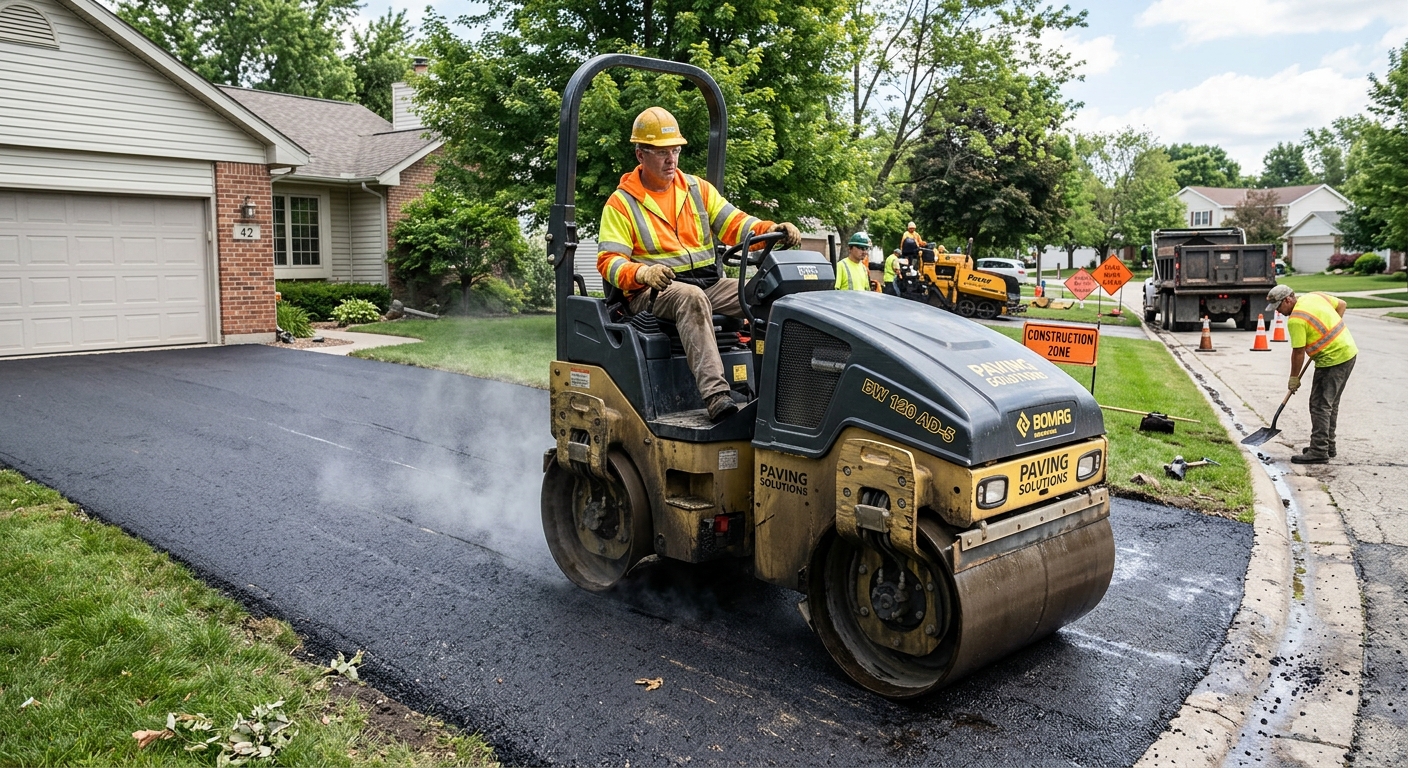
What a new driveway costs in Hempfield
In Hempfield, where 78.2% of homes are single-family and the homeownership rate stands at 83.0% (U.S. Census Bureau, ACS 2024), most properties have driveways—making paving a common and necessary investment. The region’s freeze-thaw cycles and the local mix of clay and shale subgrade mean driveways face harsher conditions than in much of Pennsylvania. These environmental stresses dictate costs and life expectancy more than material choice.
What sets one Hempfield paving quote apart from another is usually not the asphalt or concrete you see, but the unseen work below the surface. The depth and quality of the base, water management, and proper grading matter far more than the top layer. The base is where most corners get cut—and where most future repairs will come from.
Below are the typical costs for driveway options in Hempfield. Square footage and the existing base’s condition drive price more than anything else. Concrete runs higher up front but lasts longer; overlays and sealcoating suit driveways with structurally sound bases. Preventive maintenance like crack filling and timely sealcoating can buy years before a replacement is needed.
| Service |
Best for |
Lifespan |
Price range |
| Asphalt — full replacement with new base |
failed base, structural cracking |
20–30 yrs |
$3,500–$8,900 |
| Asphalt overlay / resurfacing |
sound base, surface cracking only |
8–15 yrs |
$1,500–$4,500 |
| Sealcoating — single application |
preventive maintenance on sound asphalt |
2–4 yrs |
$200–$700 |
| Concrete — new installation |
long service life, low maintenance |
30–50 yrs |
$5,000–$12,000 |
| Crack filling and patching |
isolated cracks under a quarter inch |
1–3 yrs |
$200–$800 |
| Gravel driveway |
rural, budget, long runs |
5–10 yrs with upkeep |
$900–$3,500 |
Estimates for a typical Hempfield driveway. Square footage and base condition drive these figures more than material choice.
Comparing materials in southwestern Pennsylvania
In southwestern Pennsylvania, including Hempfield, choosing the right paving material is all about freeze-thaw performance and the local use of de-icing salt. Asphalt has the advantage here: it’s flexible, and that means it survives the region’s constant cycle of freezing and thawing by moving with the ground, rather than cracking apart. It will develop surface cracks over time, but those can be filled or sealed. Asphalt will need resealing every three to four years—an ongoing cost, but a known one.
Concrete is more rigid and, in perfect conditions, will outlast asphalt by decades. But there’s a catch: concrete here rarely gets “perfect” conditions. Salt used to melt ice in Westmoreland County damages concrete far faster than freeze-thaw alone. Spalling and scaling—where the surface flakes and pits—are the usual failure, not cracks. Avoiding salt-based de-icers is the only way to prevent this, but in practice, few homeowners can forego salt in a Hempfield winter. So while the up-front cost of concrete is higher, you must be honest about your snow and ice management habits before choosing it.
Pavers work where appearance and ease of repair matter, but the cost is higher and weeds can creep through. Gravel is a valid choice for rural or extra-long driveways off the main roads, provided you keep up with raking and adding new stone every few years.
| Option |
Installed cost |
Maintenance |
Freeze-thaw performance |
Lifespan |
| Asphalt — new install |
$3,500–$8,900 |
sealcoat every 3–4 yrs |
excellent, flexes |
20–30 yrs |
| Asphalt — overlay |
$1,500–$4,500 |
same |
good if base is sound |
+8–15 yrs |
| Concrete |
$5,000–$12,000 |
low, avoid de-icing salt |
fair, spalls with salt |
30–50 yrs |
| Pavers |
$7,900–$12,000 |
individual units replaceable |
good, settles gradually |
25–50 yrs |
| Gravel |
$900–$3,500 |
top-dress every 2–3 yrs |
excellent drainage |
indefinite with upkeep |
Permits and approvals for paving in Hempfield
In Hempfield Township, repaving or resurfacing a driveway in the same footprint does not require a municipal permit, saving most homeowners a paperwork step. However, if you’re working on the driveway approach—the section that connects to a public street—permits come from a different place. Here, PennDOT District 12, through the Westmoreland County maintenance office, handles approach permits for any driveway meeting a state road. Homeowners often miss this and risk fines or a stop-work order if the approach is altered without approval.
Expanding your driveway or changing drainage patterns can trigger requirements for stormwater management and possibly a review by the Hempfield Township Code & Inspection Department. Even if you don’t need a permit for the work itself, directing runoff onto a neighbor’s land is a liability under both code and civil law. Permits never grant you the right to move your drainage problem onto someone else’s property.
Pennsylvania requires any contractor taking on a home improvement job over $500 to have a Home Improvement Contractor (HIC) registration through the Office of Attorney General. Always verify this at hic.attorneygeneral.gov. Employers must also carry workers’ compensation insurance, verifiable via WCAIS (wcais.pa.gov). Both checks protect you from legal and financial headaches if something goes wrong.
Diagnosing a failing Hempfield driveway
The decision between repair and replacement depends almost entirely on what’s happening beneath the surface. In Hempfield, where ground movement is common due to clay and shale subgrade, knowing the difference can save thousands.
Here’s what to look for: if your driveway has widespread alligator cracking (a web pattern), it means the base has failed. No overlay will fix this; it will just keep breaking through. Isolated, mostly straight cracks are usually cosmetic and can be sealed. If you see depressions that hold water (birdbaths), the subgrade has shifted—patching may work for small areas, but large movement typically means a full-depth fix. Crumbling edges signal lack of support and may mean water is washing away the base. Potholes mean water has already reached and weakened the base below; patching may hold, but needs assessment.
Beware of any contractor who doesn’t probe the base before quoting an overlay—without checking, they’re guessing with your money. Don’t pay for an overlay on a failing base; it rarely lasts.
| What you see |
Likely cause |
Right fix |
Cost |
| Isolated cracks under 1/4 inch |
surface aging |
crack fill and seal |
$200–$700 |
| Alligator cracking over a wide area |
base failure |
full replacement |
$3,500–$8,900 |
| Depressions holding water |
subgrade movement |
excavate and rebuild that area |
$3,500–$5,500 |
| Crumbling edges |
no edge support |
edge repair, consider curbing |
$400–$1,500 |
| Potholes |
water into the base |
full-depth patch, then assess |
$250–$900 |
| Faded but sound surface |
oxidation only |
sealcoat |
$200–$700 |
Why driveways behave differently in Hempfield
Hempfield’s driveways deal with soil that’s mainly clay and shale—a combination that profoundly affects how long a driveway lasts and how it fails. Clay soils hold water, expand when wet, and shrink when dry, which encourages heaving and rutting when winter freeze-thaw sets in. Shale in the subgrade can provide some drainage, but is often mixed with less stable layers.
The region’s frost depth reaches 36 inches, so freeze-thaw cycles are intense. In older subdivisions, many driveways were originally poured with the minimum possible base or simple “builder’s gravel,” not meant for decades of heavy vehicles or heavy weather. After the post-1960s suburban growth, typical for Hempfield and North Huntingdon, many driveways here are now due for resurfacing, rather than full-depth replacement—but only if the base was built right in the first place.
Because of this local ground, new driveways in Hempfield always need a deeper, well-compacted stone base than would be standard in milder climates or where sandy soils allow for better drainage. Cheap or thin subbase work will show up quickly as ruts, cracks, or heave after just a few winters.
What to put in a Hempfield paving contract
In Hempfield, a driveway contract should be about more than price: it’s your protection against future failures that show up after the check is cashed. With our heavy freeze-thaw cycles and the challenging clay and shale subgrade, shortcutting base preparation or skimping on thickness is a path to wasted money.
Any good contract should specify numbers for two things: how deep the contractor will excavate—and with what equipment—and how much base (by depth and type) will go in, with compaction done in lifts. The next details are the compacted thickness for each layer of asphalt: binder course and surface/wearing course, not just “total thickness.” Material compresses up to a third, so “three inches as laid” can settle to two inches actually supporting your vehicles. Mix type and gradation matter, as does method for compacting edges (most failures start at the sides).
If you see “we’ll put down three inches” with no breakdown or mention of compaction, ask for more. Cheap jobs look fine on day one but age fast here. These details are why costs run higher in Hempfield than in softer-soil, warmer markets.
- Excavation depth to reach stable subgrade (typically 8–12 inches)
- Type and depth of aggregate base (at least 6–8 inches compacted limestone or approved stone blend)
- Base installed and compacted in multiple lifts, not just dumped and leveled
- Compaction method (roller tonnage and passes specified)
- Asphalt binder course: compacted thickness (usually 2–3 inches)
- Asphalt wearing/surface course: compacted thickness (1.5–2 inches)
- Mix designation for both asphalt courses (e.g., PennDOT ID-2 wearing)
- Edge treatment (hand tamped, with or without curbing specified)
- Slope for drainage stated as percent or inch-per-foot value
- Written warranty terms for workmanship and material
Drainage: the failure nobody plans for
In Hempfield, poor drainage is the root cause behind most driveway failure—and fixable only before paving goes down. Surface water must have a clear, effective path away from both the driveway and any structure it leads to. Best practice is a minimum slope of around 2%, or about a quarter inch per foot, to ensure water can’t pond, especially on heavy clay soil that doesn’t absorb runoff readily.
Crowning—the practice of shaping the driveway higher in the center—works for wide or rural drives but often isn’t suitable in suburban subdivisions. For many driveways in Hempfield, a consistent cross-slope, draining to one side and away from buildings, is the right choice. If your grade slopes toward the garage or house, trench drains or channel drains at the threshold are essential—otherwise, you risk water against your foundation, especially when clay holds it there.
Just as important is where the water goes: daylighting the outflow downslope is ideal, but if the lot doesn’t allow it, a dry well may be the fallback. Local clay soils mean water lingers longer at the base, multiplying freeze-thaw damage. Sending runoff onto your neighbor’s lot, whether by accident or design, opens you to legal and code headaches. Municipal officials in Hempfield and Greensburg see these disputes regularly, and permits do not shield you from liability.
Frequently asked questions — driveway paving in Hempfield
How deep should the aggregate base be here?
For Hempfield driveways, where the subgrade is predominantly clay and shale, the aggregate base is critical. You want a minimum of 6 to 8 inches of compacted limestone or PennDOT-approved crusher-run for asphalt, and at least 8 inches if your drive will also carry delivery trucks or RVs. This depth is higher than in other parts of Pennsylvania because clay and shale soils hold water and shift with freezing, making shallow bases a gamble—one that rarely pays off. Thinner bases (4 inches or less) found in older Hempfield subdivisions are a main reason so many post-1960s driveways need resurfacing now. A proper base increases upfront cost—totaling around $3,500–$8,900 for a full replacement—but buys you years of trouble-free use.
How much does driveway paving cost in Hempfield?
Driveway paving costs in Hempfield in 2026 average $5,500 for a full asphalt replacement, with the price band running from $3,500–$8,900 depending on driveway size, base condition, and access. Resurfacing an existing drive typically costs $1,500–$4,500 if the base is still solid, while concrete installs start around $5,000 and can hit $12,000 for double- or triple-wide drives. Gravel is your least expensive option, at $900–$3,500. Local stone and aggregate supply in Hempfield helps keep hauling costs down compared to more rural areas. Always ask for a breakdown of base work and asphalt thickness, since the “cheap” jobs usually skip these and fail fast in our climate.
What are the signs of a failing driveway base?
A failing driveway base in Hempfield shows itself with spread-out alligator cracking (a dense mesh or web), which means the layers underneath can no longer support weight. Other signs include depressions or birdbaths—especially those that return after a rain—a hint that the clay or shale subgrade has shifted or compacted unevenly. Edge crumbling and frequent potholes are also classic red flags, as they mean water is getting under the asphalt and undermining its support. Any “soft spots” that flex underfoot, or areas where rutting forms in the wheel paths, are signals that it’s time to consider a full replacement, likely in the $3,500–$8,900 range depending on size.
Can asphalt be laid in cold weather?
Asphalt paving in Hempfield is seasonal by necessity. You generally want temperatures above 50°F for good compaction, bonding, and long-term durability, which usually means paving happens from April through late October depending on the year. While patching or base repairs can be done in cooler weather, laying a full driveway when it’s cold risks poor adhesion, weak structure, and early failure—especially in our freeze-thaw cycle. Some contractors may agree to squeeze in jobs as late as November, but quality suffers. The cost for proper, warm-weather paving remains $3,500–$8,900 for a full asphalt job, but a spring or summer schedule gets you the product you paid for.
Are there stormwater rules on paving in Hempfield?
Stormwater is a real concern in Hempfield and across Westmoreland County because clay soils cause slow drainage and any increase in impervious area can send runoff to neighbors or public drains. While you generally don’t need a permit for basic repaving in Hempfield Township, expanding your driveway or rerouting water flow can trigger review by the township’s Code & Inspection Department, especially if you’re within a subdivision with HOA or local stormwater requirements. No permit in Hempfield ever grants you the right to discharge runoff onto a neighbor’s land. Budget for possible grading or drainage work, which might add $400–$1,500 to the project price if channel drains, swales, or subsurface solutions are required.
What kind of soil is under Hempfield driveways?
Most Hempfield properties sit on clay and shale subgrade, which are notorious for holding water. Clay expands and heaves when saturated, especially during freeze-thaw winters, while shale layers can break down over time and influence drainage. These soils mean driveways are more stress-prone than in sandier or limestone-based regions of Pennsylvania, which is why base preparation and drainage here need to be more robust. If the original build used minimal stone or poor compaction, you’re more likely to deal with rutting and early cracks. Base fixes here drive costs—expect $3,500–$8,900 for a proper rebuild.
Should I repair or replace my Hempfield driveway?
Start by inspecting: small, straight cracks (under 1/4 inch) mean repairs and sealcoating may suffice—a common scenario for driveways laid after the suburban expansions of the 1960s and 70s. But widespread alligator cracking, soft spots, or recurring potholes are strong signals of base failure, typical in Hempfield after decades of freeze-thaw and heavy vehicles. In those cases, overlays or patching are just stopgaps and replacement is the only long-term fix. Repair costs like crack filling stay in the $200–$800 range, while full replacement jumps to $3,500–$8,900. If in doubt, ask for a base probe or core sample before you commit—contractors willing to check up front are a safer bet.
Does sealcoating fix cracks?
Sealcoating is not a true crack repair; it covers minor surface wear and oxidation and helps slow down future damage from UV and water. Hairline cracks may get partially masked, but anything over 1/8 inch wide or deep will open back up quickly unless filled first with proper hot or cold-pour crack filler. In Hempfield, where freeze-thaw cycles are harsh, water creeps through untreated cracks and causes more base damage each winter. For faded but mostly intact driveways, a sealcoat application typically runs $200–$700, but budget for separate crack filling if you see significant defects.
How much does it cost to widen a driveway?
Widening a driveway in Hempfield—whether to fit extra vehicles, add a turnaround, or replace deteriorated edges—usually involves full-depth excavation along the new section, matching both the original base thickness and asphalt or concrete surface. Costs start at $1,500–$3,500 for small single-lane widening, but a full-width two-car expansion can push totals toward $5,500–$8,900 if drainage, edge curbing, or grading must also be redone. Check first if you’ll need a driveway approach permit from PennDOT if widening where the drive meets a state-maintained road.