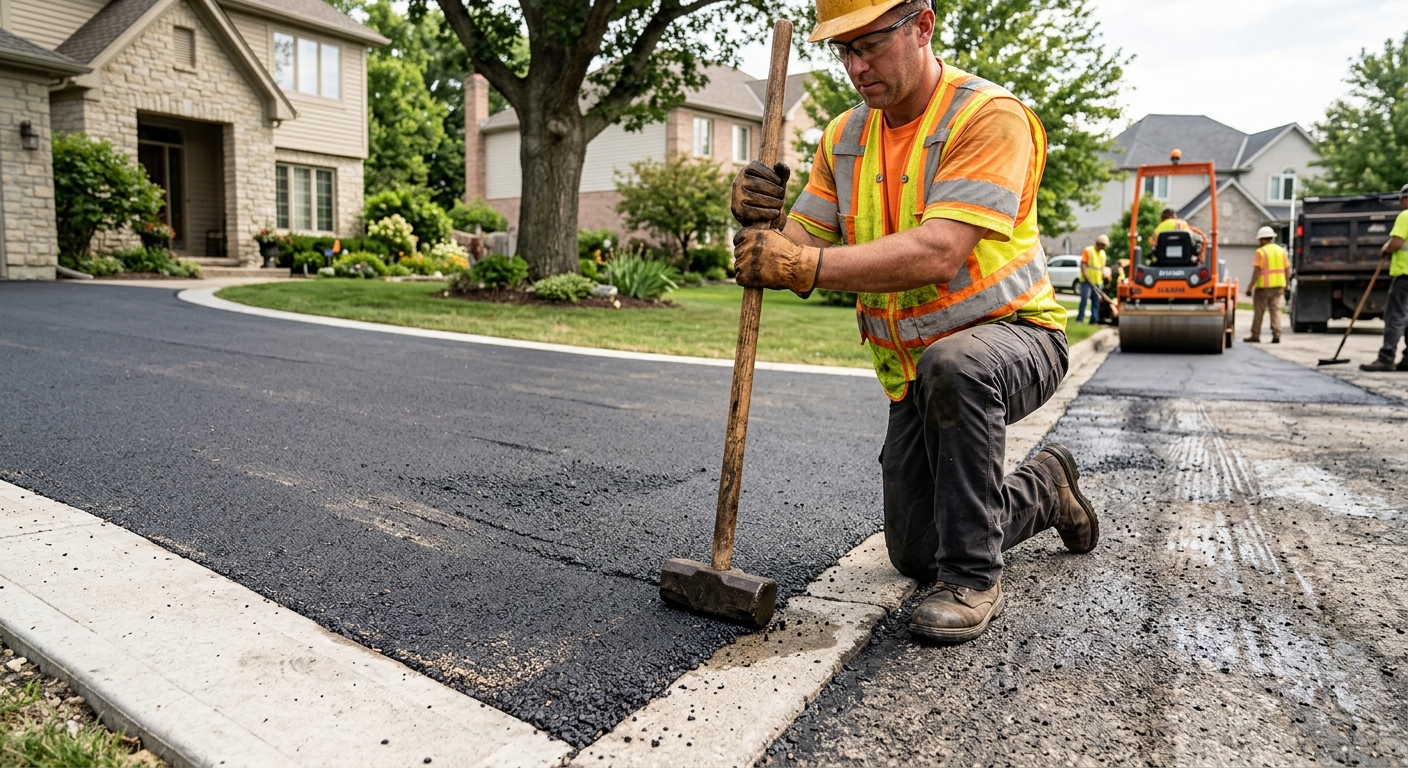
Driveway paving costs in Red Lion — 2026
Red Lion has a distinctive housing stock with just 28.8% single-family homes and a homeownership rate of 55.7% (U.S. Census Bureau, ACS 2024). This means driveways here are primarily the responsibility of owners with detached homes—not renters or condo associations. Most of these homes are older, and repair or replacement is often overdue. In south-central Pennsylvania’s freeze-thaw climate, what you pay for driveway work hinges less on the visible surface than on the unseen base and drainage preparation underneath. Two estimates can differ by thousands for what appears to be the same "asphalt driveway" because one includes proper excavation, base correction for York County’s native shale, and drainage grading, and the other does not.
Softer or poorly drained soils (shale is common here) demand more extensive base work, and skipping it is the fastest way to guarantee failure. A cheap quote that skips subgrade improvement will cost more in the long run. Sealcoating, crack filling, overlays, and full replacements reflect not just material costs, but whether the underlying structure is stabilized for local conditions. In Red Lion, it’s smart to drill into the details of what’s below, because that's where price and performance part ways.
| Service |
Best for |
Lifespan |
Price range |
| Asphalt — full replacement with new base |
failed base, structural cracking |
20–30 yrs |
$3,400–$8,600 |
| Asphalt overlay / resurfacing |
sound base, surface cracking only |
8–15 yrs |
$1,450–$4,300 |
| Sealcoating — single application |
preventive maintenance on sound asphalt |
2–4 yrs |
$200–$650 |
| Concrete — new installation |
long service life, low maintenance |
30–50 yrs |
$4,800–$11,500 |
| Crack filling and patching |
isolated cracks under a quarter inch |
1–3 yrs |
$200–$800 |
| Gravel driveway |
rural, budget, long runs |
5–10 yrs with upkeep |
$900–$3,500 |
Estimates for a typical Red Lion driveway. Square footage and base condition drive these figures more than material choice.
Drainage: the failure nobody plans for
In York County, proper driveway drainage is more important than the surface you see—and it's often what separates a 5-year driveway from a 25-year one. Water that sits or flows where it shouldn’t will always win. Minimum practical slope for runoff is about 2% (a quarter inch per foot) across the driveway. Crowning the centerline helps, sending water away on both sides, but many properties in Red Lion are too narrow or have lot lines that complicate cross-slope.
If your driveway slopes toward your home or garage, you’re exposing your foundation to risk. Here, trench or channel drains across the driveway entrance can intercept water before it causes damage when the lot’s grade can’t be corrected. The best solution is always moving water off the driveway promptly and away from structures, using gravity over mechanical solutions. Daylighting (discharging water on a downhill side of the lot) is ideal, but where that’s impossible, a dry well may be used—understanding that shale soils common to this area don’t accept water quickly.
The freeze-thaw cycle in south-central Pennsylvania worsens everything. When ponded water enters the base and freezes, it expands, breaks up the support under your driveway, and creates heaving and potholes. Heavy, fine soils slow drainage and can trap water, making the situation worse. Finally, be aware: sending your runoff onto a neighbor’s property creates liability you won’t win by waving a permit.
Local soil, drainage and driveway lifespan
Red Lion sits in York County’s shale belt, which dictates driveway performance more than most homeowners expect. Shale is less forgiving than sand or loam; it doesn’t absorb water well and can trap runoff where you least want it, holding moisture against your driveway base. If the driveway base isn’t deep enough, or if drainage is ignored, water will find its way into the structure. When the winter freeze-thaw cycle hits—frost depth in this region goes to 30 inches—trapped water expands and contracts, lifting or breaking both asphalt and concrete. Older postwar driveways were often built with the bare minimum in base depth, especially during the building surges after WWII. Many existing driveways in Red Lion were poured or laid over little more than compacted soil and an inch or two of stone, making them early candidates for replacement.
A proper base for a new driveway on shale needs more excavation and stone, especially in areas with low spots or evidence of settlement. Skipping that is tempting but short-sighted. Even gravel driveways in this area need thick, well-drained stone beds to avoid rutting and washouts. The upshot: If your driveway is more than a few decades old or already showing signs of base failure, the culprit is often the local soil working against poor or outdated construction—not just years of wear.
Asphalt or concrete for a Red Lion driveway?
Red Lion’s climate, with regular freeze-thaw cycles and moderate snowfall, is hard on any driveway—but there are real differences in how asphalt and concrete handle it. Asphalt is flexible, able to bend and recover as the shale-based ground beneath it heaves through winter. It may show small cracks over time, but can usually be patched or resurfaced for less than a full replacement. Concrete, by contrast, is rigid and can last decades longer if the base is solid. The problem? Concrete doesn’t like salt, and spalling—from salt-based de-icers and freeze-thaw action—is the number one reason it fails here. If you plan to clear your own snow using salt, think twice before pouring expensive concrete.
Yes, concrete is lower maintenance: you don’t need to seal it every few years like asphalt. But most homeowners can’t or won’t avoid salt on icy driveways in a Red Lion winter, which limits real-world lifespan. Pavers are a middle ground: they withstand movement, and individual blocks can be replaced, but they cost more to install. Gravel works for longer rural drives, providing excellent drainage, but will wash out without careful edge and runoff management.
| Option |
Installed cost |
Maintenance |
Freeze-thaw performance |
Lifespan |
| Asphalt — new install |
$3,400–$8,600 |
sealcoat every 3–4 yrs |
excellent, flexes |
20–30 yrs |
| Asphalt — overlay |
$1,450–$4,300 |
same |
good if base is sound |
+8–15 yrs |
| Concrete |
$4,800–$11,500 |
low, avoid de-icing salt |
fair, spalls with salt |
30–50 yrs |
| Pavers |
$7,700–$11,500 |
individual units replaceable |
good, settles gradually |
25–50 yrs |
| Gravel |
$900–$3,500 |
top-dress every 2–3 yrs |
excellent drainage |
indefinite with upkeep |
Finding a legitimate paver in York County
In York County, due diligence when hiring a driveway contractor isn’t about paranoia—it’s about protecting yourself from brokers, fly-by-nights, or out-of-area operators who cannot back their work. The Pennsylvania Office of Attorney General requires Home Improvement Contractor (HIC) registration for any job over $500. You can verify this directly at hic.attorneygeneral.gov. For any company with employees, up-to-date workers’ compensation insurance is also mandatory—confirmable with WCAIS online. Legitimate contractors will have a physical business address in or near York County, not just a cell phone and a P.O. box. Ask about their asphalt supplier directly. If they can’t name which local York County quarry or blacktop plant supplies their material, it’s a red flag—they may be reselling someone else’s work, not actually paving.
Other checks matter, too: does the contractor use their own equipment, or rent everything from local yards? Can they give you a recent job to look at, plus a job three to five years old? New references only show you how tidy the crew was, not whether their work lasts through winters here.
- Confirm HIC registration at hic.attorneygeneral.gov
- Verify active workers’ comp coverage through WCAIS
- Local physical business address (not just a mobile number)
- Ownership of paving equipment—no substituting all rented gear
- Provide references from work 3+ years old
- Able to name their York County asphalt supplier or plant
- Written detailed contract as required by state law
- No pressure to sign on the spot or waive your 3-day right to cancel
- Provides proof of liability insurance
- No offer to "eat the deductible" or skirt insurance requirements
- Uses a permanent crew, not day labor only
- Ready to explain their base and drainage plan in detail
If someone’s quote is far lower than others, skips base details, or pushes aggressive sales tactics, that’s a sign to walk away.
Driveway permits, approaches and stormwater rules
For most driveway jobs in York County outside of York City, repaving or resurfacing an existing driveway—not expanding or moving it—usually does not require a building permit. This saves you time and paperwork. However, where your driveway meets the street—the approach or apron—things change. If your driveway connects to a state road, PennDOT District 8 is in charge and requires a Highway Occupancy Permit. For driveways on township or municipal roads, your individual township will process any needed permits for new approaches or changes. In the City of York, rebuilding, widening, or any significant changes to your driveway do require a building permit through the Bureau of Permits and Inspections.
Any time you increase your driveway’s size or change its orientation, you may hit local rules for stormwater management. Adding impervious surface can trigger runoff containment (retention basins or dry wells), and directing any extra runoff onto your neighbor’s property is a reliable route to complaints and liability whether or not you have a permit.
With every contract over $500, Pennsylvania law requires a written agreement with your right to cancel within three business days. Take advantage of state tools—verify your contractor’s HIC registration at hic.attorneygeneral.gov, and make sure they have workers’ compensation coverage by checking WCAIS. It’s worth the few minutes to protect yourself.
Overlay, patch or full replacement?
Base condition is what counts in Red Lion—it’s what separates a band-aid fix from a real solution in our ice-prone soils. To self-diagnose: If you see alligator cracking—those interconnected cracks like an old road map—spreading over wide areas, your base has failed. Any overlay will follow the same cracks within a year or two because the movement below hasn’t gone away. If what you see is mostly straight, isolated cracks no wider than a quarter inch, it’s likely just surface aging and can be fixed with proper crack filling and sealcoating.
Low spots or "birdbaths" that collect water signal movement in the underlying soil (subgrade), often relating to water trapped by our local shale. Crumbling at the edges points to a lack of base support, which can be fixed by adding edge stone or curbing. Every pothole means water’s already made it through the surface—those can be patched individually but warn of deeper problems.
What you should never accept: an overlay over a driveway that has base failure. That’s throwing good money after bad. Any trustworthy contractor should dig a small test hole to evaluate the base before quoting a remedy.
| What you see |
Likely cause |
Right fix |
Cost |
| Isolated cracks under 1/4 inch |
surface aging |
crack fill and seal |
$200–$650 |
| Alligator cracking over a wide area |
base failure |
full replacement |
$3,400–$8,600 |
| Depressions holding water |
subgrade movement |
excavate and rebuild that area |
$3,400–$5,300 |
| Crumbling edges |
no edge support |
edge repair, consider curbing |
$400–$1,500 |
| Potholes |
water into the base |
full-depth patch, then assess |
$250–$900 |
| Faded but sound surface |
oxidation only |
sealcoat |
$200–$650 |
Frequently asked questions — driveway paving in Red Lion
Can I pave over my existing driveway?
If your existing driveway in Red Lion has a strong, stable base and only surface cracks or minor wear, you can often overlay new asphalt directly on top. This method is called resurfacing or asphalt overlay, and it typically costs $1,450–$4,300 for a standard residential driveway. However, if you see widespread alligator cracking, potholes, or sinking areas, overlaying is just covering up deeper problems. York County's freeze-thaw cycles and shale soils mean any trapped moisture or weak spots will cause fresh cracks to appear in the new layer soon after. A trustworthy contractor should test the base by digging a few spots to check for hidden failure. Don’t let anyone sell you an overlay without inspecting what’s underneath—the short-term savings aren’t worth a redo in just a few years.
How far ahead should I book a paver in Red Lion?
Spring and summer are peak paving seasons in Red Lion, and most reputable contractors in York County book jobs two to three months out, especially if you want asphalt work done before cooler fall weather. With the area's moderate suburban density and the logistics of hauling material from local quarries (which impacts price and availability), top crews fill their schedules early. For a typical asphalt replacement job costing $3,400–$8,600, aim to contact contractors for an estimate at least 6–8 weeks ahead of your ideal project window. Last-minute bookings are rare except for small patching or sealcoating, which can sometimes work into the schedule on shorter notice.
Are there stormwater rules on paving in Red Lion?
Yes, expanding or changing your driveway in Red Lion can trigger stormwater management rules, even if you don’t need a building permit for repaving. If you add width or a new parking area, you increase impervious surface, which changes how rain flows off your property. Depending on your township or if you're on a state road, you may need to show how you'll manage that runoff. Solutions can include grading, dry wells, or retention basins, especially in areas with our typical shale subgrade that doesn't readily absorb water. Besides the rules, you're also liable if increased runoff damages your neighbor’s property. Adding a new concrete section (costing $4,800–$11,500) or another parking area should always be reviewed for stormwater impact before hiring anyone.
What are the signs of a failing driveway base?
In Red Lion’s climate, a failing driveway base shows up as alligator cracking (net-like cracks across large patches), low spots that hold water after rain, edge crumbling, or recurrent potholes. These symptoms are often linked to our local shale soils and years of freeze-thaw cycling. Surface cracks less than a quarter inch wide can be normal aging, but widespread or deep cracks mean the structure underneath is moving or breaking down. Once you have recurring potholes or subsiding sections, no overlay or patch will last. Full-depth replacement (typically $3,400–$8,600) is the right call when the base is truly gone, especially on postwar homes with minimal original base.
How thick should asphalt be for a residential driveway in Red Lion?
For Red Lion homes, new asphalt driveways should have at least 3 inches of compacted asphalt on top of a properly graded and compacted stone base, with the base itself ideally 6–8 inches deep to handle local shale and freeze-thaw movement. Many older driveways around Red Lion were built with thinner sections, which is why you see so many in need of replacement now. Modern standards—not just local code—reflect what actually survives our winters. While you may find contractors pricing overlays (at $1,450–$4,300) with as little as 1.5 inches, these are maintenance coats, not base stabilization. Skimping on thickness is a waste of money on these soils.
Does Red Lion have local asphalt plants?
Yes, York County is served by local quarries and asphalt plants, which helps keep hauling costs reasonable for Red Lion homeowners. This is a plus, because delivery distance affects both the quality (temperature of asphalt on arrival) and final installation price. Local supply is why a typical new asphalt driveway replacement runs $3,400–$8,600 instead of much higher figures seen farther from material sources. Always ask a contractor which plant they use—a legitimate paver will be able to tell you without hesitation and may even suggest you visit the yard if you want to see what materials look like before they’re installed.
How much does driveway paving cost in Red Lion?
For most single-family homes in Red Lion, a full asphalt driveway replacement (excavation, new base, and asphalt) ranges from $3,400–$8,600, with a typical job around $5,300. Resurfacing, which is only possible when the base is sound, costs $1,450–$4,300. Concrete driveways are more expensive upfront, falling between $4,800–$11,500. These bands cover standard driveways; longer or especially wide ones will cost more, but a big chunk of the final bill is in base preparation, especially over local shale.
How much does it cost to widen a driveway?
Widening an asphalt driveway in Red Lion generally costs $3,400–$8,600 when it involves full base excavation and new paving for the expanded area, since you can’t just add a thin strip to the edge and expect it to last. If you’re just resurfacing a wider existing footprint, the price falls in the $1,450–$4,300 range, provided the base still meets grading and compaction standards. Permits may be required if you affect the driveway apron, and expanding your impervious surface area could trigger township runoff controls.
How often should I sealcoat my driveway in Red Lion?
With Red Lion’s freeze-thaw cycles, it’s smart to sealcoat your asphalt driveway every three to four years to protect against water penetration and oxidation. Waiting longer risks fine surface cracks turning into broader issues, especially where winter salt and summer sun both stress the pavement. A single sealcoating costs $200–$650 for a typical driveway and can postpone the need for more expensive resurfacing. Just don’t have it done too soon after installing new asphalt—the surface needs at least six months to cure fully before a sealer can bond properly.