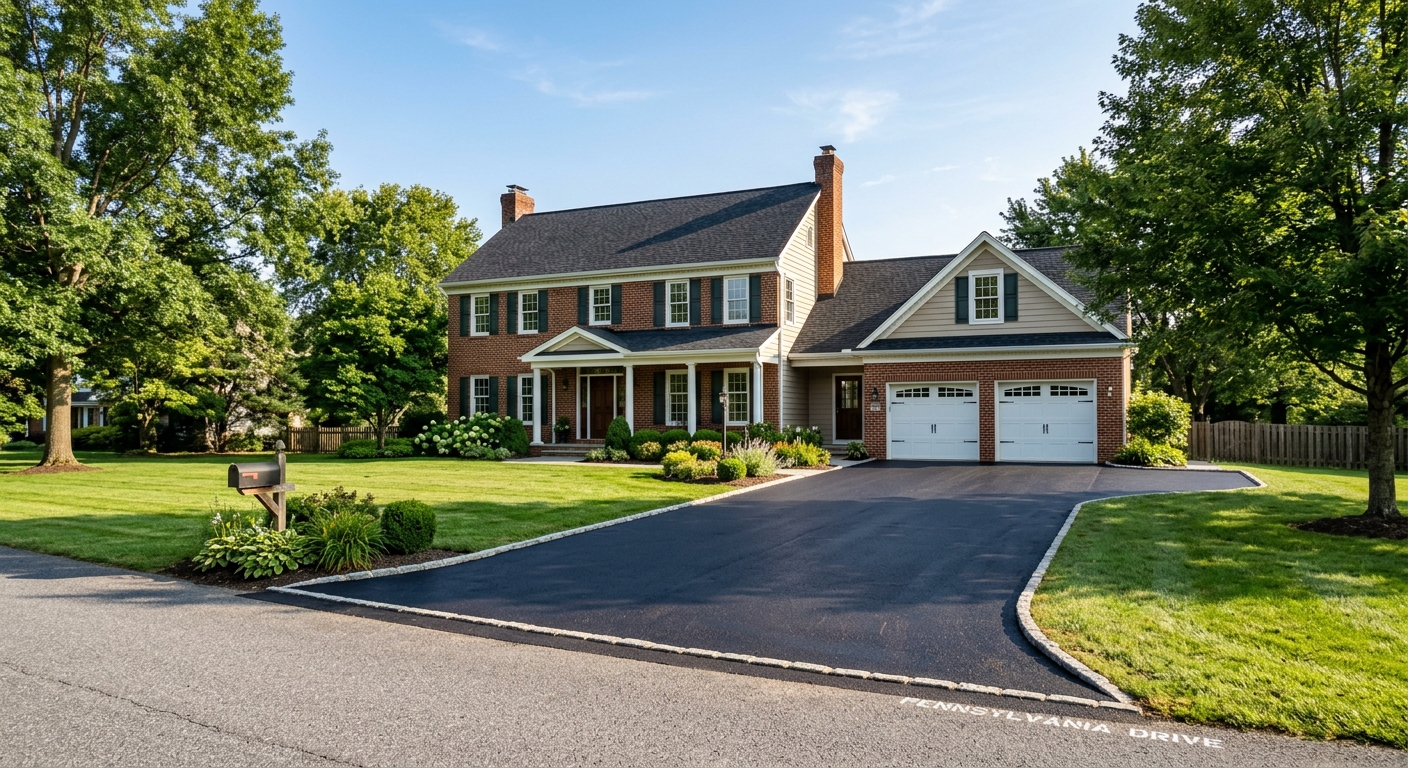
Driveway paving costs in Kennett Square — 2026
Kennett Square’s driveways, like nearly every other infrastructure element in this area, are feeling their age. More than half of properties here are single-family homes, but the homeownership rate is about 56.4% (U.S. Census Bureau, ACS 2024). Most driveways are detached-home assets, and replacement or major repairs aren’t minor household expenses — especially on lots built before 1980, which is the majority here. In this region of southeastern Pennsylvania, the moderate freeze-thaw climate and the limestone and dolomite soils across central Chester County mean that underlying base preparation is every bit as important as the surface. What you see is just the top layer; what you pay for is what’s beneath, and it takes experience and honesty to know if a quote reflects solid prep or corner-cutting.
The biggest cost differences between paving quotes in Kennett Square usually boil down to how the crew handles excavation and base installation. It’s almost impossible for a homeowner to see corners being cut during installation, but shortcuts down there show up as cracks and settlement within a few winters. Here’s what you can expect for the most common options:
| Service |
Best for |
Lifespan |
Price range |
| Asphalt — full replacement with new base |
failed base, structural cracking |
20–30 yrs |
$3,800–$9,900 |
| Asphalt overlay / resurfacing |
sound base, surface cracking only |
8–15 yrs |
$1,650–$4,900 |
| Sealcoating — single application |
preventive maintenance on sound asphalt |
2–4 yrs |
$225–$750 |
| Concrete — new installation |
long service life, low maintenance |
30–50 yrs |
$5,500–$13,000 |
| Crack filling and patching |
isolated cracks under a quarter inch |
1–3 yrs |
$200–$800 |
| Gravel driveway |
rural, budget, long runs |
5–10 yrs with upkeep |
$900–$3,500 |
Estimates for a typical Kennett Square driveway. Square footage and base condition drive these figures more than material choice.
Maintenance that actually works
The single most effective way to extend the life of a driveway around Kennett Square is to keep water out of the base. That means filling cracks — especially as soon as you see them, before water can work its way below. Never ignore even a thin crack. Once moisture gets in and we cycle through a few freeze-thaw winters like southeast Pennsylvania routinely dishes out, you’ll see the difference in rapid spreading and new cracks every spring.
Supporting the edges is next. Most driveways in this area die from the sides in, not the middle out. Don’t let the earth fall away from the asphalt or concrete edge — backfill and tamp as needed. Never let heavy point loads like jack stands, dumpsters, or loaded trucks sit for days — especially during spring thaw when the ground is softest.
After installing new asphalt, wait at least 48–72 hours before parking, and longer if weather is cool. Avoid tight turns in place for several weeks; steering on fresh asphalt stresses the surface before it hardens. For concrete, never use salt or deicers in the first winter. Salt attacks concrete, shortening its life dramatically, and freeze-thaw cycling from chemical deicers puts both concrete and asphalt at risk. Sand or non-chloride alternatives are kinder but cost more up front. Around Kennett Square, with moderate but frequent freeze-thaw cycles, patience and good drainage get you far more years between projects.
The driveway scams that work in Kennett Square
Paving is ripe for scams because it’s visible to everyone, expensive, and the real defects don’t show up right away. Kennett Square’s position in Chester County — where homes are spaced out and neighbors often can’t easily compare work in person — makes it easier for a one-day operator to disappear before the problems emerge.
Watch for the classic pitches. If someone says they have “leftover material from a job down the street,” or offers “today only” pricing, that’s a flag. Out-of-area or unmarked trucks, especially with plates not from here, usually mean there’s no local track record. Never hand over cash up front, and never accept a job without a written scope of work. One of the simplest cons is the “sealcoating” crew who sprays a thin, oily liquid, gone in a month — it looks good for a week or two and adds nothing but cost.
Under Pennsylvania law (specifically the Home Improvement Consumer Protection Act), any pavement contract over $500 requires a signed written contract and gives you three business days to cancel. Don’t let anyone rush you past this — it exists to protect you from precisely these fast-moving scams. Refuse any contractor who pushes a verbal quote, wants to skip paperwork, or won’t wait for your decision period.
Do these checks before signing: confirm their Home Improvement Contractor registration at hic.attorneygeneral.gov, check workers’ compensation at wcais.pa.gov, and get every promise in writing. Five minutes spent here beats years of regret.
Permits and approvals for paving in Kennett Square
In much of Chester County, including many areas of Kennett Square, you won’t need a building permit to resurface an existing driveway if you’re not expanding it or working inside the public right-of-way. This saves time and paperwork for most typical repaving jobs. However, if your driveway meets a public road — especially a state route — or you’re expanding or changing the entry, you’ll need to obtain a highway occupancy/driveway approach permit from PennDOT Engineering District 6-0, not just the local township office. Homeowners are often surprised by this since PennDOT, not the township, oversees these connections.
Adding pavement or new impervious surfaces can trigger local stormwater management rules, which are handled on a township basis here. Even if you don’t need a formal permit, directing runoff onto a neighbor’s lot can leave you legally responsible for resulting damage. Always resolve where the water will go before hiring anyone.
If your project is more than $500, Pennsylvania law requires a signed contract. You should also verify any paving contractor’s Home Improvement Contractor registration number at hic.attorneygeneral.gov. For any employer, workers’ compensation coverage is mandatory; you can check their status with WCAIS at wcais.pa.gov before work begins. These are basic protections — use them.
Overlay, patch or full replacement?
Knowing which fix your driveway needs starts with what you can see and touch. Wide zones of “alligator” cracking — that webbed look — almost always mean the base under the asphalt has failed. No overlay or patch can fix the underlying weakness, and a contractor pushing an overlay here is selling you a short-term band-aid. If cracks are narrow, straight, and limited in number, that usually means surface aging only, and those can be filled and sealed.
Depressions or “birdbaths” — puddles that appear after rain — signal subgrade movement and need excavation and rebuilding in that zone. If the edges are crumbling away or you find potholes, water has reached below and started working on the foundation. Every one of these signs tells its own story. Never commit to a major expense unless the contractor checks base conditions with a probe or small excavation. If they don’t inspect, they don’t know — and you’ll pay for it within a few years.
| What you see |
Likely cause |
Right fix |
Cost |
| Isolated cracks under 1/4 inch |
surface aging |
crack fill and seal |
$225–$750 |
| Alligator cracking over a wide area |
base failure |
full replacement |
$3,800–$9,900 |
| Depressions holding water |
subgrade movement |
excavate and rebuild that area |
$3,800–$6,000 |
| Crumbling edges |
no edge support |
edge repair, consider curbing |
$400–$1,500 |
| Potholes |
water into the base |
full-depth patch, then assess |
$250–$900 |
| Faded but sound surface |
oxidation only |
sealcoat |
$225–$750 |
What's under the asphalt matters more than the asphalt
In Chester County, and especially around Kennett Square, most driveway failures aren’t about the surface — they’re about what’s underneath. A proper driveway is a three-layer system: the subgrade soil at the bottom, a layer of compacted crushed stone aggregate, and then the asphalt surface. Each layer has a job: the subgrade has to be stable and able to drain, the aggregate base spreads the weight and protects against subgrade movement, and the asphalt simply provides a smooth, weather-resistant surface. Lay two inches of blacktop over an inadequate or uncompacted base and it won’t matter that the surface looks perfect on day one. You’ll see cracks, rutting, and settlement by the third winter, especially with moderate freeze-thaw cycles and frequent rains in this region.
Kennett Square sits over limestone and dolomite, which can require a thicker aggregate base — usually 6 to 8 inches, compacted in two or more lifts. The reason is frost heave: when water in the subgrade freezes, it expands and pushes the slab up. If your contractor skips excavation, lays aggregate too thin or loose, or neglects to compact in layers, it might look fine at first but you’ll see buckle and crack as soon as the ground moves. If there’s poor drainage, the risk multiplies; surface runoff must be directed away from the driveway so water never lingers at the base.
The most honest contractors in Kennett Square always specify in writing: thickness of the aggregate base (inches after compaction, not before), type of stone to be used (usually 2A modified), and that compaction is done in multiple lifts, not just at the surface. If none of that’s on your quote, you’re not buying what you think you are — and the low price will show up as early failure, not savings.
The paving season in southeastern Pennsylvania
In southeastern Pennsylvania, paving is a strictly seasonal trade — there is no safe year-round window. Hot-mix asphalt must be placed and compacted while it’s still above a critical temperature, or the layers won’t bond and the finished driveway will be porous and prone to cracking. Regional plants near Downingtown and Coatesville supply most jobs in Kennett Square, but they shut down altogether when colder weather sets in. For concrete, it’s a similar story: with a winter design temperature of 14°F, there’s no way to guarantee proper curing if a cold snap hits.
Practically, the paving season in Kennett Square runs from late April into October, with the shoulder months (May and September) being the sweet spot for both availability and price. In midsummer crews are fully booked — everyone wants the work done at once. If anyone proposes hot-mix asphalt installation here after Thanksgiving, that’s not a sign of dedication; it’s a red flag about shortcuts or leftover material. Conversely, if a paving contractor pushes for a rush job in March or early April, know that surprise cold snaps can mean instant surface failure.
Scheduling around Chester County’s climate isn’t just best practice — it’s the only way to get a driveway that lasts. Good contractors will advise you to wait if the timing isn’t right, because no reputable team wants their name on a driveway that doesn’t even make it through the first winter.
Frequently asked questions — driveway paving in Kennett Square
Does Kennett Square have local asphalt plants?
There are several asphalt plants and quarries located near Downingtown and Coatesville, just a short haul from Kennett Square. This proximity means supply logistics rarely slow down paving work or drive up your quote. For homeowners, this is an advantage—crews can get fresh material and typically complete installations in a single day, reducing the odds of cold seams and uneven compaction. Many driveway replacement jobs in Kennett Square fall in the $3,800–$9,900 range for full removal and replacement, thanks in part to this ready supply. For overlays or minor repairs, hauling costs are not a major factor here, so any contractor blaming supply distance is glossing over other cost drivers.
How long before I can drive on a new asphalt driveway?
In Kennett Square, the general rule for new asphalt is to wait at least 48 to 72 hours before driving a passenger car onto the surface. That said, if the weather is cool or overcast—spring and fall are common paving times—you might need to wait a bit longer. Asphalt remains soft and vulnerable to scuffs, depressions, and gouges in the first week, so avoid sharp turns in place or heavy vehicles for at least a week, and skip dumpsters or delivery trucks for a month if you can. Contractors who know southeastern Pennsylvania’s climate will typically be clear about this; rushing costs years of driveway life. Remember, your investment of $3,800–$9,900 for a full replacement deserves basic patience.
How much does a concrete driveway cost in Kennett Square?
The price to install a concrete driveway in Kennett Square typically falls into the $5,500–$13,000 range, depending on the size and specifics—such as thickness, any required base work, and whether decorative finishes are chosen. Most homeowners see bids around the $8,800 mark for an average two-car drive. Costs here track with regional material and labor rates, but the important local factor is that central Chester County’s limestone and dolomite soils can demand extra base prep for proper drainage. While concrete offers a longer service life and fewer maintenance headaches than asphalt, upfront costs are roughly double for similar drive sizes.
How deep should the aggregate base be here?
In Chester County, especially in the Kennett Square area with its limestone and dolomite subsoils, the aggregate base for an asphalt driveway should be at least 6 to 8 inches deep after compaction (not just loosely dumped). This is deeper than the minimum codes in some other regions, but it’s what’s needed to survive local freeze-thaw cycles and resist reflective cracking. The most reliable contractors will specify “2A modified crushed stone, compacted in multiple lifts” right in the quote. Skimping on the base isn’t worth the $1,650–$4,900 you might save on a thin overlay, because repair costs multiply when premature failure sets in.
Are there stormwater rules on paving in Kennett Square?
Yes, most Chester County municipalities, including those covering Kennett Square, have stormwater management rules relating to driveway projects. While you may not need a building permit to resurface an existing drive, expanding it or increasing impervious area can require runoff management measures and sometimes formal approval. No permit protects you if your changes cause water to drain onto a neighbor’s property and create damage—liability is yours no matter what. A reputable local contractor will design for drainage and not just pitch the quick fix. In the end, even a low-cost job ($3,800–$9,900 for asphalt) can turn costly if runoff is ignored.
How often should I sealcoat my driveway in Kennett Square?
Most driveways in Kennett Square need sealcoating every two to four years. The wide temperature swings, humid summers, and road salt in winter all accelerate wear on asphalt surfaces here. If the driveway gets a lot of sun or traffic, err on the shorter end of that range. The typical single application runs between $225–$750, which is a worthwhile preventive expense. Over-sealing can be as bad as neglect—build-up causes cracking and poor traction—so always base the interval on actual surface condition rather than a rigid schedule.
Are pavers worth the cost in southeastern Pennsylvania?
Pavers can deliver beautiful results and a genuinely long lifespan—often 30 years or more if installed correctly—but costs for full installation in Kennett Square almost always exceed even a top-tier concrete driveway ($13,000 or more for average drives). Freeze-thaw cycles here demand particular care with the base; pavers must be set on an extra-deep, well-compacted aggregate layer to resist heaving. Maintenance is lower than asphalt but not zero: weeds and settling joints need attention. For most homeowners on typical Chester County lots, asphalt or concrete delivers more value per dollar unless you have specific architectural goals or historic restrictions to meet.
Is gravel a cheaper option in Kennett Square?
Gravel is the lowest-cost option for driveways in the Kennett Square area, with installation ranging from $900–$3,500. It’s most practical for long or rural drives—typical in outer parts of Chester County—but every dollar you save up front comes with tradeoffs: annual regrading, weed control, and a rougher surface in winter. Dust and tracking onto the street are common complaints from newer developments, so it’s best suited to situations where cost and rural character matter more than appearance. Still, when budgets are tight or access is infrequent, it’s a legitimate choice.
What are the signs of a failing driveway base?
Signs that your Kennett Square driveway base is failing include widespread alligator cracking, repeated potholes, depressions that hold water after rain, and edges that crumble even after cleanup. These symptoms mean water has reached the base and started eroding support or that the original stone was never deep enough. Surface repairs or overlays won’t help much if the base is no longer sound. Even if a contractor offers a quick asphalt overlay at $1,650–$4,900, it will be money wasted unless the underlying base is rebuilt or properly stabilized. Always ask for core testing or a base probe before agreeing to anything more than cosmetic repairs—otherwise you’re patching symptoms, not fixing the cause.