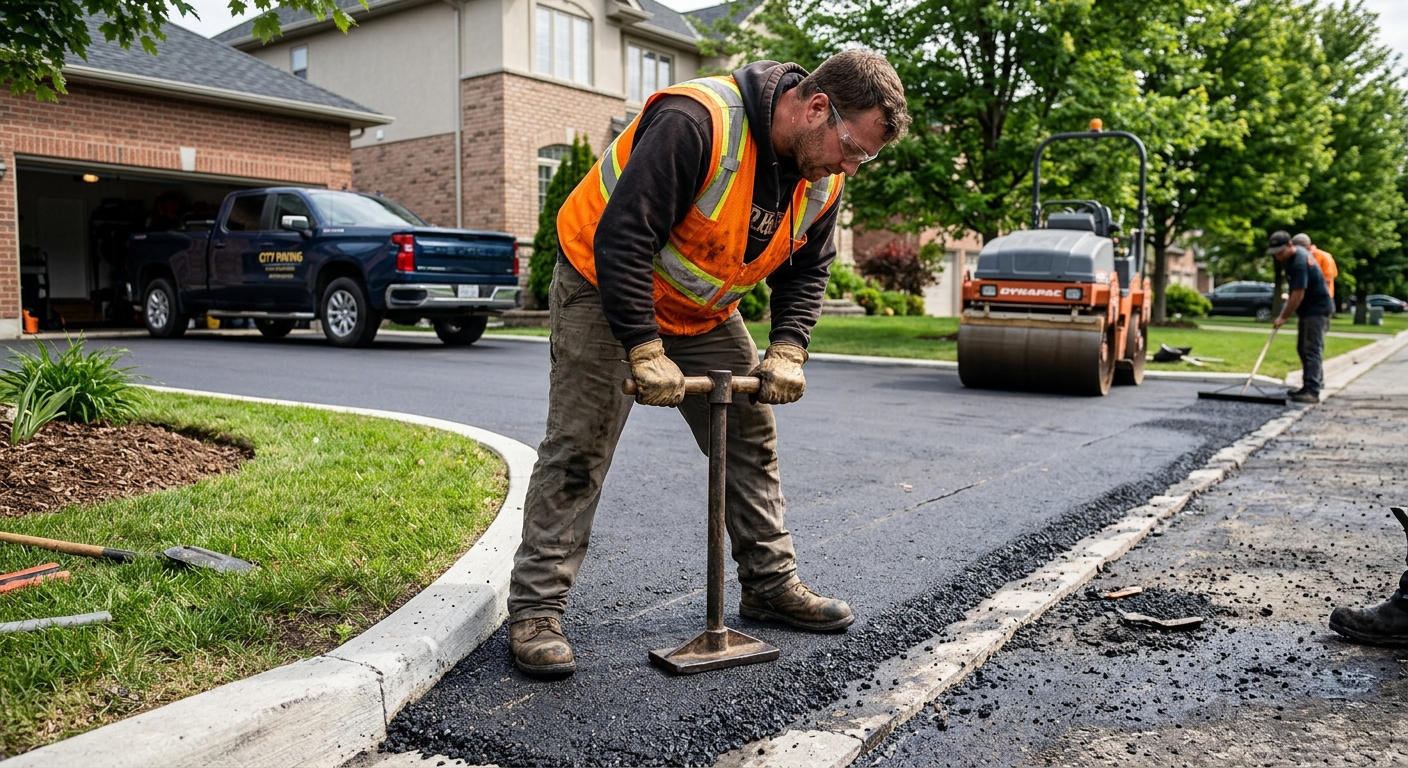
East Buffalo paving prices by scope — 2026
East Buffalo’s driveways are overwhelmingly found at single-family homes, with 91.3% of the housing here being detached properties (U.S. Census Bureau, ACS 2024). Most are owner-occupied (87.1%), which means when the driveway shows cracking, crumbling, or rutting, it’s usually up to the homeowner to address. Union County’s long freezing season (ground frost to 36 inches, 2°F design temp) and alluvial silty soils along the West Branch Susquehanna River mean that the real cost in any paving project isn’t just the part you see, but the excavating, prepping, and base-building below the surface. If you’re comparing two quotes for driveway work in East Buffalo, up to half your price difference is buried unseen under the finished pavement—either as extra stone and compaction or as shortcuts you’ll only discover after a few winters. Hauling distances from Williamsport asphalt plants also mean quoted prices here lean higher than state averages, especially for concrete work.
| Service |
Best for |
Lifespan |
Price range |
| Asphalt — full replacement with new base |
failed base, structural cracking |
20–30 yrs |
$3,800–$9,700 |
| Asphalt overlay / resurfacing |
sound base, surface cracking only |
8–15 yrs |
$1,600–$4,800 |
| Sealcoating — single application |
preventive maintenance on sound asphalt |
2–4 yrs |
$225–$750 |
| Concrete — new installation |
long service life, low maintenance |
30–50 yrs |
$5,400–$13,000 |
| Crack filling and patching |
isolated cracks under a quarter inch |
1–3 yrs |
$200–$800 |
| Gravel driveway |
rural, budget, long runs |
5–10 yrs with upkeep |
$900–$3,500 |
Estimates for a typical East Buffalo driveway. Square footage and base condition drive these figures more than material choice.
What you need before paving in East Buffalo
If you’re resurfacing or repairing a driveway within its original footprint in East Buffalo Township, you’ll still need a driveway permit even for repair work—local ordinances make this clear. Permits aren’t just for new driveways; almost all work, including repairs and overlays, requires you to check with the township office before starting. However, if your project only resurfaces an existing driveway and doesn't touch the approach or expand its area, a building permit is usually not needed (always confirm with your municipality).
Where your driveway meets the public road—the approach—you generally need a permit from a different authority. If your driveway connects to a state route, that permit comes from PennDOT Engineering District 3-0, not the township, so don’t skip this step or your project can get red-flagged during or after work.
Adding hard surface means more runoff, and if you direct stormwater onto a neighbor’s property or public right-of-way, you are liable—permits or not. Expanding your pavement could trigger review for local stormwater management, especially with larger or corner properties.
Before you sign a contract over $500, Pennsylvania law requires your contractor to hold and display a valid Home Improvement Contractor (HIC) registration. You can check this at hic.attorneygeneral.gov. Additionally, workers’ compensation coverage is mandatory for any company bringing employees to your property—verify it through WCAIS (wcais.pa.gov).
When paving can actually be done in East Buffalo
Paving in Union County is strictly a seasonal business. The region’s high snow loads and long heating season mean that you can't pave reliably from November through March. Hot-mix asphalt needs the air and ground to be warm enough—below about 45°F, the mix cools before it can be compacted, leading to weak, porous pavement. It’s not just a preference, it’s a hard limit: asphalt plants serving East Buffalo from Williamsport simply shut down for winter, and no material is available at any price until spring.
Concrete has its own limits, needing above-freezing temperatures to cure properly. Trying to install a concrete drive in an East Buffalo winter exposes you to heaving, surface scaling, or outright slab failure by spring. The region’s 2°F winter design temperature and deep frost depth mean these are not risks worth taking.
The paving season generally runs from mid-April to late October. Most contractors get booked solid in the peak of summer, especially as rural supply is limited by hauling distance. The best value for a typical homeowner often falls in the spring or fall “shoulder seasons,” when crews have daylight but less backlog. If anyone offers to lay hot-mix late in November or early in March, ask yourself why they have time—usually, it’s because they’re cutting critical corners, and you’ll pay for it in repairs later.
How to vet a paving contractor in East Buffalo
Hiring a paving contractor here is not just about price or the number of trucks—you want someone whose reputation you can verify and whose work will outlast the first two winters. Start by confirming Home Improvement Contractor (HIC) registration at hic.attorneygeneral.gov. Union County is rural, with local aggregate trucked in from Williamsport, so a contractor who doesn’t know where their material is coming from, or who won’t name their supplier, is one to steer clear of—they’re likely just a broker or worse. Real operators own equipment, have a fixed business address, and gladly provide references from driveways they've built here, not just in another county.
- Verify HIC registration at hic.attorneygeneral.gov
- Check workers’ comp status via WCAIS (wcais.pa.gov)
- Ask for the business address, not just a mobile number
- Request references from completed local jobs at least 3 years old
- Look for owned (lettered) equipment, not all rentals or out-of-area logos
- Ask which Williamsport plant or quarry supplies their asphalt or stone
- Get a written contract that lists scope, thickness, and materials
- Inquire about their compaction process and base prep details
- Ask how they handle drainage correction
- Check for clear cancellation terms (as required by PA law)
- Look up prior complaints with the PA Office of Attorney General
- Skip anyone demanding full cash payment upfront
Red flags: out-of-state or no business address, refusals to name material suppliers, reluctance to put terms in writing, and references that are only weeks or months old—these are all signals to reconsider.
Changing the footprint of a East Buffalo driveway
Widening a driveway to fit two cars, extending it to a garage or parking pad, adding a turnaround, or upgrading a gravel drive to asphalt all move your project out of simple “repair” territory. Changing the footprint means breaking new ground: the new area needs an all-new compacted base over previously undisturbed subgrade, and the seam where old and new meet will always stay a weak point prone to future cracking. If you push toward your property lines, local setback rules can limit how close you pave to the edge of your lot.
Any expansion triggers East Buffalo’s driveway permit requirement and—if your approach touches a state highway—PennDOT’s permitting process for new or widened approaches. Changing your pavement footprint also increases impervious area, which can impact stormwater runoff requirements. If the work sends water toward a neighboring property, you bear responsibility, even if your permit is in order.
The upshot: widening, adding a pad, or converting gravel to asphalt is a bigger deal than straight replacement. Budget more for excavation, base, and permits, and expect additional oversight from the township.
Door-knocking crews and leftover material
Paving brings out some of the pushiest short-term operators in home improvement. A thin rural market like Union County is a favorite target because townships are spread out, neighbors might not know one another, and unverified crews can vanish before mistakes appear. The most common pitches: “We have leftover asphalt from a job nearby and can do yours for cheap,” “Today only,” a low verbal price, or a demand for cash payment up front. You’ll often see unmarked trucks, sometimes with out-of-state plates, and no written quote—just a handshake and a rush to get started.
Be especially wary of anyone selling “sealcoating” from a pickup or trailer. Many apply only an oil-based spray that looks dark but adds no real protection, or thin layers that last less than a year, all at cash prices. Rarely is the application at a legitimate rate like $225–$750 for a single coat on a typical East Buffalo drive.
The Home Improvement Consumer Protection Act (HICPA) exists for exactly these situations. If a contract is over $500 and solicited at your door, you have an absolute right to cancel within three business days—no explanation needed. No Pennsylvania contractor can lawfully ask or offer to waive your homeowner’s insurance deductible. Always demand a fully itemized, written contract (required by state law), and never pay cash to strangers at your door.
Five-minute checks: verify HIC at hic.attorneygeneral.gov, look up the truck plates, call the phone number, check their address, and ask for references older than three years. Any hesitation on these points—send them away.
Base preparation: the part you pay for and never see
Every proper driveway job in East Buffalo starts from the ground up. The bottom layer is the subgrade (your native soil), which is shaped and compacted to the right slope. Next comes the aggregate base—usually 6 to 10 inches of compacted 2A modified stone, thicker here than in many places because of our alluvial silty soils and extreme freeze-thaw cycles. Finally, the asphalt layers go on top, ideally in two lifts: an initial base (binder) course for strength, and a surface course for smoothness and water shedding.
The most important difference between a long-lasting drive and one that fails in a few winters is all under the top layer. Water in the subgrade can freeze, expand, and lift parts of your driveway—a process called frost heave. On East Buffalo’s deep frost line (36 inches), any shortcut in base thickness or compaction lets water and winter destroy your pavement from below. Putting down thick hot-mix on a thin or poorly compacted base is wasted money, and the cracks or ruts may not show until year three or four, well after your “warranty.”
Budget contractors skip excavation, patch over collapsing bases, or use too little aggregate spread thin and rolled just once. None of this is obvious on the day they finish. To avoid this, demand these details in writing:
- Excavation and removal of all failed base and soft subgrade
- Minimum 8–10 inches of compacted 2A modified crushed stone base for our silty soils
- Aggregate delivered from a named Williamsport-area plant
- Compaction done in lifts—not all at once—using a vibratory roller
- Written confirmation of final thicknesses and compaction methods
If your quote doesn’t specify these things, ask why—or look elsewhere. A driveway is only as good as its base, and in East Buffalo, that’s the part that matters.
Frequently asked questions — driveway paving in East Buffalo
When can I seal a brand new asphalt driveway?
In East Buffalo, you should wait a full season—typically six to twelve months—before applying sealcoat to new asphalt. Our region’s freeze-thaw cycle and summer paving window matter: fresh asphalt needs time to fully cure and for oils to come out of the mix. Sealing too soon—especially before the first winter—can trap these oils and lead to a soft, scuffed surface, which wears faster under plowing or wheel turns. For most homeowners, the first recommended single sealcoating application runs $225–$750. Ideally, pave in late spring or early summer, then schedule your first sealcoat for the following spring. This maximizes lifespan and appearance for driveways in our climate. If you’re unsure, a reputable local contractor will advise you to wait, not try to sell a same-day sealing.
How much does driveway paving cost in East Buffalo?
Paving a driveway in East Buffalo typically means higher costs than the state average, mostly due to hauling aggregate and asphalt from Williamsport, and the need for thicker stone base with our local silty soils. For a full asphalt replacement with proper excavation and new base, expect $3,800–$9,700, while a resurfacing (overlay) across a solid base is usually $1,600–$4,800. Concrete driveways are pricier, commonly coming in between $5,400–$13,000. Your final price depends mostly on square footage and what’s under the surface—a long rural drive costs more to build and maintain than a short urban pad.
What kind of soil is under East Buffalo driveways?
Most driveways in East Buffalo, especially those near the West Branch Susquehanna River, are built over alluvial silty soils. These soils hold water easily and can rut or shift if not properly prepared, which is why local installation standards always call for thicker aggregate bases—commonly 8 to 10 inches of 2A modified stone compacted in lifts. Cheaper jobs that skip this essential work often look fine on day one but start settling or cracking within a couple of freeze-thaw seasons. If you’re quoted a full replacement with new base, the local price band is $3,800–$9,700, reflecting all that buried labor and material.
What is the difference between binder and surface course?
The binder course is the first layer of hot-mix asphalt applied over the compacted stone base—it's thicker and contains larger aggregate for structural strength. The surface course (also called the wearing course) is finer, denser, and designed for appearance and water shedding. In East Buffalo, a standard driveway replacement calls for the binder course to go down first and be compacted, followed by a thinner surface course. The proper combination ensures the driveway flexes with temperature swings and resists rutting or cracking from above. Skipping the binder or thinning the top layer is a common shortcut in cheap paving jobs. For correct dual-course construction in this climate, expect total costs in the $3,800–$9,700 band for asphalt with new base.
Why are my driveway edges crumbling?
Crumbing at the edges is a common problem on East Buffalo driveways, especially those installed before 1980 or built to minimum widths for narrow single-lane drives. Our region’s silty soils and repeated freeze-thaw cycles speed up edge failure when asphalt is left unsupported by stone base or grading. If cars regularly drive off the edge, or the initial installation left no “shoulder” of gravel or topsoil, the sides can quickly break up. Professional repairs include properly extending the base and compacting the edge, which usually falls in the crack filling and patching price range of $200–$800 for isolated edge repairs. If you’re seeing widespread crumbling, you may need a full replacement.
How long does a driveway installation take?
A standard East Buffalo asphalt driveway replacement typically takes two to four days from excavation to final compaction, depending on weather, square footage, and the amount of base preparation needed. If the soil under your driveway is soft or was poorly compacted to begin with, more time goes into excavation and rebuilding the base—essential in our region. Concrete drives also require time for curing, often 5–7 days until you can drive on them safely. Quick, “same-day” installs are possible only for thin overlays, not full replacements. Rushing the process is a recipe for early failure, which is why local industry-standard pricing—$3,800–$9,700 for asphalt replacement—includes proper cure and compaction time.
How much does a concrete driveway cost in East Buffalo?
Concrete is a long-term investment in East Buffalo, favored for maintenance-free service and a clean look, especially on properties built after 1980. Because nearly all concrete here is supplied from Williamsport-area plants, and because installers must pour thicker slabs to deal with our deep frost line (36 inches), you can expect to pay between $5,400–$13,000 for a typical new installation. That range reflects everything from a small urban pad to a long rural approach, but includes base, steel reinforcement, and proper curing. If you're quoted much less, something is being left out—usually base or reinforcement—which can shorten the lifespan in a climate with 6,300 heating degree days.
Can I pave over my existing driveway?
Overlaying or resurfacing is possible in East Buffalo only if your current driveway base is in good shape and hasn't heaved or settled. If you’re just seeing scattered surface cracks but the base layer is solid and drains well, an asphalt overlay can buy you another 8–15 years, with typical costs in the $1,600–$4,800 range. However, if the base is failing—deep cracks, rutting, or pooling water—a “quick fix” overlay will fail in a few years or less, especially with our heavy freeze-thaw cycles. A reputable contractor will cut test patches to judge the base before recommending an overlay. Don’t waste money resurfacing over a bad foundation.
Can I cancel a paving contract I signed at my door?
Yes, in Pennsylvania—including East Buffalo Township—the Home Improvement Consumer Protection Act gives you the right to cancel at any time within three business days if you signed a paving (or any home improvement) contract solicited at your door for over $500. The contractor must give you written notice of this right. No explanation is required—simply deliver written notice that you wish to cancel. If the crew began work before the end of the cancellation period and you weren’t properly notified, you retain this right. This consumer protection is designed to stop high-pressure “drive-by” sales and substandard work. Take advantage of it if you have doubts about a contract that feels rushed or incomplete.