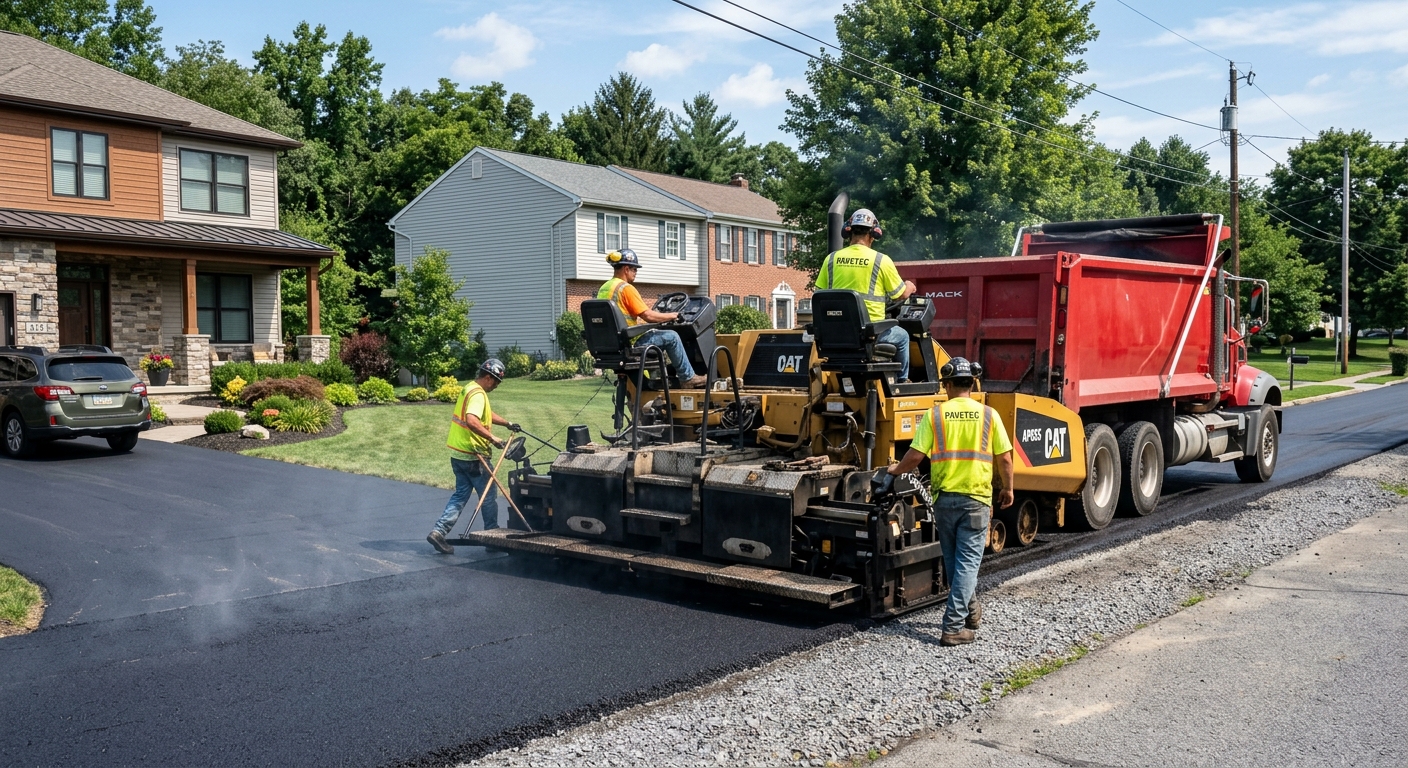
Driveway paving costs in McKees Rocks — 2026
McKees Rocks is made up largely of older single-family homes, with 55.3% of residences falling into this category and a homeownership rate of just 45.3% (U.S. Census Bureau, ACS 2024). For homeowners here, driveway work is a significant investment—one that matters most for detached homes with aging surfaces. The hilly terrain and clay/shale subgrade across Allegheny County make driveway costs more variable than some expect. Freeze-thaw cycles are harsh in this part of Pennsylvania; this means the real difference between a low and high price is nearly always hidden below the surface, in how the base and drainage are handled—not in the visible asphalt or concrete.
Driveways installed on clay and shale on McKees Rocks’ hillsides require thicker and well-compacted aggregate bases to avoid heaving and settlement. When you compare quotes, remember: the driveway surface is the part you see, but the investment is in the preparation below. Homeowners who save a few hundred dollars up front often discover much larger costs when early cracks, birdbaths, or potholes reveal shortcuts in excavation or base under their feet.
| Service |
Best for |
Lifespan |
Price range |
| Asphalt — full replacement with new base |
failed base, structural cracking |
20–30 yrs |
$3,300–$8,500 |
| Asphalt overlay / resurfacing |
sound base, surface cracking only |
8–15 yrs |
$1,400–$4,200 |
| Sealcoating — single application |
preventive maintenance on sound asphalt |
2–4 yrs |
$200–$650 |
| Concrete — new installation |
long service life, low maintenance |
30–50 yrs |
$4,700–$11,500 |
| Crack filling and patching |
isolated cracks under a quarter inch |
1–3 yrs |
$200–$800 |
| Gravel driveway |
rural, budget, long runs |
5–10 yrs with upkeep |
$900–$3,500 |
Estimates for a typical McKees Rocks driveway. Square footage and base condition drive these figures more than material choice.
How to vet a paving contractor in McKees Rocks
Paving is a frequent target for out-of-area contractors and brokers, especially in the competitive Allegheny County market. To protect your investment in McKees Rocks, you need more than just a business card and a handshake. Reliable contractors will be registered with the Pennsylvania Office of Attorney General as a Home Improvement Contractor for any contract over $500 — you can confirm this at hic.attorneygeneral.gov. For employers, Pennsylvania requires mandatory workers’ compensation insurance; this, too, is verifiable through the WCAIS system (wcais.pa.gov).
The strongest local contractors typically have a physical business address, not just a PO box or mobile phone. They own their key equipment, not just pickup trucks with rented rollers. Ask for references specifically from jobs done no less than three years ago — recent jobs don’t prove anything about long-term performance. And ask about materials: a credible contractor can tell you exactly which Pittsburgh-area asphalt plant or quarry they use, thanks to the dense network of local suppliers in Allegheny County. If they dodge the question, you may be dealing with a broker, not a builder.
- Verify HIC registration at hic.attorneygeneral.gov
- Check workers’ compensation insurance at wcais.pa.gov
- Ask for a local business address, not just a phone number
- Ask to see or visit a job they completed at least three years ago
- Request proof of owned, not fully rented, equipment
- Get the name of their asphalt and aggregate supplier
- Require detailed written estimates covering base depth and materials
- Read the written contract and confirm your right to cancel (HICPA)
- Never accept off-book or handshake agreements over $500
- Get a clear timeline and explanation of work sequence
- Refuse to waive or rebate your insurance deductible (illegal in PA)
- Be suspicious of high-pressure, door-to-door sales tactics
Red flags include out-of-state licence plates, refusal to name suppliers, and “leftover material” offers. If you feel pressured to sign on the spot, walk away.
Diagnosing a failing McKees Rocks driveway
In McKees Rocks’ aging neighborhoods, especially with so many homes built before 1980, driveways often show their age. The real question is whether you need full replacement or just maintenance — and only the base condition gives the answer. Alligator cracking across large areas means the aggregate base under your asphalt has failed, which no overlay or patching can fix for long. On the other hand, a driveway with just a few straight, narrow cracks is only suffering from surface aging and can often be sealed and filled for a fraction of the cost.
If you see depressions (“birdbaths”) after rain, this points to subgrade movement — a problem with what’s under both the base and the asphalt, likely related to the clay and shale common in the area. Crumbling at the edges is a sign of no or poor edge support, which should not be fixed by just slapping on more asphalt. Potholes mean water has already worked its way to the base: patching helps, but you’ll need to address drainage or next year’s freeze-thaw cycle will make it worse.
Never accept an overlay if your base is failed. A contractor who quotes you a resurfacing without probing or digging into the base is not acting in your interest; overlays on bad bases are money burned in short order here.
| What you see |
Likely cause |
Right fix |
Cost |
| Isolated cracks under 1/4 inch |
surface aging |
crack fill and seal |
$200–$650 |
| Alligator cracking over a wide area |
base failure |
full replacement |
$3,300–$8,500 |
| Depressions holding water |
subgrade movement |
excavate and rebuild that area |
$3,300–$5,200 |
| Crumbling edges |
no edge support |
edge repair, consider curbing |
$400–$1,500 |
| Potholes |
water into the base |
full-depth patch, then assess |
$250–$900 |
| Faded but sound surface |
oxidation only |
sealcoat |
$200–$650 |
Widening, extending or adding a parking pad
If you’re looking to widen your McKees Rocks driveway for a second vehicle, extend it to a detached garage, add a turnaround, or convert a gravel run to asphalt, you’re tackling more than a simple resurface. Any new pavement footprint—meaning paving over ground where no driveway existed before—needs a brand new compacted aggregate base. Allegheny County’s shallow clay and shale subgrades mean base thickness and compaction are essential here to avoid future heaving or settling.
Any seam where new paving meets old will always be a permanent weak spot, prone to cracking and separation over time. While contractors can tie in the joint carefully, it will never perform as well as continuous, seamless paving. If you increase your driveway’s size, you may hit local or county impervious-surface limits—basically, rules about how much of your lot can send runoff into sewers. Setback rules may restrict paving close to property lines, so check with your borough or township before paying a deposit.
Remember: in the Pittsburgh area, any driveway alteration that changes the curb, sidewalk, or touches the public right-of-way needs the proper permit. If you connect to or widen at a state road, a Highway Occupancy Permit from PennDOT District 11-0 is required. Be sure your contractor can navigate these before starting.
Driveway permits, approaches and stormwater rules
Repaving your existing residential driveway—on your own property and in its original footprint—in municipalities like Ross Township can typically proceed without a new building permit. But the rules change quickly once you touch the approach: where your driveway meets the public street. This crucial point is often managed not by the building department, but by a specific transportation or public works agency. For state roads in Allegheny County, that’s PennDOT District 11-0, which handles Highway Occupancy Permits for these connections. In the City of Pittsburgh, any work changing a curb, sidewalk, or apron must go through the Department of Mobility and Infrastructure.
Expanding the impervious surface of your property can trigger stormwater requirements. Even where permits aren’t needed up front, if your new driveway sends runoff onto a neighbor’s property, you’re liable for any damage, whether you have a permit or not. Drainage plans may be required for significant expansions.
Before signing any contract over $500, verify your paving contractor’s Home Improvement Contractor registration at hic.attorneygeneral.gov. Also, always confirm workers’ compensation insurance is active via the WCAIS system—don’t just take the contractor’s word for it, even for smaller jobs. Written contracts are not optional in Pennsylvania for work over $500, and you get a three business-day right of cancellation under state law.
What's under the asphalt matters more than the asphalt
The durability of a McKees Rocks driveway is decided long before the asphalt goes down. Here’s the structure: at the bottom is the subgrade—typically undisturbed clay or shale soil in this part of Allegheny County. Above that goes a compacted aggregate base, often crushed limestone, which spreads weight and drains water. Only then is asphalt placed on top. Each layer’s purpose is to distribute the load above to the layer below; if the aggregate base is too thin or poorly compacted, no amount of top-quality asphalt will stop cracks and ruts from showing up after a few freeze-thaw cycles.
Freeze-thaw is particularly punishing in McKees Rocks: water held in clay-heavy soils expands when it freezes at depth—here, the frost line runs to 36 inches. This force lifts the base and asphalt, often unevenly, leading to bulges, heaving, and cracks that seem to appear out of nowhere. That’s why a thick, well-compacted aggregate base (often 6–10 inches, more on known poor soils) and proper pitch to shed water are more important than the mix of the top layer. Drains and thoughtful grading can’t compensate for skimped excavation or thin base.
This is where a cheap quote really gets cheap: skipping full excavation, laying thin aggregate in a single pour (instead of compacted lifts), and never testing compaction. The cost savings are invisible on project day but obvious when your driveway is ponded or cracked within a few winters. Demand specifics, in writing: aggregate base depth (at least 6 inches on stable soil, 8–10 inches on hillsides and clay), type of crushed stone, and that the base will be compacted in lifts, not all at once. A good contractor will welcome this conversation—the ones who balk are the ones to avoid.
Grading and water management on a McKees Rocks driveway
Water management is the most critical (and most often ignored) factor in how long your driveway lasts in McKees Rocks. In this climate, every flaw in drainage gets amplified through freeze-thaw—ponded water seeps into the base, freezes, and creates heaves or cracks from below. With heavy clay soils common on local hillsides, water drains slowly and tends to linger against the base, increasing failure risk. That’s why a good paving job isn’t just about what’s on the surface—it’s about what happens to rainwater next.
A minimum slope of 2%—that’s about a quarter inch per foot—away from buildings is a must. Where possible, driveways are crowned in the middle to send water off both edges, or sloped sideways (cross-slope) to one side for collection. If your driveway slopes toward your house or garage, plan for surface drainage (trench or channel drains) to intercept runoff before it enters your foundation. In areas where water can’t exit to daylight—due, for example, to property line constraints—you may need a dry well or similar solution for infiltration.
And always remember: it’s not just about moving water off your driveway, but also not sending it onto your neighbor’s lot. In Allegheny County, that’s a fast way to end up in a dispute regardless of what your permit says. Good grading prevents both driveway headaches and neighbor trouble years down the line.
Frequently asked questions — driveway paving in McKees Rocks
Does McKees Rocks have local asphalt plants?
There are several asphalt plants and quarries located in and near Pittsburgh, serving the entire Allegheny County region, including McKees Rocks. With this strong local supply, contractors do not need to transport asphalt long distances, which helps keep material quality high and prices more predictable for homeowners. If your contractor can't name their Pittsburgh-area plant or supplier, that's a red flag—local outfits have tight relationships with these suppliers. This is why you’ll often see similar cost ranges across the area, such as $3,300–$8,500 for a full asphalt replacement. That said, being close to multiple plants doesn’t guarantee quality; it only means genuine contractors have easy, same-day access to fresh, hot mix for your driveway.
How do I verify a paving contractor in Pennsylvania?
To properly check a paving contractor in Pennsylvania, start with the Home Improvement Contractor (HIC) registration—this is required for any job over $500. You can look up their registration at hic.attorneygeneral.gov. Also, for any business with employees, workers’ compensation insurance is mandatory; verify that through the state’s WCAIS system at wcais.pa.gov. In McKees Rocks, with its high competition, the best contractors will also give you references from jobs at least three years old. Heavy freeze-thaw and hilly terrain mean poor work will show up in a few seasons. Reputable contractors are easy to check and do not hesitate to provide proof. For a job like an asphalt overlay, which can run $1,400–$4,200, these checks protect your money and your property.
How long should an asphalt driveway last in McKees Rocks?
In McKees Rocks, a properly installed asphalt driveway with a well-compacted aggregate base can last 20–30 years. This estimate assumes regular maintenance (like sealcoating) and that drainage is taken seriously during installation. The main enemies here are freeze-thaw cycles, ponded water due to hilly or poorly graded lots, and the clay/shale soils common in Allegheny County. Skimp on subgrade prep and the driveway may show distress in as little as 5–7 years. With real attention to grading, compaction, and water management, you can approach the top end of the lifespan—and it's worth the difference, since a replacement costs $3,300–$8,500 locally.
What does an asphalt overlay cost in McKees Rocks?
For a home in McKees Rocks where the existing driveway base is still sound but the surface has cracked or oxidized, an asphalt overlay typically runs between $1,400–$4,200. This range depends on driveway size and detailed site conditions. The price is much lower than a full replacement because it skips the cost of new base and deep excavation. However, overlays are only worth doing if the underlying base is truly solid—overlaying a failed base will only hide problems for a year or two before cracks or ruts reappear. If a contractor skips checking your base and immediately recommends an overlay, get a second opinion.
What is the difference between binder and surface course?
When paving a driveway in McKees Rocks—or anywhere in southwestern Pennsylvania—a typical asphalt job involves two layers: the binder course and surface course. The binder is a thicker, coarser layer that provides strength and stability; it's what does the heavy lifting in terms of load-bearing. The surface course is a finer, smoother asphalt designed for appearance, water shedding, and durability against the elements. Good local contractors use material from Pittsburgh-area suppliers to match local conditions—like clay and frequent freeze-thaw. A two-layer approach will be more expensive than a single pass (typically $3,300–$8,500 for full replacement), but it's critical for longevity, especially on slopes.
How long before I can drive on a new asphalt driveway?
After new asphalt is laid in McKees Rocks, you’ll typically need to wait 3–7 days before driving or parking a car on it. The exact time depends on weather, temperature, and thickness. In summer, local contractors may recommend waiting a little longer for the asphalt to harden, since soft, hot mix can deform under weight in high heat. Walking or biking is usually fine after 24 hours. Keep heavy trucks and dumpsters off for a month, if possible. For driveway resurfacing or overlays—at prices between $1,400–$4,200—the curing time is similar, but always follow your contractor’s specific advice to avoid ruts or scarring in the first week.
Asphalt or concrete for a McKees Rocks driveway?
Asphalt and concrete both work in McKees Rocks, but each has tradeoffs. Asphalt costs less up front—$3,300–$8,500 for a replacement—while concrete is more expensive, $4,700–$11,500 for the same footprint. Asphalt handles freeze-thaw better and small repairs are straightforward, but it will need maintenance like sealing. Concrete offers a longer lifespan (30–50 years instead of 20–30) and stays lighter and cooler in summer. However, it’s susceptible to salt damage in winter and patching is harder to disguise. For driveways on slopes or with severe clay issues, good drainage and base prep are critical—more so than which surface you choose.
Is sealcoating a scam?
Sealcoating isn’t a scam—when done right, on a driveway in sound structural condition, it’s a valuable maintenance tool that extends the lifespan by slowing oxidation and water intrusion. In McKees Rocks, with so many aged surfaces (over 88% of homes built before 1980), many driveways need more than sealing. If your surface is cracked, alligatored, or showing birdbaths, sealcoating won’t fix underlying problems. Still, if your driveway just looks faded but is solid, a professional sealcoat every 2–4 years (typically $200–$650) is money well spent. Beware of contractors pitching sealcoating as a fix for major structural issues—it isn’t.
Is gravel a cheaper option in McKees Rocks?
Gravel is definitely a budget option for long or rural driveways around McKees Rocks, with installation costs running $900–$3,500. For short, urban or suburban residential runs, it’s less common but still used where the budget is tight or where access changes seasonally. Gravel needs regular regrading, weed control, and periodic top-ups, but it doesn’t crack or heave like asphalt and concrete can in freeze-thaw conditions. Many older homes in the area—especially those with large lots—started with gravel and were later paved. If your main concern is upfront price rather than appearance or maintenance, gravel remains a viable choice for Allegheny County properties.