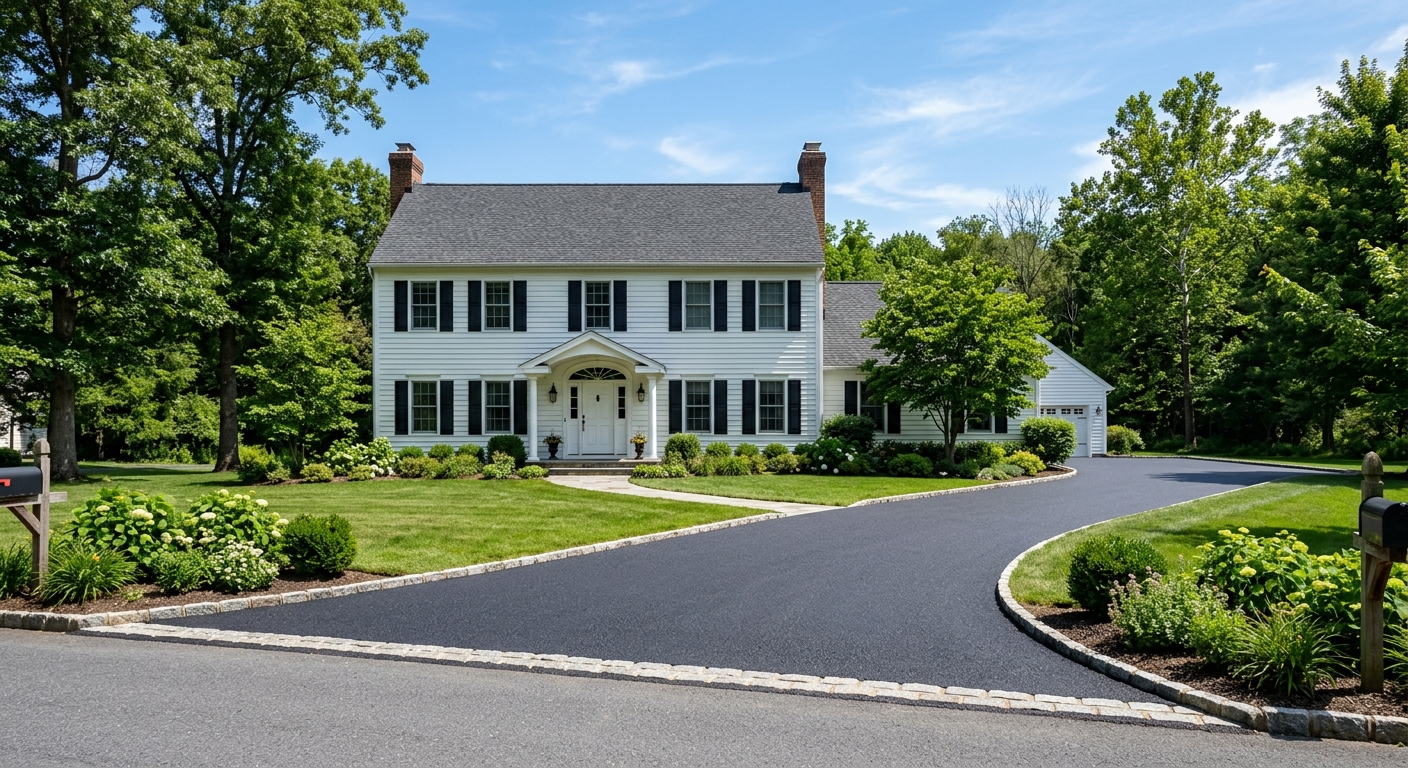
Driveway paving costs in Lower Nazareth — 2026
Lower Nazareth is overwhelmingly made up of single-family homes, and the homeownership rate here is exceptionally high. For nearly every homeowner, driveway paving is a necessary part of maintaining curb appeal and property value. With an aging housing stock and a freeze-thaw climate, driveway repair and replacement are recurring projects—especially as many older driveways were built to the minimum standards of a different era.
The big cost drivers aren’t always visible from the surface. Two quotes that look similar may hide big differences underneath: things like depth and compaction of the stone base, the thickness (compacted) of asphalt or concrete, and drainage details. Northampton County sits on a limestone karst subgrade, which makes careful grading and drainage especially important—skip it, and settlement or underground water issues can turn even a new driveway into a patchwork of cracks and potholes. If one quote is dramatically lower than another, the savings are almost always happening where you won’t see—the base materials and preparation matter more than the surface itself.
| Service |
Best for |
Lifespan |
Price range |
| Asphalt — full replacement with new base |
failed base, structural cracking |
20–30 yrs |
$3,900–$10,000 |
| Asphalt overlay / resurfacing |
sound base, surface cracking only |
8–15 yrs |
$1,700–$5,000 |
| Sealcoating — single application |
preventive maintenance on sound asphalt |
2–4 yrs |
$225–$800 |
| Concrete — new installation |
long service life, low maintenance |
30–50 yrs |
$5,600–$13,500 |
| Crack filling and patching |
isolated cracks under a quarter inch |
1–3 yrs |
$200–$800 |
| Gravel driveway |
rural, budget, long runs |
5–10 yrs with upkeep |
$900–$3,500 |
Estimates for a typical Lower Nazareth driveway. Square footage and base condition drive these figures more than material choice.
Grading and water management on a Lower Nazareth driveway
Water is the silent destroyer of driveways in Lower Nazareth. Proper grading is absolutely not an afterthought—it is the main line of defense against premature failure. Here, every driveway should be sloped to direct surface runoff away from the house, garage, and any flat spots where water could pool. The typical target is a minimum slope of 2% (about a quarter-inch per foot) to shed water efficiently. Most driveways use either a crown (high in the center, draining to both edges) or a consistent cross-slope, depending on layout.
When a driveway slopes toward the home or garage—common in older Lower Nazareth properties—drainage fixes become crucial. Channel or trench drains at the base of the slope collect runoff, ferrying it safely away from the structure. If there is nowhere for water to go naturally, “daylighting” it (discharging the pipe at grade, away from all structures and property lines) is preferred. Only use dry wells where truly necessary, as limestone soils don’t always infiltrate as expected.
Freeze-thaw cycles compound the issue: trapped water in the base will freeze, expand, and heave pavement, opening cracks and gaps in just a season or two. On Northampton’s limestone subgrade, this is especially damaging—the ground can settle unpredictably if drainage isn’t handled right. Never route driveway water onto an adjacent property. Even if the township overlooks it, you'll be exposed to neighbor disputes or liability down the road.
Driveway permits, approaches and stormwater rules
In much of Northampton County, resurfacing or repairing an existing driveway in its current footprint does not usually trigger a building permit—saving homeowners both time and paperwork. That said, if you’re expanding or installing a new paved area, a permit review may be required, particularly in Bethlehem.
The driveway approach—that section where your drive meets the public roadway—is another matter. Local townships handle curb cuts for municipal roads, but if your Lower Nazareth property fronts a state route, the approach permit comes from PennDOT District 5-0, not your township office. This surprises many people, but following the right process keeps closing from being delayed.
Any time you expand impervious surfaces, expect a review of stormwater management. Even if no official review is required, channeling runoff onto a neighbor’s land can create significant legal headaches. It’s not about permit compliance—it’s about liability and doing right by your neighbors.
If you’re hiring for a job over $500, verify your contractor holds a Pennsylvania Home Improvement Contractor registration at hic.attorneygeneral.gov, and confirm they maintain mandatory workers' compensation through WCAIS (wcais.pa.gov). Both are enforced statewide and protect you if anything goes wrong.
Maintenance that actually works
The best way to extend the life of a Lower Nazareth driveway starts simple: seal out water early. Crack filling is the number one cost-effective maintenance step—address any cracks under a quarter inch wide before freeze-thaw cycles let water reach and damage the base. Keep driveway edges supported with backfill or landscape boundaries; unsupported edges break off quickly in this region’s winter heave.
Ensure that leaves, debris, and snow are regularly removed so water can drain freely. Avoid parking heavy trucks, dumpsters, or equipment on one spot; point loads are the reason for most early failures of driveways in this area. If you’re installing new asphalt, don’t drive or turn wheels while stationary for at least 5–7 days—allow full cure before subjecting the surface to twisting motions.
When it comes to de-icing, rock salt will break down concrete quickly and shorten the lifespan of asphalt by cycling freeze-thaw damage rapidly. Calcium chloride is less damaging to both surfaces but costs more. On concrete, sand is the safest nonslip alternative, but be ready for more sweeping. These steps are more than theoretical—they address the freeze-thaw and high snow/ice exposure that Lower Nazareth faces every winter.
What to put in a Lower Nazareth paving contract
Shopping on price alone is how homeowners end up with short-lived driveways. In Lower Nazareth, the only real protection is to demand detailed specs up front—then hold the contractor to them. Every quote should clearly state excavation and base depths, the size and quality of stone used, the type and thickness (as compacted, not as laid) of each asphalt or concrete course, the compaction method (and whether it’s done in layers/lifts), and how edges will be treated and supported. Ask for the PennDOT or industry mix designation for clarity.
The phrase “we’ll put down three inches” is too vague—three inches before rolling out can mean far less once compacted. The compaction process reduces thickness, and it’s the final thickness after rolling that matters for durability, especially given Lower Nazareth’s 36-inch frost depth and the aggressive freeze-thaw cycling. A thin or poorly compacted base always gives out first, regardless of surface material.
- Excavation depth (inches, below finished grade)
- Aggregate base depth (inches, after compaction)
- Aggregate type (e.g., crushed limestone, gradation standard)
- Compaction method (roller size and passes, done in lifts)
- Binder course asphalt thickness (inches, compacted)
- Surface course asphalt thickness (inches, compacted)
- Asphalt/concrete mix designation (e.g., PennDOT Superpave, mix code)
- Edge support/treatment (flush, sloped, concrete haunch)
- Drainage plan (target slope, surface runoff handling)
- Joint and crack treatment details (for overlays or patches)
Asphalt or concrete for a Lower Nazareth driveway?
In Lower Nazareth, the climate makes this a practical rather than an aesthetic debate. Asphalt’s strength is flexibility—it bends slightly with the ground as freeze-thaw cycles push and pull at the base. That flex takes pressure off cracks and makes asphalt driveways more tolerant of the deep frost penetrations common here.
Concrete is stiffer and can last a generation or longer if it survives the environmental abuse, especially if installed to a proper spec. Its drawback in northeastern Pennsylvania is spalling and scaling under de-icing salt. Local winters—and the region’s necessary reliance on salt for ice—turn this into the primary failure mode. You’ll hear advice to “just don’t use salt,” but in practice, most homeowners use what’s available, especially on steep or shaded driveways.
Paver driveways add curb appeal and handle frost well since each unit can shift or be replaced independently—but the up-front cost is high. Gravel works for long rural runs or as a modest option, but it requires regular maintenance and is best outside developed neighborhoods.
| Option |
Installed cost |
Maintenance |
Freeze-thaw performance |
Lifespan |
| Asphalt — new install |
$3,900–$10,000 |
sealcoat every 3–4 yrs |
excellent, flexes |
20–30 yrs |
| Asphalt — overlay |
$1,700–$5,000 |
same |
good if base is sound |
+8–15 yrs |
| Concrete |
$5,600–$13,500 |
low, avoid de-icing salt |
fair, spalls with salt |
30–50 yrs |
| Pavers |
$9,000–$13,500 |
individual units replaceable |
good, settles gradually |
25–50 yrs |
| Gravel |
$900–$3,500 |
top-dress every 2–3 yrs |
excellent drainage |
indefinite with upkeep |
The paving season in northeastern Pennsylvania
The paving calendar in Lower Nazareth is dictated by climate and asphalt plant operations, not by contractor preference. For hot-mix asphalt, there is no leeway: temperatures must be above 50°F for both the material and the base, since cooling too quickly prevents proper compaction and leaves the finished surface weak and porous. The local hot-mix plants around Bethlehem and Easton close outright from late fall through early spring—meaning material is simply off the market for months at a time.
Concrete pours also have temperature constraints; if the air or ground are below freezing, concrete will not cure properly, leading to scaling or early failure. The region’s 4°F winter design temperature and over 6,000 heating degree days mean most paving work shuts down between November and March.
If you want to secure a spot in the schedule and get better rates, look to the shoulder seasons—April through early June, and late September through October. Summer is the busy season, with crews booked solid and premium pricing common. Be wary of any contractor promising to pave late in the year “if the weather holds”—it’s almost always a warning sign about rushed or cut-corner work.
Frequently asked questions — driveway paving in Lower Nazareth
Are there stormwater rules on paving in Lower Nazareth?
In Lower Nazareth, stormwater management comes up any time you expand a driveway or create new impervious surface. Even if a township permit isn't formally required for repaving an existing drive, expanding the size can trigger special runoff requirements or reviews. Channeling runoff from your driveway onto a neighbor’s property is always a liability, regardless of permits—especially with Northampton County’s rapid snowmelt cycles and heavy rainfall. Typical costs for repaving and minor stormwater corrections can run from $1,700–$5,000 if additional grading or drainage is needed.
Why are my driveway edges crumbling?
Driveway edges in Lower Nazareth often crumble because they are left unsupported—especially after repeated freeze-thaw cycles and plowing along the shoulder. Asphalt and even concrete driveways in our region are exposed to plows, lawn equipment, and water that collects along the edge. Over time, this repeated stress breaks down the edge, starting with small chips and escalating to wider cracks. Proper prep in Lower Nazareth should always include backfilling or edge support, but it’s commonly overlooked to keep bids low. Repairs for edge crumbling, if caught early, can often be handled for $200–$800.
How long before I can drive on a new asphalt driveway?
After a new asphalt driveway installation in Lower Nazareth, it’s best to wait at least 3–7 days before driving on it, depending on the temperature. In peak summer, when the pavement softens, waiting on the longer side is smart—turning wheels while stationary and parking heavy vehicles are especially hard on fresh surfaces. The waiting period gives the binder time to set and prevents tracking or surface scarring, which can lead to early repairs. That investment (typically $3,900–$10,000) needs that curing period to reach its designed 20–30 year lifespan.
Are pavers worth the cost in northeastern Pennsylvania?
Paver driveways are attractive and frost-tolerant, since individual bricks can move or be replaced as the ground shifts. In Lower Nazareth’s climate, they fare better than concrete against freeze-thaw damage and de-icing salt. However, pavers carry a high up-front cost—typically $9,000–$13,500 for a residential installation. Maintenance involves resetting units that settle or shift, but major repairs are rare. If aesthetics and long-term durability matter most and your budget allows, pavers outperform plain concrete, but their price is hard to justify if simple function is your only concern.
Why are paving quotes in Lower Nazareth so different from each other?
The reason driveway paving quotes vary so widely in Lower Nazareth is what’s hidden beneath the surface. The Lehigh Valley’s limestone base means extra prep and thicker stone layers matter a lot here. Some bids cut costs on excavation depth, stone quality, or compaction, which might not show for a year, but will in the long term. Others might skip drainage fixes or edge supports entirely. It’s common to see overlays quoted much lower than proper full-depth replacements ($1,700–$5,000 vs. $3,900–$10,000), but overlays only work if the base is truly sound. Always ask for detailed specs in writing.
Are door-to-door pavers a problem in Lower Nazareth?
Lower Nazareth, like much of Northampton County, sees its fair share of door-to-door paving offers, especially in spring and fall. Some legitimate companies may market this way, but many more are uninsured or unregistered outfits looking for quick profit. Pennsylvania law requires written contracts over $500 and Home Improvement Contractor registration, which you can verify at hic.attorneygeneral.gov. These “traveling” crews often promise cut-rate prices—sometimes under $1,700–$5,000—but quality and warranty are usually absent. Always verify credentials, insurance, and get every spec in writing before work starts.
How much does driveway paving cost in Lower Nazareth?
For most homes in Lower Nazareth, a full-depth asphalt driveway replacement typically lands between $3,900–$10,000. An asphalt overlay, where the base is sound, can be done for $1,700–$5,000. Concrete installations require a bigger investment, running $5,600–$13,500 for most jobs. Paver options are on the higher end, while gravel is much less if upkeep isn’t an issue. Driveway square footage and base condition are the key cost factors, not just the surface material.
What is the difference between binder and surface course?
In asphalt paving for Lower Nazareth homes, the “binder course” is the structural layer laid first. It uses a coarser aggregate for strength and makes up most of the driveway’s thickness—commonly specified at two to three inches (compacted) in this climate. The “surface course” is finer, providing the smooth finish and weatherproofing. Some low-cost jobs cut corners here, skimping on the base and the binder to save money. For a typical driveway in Northampton County, a properly built assembly within the $3,900–$10,000 price range specifies both layers clearly, by thickness after compaction.
Is sealcoating a scam?
Sealcoating is not a scam if used as intended—in Lower Nazareth, it offers genuine preventive maintenance for asphalt, helping keep UV and water from breaking down the surface. That said, once cracks open or base damage appears, sealcoating alone can’t restore a failing driveway—anyone promising otherwise is overselling. In this area, a single proper application runs $225–$800 and should be reapplied every 3–4 years, but only on a sound driveway. Be wary of anyone pushing annual applications or promising it will “fix” structural cracks, as it won’t stop the underlying issues.