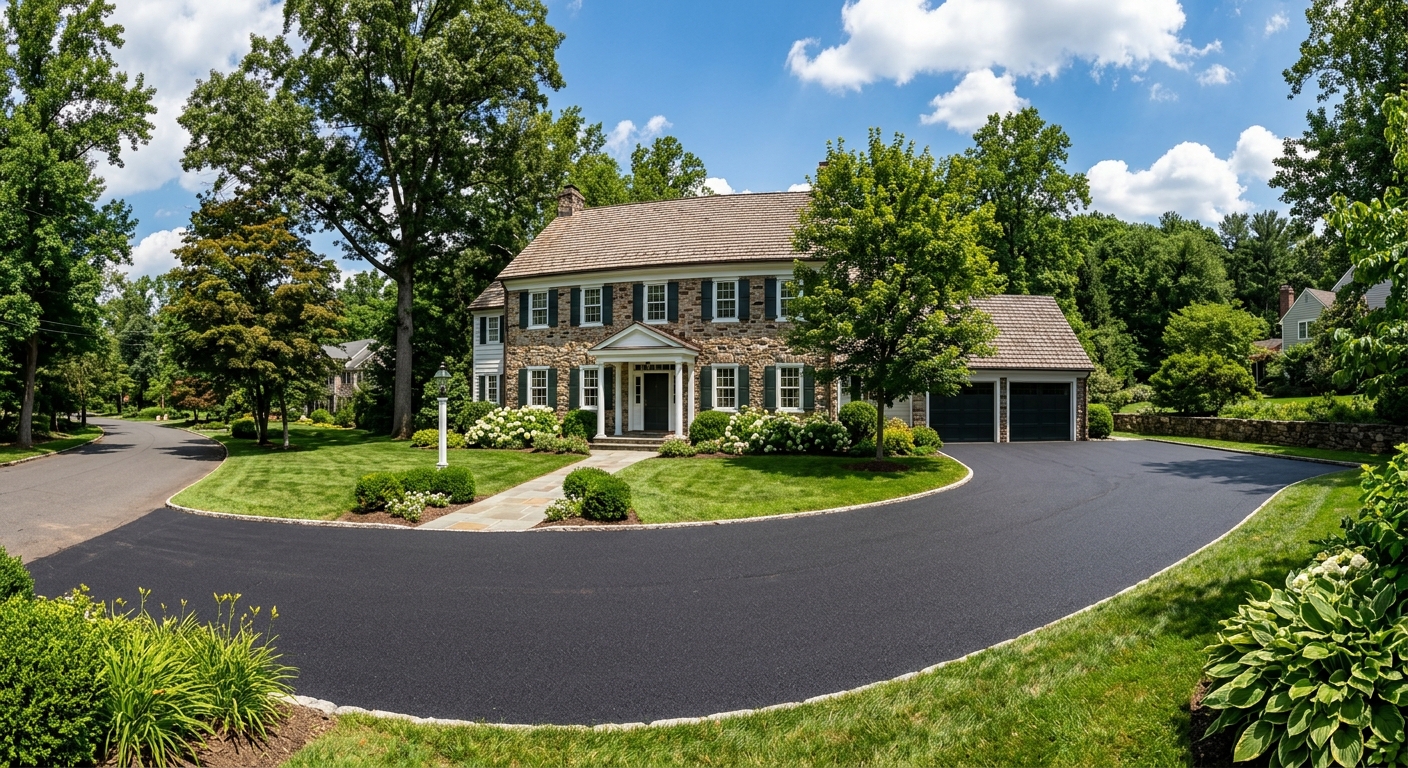
What a new driveway costs in Lower Salford
In Lower Salford, where 69.5% of homes are single-family and the homeownership rate exceeds 78% (U.S. Census Bureau, ACS 2024), driveway paving is a significant, long-term investment — not a landlord’s routine expense. The silty clay and glacial till soils typical of eastern Montgomery County mean base prep is everything: when a base isn’t well built, no surface lasts. Combine that with southeastern Pennsylvania's moderate freeze-thaw cycles, and you have reasons for cost differences that run deeper than just the materials you can see.
That’s why in Lower Salford, the biggest variable in driveway price isn’t concrete vs. asphalt, or even square footage. It’s what happens under the surface — excavation depth, thickness and type of stone, and base compaction. The lowest bid may save up front but risks rutting, cracking, and water issues in only a few winters. Paying more often means getting a properly designed and executed base. Unless the conditions and work are specified in detail, comparing bids is just rolling the dice.
| Service |
Best for |
Lifespan |
Price range |
| Asphalt — full replacement with new base |
failed base, structural cracking |
20–30 yrs |
$4,300–$11,000 |
| Asphalt overlay / resurfacing |
sound base, surface cracking only |
8–15 yrs |
$1,850–$5,500 |
| Sealcoating — single application |
preventive maintenance on sound asphalt |
2–4 yrs |
$250–$850 |
| Concrete — new installation |
long service life, low maintenance |
30–50 yrs |
$6,100–$14,500 |
| Crack filling and patching |
isolated cracks under a quarter inch |
1–3 yrs |
$200–$800 |
| Gravel driveway |
rural, budget, long runs |
5–10 yrs with upkeep |
$900–$3,500 |
Estimates for a typical Lower Salford driveway. Square footage and base condition drive these figures more than material choice.
Driveway permits, approaches and stormwater rules
In Lower Salford and throughout Montgomery County, repaving or sealing a residential driveway in its current footprint is typically considered routine maintenance and does not need a municipal permit. This is especially true for work that doesn’t alter the curb, apron, or create more impervious surface. However, as soon as you plan to widen your driveway or change the approach (the part connecting directly to a township road), a separate road occupancy permit is generally required, usually through your municipality’s public works department — not a county or state office. For example, in Montgomery Township, the driveway approach is specifically regulated by the Montgomery Township Public Works Department.
Stormwater matters: if your new or expanded driveway adds hard surface area, you may trigger municipal drainage requirements. Even if you skirt permits, Pennsylvania liability still follows if you direct water on a neighbor’s property — which happens quickly in Lower Salford’s silty clay soils. Drainage planning is not the place to skimp.
Contractors on any job over $500 must carry valid Home Improvement Contractor (HIC) registration, verifiable at hic.attorneygeneral.gov. All Pennsylvania employers must have workers’ compensation insurance, checkable on WCAIS (wcais.pa.gov). A written contract is required for jobs above $500, and you have a 3-business-day right to cancel under the Home Improvement Consumer Protection Act.
Getting thirty years out of a driveway
In Lower Salford, prevention beats repair by a mile. The single most effective step to extend an asphalt driveway life is keeping cracks sealed before water gets to the base. Even cracks under a quarter inch wide let water move through the surface, freeze, and break things up from underneath—especially in our region’s freeze-thaw window. Prompt crack repair is cheap and saves thousands.
Next: keep the edges strong. Driveways fail earliest where cars or plows break unsupported edges, so support matters. Keep the surface free of ponding, and make sure water flows away, not across. Heavy, narrow loads (jack stands, dumpsters) will leave permanent divots if left for more than a day, especially right after install.
With new asphalt, take it easy for the first 2–4 weeks—don’t park in the same spot or turn tires sharply while stationary until the surface fully cools and stiffens, or ruts will form.
For de-icing, salt is murder on concrete, accelerating surface pitting and rebar corrosion; use sand or calcium chloride where possible. For asphalt, the problem isn’t the salt directly but the repeated melt and refreeze that opens cracks, not the salt’s chemistry.
With southeastern Pennsylvania's 30-inch frost line and frequent temperature swings, routine crack filling each fall and quick snow removal go further than anything you can buy in a bucket.
Numbers, not adjectives
If you’re price shopping for a driveway in Lower Salford, change your focus to the numbers in the quote. That’s how you protect your investment. This isn’t California: our silty clay subgrade and freeze-thaw cycles demand more excavating, thicker aggregate base, and properly compacted asphalt lifts.
It isn’t enough for a contractor to say “we’ll put down three inches.” Is that as placed or as compacted? There’s a 20–25% difference. Does “base” mean coarse clean stone, or whatever’s in the truck? How many lifts, how is each compacted, and what mix is specified? These are not technicalities; they decide whether you get thirty years or five.
- Excavation depth in inches (not “as needed”)
- Subgrade type and preparation (strip topsoil, proof roll)
- Aggregate base: material type (e.g. 2A modified), thickness after compaction (typically 6–8")
- Asphalt binder course: thickness as compacted (typically 2"–2.5")
- Asphalt surface course: thickness as compacted (1–1.5")
- Mix designations for each lift (e.g. PennDOT 25mm, 9.5mm)
- Compaction method (roller tonnage, passes, per lift)
- Edge support treatment (hand-tamped shoulders or concrete edge restraint)
- Grading and drainage plan showing water direction
- Restoration spec: lawn edges, landscaping, apron if disturbed
Ambiguity favors the contractor, not you. Most Lower Salford driveways need more stone and depth than a mild-climate install—don’t settle for less.
How often should a Lower Salford driveway be sealed?
Sealcoating a residential asphalt driveway in Lower Salford does one thing well: it protects against UV, slows surface oxidation, and offers light resistance to oil and gas spills. It restores the black color, which is mostly cosmetic but does discourage hairline cracks. What it does not do is fix existing cracks, strengthen the pavement, or make a worn-out driveway last longer. If your base is shot, sealcoat is purely superficial.
The neglected downside is over-sealing. Applying sealer every year builds up layers that start to crack and peel, especially in humid southeastern Pennsylvania summers. Worse, sealing brand-new asphalt traps solvents and shortens life. Wait at least 6–12 months after installation—if you can still smell asphalt in summer, it’s too soon.
A responsible schedule is every 2–4 years. Even then, assess the surface; if it’s not showing fine cracking or fading, hold off. Crack filling is actually more important for lifespan than routine sealing.
What a suspiciously cheap sealcoat buys in Lower Salford is almost always a thin spray-on job—less labor, less material, rarely including any crack prep, and it washes off by winter. Expect to pay $250–$850 for a real application, depending on driveway size. Compare the bid: brush-applied or squeegee, with surface cleaning and crack treatment first, is what you want.
How to tell if the base is gone
Here’s how any Lower Salford homeowner can diagnose driveway base failure: When you see alligator cracking (those tight, interconnected cracks across a large patch), the base has let go. No overlay or patch will last unless the base is rebuilt. On the other hand, isolated linear cracks mean surface wear—you can repair and extend life with crack fill and seal. If you spot birdbaths or drive through standing depressions, the subgrade has settled, and repair means excavation and new base material. Edge crumbling points to lack of support—sometimes correctable, but also a sign the rest could follow.
Potholes tell you water has reached and undermined the base. Don’t patch over and forget: fully assess the area. The core rule in Lower Salford is clear—never agree to an overlay until the base is checked with test holes or heavy probing. A contractor who skips this is giving you a cosmetic, not structural, fix.
| What you see |
Likely cause |
Right fix |
Cost |
| Isolated cracks under 1/4 inch |
surface aging |
crack fill and seal |
$250–$850 |
| Alligator cracking over a wide area |
base failure |
full replacement |
$4,300–$11,000 |
| Depressions holding water |
subgrade movement |
excavate and rebuild that area |
$4,300–$6,700 |
| Crumbling edges |
no edge support |
edge repair, consider curbing |
$400–$1,500 |
| Potholes |
water into the base |
full-depth patch, then assess |
$250–$900 |
| Faded but sound surface |
oxidation only |
sealcoat |
$250–$850 |
What a real paving quote contains
You shouldn’t accept a driveway quote in Lower Salford unless it details every step: measured square footage taken on site (never guessed), excavation depth and disposal method, type and depth of base stone, how compaction is done, how many asphalt layers and exactly how thick they’ll be after compaction, edge treatment, and provisions for drainage and grading. The quote should finish with a written payment schedule and warranty terms.
Never accept a one-line “Asphalt Driveway: $X,XXX” slip. These are designed so you can’t compare, spot material shortcuts, or enforce quality. In this area, too many “cheapest bids” wind up with thin base, quick failure, and no recourse. Make the contractor spell out the job, line item by line item.
| Line item |
What to look for |
Red flag if… |
| Area |
measured square footage stated |
eyeballed or absent |
| Excavation |
depth and disposal included |
'we'll pave over it' |
| Base |
aggregate type and depth in inches |
'proper base' |
| Compaction |
method, and done in lifts |
not mentioned |
| Asphalt |
courses and compacted depth |
'3 inches' unqualified |
| Drainage |
slope and water direction stated |
silent |
| Warranty |
what is covered and what is excluded |
verbal only |
| Payment |
modest deposit, balance on completion |
full cash up front |
Frequently asked questions — driveway paving in Lower Salford
Does road salt damage driveways in Lower Salford?
Road salt is harshest on concrete driveways in Lower Salford, where frequent freeze-thaw cycles already stress surfaces. Salt accelerates scaling and pitting and will sometimes void a new concrete warranty. For asphalt, the chemical isn’t the main issue — the real harm comes from creating meltwater that seeps into cracks and then freezes again, prying the asphalt apart by spring. Using sand or calcium chloride is safer but does cost more per bag, and you’ll trade off some ice-melting speed. For both types, prompt crack filling (at a typical $200–$800) keeps water out and prevents most salt-related damage.
Should I repair or replace my Lower Salford driveway?
The right call hinges on your driveway’s base condition. In Lower Salford’s climate and soils, if you see alligator cracking — dense network cracks across a big area — your base is broken, and full replacement (costing $4,300–$11,000) is justified. But for isolated linear cracks or edge crumbling, crack filling and localized patching is often enough and much less. Never accept an overlay unless the contractor has actually checked the base: skipping this means you’re paying for a band-aid. If in doubt, ask for test holes or heavy probing before you commit to a major job.
What does an asphalt overlay cost in Lower Salford?
Overlaying a driveway is a way to resurface when the base is still solid. In Lower Salford, you can expect to pay between $1,850–$5,500 for a typical overlay, with the average around $3,700. This assumes your base is solid with only surface cracks, not structural failure. If more than a third of your driveway has deep alligator cracks or sunken spots, an overlay won’t last and that money is likely lost within a few years.
How do I verify a paving contractor in Pennsylvania?
Every legitimate paving contractor in Pennsylvania working on jobs over $500 must hold Home Improvement Contractor (HIC) registration, which you can check at hic.attorneygeneral.gov. For jobs in Lower Salford, also make sure any crew operating equipment has valid workers’ compensation insurance by searching WCAIS (wcais.pa.gov). Written contracts are required by law for work of this size — no handshake deals. You should never pay a large cash deposit or get a quote that doesn’t spell out scope and materials. If you’re quoted for a typical full asphalt replacement (say $4,300–$11,000), expect everything in writing before a shovel hits the ground.
How thick should asphalt be for a residential driveway in Lower Salford?
Because Lower Salford sits on silty clay soils and faces regular freeze-thaw, asphalt driveways need to be built with more stone and thicker asphalt layers than in milder climates. A good specification is at least 6–8 inches of compacted 2A modified stone for the base, then 2–2.5 inches of compacted binder (the rough lower layer), and 1–1.5 inches of compacted surface mix. Beware of any quote that just mentions “three inches” — make them specify compacted thickness for each course. Skimping here is why some driveways fail five years in, not thirty.
How long should an asphalt driveway last in Lower Salford?
When properly built over a well-compacted base, an asphalt driveway in Lower Salford should last 20–30 years. Most driveways that fail sooner are underbuilt — a common problem in Montgomery County’s saturated contractor market. Preventive maintenance like crack filling (usually $200–$800) and sealcoating every few years (at $250–$850) will help your driveway reach that full life, especially with our climate’s regular cycle of freezing, thawing, and occasional coastal storm runoff.
How long does a driveway installation take?
A typical asphalt driveway installation in Lower Salford will take 1–2 days for removal, base work, and paving, with an additional 2–5 days needed before you should park on the new surface — longer in humid weather or for concrete. Time frames depend on weather, square footage, and especially preparation: full replacement with a new base ($4,300–$11,000) may take longer than an overlay ($1,850–$5,500), but the wait is worth it for long-term performance.
What does sealcoating cost in Lower Salford?
Sealcoating a standard residential driveway in Lower Salford typically runs from $250–$850, in line with the local market. Expect to be toward the higher end for above-average square footage or if crack filling is included. Prices below this are a red flag for thin or poorly prepped applications. Compare what’s being quoted: a good job includes thorough cleaning, crack treatment, and a brush or squeegee application, not just a quick spray.
Is sealcoating a scam?
Sealcoating is not inherently a scam — in Lower Salford, periodic sealing can protect and extend the surface life of a driveway exposed to sun, fuel spills, and freeze-thaw cycles. But the scam lies in overapplication, spraying too thin, or selling it as a cure for structural problems. Reputable contractors recommend sealing every 2–4 years, not annually, and only after the surface is fully cured. The price for a quality sealcoat is $250–$850 for a standard drive, with careful prep and crack filling included. If you hear otherwise, or see very low pricing, ask what you’re actually paying for.