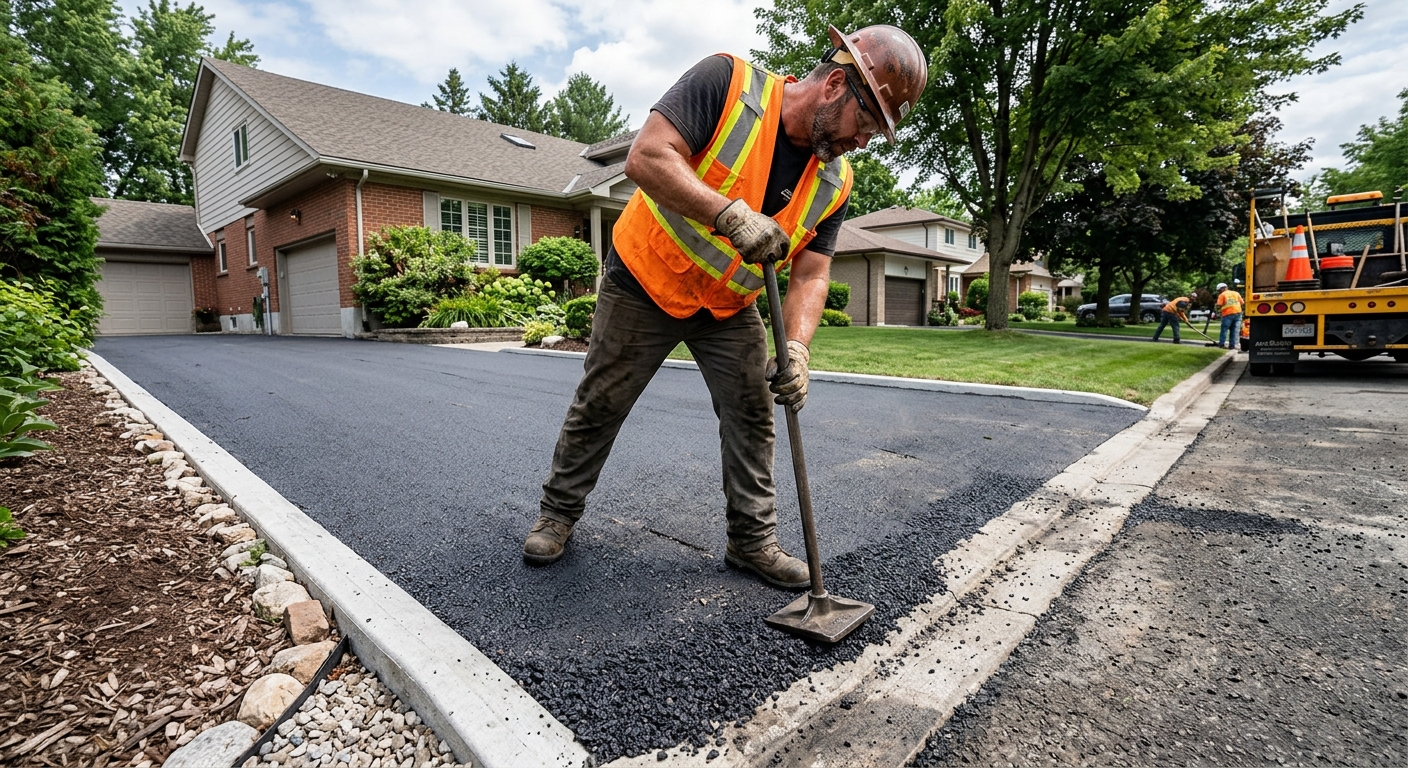
What a new driveway costs in Richland
In Richland, where about 68.2% of homes are single-family and nearly 70% are owner-occupied (U.S. Census Bureau, ACS 2024), driveway paving is an expense that matters to most homeowners. With our long winters and deep frost depth, the cost difference between quotes is rarely about visible quality—it's what gets built under the surface. The freeze-thaw cycle is rough on pavement, and the shallow shale and rocky soils seen in nearby Cambria Township push many contractors to use a thicker aggregate base here in Richland. That unseen work, from proper excavation to correct base installation, is what determines whether your new driveway will last decades or start breaking up after just a few years. The price you pay is most influenced by how thick and well-prepared that base is—much more than whether the top layer is asphalt or concrete. Even a small mistake below ground can shorten lifespan and push up long-term costs.
| Service |
Best for |
Lifespan |
Price range |
| Asphalt — full replacement with new base |
failed base, structural cracking |
20–30 yrs |
$3,300–$8,600 |
| Asphalt overlay / resurfacing |
sound base, surface cracking only |
8–15 yrs |
$1,450–$4,300 |
| Sealcoating — single application |
preventive maintenance on sound asphalt |
2–4 yrs |
$200–$650 |
| Concrete — new installation |
long service life, low maintenance |
30–50 yrs |
$4,800–$11,500 |
| Crack filling and patching |
isolated cracks under a quarter inch |
1–3 yrs |
$200–$800 |
| Gravel driveway |
rural, budget, long runs |
5–10 yrs with upkeep |
$900–$3,500 |
Estimates for a typical Richland driveway. Square footage and base condition drive these figures more than material choice.
How to tell if the base is gone
The biggest fork in the road for Richland homeowners is whether your driveway’s base is still sound. You can make a quick check yourself before ever calling a contractor. If you see alligator cracking—those interlaced, blocky cracks across a wide area—it’s almost always a sign the base beneath has failed. No amount of patching or overlay can put that right. If you see single, straight cracks here and there, that’s typically just aging at the surface. Depressions that hold water (birdbaths), especially after a rain, mean the ground below has shifted or washed away. Crumbling edges mean your driveway never had proper edge support, which is common on older installations in mill-era areas. Potholes are a dead giveaway that water has reached and damaged the base.
An overlay on a failed base is money wasted—the top will look good for a year or two before the same cracks return. If you get a quote for an overlay but the contractor never checked the thickness or dug into the base, they haven’t actually investigated the problem.
| What you see |
Likely cause |
Right fix |
Cost |
| Isolated cracks under 1/4 inch |
surface aging |
crack fill and seal |
$200–$650 |
| Alligator cracking over a wide area |
base failure |
full replacement |
$3,300–$8,600 |
| Depressions holding water |
subgrade movement |
excavate and rebuild that area |
$3,300–$5,200 |
| Crumbling edges |
no edge support |
edge repair, consider curbing |
$400–$1,500 |
| Potholes |
water into the base |
full-depth patch, then assess |
$250–$900 |
| Faded but sound surface |
oxidation only |
sealcoat |
$200–$650 |
Drainage: the failure nobody plans for
Water is what takes driveways apart in Richland, not just the wear of cars. Our long freeze-thaw season means water that seeps into the base will freeze, expand, and shift the whole structure of your drive. That’s why drainage isn’t just a finishing step—it’s job one. Every new driveway needs a slight slope—at minimum, a 2% grade—to shed water off the surface. In narrow or shared driveways common to older Johnstown-era homes, a crowned center or a cross slope will help prevent water from pooling in the center. If your driveway slopes toward your garage or home, no amount of patching will stop water from running straight at your foundation. In those cases, a trench or channel drain is the only way to intercept runoff and get it away from your house. Where possible, run water out to daylight; where that’s not possible, a dry well can help, but only if placed in soil that will absorb—and not just hold water.
Richland's shallow shale and rocky subgrade drain neutrally, but if you move into the heavier soils closer to Cambria Township, poor drainage compounds base problems. Sending your runoff onto the neighbor's lawn isn’t just bad manners—it can create real legal liability, permit or not. Careful grading and a thought-out drainage plan keep your driveway (and neighbor relations) solid for years.
The honest case for and against sealcoating
Sealcoating a driveway in Richland is one of those maintenance items where the hype often oversells the benefit. Done properly, a quality sealcoat blocks out oxygen, sunlight, and the drips of oil and fuel that break down asphalt binders over time. It can refresh the look of a faded driveway and protect against surface-level damage, but it will not fix cracks or add years to a driveway whose base has already failed. If the base is moving, sealing just traps the problem.
The part nobody says: sealing more than every few years creates new issues. Each application leaves behind a thin film of polymer or tar. Too many layers build up and start to peel, especially after a few harsh freeze-thaw cycles. Laying sealer on fresh asphalt is just as bad—the surface needs at least 60–90 days of cure time for oils to come off; otherwise, those trapped volatiles prevent proper bond and make the sealer fail early.
Crack filling prevents water from reaching the base, which is much more important than getting a shiny black surface each year. A proper sealcoat—done with brushes or a heavy squeegee, not just a quick spray—costs from $200–$650 for a single Richland driveway. When you see “budget” sealcoats at half that price, you’re getting a thin spray that wears off in six months and may do more harm than good by creating surface buildup.
Comparing paving estimates in Richland
Paving quotes vary wildly, but in Richland you should insist on details you can check. A good estimate lists the measured square footage—not just a guess. It spells out how much soil or old asphalt will be excavated and who hauls it away. The kind, thickness, and compaction of the aggregate base matter as much as the asphalt itself. Ask for the thickness of each asphalt layer after it’s compacted, not just “three inches”—that’s a common shortcut. Edge details are extra work but prevent crumbling and migration over winter; if not mentioned, you’re not getting it. Any grading and drainage calls should be written, with water direction pointed out. Cleanup should include lawn restoration where the crew edges out the drive. A fair payment schedule is a small deposit with the remainder due when all work is finished. Warranty is worth less than you think—most don’t cover the cracking you’re trying to avoid.
A one-page total with no specifications is the top complaint from homeowners who overpaid for a short-lived job. You can’t compare or hold anyone to it.
| Line item |
What to look for |
Red flag if… |
| Area |
measured square footage stated |
eyeballed or absent |
| Excavation |
depth and disposal included |
'we'll pave over it' |
| Base |
aggregate type and depth in inches |
'proper base' |
| Compaction |
method, and done in lifts |
not mentioned |
| Asphalt |
courses and compacted depth |
'3 inches' unqualified |
| Drainage |
slope and water direction stated |
silent |
| Warranty |
what is covered and what is excluded |
verbal only |
| Payment |
modest deposit, balance on completion |
full cash up front |
What's under the asphalt matters more than the asphalt
In Richland, the difference between a driveway that lasts thirty years and one that makes you curse every spring isn’t the asphalt on top—it’s what’s underneath. Every driveway starts with your subgrade, the native earth you build on. In Cambria County, close to Johnstown, that can be shallow shale and rocky fill. This is where freeze-thaw cycles do their worst. Any water trapped in that subgrade will freeze come winter, expand, and push up parts of your driveway—a process called frost heave. Once the base heaves, cracks open from below, and it’s game over for your pavement.
On top of the subgrade sits the aggregate base, usually compacted crushed stone. In places with rocky subgrade like Cambria Township, you want a thicker base—typically 6 to 8 inches, compacted in two or more lifts—to spread loads and protect against heave. The final asphalt layer—usually two lifts, totaling 3 inches compacted—sits above that. If the base isn’t thick enough or was slapped down in a single, loose layer, even thick asphalt will crack and sag in our climate. All of this is invisible once the crew rolls up and steamrolls the top; you have no way to check later.
If a quote is suspiciously cheap, check which steps got skipped: Was there excavation of the old base? What type and depth of crushed material is going in? Is compaction being done in 2–4 inch lifts? Demand in writing: the exact aggregate type and at least 6 inches (eight is better, especially over shale), and that compaction testing is done every lift. The surface is easy—what lasts is underneath.
Permits and approvals for paving in Richland
For most Richland homeowners, resurfacing or replacing your asphalt driveway in the same footprint does not require a building permit—Adams Township, for example, allows like-for-like replacement without a new driveway construction permit. However, if you’re expanding, regrading, or connecting to a township or state road, an approach permit comes into play. In Cambria County, PennDOT District 10 reviews and issues Highway Occupancy permits for any driveway approach linking to a state route, while township roads use the local municipal driveway permit office. If your driveway work alters stormwater runoff, you could also be subject to additional drainage or zoning requirements, so it’s wise to check with your township first.
Contractors working on jobs over $500 must be registered with the Pennsylvania Office of Attorney General Home Improvement Contractor (HIC) registry—verify at hic.attorneygeneral.gov. Pennsylvania law also requires all contractors with employees to carry worker’s compensation, which you can check via WCAIS (wcais.pa.gov). No one should offer to waive your insurance deductible—it’s prohibited. Written contracts are required above $500, and by Pennsylvania Home Improvement Consumer Protection Act, you have three business days to cancel any paving contract you sign in your home.
Frequently asked questions — driveway paving in Richland
How much does a concrete driveway cost in Richland?
Concrete driveways in Richland typically run between $4,800–$11,500 depending on size, layout, and whether excavation or special features are needed. The typical cost for a standard single-family drive sits around $7,600. Concrete is more expensive up front than asphalt, but it delivers a longer lifespan—30 to 50 years with proper installation and routine sealing. In Cambria County, concrete makes sense for homeowners seeking the lowest maintenance solution, especially on high-traffic or sloped sites. Keep in mind, the rocky subgrade and freeze-thaw climate in Richland require a properly compacted, deep base to prevent cracking and heaving—so never cut corners on prep to save money. If you live in a part of Richland where salt is used heavily for winter ice, ask about mixes with air entrainment; it’s a small cost for much greater durability.
Is an overlay worth it or should I start over?
Overlays—where new asphalt is laid over an existing driveway—cost less than full reconstruction, with most Richland jobs landing in the $1,450–$4,300 range. But the base decides everything. If your driveway only has surface cracks and the base is still intact, an overlay can give you 8–15 more years for less money. However, in Cambria County’s freeze-thaw climate, overlays on a failed, soft, or heaved base won’t last: cracks will reappear within a couple winters. Check for alligator cracking, potholes, or depressions, which mean it’s time for a rip-out and full base rebuild—even if that’s a bigger up-front bill in the $3,300–$8,600 band. Don’t trust anyone quoting you for an overlay if they haven’t directly checked the base with a probe or core sample.
Can I cancel a paving contract I signed at my door?
Yes, in Pennsylvania—including Richland—you have the right to cancel any home improvement contract worth over $500, signed at your residence, within three business days (thanks to the Home Improvement Consumer Protection Act). This rule covers driveway paving and replacement, which nearly always fall above that mark—think $3,300–$8,600 for a full asphalt replacement here. You don’t need a reason, but you must send a written notice to the contractor within that time. Legitimate contractors will include this right-to-cancel in your contract, as required by state law. If your paving contract does not mention this, or you’re pressured to pay a deposit or start immediately, step back and double check the company’s standing on the Attorney General’s HIC registry. It’s your money and your right to reconsider.
What is the difference between binder and surface course?
On driveway paving in Richland, two layers of asphalt are usually installed: the binder and the surface (wear) course. The binder is a thicker layer with larger stone, laid first for strength; it absorbs movement and helps bridge minor subgrade imperfections—critical in Cambria County, where frost heave and rocky soils are common. The surface course is a finer, smoother asphalt that makes up the final layer—what you see and drive on every day. Its job is to resist water, UV, and traffic, and provide a clean finish. Good Richland paving specs call for a combined compacted thickness of about 3 inches—split between a 2-inch binder and a 1–1.5-inch surface course. If a quote mentions only “3 inches of asphalt” with no breakdown, ask for detail. Skimping on either layer will shorten the life of your driveway—and won’t save much money compared to full replacement, which should be $3,300–$8,600.
What does sealcoating cost in Richland?
For most single-family driveways in Richland, a proper sealcoating costs between $200–$650, with the typical price landing around $375. The wide band reflects driveway size, surface preparation, and whether the job is brush-applied or just sprayed on. Don’t be tempted by cut-rate offers: quick spray jobs often last less than a year and offer little protection, especially after Richland’s harsh winters. A good contractor will fill cracks and clean the surface before applying a thick, even coat. If your drive needs patching or the base is moving, shift your money to repairs rather than a fresh coat of black. Remember, too much sealcoat, or sealing too soon after new asphalt, causes more problems than it solves, so a reasonable interval is every two or three seasons at most.
Can asphalt be laid in cold weather?
Asphalt can technically be laid in cold weather, but it’s rarely a good idea in Richland. For best results, surface temperatures should be above 50°F, and ideally asphalt should be delivered and placed hot—above 275°F. In our climate, paving much later than early November means the mix cools too fast, leading to poor compaction and weak bonds. These cold-laid drives are the ones that crumble in a couple years, instead of lasting the 20–30 you expect from a job in the $3,300–$8,600 range. Good contractors in Cambria County will refuse to pave in freezing temps, especially if the subgrade or base is hard or frozen. Scheduling in late spring through early fall ensures your drive is built to survive Richland's winter freeze-thaw cycles, not just to look smooth on day one.
When can I seal a brand new asphalt driveway?
You should wait at least 60 to 90 days after a new asphalt driveway is installed in Richland before applying any sealcoat—longer is better if the weather is cool. Fresh asphalt is full of oils and volatiles that need time to cure and come to the surface. Sealing too soon traps these inside, making the sealcoat bubble, peel, and fail. Your contractor should advise on timing, but generally aim for your first sealcoat the season after installation—never the same month as a $3,300–$8,600 new asphalt job. Until then, don’t park heavy equipment or trailers on your new driveway and avoid turning tires sharply. Once the drive is cured and sealed, you can follow a more typical maintenance interval of every two or three years. Rushing the process shortens the life of both the pavement and the sealer.
What causes concrete to spall or flake in Richland?
Concrete spalling—surface flaking or chipping—happens frequently in Richland due to our region's freeze-thaw cycle and widespread use of de-icing salt. Water seeps into the surface, then freezes and expands, popping off small chips each winter. Poor air entrainment (the mix's ability to handle freeze-thaw), over-finishing, or using too much water during placement also encourage spalling. If rock salt or other aggressive ice melts are used on a new driveway, scores of freeze-thaw cycles compound the effect. For a new concrete driveway—costing around $4,800–$11,500—ask for entrained air in the mix, and avoid deicers until after the first winter. Good drainage and thick, well-compacted base go a long way in reducing moisture trapped against the slab. Most spalling in Cambria County traces to a mixture not tailored for local climate or shortcuts in prep, so always get specs in writing.
What kind of soil is under Richland driveways?
Richland driveways are typically built over shallow shale and rocky subgrade, distinctive for Cambria County and especially near Cambria Township. This rocky base doesn’t hold water as much as heavy clay, but it does require a deeper aggregate base—usually 6 to 8 inches—to prevent movement during freeze-thaw seasons. If a thinner base is installed, even a new driveway in the $3,300–$8,600 price range won’t last. In outlying areas you may find patches of heavier soil that can trap water and demand even more drainage attention. Always have your contractor check subgrade depth and type before quoting—these conditions affect both longevity and the total you pay. The cost is mostly buried beneath: properly handling our local soil makes all the difference in how long your drive survives Richland’s harsh winters.