East Brandywine paving prices by scope — 2026
East Brandywine is a community of almost 80% single-family homes, and with a homeownership rate of 92.8% (U.S. Census Bureau, ACS 2024), most driveways in town are a personal investment—not something handled by an association. In this part of Chester County, where freeze-thaw cycles and periods of wet weather are regular features, hidden issues beneath the surface drive paving cost more than any visible detail. Whether you’re looking at a top-dollar quote or a lowball bid, what’s really being priced is the unseen—the base preparation, thickness, and drainage control. The most expensive driveway mistake is not what you can see, but what’s buried below: an under-built base or poor drainage will cost far more in repairs than up-front savings.
| Service |
Best for |
Lifespan |
Price range |
| Asphalt — full replacement with new base |
failed base, structural cracking |
20–30 yrs |
$4,400–$11,500 |
| Asphalt overlay / resurfacing |
sound base, surface cracking only |
8–15 yrs |
$1,900–$5,700 |
| Sealcoating — single application |
preventive maintenance on sound asphalt |
2–4 yrs |
$250–$900 |
| Concrete — new installation |
long service life, low maintenance |
30–50 yrs |
$6,300–$15,000 |
| Crack filling and patching |
isolated cracks under a quarter inch |
1–3 yrs |
$200–$800 |
| Gravel driveway |
rural, budget, long runs |
5–10 yrs with upkeep |
$900–$3,500 |
Estimates for a typical East Brandywine driveway. Square footage and base condition drive these figures more than material choice.
How often should a East Brandywine driveway be sealed?
Sealcoating is pitched as a panacea, but in East Brandywine, the facts are more nuanced. A proper sealcoat protects asphalt by shielding it from UV rays, oxidation, and surface spills like oil or gas. It also restores a dark, clean look. However, what sealcoating does not do is strengthen the driveway or repair underlying structural problems—no matter what you’re told, it doesn’t stop cracks or extend the life of a driveway whose base is crumbling under the surface.
Applying sealcoat too frequently is a common mistake. When new coats are layered on annually, they can peel and crack from trapped moisture. Even worse, sealing brand-new asphalt before it’s fully cured does more harm than good, locking in volatile compounds that need time (often a full season) to escape. The right interval? Every two to four years, not every spring.
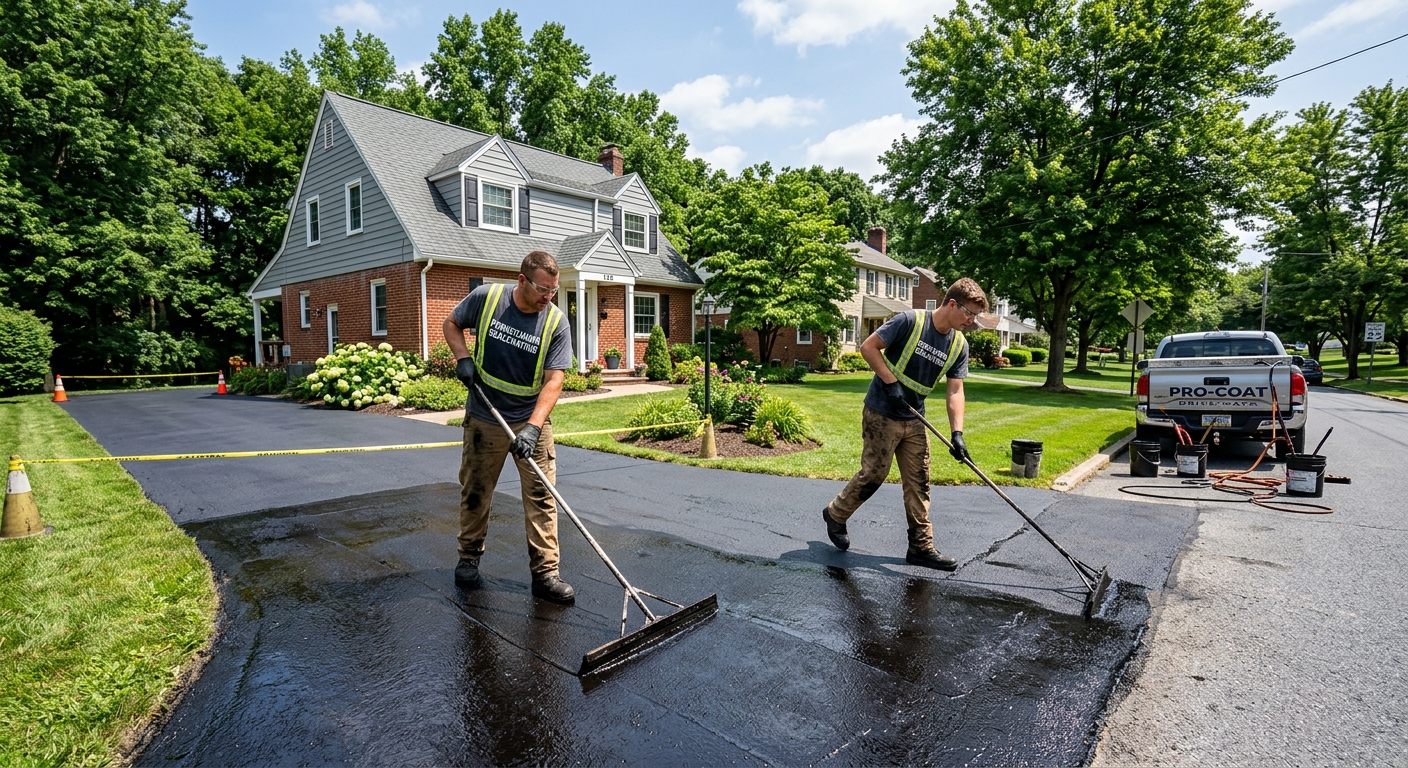
While sealcoating gets the marketing dollars, it’s crack filling that delivers the most bang for your maintenance buck. Proper crack filling keeps water out of the base—the single biggest cause of failure in Chester County’s freeze-thaw cycles. A solid sealcoating application involves thorough cleaning, filling cracks, and a squeegee-applied coat, not just a quick spray. Suspiciously cheap sealcoating is usually just watered-down oil sprayed thin for a short-lived shine—often under $250 for the “service,” but you’ll see streaks and no meaningful protection. A good pro will charge $500 or more for proper work, because crack filling and prep is time-consuming.
Maintenance that actually works
In East Brandywine, practical maintenance boils down to a few key steps that really extend driveway life. First, focus on crack filling as soon as you see gaps—especially before freeze-thaw weather sets in. Water is the enemy; once it gets to the base and freezes, it pries open cracks and accelerates failure. Year for year, spending $200–$800 on proper crack filling will last longer than annual sealcoating.
Keep driveway edges supported: don’t let grass or soil erode away and leave the asphalt hanging or weak. Make sure water flows off, not across or under, your driveway. Clogged drains or poor grading speed up every kind of damage.
Don’t park heavy trailers, dumpsters, or leave jack stands in place—these point loads leave lasting dents, especially in warm weather or if the asphalt hasn't fully cured. For new asphalt, be patient: wait at least 4–7 days in summer before parking, and avoid tight turns while stationary until it’s fully set.
For snow and ice, rock salt can pit and flake concrete, especially older slabs in wet winters like Chester County’s. Calcium chloride is gentler but pricier; sand works for traction with neither risk. On asphalt, the freeze-thaw from repeated melting matters more than chemical attack. Always push snow off before it can melt and refreeze.
Where the water goes
Water is the main reason driveways fail in East Brandywine, whether you see puddles after rain or cracking after winter. The right grade is essential. Your driveway should slope away from buildings and toward a safe outlet with a minimum slope of 2% (about a quarter inch per foot). Slight crowning keeps water moving off wide driveways; for single-lane drives, a gentle cross-slope works well.
The worst setup is a driveway that pours water toward your garage or home—standing water soaks into the base, and when winter arrives, it freezes, heaves, and destroys the slab faster. Where the grade can’t be solved with pitch alone, trench or channel drains at the low point help intercept and redirect drainage before water enters the structure or washes across the whole base. Ideally, water reaches daylight somewhere safe; if not, a properly sized dry well collects runoff underground.
Ponded water is even more dangerous on clay soils, which hold moisture against the gravel base and trap it, preventing quick drainage. That means ice lenses form under the driveway, pushing up and cracking the pavement from below. Don’t forget the neighborhood factor—sending drainage onto a neighbor’s land won’t just get you a bad stare; it brings real liability whether or not you needed a permit.
The driveway scams that work in East Brandywine
Paving scams are a recurring problem in East Brandywine for a reason: driveways are visible from the street, and poor work is hidden for several years—well after the crew is gone. Operators show up with leftover material, offer a “deal” because they’re finishing a job nearby, then pressure for immediate cash or a handshake deal. Key red flags include unmarked trucks, out-of-area plates, and today-only quotes. If someone wants all cash up front or avoids giving you a detailed, written scope, walk away.
In Chester County’s semi-rural areas, where homes are spread apart and there’s less neighborly oversight, these operators find softer targets. Thin, oil-based sprays sold as sealcoating for $250–about the cost of materials and fast labor–give a glossy finish for weeks but do nothing to protect your drive. Verbal “guarantees” vanish the first time rain washes off the shine.
You have serious protections under the Home Improvement Consumer Protection Act: any job over $500 must come with a detailed written contract, and you get a 3 business-day right to cancel for any deal signed at your home. It’s illegal for a contractor to offer to cover your insurance deductible.
The five-minute checks: ask for their HIC registration, confirm it at hic.attorneygeneral.gov, look up their workers’ comp status via WCAIS, and demand a contract in writing, every time. Anything short of that, let them move on to the next house.
Driveway permits, approaches and stormwater rules
In many parts of Chester County, including East Brandywine, resurfacing your residential driveway—if it’s entirely inside your property and not expanding—doesn’t usually trigger the need for a driveway permit. That saves you money and paperwork if you’re just overlaying or replacing in-kind. However, wherever your driveway connects to a public road, the approach is under a different authority. In Chester County, PennDOT Engineering District 6-0 issues Highway Occupancy permits for driveways connecting to state routes—don’t overlook this if you’re on a state-maintained road.
If you add new pavement or expand your hard surface, you may be required to manage stormwater. Directing runoff onto neighboring lots is not allowed and brings a liability risk regardless of your permit status. Keeping water on your property with proper grading, or using dry wells and drains, is the expectation—not just for your benefit but to avoid complaints later.
For contractor verification, the Pennsylvania Home Improvement Contractor (HIC) registry is the only legal standard—check at hic.attorneygeneral.gov. For any crew putting shovels in your yard, confirm workers’ comp insurance through WCAIS (wcais.pa.gov). Pennsylvania law requires both for jobs over $500; don’t take a risk on anyone without proper credentials.
Local soil, drainage and driveway lifespan
Central Chester County, including East Brandywine, sits over limestone and dolomite bedrock. This matters more than most people realize. Limestone karst creates pockets and uneven settlement, which means your driveway base has to be thicker than it would over clay or sand—skimp on stone, and you’ll see reflective cracking and dips in a few seasons.
With a regional frost depth of 30 inches and regular freeze-thaw cycles, driveways here suffer from water moving in and out from below. Any base that isn’t deep and well-drained will shift and break up fast. Many houses here, especially around Exton and West Goshen, were built between the 1960s and 1980s. In that era, local standards were lower; many original drives were laid thin, directly on subsoil with a dusting of stone. If you’ve got spiderwebs of cracks or noticeable low spots, odds are your base needs a full rebuild, not just a new top layer.
The right design in East Brandywine is not just about asphalt or concrete. It’s about putting enough aggregate under the surface to bridge the limestone voids, keep drainage moving, and prevent sinking. This means a higher up-front price—$4,400–$11,500 for full-depth asphalt—but a much longer lifespan. Cut corners on this step and you’ll pay for it twice.
Frequently asked questions — driveway paving in East Brandywine
Why does my driveway have depressions that hold water?
Depressions or “birdbaths” in a driveway usually point to base settlement. In East Brandywine, the underlying limestone and dolomite bedrock can cause uneven settling if the stone base isn’t thick enough. Water pools in these low spots, especially after heavy rain, and when winter freeze-thaw sets in, those areas deteriorate quickly. Often, these dips mean the original driveway (especially if installed in the 1960s–1980s) lacked a proper stone base. A patch might last a season or two ($200–$800), but for repeating depressions, a full-depth replacement is the real fix. Strong subgrade prep is more important here than elsewhere in PA due to the local geology.
When can I seal a brand new asphalt driveway?
For a new asphalt driveway in East Brandywine, patience is critical. Asphalt needs time to cure, releasing oils and volatiles trapped during paving. Sealing too soon locks those compounds in, leading to surface problems like peeling and early cracking. The standard recommendation is to wait at least six months before your first sealcoat. Most professionals here suggest holding off until the following spring or fall, depending on when the drive was laid. Applying sealant too early is a waste of money, as it can do more harm than good. When it’s time, expect a proper single application to cost around $250–$900 for a typical driveway.
When is the best time of year to pave in East Brandywine?
The ideal paving window in East Brandywine generally runs from late April through mid-October, when daytime temperatures are reliably above 50 °F and there’s less risk of sudden frost at night. Chester County’s climate means you want several dry days: rain, high humidity, or overnight cold snaps can all ruin a fresh install by slowing curing or causing weak bonds. Avoiding the cold is especially important for both asphalt and concrete, which need warmth to set properly. Scheduling right means your new driveway will last years longer for the same investment—standard new full-depth jobs range from $4,400–$11,500.
How much does a concrete driveway cost in East Brandywine?
For a standard single-lane, two-car concrete driveway in East Brandywine, you’re looking at $6,300–$15,000 in 2026, depending primarily on length, width, and the need for grading. Concrete runs higher in up-front cost than asphalt but offers lower maintenance and a 30–50 year lifespan—ideal if you plan to stay in your home long-term. Local limestone soils can require a thicker gravel base, which pushes the cost up. If you’re quoted at the very low end, ask what’s being done for subgrade preparation and control joints.
How thick should asphalt be for a residential driveway in East Brandywine?
For East Brandywine residential driveways, a good standard is at least 4 inches of compacted hot mix asphalt over 6–8 inches of crushed stone base. The limestone subgrade common in Chester County means some locations should go thicker on the stone layer to prevent settlement and cracking. Beware quotes that dramatically undercut local prices; shortcuts on thickness show up as cracks and dips within a few winters. Expect a full replacement with proper base prep to cost $4,400–$11,500 for a typical driveway.
Is gravel a cheaper option in East Brandywine?
Gravel driveways are the most affordable choice in East Brandywine, especially for longer rural runs. You’ll generally pay $900–$3,500 depending on length and base prep, which is far less than concrete or even asphalt. Just remember, you’re trading lower cost for annual or biannual upkeep: expect to need top-up gravel, grading, and weed control to keep things smooth and passable. Gravel works well here if you’re comfortable with a less formal look and some seasonal maintenance.
Can I pave over my existing driveway?
Overlaying an existing driveway—adding a new layer without removing the old—can be an option in East Brandywine if the base and underlying surface are sound. This saves on demo costs and keeps prices down to $1,900–$5,700. However, it’s only worth considering if there are no deep cracks, heaving, or soft spots. If the old drive is already failing, an overlay just covers up symptoms; problems quickly reappear. Have a contractor core-test or check the base before deciding.
Are door-to-door pavers a problem in East Brandywine?
Yes—East Brandywine, like much of Chester County, sees transient crews selling quick paving jobs off unmarked trucks. They often offer today-only pricing or say they "have leftover materials." This is more common in areas with fewer immediate neighbors. These crews often cut corners on base prep and thickness, leaving you with a driveway that fails prematurely. If you see prices well below $1,900 for a resurfacing or no written contract, steer clear and use Pennsylvania’s contractor registry before signing anything.
Can I cancel a paving contract I signed at my door?
Yes, under Pennsylvania law—and it’s designed for situations like driveway sales. If you agree to a paving job at your home, and the contract is for more than $500, you have a 3 business-day right to cancel in writing, no penalty. Be sure you get a dated, detailed written contract (required by law) stating this right. Reputable contractors in East Brandywine should always inform you of this on paperwork. If you don’t see the cancellation notice, that’s another red flag.