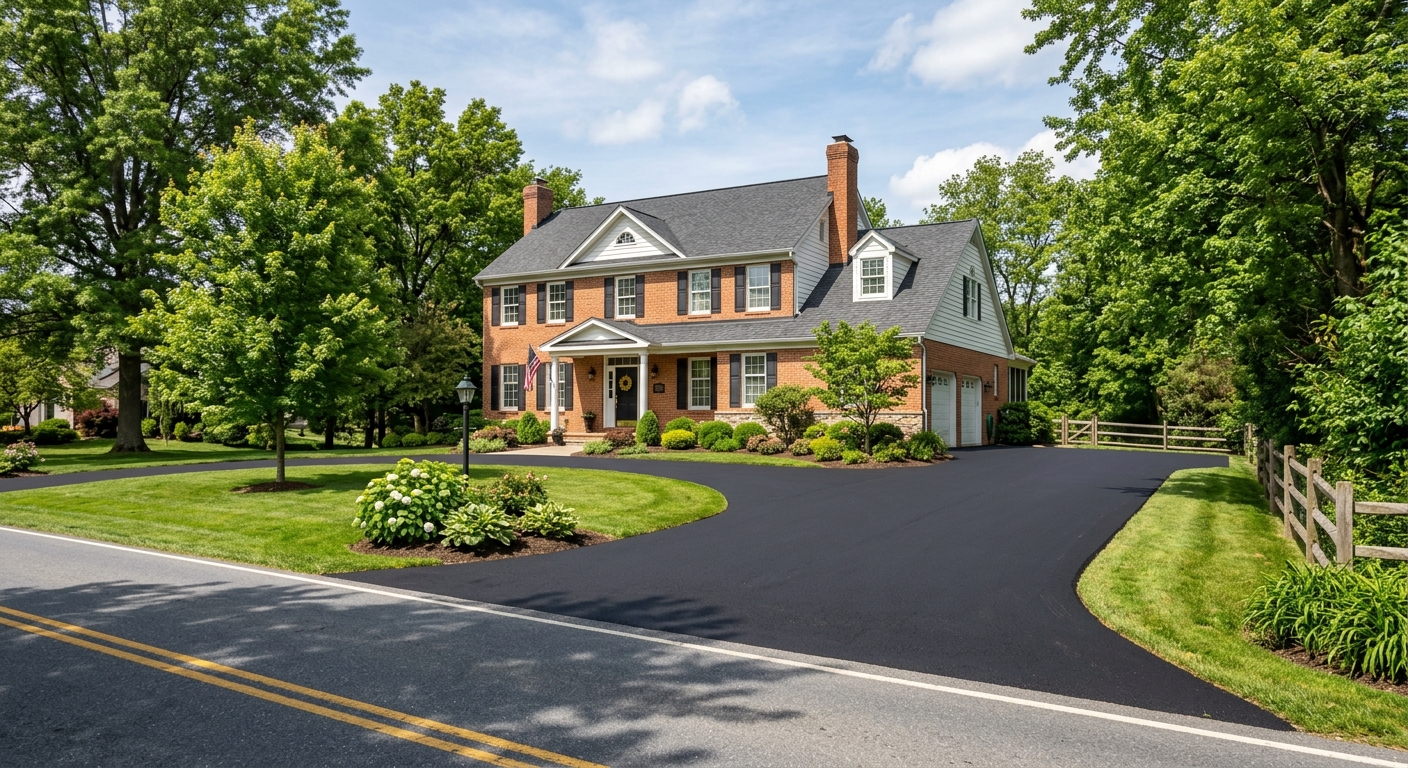
Lower Providence paving prices by scope — 2026
Lower Providence, with its 63.4% single-family homes and 76.1% homeownership rate (U.S. Census Bureau, ACS 2024), sees a steady demand for driveway paving as homeowners here are mostly responsible for their own access, parking, and curb appeal. Expect quotes to range widely—even for what look like similar jobs. The main reason is hidden: most of the cost difference is underneath what you see, in excavation, base stone, and preparation. Especially with our moderate freeze-thaw conditions and the glacial till and silty clay subgrade in parts of Montgomery County, a properly built stone base matters much more than the asphalt or concrete on top. Where the ground holds water or heaves, skimping on depth and drainage ensures cracks and potholes down the line.
In Lower Providence, asphalt driveways dominate because they pair well with the neighborhood’s age and lot sizes, but concrete is still an option for homeowners willing to pay for longer service. Sealcoating, overlays, and patchwork offer cheaper maintenance alternatives, but won’t fix structural issues. Here is what you can expect to pay for various services:
| Service | Best for | Lifespan | Price range |
| Asphalt — full replacement with new base |
failed base, structural cracking |
20–30 yrs |
$3,900–$10,000 |
| Asphalt overlay / resurfacing |
sound base, surface cracking only |
8–15 yrs |
$1,700–$5,000 |
| Sealcoating — single application |
preventive maintenance on sound asphalt |
2–4 yrs |
$225–$800 |
| Concrete — new installation |
long service life, low maintenance |
30–50 yrs |
$5,600–$13,500 |
| Crack filling and patching |
isolated cracks under a quarter inch |
1–3 yrs |
$200–$800 |
| Gravel driveway |
rural, budget, long runs |
5–10 yrs with upkeep |
$900–$3,500 |
Estimates for a typical Lower Providence driveway. Square footage and base condition drive these figures more than material choice.
The paving season in southeastern Pennsylvania
Paving in Lower Providence isn’t just a matter of preference—it’s dictated by the weather and the supply chain. Hot-mix asphalt can only be installed when both the air and ground are warm enough that the mix won’t cool before it’s fully compacted. In this region, with a winter design temperature of 14 °F and moderate freeze-thaw, local asphalt plants close from late November through much of March. That means during deep winter, you simply can’t get fresh hot asphalt delivered from the plants along the I‑276 and US 202 corridors. Concrete work is also out when temperatures will fall below freezing, as it needs time above 32 °F to cure properly.
That local reality—shaped by our climate and supply lines—means driveway work here really happens from April through early November. The summer months are the busiest, with crews booked out and prices highest. If you aim for spring or late fall (but before frost risk), you’ll usually get better availability and sometimes more competitive pricing. If someone offers to pave your driveway after plant closures or during a cold snap, that’s a bright red flag about their quality or source. The same holds for “off-season deals”—with the ground cold and plants closed, good material simply isn’t available. Timing your job within the real paving season is the single best way to ensure a quality result in southeastern Pennsylvania.
What you need before paving in Lower Providence
In Lower Providence, most straightforward driveway replacements—meaning resurfacing or replacing in the same footprint—do not require a building permit from the township. That saves you paperwork and time if you’re not changing the boundaries. However, if you plan to widen your driveway or alter the street connection, you most likely need a permit for the driveway approach. In Montgomery Township just to the north, for example, the Public Works Department issues road occupancy permits for any changes at the road end. Expect similar scrutiny in Lower Providence: if your project affects the curb, apron, or public right-of-way, always check with the local code office or public works first.
Another key point: expanding your driveway adds impervious surface, which can trigger stormwater management requirements and, in some cases, set caps based on zoning. Even if no permit is needed, you cannot direct runoff onto a neighbor’s property—liability for water damage remains with you, and poor drainage is one of the fastest ways to damage your own base and driveway.
Finally, Pennsylvania law requires all contractors offering home improvement work over $500 to be registered with the PA Office of Attorney General—verify them at hic.attorneygeneral.gov. Proof of workers’ compensation insurance is also mandatory for every employer; you can check coverage status on WCAIS at wcais.pa.gov. Always insist on documentation before you sign.
Local soil, drainage and driveway lifespan
The eastern half of Montgomery County, including Lower Providence, sits mainly on glacial till and silty clay subgrade. This local fact matters more for your driveway than any brand of asphalt or concrete. Silty clay holds water and swells during our freeze-thaw cycles, then shrinks and cracks when it dries. Glacial till drains a little better but is usually uneven, so it can lead to settlement if base stone isn’t deep and well-compacted.
Add in our regional frost depth of 30 inches and a genuine freeze-thaw swing, and you can see why shortcuts on sub-base prep spell trouble. Older driveways—especially those laid during the post‑1945 housing boom in nearby Abington and Upper Dublin—were often built thin as development outpaced standards. Many of those are now due for replacement, and the right fix means stripping down to solid subgrade and building up with extra stone for drainage and stability. If a quote is much cheaper than another, check if it includes base excavation and replacement—it’s usually the difference between a 10-year surface and one that goes the distance.
Drainage correction matters too: water must be kept moving away from the drive, not allowed to pool or run under the pavement, or base failure won’t be far behind.
Caring for a new Lower Providence driveway
If you want your new driveway to last in Lower Providence’s climate, focus on maintenance that actually works. Filling cracks before water seeps into the base is the most effective—and cheapest—step. Make it a habit every fall, before repeated freezing and thawing can wedge those cracks wider and undermine your stone base. Support the driveway edges with soil or stone so the asphalt or concrete isn’t left hanging, which leads to cracks and eventual breakup.
Keep water moving: unblock downspouts, sweep back debris, and avoid trapping water along the sides. Don’t let dumpsters, jack stands, or heavy trailers sit on one spot—point loads cause dents and, over time, deep depressions that aren’t fixable with surface patching alone.
For new asphalt, wait at least a week before parking, and avoid turning wheels sharply while stationary for the first month—otherwise, you’ll scar or rut the surface while it’s still curing. On the winter question: salt speeds up freeze-thaw damage on asphalt, but is especially hard on concrete. Calcium chloride and magnesium chloride cost more but do less harm; sand is safest but doesn’t melt. With humid summers and occasional storm remnants, drainage and crack sealing matter here more than in drier regions.
Sealcoating: what it does and what it doesn't
Sealcoating is widely sold around Lower Providence, but its benefits are often overstated. Here’s what it truly does: a proper sealcoat protects the top layer of asphalt from oxidation by sun and air, slows down softening from oil/gas leaks, wards off early raveling, and makes a faded driveway look new again. That’s real value if your asphalt’s in good shape and you want it to stay that way.
But what sealcoating cannot do is add any structural strength or fix a failing base. If your driveway is already cracked through or has soft spots, a sealcoat won’t change that—no matter what a flyer claims. Even worse, sealing too often (every year) leads to thick, brittle layers that crack and peel up. For a new asphalt drive, you should actually wait a year before the first sealant; sealing too soon traps oils and causes long-term problems.
The “right” interval for sealcoating in Lower Providence is every 2–4 years—not annually. A proper job is a squeegee or brush-applied layer, not a thin spray. Budget jobs at the low end of the $225–$800 range often skip cleaning and go on thin, which won’t last a full season. If a price sounds too good, that’s likely what you’ll get.
Honestly, if you have to pick between yearly sealcoating and thorough crack filling, spend your money on the cracks. Keeping water out of the base delivers more extra years than new sealer ever will.
Widening, extending or adding a parking pad
Projects that go beyond a simple replacement—such as widening for a second car, extending toward a detached garage, adding a turnaround, or finally paving an old gravel run—introduce new rules and costs in Lower Providence. A new footprint means building a new stone base directly on undisturbed subgrade, which costs more than resurfacing. Where the new and existing pavements meet, there’s always a seam: this will be a permanent weak spot and may be visible no matter how good the crew is.
Every added square foot of pavement counts as new impervious surface, so stormwater management rules may apply. Setback requirements can limit how close you can pave to property or township rights-of-way. And if your project affects the apron or curb (where your driveway meets the road), expect to need a road occupancy or approach permit from public works for that portion, even if the rest of the drive is permit-free.
None of these extras make the job “unnecessary,” but they do change what you need to plan and budget for. Don’t expect a simple overlay price on an expansion—the labor and requirements are simply different.
Frequently asked questions — driveway paving in Lower Providence
Is sealcoating a scam?
Sealcoating isn’t a scam in Lower Providence if it’s sold honestly. A good sealcoat will slow down the fading, brittle cracking, and surface wear that our climate brings. It keeps an already-solid driveway looking fresh and blocks oil and sun. But too often, it gets pushed as a fix for deep cracks or failing driveways—which it isn’t. Worse is when it’s sold as a yearly “must”—if you seal every year, you’ll build up brittle layers that can peel or crack, doing more harm than good. For well-built asphalt, sealing every 2–4 years at $225–$800 is reasonable here. If your drive is broken, blocky, or soft underneath, sealcoating won’t fix the real problem. Be wary of lowball offers in flyers; sometimes you just get a thin, watered-down application that washes off with the first heavy rain.
What does compaction in lifts mean?
Compaction in lifts means the paving crew builds up the driveway base and surface in several thin layers, called lifts, compacting each before the next is added. In Lower Providence, this is essential because our glacial till and silty clay soils will settle and hold water if they aren't stabilized properly. A single thick layer won’t compact evenly, leaving soft spots. For asphalt base, each lift is usually 2–3 inches, compacted while hot. Good crews use a plate compactor or roller on every layer—cutting corners here is what leads to ruts and early cracking. It adds labor and time but directly determines whether your driveway lasts 8 years or 25. Quotes at the low end of $3,900–$10,000 for full replacement may skip this step; ask specifically about lifts and compaction before you sign.
How many freeze-thaw cycles does Lower Providence get?
Lower Providence gets a moderate number of freeze-thaw cycles each winter—often 30 or more. Each cycle is when the temperature swings above and below freezing, causing trapped water in clay or base stone to expand and contract. Over time, this pries apart weak points and widens small cracks. The real issue isn’t just “freezing” but this back-and-forth, which we see from November through March most winters. Combined with our silty clay subgrade, these cycles are especially tough on driveways without a deep, well-drained stone base. That’s why patch jobs and overlays without fixing base drainage often fail here quicker than homeowners expect, pushing them back toward full replacement around $3,900–$10,000 sooner than they’d like.
When is the best time of year to pave in Lower Providence?
The best time to pave in Lower Providence is late spring to early fall, ideally between April and early November. Outside those months, temperatures dip too low and asphalt plants close, so quality work simply isn’t possible. Summer is busiest, with contractors booked out and prices firmer. If you schedule during the April–June shoulder, you’ll often find more contractor availability and possibly get better pricing. Trying to squeeze in a job late in the season risks weak compaction and short-lived pavement. For a typical asphalt replacement, budget $3,900–$10,000. Don’t fall for “off-season” discounts in deep winter; in this market, quality work just isn’t done after the plants close for the season.
Should I repair or replace my Lower Providence driveway?
Whether to repair or fully replace comes down to the condition of your base and the extent of cracking. In Lower Providence, if cracks are narrow (under 1/4") and isolated, crack filling or patching in the $200–$800 range can buy a few more years. If you’re seeing wide or alligator cracks, low spots, or the surface flexes underfoot, your base may have failed. That means overlays, even at $1,700–$5,000, are only a bandaid. Full replacement—removing old asphalt and rebuilding the stone base—is costlier, but it’s the only path to a decades-long fix here given our soil and winter cycles. Don’t let a contractor talk you into “just another coat” if water sits or the drive feels soft. The right answer is about what’s underneath, not surface appearance.
What does an asphalt overlay cost in Lower Providence?
An asphalt overlay—putting new hot-mix asphalt over a sound, existing base—costs most Lower Providence homeowners between $1,700–$5,000. The wide range depends on driveway size and how much prep is needed. This is a solid option if your cracks are shallow and the base is firm everywhere, but overlays are not a fix for structural base failure. In our area, overlays typically add 8–15 years of life, compared to 20–30 years for full replacement with new base. If a quote is on the low side, ask if they’ll be milling (roughening) the old surface, patching low spots, and compacting the overlay in proper lifts—these steps prevent “slip” and early resurfacing failure.
How do I verify a paving contractor in Pennsylvania?
To verify a driveway paving contractor in Pennsylvania, especially in Lower Providence, use two official sources. First, confirm they are registered as a Home Improvement Contractor with the Office of Attorney General at hic.attorneygeneral.gov—required for any contract over $500 by state law. This registry lists companies, not individuals, and you can check for recent complaints too. Second, if the crew is more than one person, ask for proof of workers’ compensation insurance; this protects you from injury liability. You can check coverage status on WCAIS at wcais.pa.gov. Good contractors will provide these without hesitation. A cheap quote for any driveway job—whether $225–$800 for sealcoating or $3,900–$10,000 for full replacement—means nothing if the company is unregistered or uninsured.
What are the signs of a failing driveway base?
Signs of a failing driveway base in Lower Providence include widespread “alligator” (blocky, interconnected) cracking, soft or spongy spots underfoot or under a parked car, and areas where water ponds or seeps after rain. Potholes that return quickly after patching, edges that crumble away, or asphalt that flexes or ripples are also red flags. Local silty clay soils mean that base failure is often from trapped water and freeze-thaw damage, not just age. If the problems are just a few small, narrow cracks, crack filling in the $200–$800 range can control the spread. But widespread symptoms mean the only real fix is a full replacement—excavating to subgrade and rebuilding a deeper stone base.
What does sealcoating cost in Lower Providence?
Most Lower Providence homeowners pay $225–$800 for a single, proper sealcoating on a two-car asphalt driveway. Price depends on square footage, cleaning and prep, and how the sealant is applied. The low end usually means a quick spray (thin and less effective), while the upper end can include crack sealing and a brush or squeegee application. You’ll see flyers advertising “whole drive $99” or some similar lowball, but these jobs tend to skip prep and use heavily diluted or low-grade products that won’t last. Spending the few hundred for a careful, professional coat every 2–4 years actually pays for itself in appearance and prolonging surface life in our climate. Don’t overdo it annually—wait until the surface is faded, not chalky.