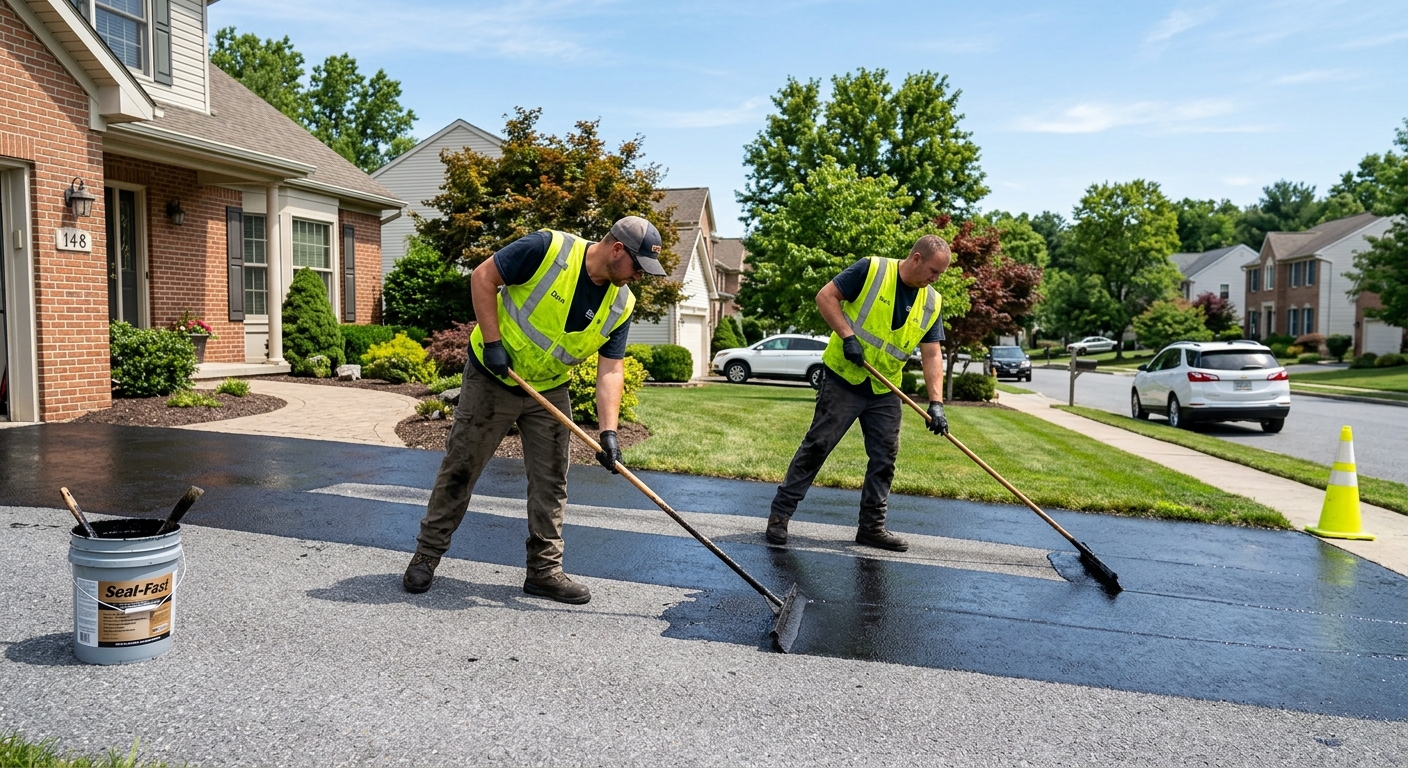
Milton paving prices by scope — 2026
In Milton, a driveway project is a major homeowner expense, and it shows up in the numbers—less than half of local households own their home, and only 42.5% of homes are single-family (U.S. Census Bureau, ACS 2024). For those single-family homeowners, a driveway is often the largest exterior investment aside from the roof. Our north-central Pennsylvania climate, with its intense freeze-thaw cycles and deep frost line, means the ground shifts: the subgrade under every driveway is at risk for movement. Here, that subgrade is mostly shale and glacial till, which can demand extra excavation and compaction compared to other areas.
Most of the price difference between two paving quotes in Milton is hidden below the surface—specifically, in the quality and depth of the stone base, how much old material is undercut and removed, and how thoroughly the base is compacted. A driveway that "looks fine" on top can fail quickly if shortcuts are taken below. So, while material choice matters, it is the invisible work that truly determines longevity and costs. Below are the typical Milton price bands for each service:
| Service |
Best for |
Lifespan |
Price range |
| Asphalt — full replacement with new base |
failed base, structural cracking |
20–30 yrs |
$3,200–$8,100 |
| Asphalt overlay / resurfacing |
sound base, surface cracking only |
8–15 yrs |
$1,350–$4,100 |
| Sealcoating — single application |
preventive maintenance on sound asphalt |
2–4 yrs |
$175–$650 |
| Concrete — new installation |
long service life, low maintenance |
30–50 yrs |
$4,500–$11,000 |
| Crack filling and patching |
isolated cracks under a quarter inch |
1–3 yrs |
$200–$800 |
| Gravel driveway |
rural, budget, long runs |
5–10 yrs with upkeep |
$900–$3,500 |
Estimates for a typical Milton driveway. Square footage and base condition drive these figures more than material choice.
Comparing materials in north-central Pennsylvania
Picking the right driveway material in Milton should be about performance, not just first cost. Winters here are hard—the ground frost reaches 36 inches deep, and north-central Pennsylvania sees more than 6,000 heating degree days per year. Those freeze-thaw cycles are brutal on rigid surfaces.
Asphalt is the most common choice for good reason: it flexes when the ground moves, and that flexibility helps it survive both the freeze-thaw cycles and subgrade shifts. You will still see cracks eventually, but with timely maintenance, an asphalt drive will last 20 to 30 years. Concrete costs more up front and, if not attacked by salt, can last twice as long. But here's the rub: concrete can't handle repeated salt de-icing, which accelerates spalling and surface scaling. Most driveways here fail for exactly that reason—not for underlying cracks. Unless you're disciplined about not using salt through the long and icy season, concrete won't deliver its theoretical lifespan.
Pavers work if you want a high-end look and can handle some minor settling, but expect a higher upfront cost. Gravel is a solid option for rural settings or long driveways, needing regular top-dressing but handling drainage and freeze-thaw better than most rigid surfaces.
| Option |
Installed cost |
Maintenance |
Freeze-thaw performance |
Lifespan |
| Asphalt — new install |
$3,200–$8,100 |
sealcoat every 3–4 yrs |
excellent, flexes |
20–30 yrs |
| Asphalt — overlay |
$1,350–$4,100 |
same |
good if base is sound |
+8–15 yrs |
| Concrete |
$4,500–$11,000 |
low, avoid de-icing salt |
fair, spalls with salt |
30–50 yrs |
| Pavers |
$7,200–$11,000 |
individual units replaceable |
good, settles gradually |
25–50 yrs |
| Gravel |
$900–$3,500 |
top-dress every 2–3 yrs |
excellent drainage |
indefinite with upkeep |
How to tell if the base is gone
If you want to know whether your Milton driveway needs a repair or full replacement, start with what you can see. Alligator cracking—tight, interlocking cracks over a wide area—almost always means the base has failed. Water has worked its way in, and the freeze-thaw cycles have finished the job. If someone offers an overlay over this, they’re skipping the problem. In contrast, straight or gently curving cracks that stay under a quarter inch wide are usually surface aging. Birdbaths or low spots that hold water suggest the subgrade under the base is unstable and shifting. Crumbling or broken edges point to missing or weak edge support, which is common in postwar housing here. Potholes are a sign that water has made its way right down to the base material.
The standard Milton subgrade—shale and glacial till—is not forgiving of shortcuts. Any overlay over a failed base is wasted money. If a quote doesn’t include base probing or excavation depths, it’s a red flag—someone hasn’t checked what matters most.
| What you see |
Likely cause |
Right fix |
Cost |
| Isolated cracks under 1/4 inch |
surface aging |
crack fill and seal |
$175–$650 |
| Alligator cracking over a wide area |
base failure |
full replacement |
$3,200–$8,100 |
| Depressions holding water |
subgrade movement |
excavate and rebuild that area |
$3,200–$5,000 |
| Crumbling edges |
no edge support |
edge repair, consider curbing |
$400–$1,500 |
| Potholes |
water into the base |
full-depth patch, then assess |
$250–$900 |
| Faded but sound surface |
oxidation only |
sealcoat |
$175–$650 |
Sealcoating: what it does and what it doesn't
Sealcoating in Milton is preventive care, not a cure. Done right, a single application shields your asphalt from UV damage, slows down oxidation, and helps guard against gas and oil drips. It makes the surface look fresh and dark, which is what most people notice right away. But it’s not a structural fix: sealcoating doesn’t glue cracks shut, restore failed areas, or turn a tired surface into new. If your base is already failing, you can seal it twice a year and the only thing that changes is the color—it won’t last any longer.
One thing most companies never say: put on too many coats and you’ll get a flaky, pebbly mess that cracks and peels away. Sealcoating a brand new drive before it’s fully cured will lock in oils and cause premature failure—waiting at least a full summer is best. No one should be selling annual sealcoats here; a good interval is every 3 to 4 years for most Milton driveways.
Crack filling matters more for lifespan. It blocks water from reaching the base and should be done properly—hot rubber, routed clean, and filled to finish. The spray-and-dash sealcoat jobs you see at the low end of $175–$650 often skip this step. If a company's price is much lower than that, it's probably water with black dye, and the coating will disappear after a season or two.
Getting thirty years out of a driveway
The biggest impact on your driveway’s life in Milton is stopping water from reaching the base. Crack filling matters most—do it before cracks let water in. Edges come next: crumbling edges allow the asphalt to break off and the base to wash away, so keep side support in good shape. Good grading is essential; water should always move away from the drive, not pond or run toward the house. Avoid point loads like jack stands or dumpsters directly on the surface—even a short stint can punch through older asphalt.
When resurfacing, let new asphalt cure fully before parking, especially in the summer. Turning the wheels in place on soft asphalt leaves scars that'll last forever. In winter, our heavy heating load and freeze-thaw cycles are rough on surfaces. Salt is a double-edged sword: on concrete, it causes spalling and can turn a new drive to rubble in a few seasons. On asphalt, the bigger threat is not the salt itself, but the meltwater that soaks in and re-freezes at night. Calcium chloride or bird seed are less damaging alternatives, but pricier.
What a real paving quote contains
When comparing driveway quotes in Milton, look beyond the bottom line. The most important details are almost always buried in the line items. A legitimate quote lists the measured square footage—and it’s measured, not guessed. It will spell out how deep old material is excavated and how disposal is handled. Stone base type and depth (in inches) matter; a good bid says both. Compaction should be done in lifts—the quote should say so. For asphalt, both number of courses and compacted depth are specified. Edge treatment, like built-up borders or curbing, must be listed if offered.
Pay attention to drainage: the slope and direction water will run should be spelled out. Cleanup—restoring the lawn edge or reseeding—is worth asking about. Payment terms should be clear and reasonable: a modest deposit, then the balance upon completion. The warranty tells you what’s truly covered, and most exclude what actually fails—cracking. A one-line “we’ll pave your driveway for $X” quote gives you no basis to compare, and that is how most Milton homeowners end up paying full price for a shortcut job.
| Line item |
What to look for |
Red flag if… |
| Area |
measured square footage stated |
eyeballed or absent |
| Excavation |
depth and disposal included |
'we'll pave over it' |
| Base |
aggregate type and depth in inches |
'proper base' |
| Compaction |
method, and done in lifts |
not mentioned |
| Asphalt |
courses and compacted depth |
'3 inches' unqualified |
| Drainage |
slope and water direction stated |
silent |
| Warranty |
what is covered and what is excluded |
verbal only |
| Payment |
modest deposit, balance on completion |
full cash up front |
What you need before paving in Milton
In Milton, a building permit is typically not required just to repave or resurface a driveway that stays within its original footprint. If you’re not widening or moving your driveway, you likely save yourself a call—this is standard in Northumberland County per the local policy facts. However, if you’re altering the driveway approach—where it meets a public road—a permit will usually be needed. For driveways that connect to a state highway, you’ll need to go through the PennDOT District 3 Maintenance Office for a highway occupancy permit, not your borough office. Homeowners are often surprised that the approach requires a different permit and authority than the rest of the drive.
Also, if you increase the paved area, consider stormwater: more impervious surface can mean new runoff rules. Directing water onto a neighbor’s property creates real liability—permits won’t protect you there. For hiring, any contractor doing more than $500 in work must have a Pennsylvania Home Improvement Contractor (HIC) registration, which you can verify at hic.attorneygeneral.gov. If the contractor has employees on-site, workers' compensation coverage is mandatory—verify this in the WCAIS system at wcais.pa.gov before any work starts.
Frequently asked questions — driveway paving in Milton
How deep should the aggregate base be here?
For Milton, a proper aggregate base is the difference between a driveway that lasts three years and one that lasts thirty. Because our local subgrade is mostly shale and glacial till, and the frost depth reaches 36 inches, the base needs to be thicker than what you might see in other regions. On a typical single-family home, 6 to 8 inches of compacted, well-graded stone is the safe minimum. For heavier vehicles or poor-draining soil, going up to 10 inches is a smart move. Cutting corners below the surface is almost always why a “bargain” driveway fails early. If your quote doesn’t specify both type and depth, you can bet you’re not getting a full rebuild—for the typical price of $3,200–$8,100, you should expect excavation and a proper base profile.
Is gravel a cheaper option in Milton?
Gravel is the lowest initial cost for a Milton driveway, especially on longer rural approaches. With a price band of $900–$3,500, it often comes in well under what asphalt or concrete would cost. Our local quarries supply suitable aggregate, though haul distance can nudge up the total price in Northumberland County. That said, gravel isn’t set-it-and-forget-it: it requires regrading and fresh gravel every few years, especially with freeze-thaw cycles and plow damage during heavy winters. Still, if you’re willing to put in a little ongoing upkeep, gravel is a practical, budget-friendly answer for driveways where dust, snow removal, and a less “finished” look are not deal-breakers.
When can I seal a brand new asphalt driveway?
In Milton’s climate, patience pays off with new asphalt. You should wait a minimum of three months, and preferably through one full summer, before applying a sealcoat. Curing depends on weather, but this region’s long, cool springs mean asphalt can take longer to fully stabilize. Seal too soon and you’ll trap solvents, which makes for soft, scuffed spots and premature peeling. Most contractors recommend your first sealcoating in late summer or early fall after installation. For the typical cost of $175–$650 in Milton, make sure you’re getting a hand-applied or squeegee coat on a fully cured, clean surface—rush it, and you lose both your money and your new driveway’s best chance at a long life.
What does sealcoating cost in Milton?
In Milton, a single application of quality sealcoat on an average driveway ranges from $175–$650, with most homeowners near the middle of that range. The price varies most with driveway size, but also with how much cleaning and prep is needed. Be wary of low bids—jobs at the bottom end often mean thin, sprayed-on coatings that wear off after a winter or skip needed crack filling. In contrast, thorough cleaning, proper crack sealing, and a two-coat hand application are worth the extra cost and can keep the driveway looking good for several years. Milton’s heavy snow and salt demand a little more investment up front for a result that lasts longer.
When is the best time of year to pave in Milton?
The best season for paving in Milton is late spring through early fall, typically May through September. Our region’s long, cold winters and damp springs make early or late paving risky—cold ground and freezing nights prevent the asphalt from bonding and compacting properly. Summer provides the warm, dry conditions asphalt and concrete need to cure. The local contractor market is thin, so booking early helps secure a spot when the window opens. Prices, such as $3,200–$8,100 for full replacements, rarely drop in late fall—rush jobs at season’s end often mean cut corners. The wait for the right weather pays off in results.
How long should an asphalt driveway last in Milton?
With proper installation and care, an asphalt driveway should last 20 to 30 years in Milton. The local climate—with its deep frost, repeated freezing and thawing, and heavy snow—puts every driveway under extra stress. What makes the biggest difference isn’t just the material, but the quality and depth of the stone base, as well as good drainage. Regular crack filling and sealcoating (typically $175–$650 every few years) help keep water out and oxidation at bay. If you see widespread cracking, crumbling edges, or birdbaths, the base may need more than a surface fix, which is why replacement costs run $3,200–$8,100 in this area.
Asphalt or concrete for a Milton driveway?
For Milton’s climate, asphalt is the practical choice for most situations—flexible enough for our harsh freeze-thaw cycles and still affordable at $3,200–$8,100 for a standard replacement. Concrete costs more, $4,500–$11,000, and can theoretically last much longer, but only if you avoid salt-based de-icers that cause scaling and spalling. With our long, icy winters, almost every concrete drive here eventually suffers from salt damage before reaching its maximum age. Asphalt, while requiring periodic sealing and crack filling, can be easily repaired and stands up better when the subgrade shifts or heaves during winter.
What kind of soil is under Milton driveways?
Almost every Milton driveway is built over a mix of shale and glacial till—typical for river-valley towns in Northumberland County. This soil type drains slowly and shifts with seasonal freeze and thaw. That’s why driveways here absolutely need a thick, compacted stone base—skimp on depth or compaction, and the surface will move, crack, or settle unevenly. This is also why bids can vary so much in price—cutting corners isn’t visible up top, but it will show up after a few seasons of Milton’s weather. Expect a full replacement in the $3,200–$8,100 range, where much of the cost is the hidden work under the surface.
Can I cancel a paving contract I signed at my door?
Yes, in Pennsylvania—including Milton—you have a legal three-business-day right to cancel a home improvement contract signed at your home under the Home Improvement Consumer Protection Act. This applies to all contracts over $500, including most driveway paving jobs. That window gives you time to check references, verify HIC registration (required for all legitimate contractors in the state), and make sure the price fits the local market band—for example, $3,200–$8,100 for a full asphalt replacement. If a contractor pressures you to waive your right to cancel or offers to cover your insurance deductible, that’s a clear violation of state law and a sign to walk away.