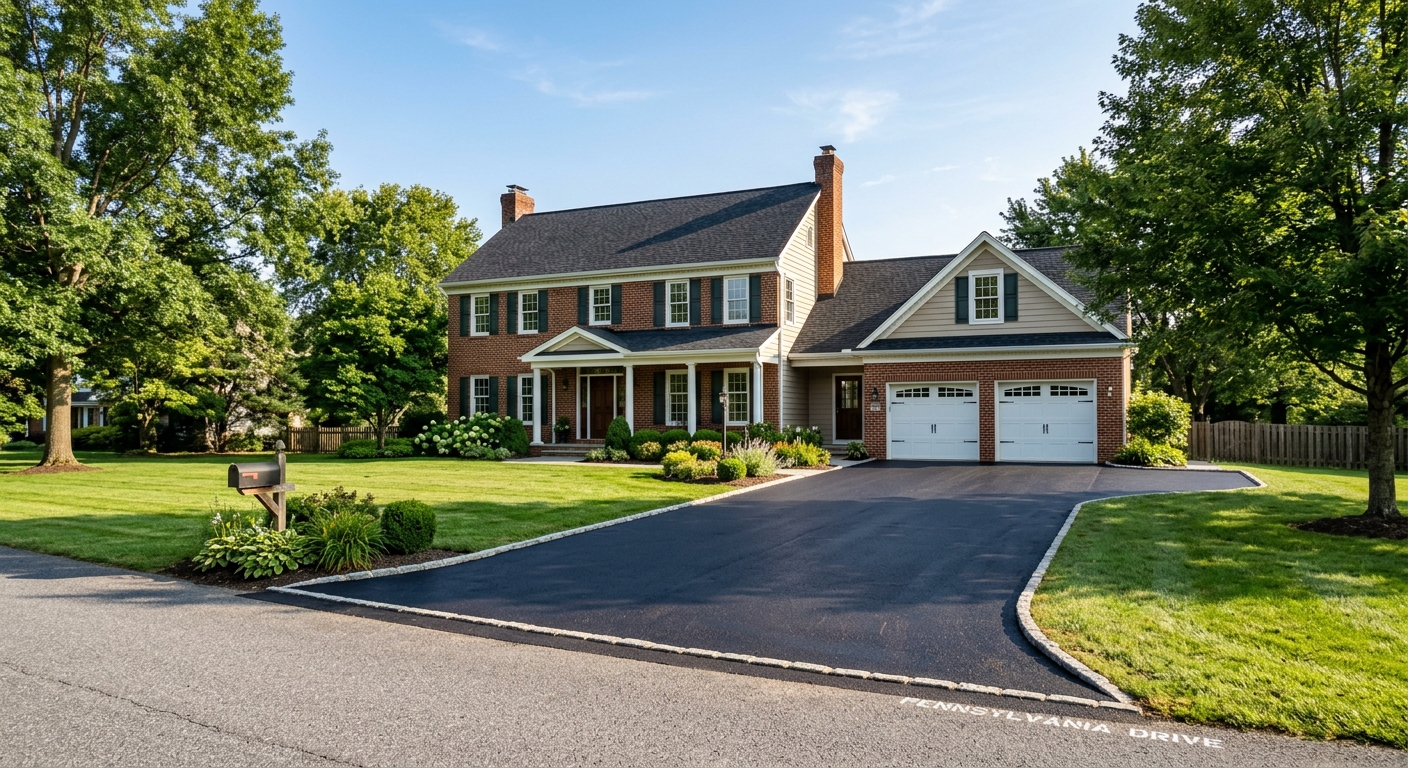
Muhlenberg paving prices by scope — 2026
In Muhlenberg, the decision to pave or replace a driveway is nearly always a single-family homeowner’s expense—relevant since 63.9% of homes here are detached, and the homeownership rate stands at 81.9% (U.S. Census Bureau, ACS 2024). Most homeowners are maintaining and updating older driveways built during the big subdivision boom before 1980. With pronounced freeze-thaw cycles every winter, asphalt driveways here take a beating below the surface, especially over the shale and limestone subgrades common in Berks County. The problem: almost every visible driveway defect—cracks, potholes, heaving—starts under the surface where you can’t see. That’s why two bids for the same job can vary by thousands of dollars: one replaces base/subgrade for longevity, the other might skip it. Material price matters, but what you’re really paying for is what goes below the blacktop.
| Service |
Best for |
Lifespan |
Price range |
| Asphalt — full replacement with new base |
failed base, structural cracking |
20–30 yrs |
$3,400–$8,800 |
| Asphalt overlay / resurfacing |
sound base, surface cracking only |
8–15 yrs |
$1,450–$4,400 |
| Sealcoating — single application |
preventive maintenance on sound asphalt |
2–4 yrs |
$200–$700 |
| Concrete — new installation |
long service life, low maintenance |
30–50 yrs |
$4,900–$12,000 |
| Crack filling and patching |
isolated cracks under a quarter inch |
1–3 yrs |
$200–$800 |
| Gravel driveway |
rural, budget, long runs |
5–10 yrs with upkeep |
$900–$3,500 |
Estimates for a typical Muhlenberg driveway. Square footage and base condition drive these figures more than material choice.
Permits and approvals for paving in Muhlenberg
For most homeowners in Muhlenberg Township, repaving or resurfacing your existing residential driveway—provided you’re not expanding the footprint—usually proceeds without any permit. This saves time and paperwork, as long as you’re not disturbing over an acre or adding more than 5,000 square feet of new impervious surface. But the spot where your driveway meets the street—the approach or apron—falls under separate rules. For driveways connecting to a state road, you’ll need a Highway Occupancy (driveway approach) permit from PennDOT, while local township offices handle approach permits for driveways joining township roads. Don’t skip this step: even if you’re just re-doing the same apron, the township or PennDOT needs to sign off for safety and drainage.
Stormwater counts: any new impervious paving increases runoff. If water starts pooling in a neighbor’s yard due to your project, you could be on the hook, no matter what your permit says. So drainage design is part of every credible paving plan in Berks County.
When choosing a contractor, Pennsylvania law (Home Improvement Consumer Protection Act) protects you: any work over $500 needs a written contract and gives you three business days to cancel. Only hire companies with a valid Home Improvement Contractor (HIC) registration (check hic.attorneygeneral.gov) for jobs over $500. If a crew has employees (not just the owner), Pennsylvania requires verifiable workers' compensation, and you can confirm coverage through WCAIS (wcais.pa.gov).
Grading and water management on a Muhlenberg driveway
Grading is the most important part of any driveway project in Muhlenberg. With pronounced freeze-thaw cycles throughout the Berks County winter, water that’s trapped in or under your driveway will freeze, expand, and heave the pavement, causing cracks and potholes that no amount of patching will really fix. The landscape here is underlain with shale and limestone, so slow-draining pockets near driveways are common—a problem made worse by subpar grading.
For surface runoff, a minimum slope of 2% (about a quarter inch per foot) is needed to reliably shed water. Most driveways use a crown (center higher than the edges) or a cross-slope (one edge higher than the other) to shed water. If your driveway slopes toward your garage or house, you’ll need corrective grading—either building up the approach or adding a trench or channel drain at the low point. Where it’s impossible to direct runoff to the street, daylighting (running a pipe to open ground) or an engineered dry well may be needed, though dry wells are a poor match with heavy clays or shallow limestone.
Redirecting runoff onto your neighbor’s property isn’t just bad manners—it’s a real risk for complaints or even legal headaches no matter what permit you hold. Drainage isn’t a finishing detail in this region; it’s mission-critical, and inadequate design is the number-one reason driveways here fail before their time.
How paving fraud actually operates
Driveway paving draws scams for one reason: the results are visible from your kitchen window, but the true quality is buried, and the real failures take years to show up. In Berks County, with its mix of moderate suburban and rural density, transient paving crews target neighborhoods where word-of-mouth is weaker and verification is harder—especially in places like Muhlenberg with older subdivisions and owner-occupied homes.
The classic scams show up every year: a stranger in an unmarked truck claims to have “leftover material” from a job down the block and offers a steep discount—if you’ll pay cash today. The pitch is pressure-heavy: “The price is only good if we start right now.” Legitimate contractors never use these tactics. Another red flag is a handshake deal or verbal estimate, which sidesteps your legal right to a written scope. And beware sealcoating: some crews thin cheap oil-based products and spray so little material that it washes away after a few rains. “References” are often bogus or from out of county. If the truck’s plates aren’t local, be extra careful.
Under Pennsylvania’s Home Improvement Consumer Protection Act, you’re entitled to a written contract on any residential job over $500 and can cancel within three business days. That law is built for driveway projects because most shoppers get approached at the door, not the kitchen table.
Do this before signing: verify their HIC registration at hic.attorneygeneral.gov, check workers’ comp at wcais.pa.gov, demand a written contract with exact specs—never pay more than a third up front, and walk away from any today-only pitch.
Local soil, drainage and driveway lifespan
The eastern side of Berks County, including Muhlenberg, sits on a mix of shale and limestone subgrade. Shale drains slowly and is prone to frost heaving, while limestone can settle unpredictably if not properly compacted and drained. This means new driveways—especially those replacing old, alligator-cracked pavement from the 1950–1980 subdivision boom—benefit from a thicker aggregate base than you might see one county east or west. If you’re just resurfacing, know that a thin overlay cannot cure water trapped underneath.
Frost depth here pushes 30 inches, and the region’s freeze-thaw cycles will punish any shortcut in base prep. A poorly-drained clay pocket or too-thin compacted stone layer means you’ll see settling and cracks in just a few years. Many driveways in Muhlenberg are now over 40 years old, built under standards that often skimped on base thickness. If your original drive has started to dip, heave, or collect water, it’s likely not a surface issue but a symptom of an underbuilt or failing base. Addressing these local soil behaviors up front is what lets a driveway actually reach the top end of its lifespan range.
Comparing materials in south-central Pennsylvania
Asphalt and concrete are the most common driveway choices in Muhlenberg for one central reason: both are suited (with caveats) to south-central Pennsylvania’s serious freeze-thaw cycling and moderate snowfall. Asphalt is flexible; it bends and absorbs movement when our base materials heave or settle, which is why it’s the go-to in areas with cold winters and mixed subgrade like Berks County. Properly maintained, an asphalt driveway can last 20–30 years, and overlaying a sound base can add another 8–15 years for far less money.
Concrete is stiffer and can easily last twice as long—if it survives the abuse. The catch? Concrete will spall and scale when de-icing salt soaks in and then freezes, and Berks County roads get plowed and salted in every storm. If you (or a neighbor’s plow) throw salt on a concrete drive, expect to see surface damage within a few winters. For those who can commit to non-salt de-icers and fast snow removal, concrete is reliable, but that’s a behavioral commitment rarely kept over the long run.
Paver driveways suit patios and high-end settings, offering individual unit repair and reasonable freeze-thaw performance, but they come at a premium. Gravel remains a good budget or rural solution—especially for long runs—though it needs periodic top-dressing. Your final choice should weigh upfront price, your tolerance for upkeep, and your willingness to swap out salt for calcium chloride or shovels on a snowy week.
| Option |
Installed cost |
Maintenance |
Freeze-thaw performance |
Lifespan |
| Asphalt — new install |
$3,400–$8,800 |
sealcoat every 3–4 yrs |
excellent, flexes |
20–30 yrs |
| Asphalt — overlay |
$1,450–$4,400 |
same |
good if base is sound |
+8–15 yrs |
| Concrete |
$4,900–$12,000 |
low, avoid de-icing salt |
fair, spalls with salt |
30–50 yrs |
| Pavers |
$7,900–$12,000 |
individual units replaceable |
good, settles gradually |
25–50 yrs |
| Gravel |
$900–$3,500 |
top-dress every 2–3 yrs |
excellent drainage |
indefinite with upkeep |
Widening, extending or adding a parking pad
When you widen a driveway for a second car, run a new pad to your detached garage, or add a turnaround for easier exits on busy roads, you’re moving beyond a simple surface replacement. Any time you increase the paved area, you’re dealing with undisturbed subgrade—which means a new compacted base is absolutely required. The seam where new paving meets old will always be prone to cracking, so if possible, feather the joint further back into the existing driveway to reduce this weak spot.
Any project adding impervious surface may also bump up against stormwater management thresholds. In Berks County townships, stay under 5,000 square feet of new paving to avoid costly runoff permits and reviews. Placement matters, too: property line setbacks and easements often restrict how close you can build—don’t pour money into a pad only to find it’s not allowed.
If your new or widened drive ties into a township or state road, you’ll need an approach permit from the township or PennDOT to alter the apron. Plan this step first, since pad or extension projects often stall because of permitting at the point where your property meets the street.
Frequently asked questions — driveway paving in Muhlenberg
Why are paving quotes in Muhlenberg so different from each other?
Driveway quotes in Muhlenberg can vary by thousands because almost all the real cost—and risk—lies beneath the surface. Two contractors might quote the same smooth top layer, but one could be cutting corners on the base (the foundation under your asphalt or concrete), skipping needed aggregate, or doing less excavation. Shale and limestone soils in Berks County demand careful base prep, especially with freeze-thaw cycles that quickly expose shortcuts. A job spanning the full range—$3,400–$8,800 for a full asphalt replacement—could mean the difference between 5 and 25 years of service. Choose the bid that spells out base thickness, materials, and how drainage gets handled, not just the surface specs. That’s what determines driveway lifespan in this township.
How often should I sealcoat my driveway in Muhlenberg?
Sealcoating is preventive maintenance that helps an asphalt driveway withstand south-central Pennsylvania’s sun, rain, and freeze-thaw cycles. In Muhlenberg, a good rule is every 3–4 years, or sooner if your driveway is exposed to lots of sun and de-icing chemicals. Overdoing it—annual sealcoating—can cause layers to build up and crack, so stick to a moderate schedule. For most driveways here, expect to spend $200–$700 per single application depending on size and layout. If your drive is already showing alligator cracking or deep ruts, sealcoating won’t help—at that point, it’s time to consider patching or resurfacing instead of another coat.
How much does a concrete driveway cost in Muhlenberg?
As of 2026, homeowners in Muhlenberg can expect a new concrete driveway to run between $4,900–$12,000. The wide range reflects differing square footage, site access, and whether thickened edges or extra expansion joints are needed due to our region’s pronounced freeze-thaw cycles. Concrete offers a longer potential lifespan—sometimes 30 to 50 years here—if you avoid salt-based de-icers and keep the slab clear of ponded water. For many suburban homes built before 1980, a new install can also mean removing old pavement and rebuilding the base, which is a common cost driver in Berks County.
Can asphalt be laid in cold weather?
Asphalt can technically be installed in cold weather, but in Muhlenberg—and all of south-central Pennsylvania—there’s a real risk if the temperature drops too low. Ideally, paving is done when daytime highs are above 50°F for good workability and compaction. Paving crews have a narrow early spring and late fall window; laying asphalt in November, or on a chilly morning, puts the driveway at risk for premature cracking and poor surface texture. Skimping on these conditions to save a few weeks is not smart. For the best outcome within the typical Muhlenberg price range of $3,400–$8,800, wait for proper temps and consistent weather.
Can I cancel a paving contract I signed at my door?
Yes. In Pennsylvania, including Muhlenberg, the Home Improvement Consumer Protection Act gives you the right to cancel any residential paving contract over $500 within three business days of signing, if you signed it at your residence. This right is automatic, and sellers are required by law to inform you—if they don’t, the contract isn’t enforceable. This “cooling off” period protects homeowners from transient or high-pressure paving crews pushing deals at the doorstep. If you’re second-guessing a quote in the $3,400–$8,800 or similar range, notify the contractor in writing within three business days to legally void the agreement.
What are the signs of a failing driveway base?
In Muhlenberg, the most common tip-offs that your driveway base is failing (rather than just the surface) are deep depressions, persistent puddling, edge cracking, and “alligator” crack patterns that keep reappearing even after patching. If you see sections of your drive settling or heaving after winter, especially over shale or limestone, the base is likely saturated or not compacted right. In these cases, repairing the surface alone—such as a quick overlay costing $1,450–$4,400—will only buy a few years at best. Long-term fixes mean replacing the base, not just topping it.
Is an overlay worth it or should I start over?
An asphalt overlay, in the Muhlenberg price band of $1,450–$4,400, is a cost-effective solution—if and only if your base is solid. Overlays can address raveling and surface cracks, but if you’ve got base movement, deep rutting, or major puddling, you’re better off with a full replacement ($3,400–$8,800). Ask your contractor how they assess the base, not just the surface. If you put a new layer over a failing foundation, the cracks and dips will come back in just a few years. For many Muhlenberg homes from the 1950s–1980s, base failure is common, making overlays a temporary fix.
Does Muhlenberg have local asphalt plants?
Yes—Berks County, including Muhlenberg, benefits from local asphalt and aggregate quarries near Reading. Hauling distance is short, so asphalt mix for your driveway is usually produced and delivered the same day, which matters for quality and consistency. That’s reflected in regional prices; local supply helps keep jobs in the $3,400–$8,800 installation band competitive. If a company claims they need to bring mix from far away, get another quote—local supply is the norm here.
What does compaction in lifts mean?
“Compaction in lifts” is the process of installing the driveway base in multiple thin layers (called lifts), compacting each layer before adding the next. In Muhlenberg, with our mix of shale, limestone, and pronounced frost depth (30 inches), it’s especially important: thick, un-compacted layers settle unevenly and trap water, leading to surface cracks and rutting within a few years. Proper lift compaction ensures a dense, stable foundation that can make the difference between a $3,400–$8,800 asphalt drive lasting five years or thirty. On-site, it means you’ll see the crew working in phases, not just dumping all the stone or asphalt at once.