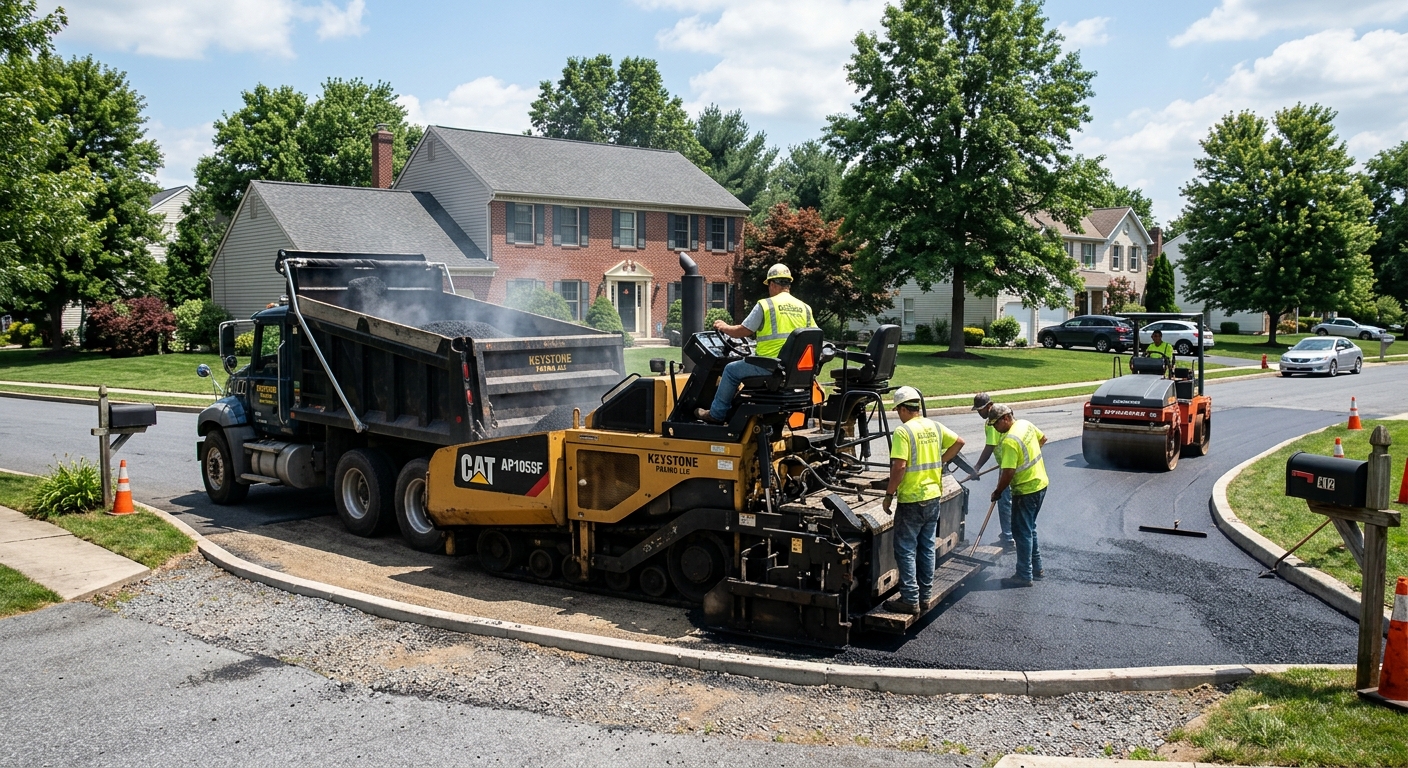
Dover paving prices by scope — 2026
If you own a single-family home in Dover, it's likely your driveway is your responsibility—86.3% of properties here are owner-occupied, and 64.7% are single-family homes (U.S. Census Bureau, ACS 2024). Driveway work is a common outlay for Dover homeowners, especially with the area's freeze-thaw cycling, moderate snowfall, and postwar building stock. The biggest reason for price variation between quotes here is what goes on under the new surface, out of sight: the base depth, type, and compaction. Most visual differences—number of crew, machine polish, crisp edges—affect curb appeal, but not longevity. The subgrade and base make or break a driveway in this region, particularly since local shale soils demand more than just a pretty top layer. Asphalt and concrete prices track national trends, but in York County, extra work on the base is often needed. Expect higher costs for proper base correction and water management; skipping them often results in early failure, not immediate savings.
| Service |
Best for |
Lifespan |
Price range |
| Asphalt — full replacement with new base |
failed base, structural cracking |
20–30 yrs |
$3,400–$8,900 |
| Asphalt overlay / resurfacing |
sound base, surface cracking only |
8–15 yrs |
$1,500–$4,400 |
| Sealcoating — single application |
preventive maintenance on sound asphalt |
2–4 yrs |
$200–$700 |
| Concrete — new installation |
long service life, low maintenance |
30–50 yrs |
$4,900–$12,000 |
| Crack filling and patching |
isolated cracks under a quarter inch |
1–3 yrs |
$200–$800 |
| Gravel driveway |
rural, budget, long runs |
5–10 yrs with upkeep |
$900–$3,500 |
Estimates for a typical Dover driveway. Square footage and base condition drive these figures more than material choice.
Base preparation: the part you pay for and never see
Everything lasting about driveway paving in Dover starts under your wheels. The typical assembly, from the bottom up, is compacted subgrade, then a thick base of crushed aggregate, topped by asphalt. Each layer exists to spread loads to the one below. If the subgrade moves, or the base is too thin, it doesn't matter how perfect the asphalt is—cracks, ruts or failed spots will show up fast, especially through our pronounced freeze-thaw cycles.
Dover is built on shale, which drains okay but isn't forgiving—shale can shift, and if water pools it freezes in winter. That’s the root of frost heave: moisture in the subgrade expands when frozen, pushing parts of the driveway up unevenly, so slabs or pavements crack from the bottom out. The fix isn’t “more asphalt”—it’s improving the base. Extra base depth and positive drainage are especially needed here, far more than in states where frost is shallow or rare.
This is also where contractors cut corners on price. Skipping excavation, paving over old, soft base, skimping on aggregate, or skipping compaction between lifts all save time and cost—but guarantee trouble in a few years. These shortcuts are invisible until year three, when edges crumble or the surface ripples.
For a real quote, demand these details in writing:
- Excavation to at least 10–12" total depth
- 6–8" of compacted 2A crushed aggregate base (from local York County supply)
- Base placed and compacted in lifts, not all at once
- Compaction verified with equipment and (if possible) density checks
- Surface asphalt layer at least 2.5–3" after compaction
If it’s not specified, you’re probably not getting it—and any “savings” is coming from your base, not their profit.
Comparing materials in south-central Pennsylvania
In Dover, climate and tradition both push homeowners toward asphalt, but for good reason. Our South-Central Pennsylvania freeze-thaw cycles mean your driveway moves a little every winter. Asphalt is flexible—it can flex and rebound as the gravel base shifts, absorbing those stresses for decades if the base is right. Concrete, on the other hand, is strong but rigid. In this region, it usually isn’t cracking that ends a concrete driveway’s useful life—it’s scaling and spalling from de-icing salt, tracked by cars or tossed during storms. Once flaking starts, repairs or patching seldom match the original.
Concrete costs more upfront and will last longer if it survives the first decade without major surface loss. But you really must avoid any salt-based de-icers. Most homeowners don’t: real winters in York County—snowfall, ice, freeze-thaw—make other options hard to stick with year in, year out. If your priority is the longest life and you can commit to not using salt, concrete can be worth the price. If you want flexibility and easier repairs, or if you take winter traction seriously, asphalt is the better pick here.
Pavers work for driveways but run higher—good for design or repair flexibility, not for budget. Gravel is still a sensible option for country parcels, driveways over 100 feet, or budget-conscious families, but expect regular grading and top-ups.
| Option |
Installed cost |
Maintenance |
Freeze-thaw performance |
Lifespan |
| Asphalt — new install |
$3,400–$8,900 |
sealcoat every 3–4 yrs |
excellent, flexes |
20–30 yrs |
| Asphalt — overlay |
$1,500–$4,400 |
same |
good if base is sound |
+8–15 yrs |
| Concrete |
$4,900–$12,000 |
low, avoid de-icing salt |
fair, spalls with salt |
30–50 yrs |
| Pavers |
$7,900–$12,000 |
individual units replaceable |
good, settles gradually |
25–50 yrs |
| Gravel |
$900–$3,500 |
top-dress every 2–3 yrs |
excellent drainage |
indefinite with upkeep |
Why driveways behave differently in Dover
Dover’s underlying geology is shale, and that has direct, practical consequences for driveway construction. Shale-based soils don’t hold water like clay, but they do require a thicker aggregate base for driveways—local experience in York County shows that skimping on base depth here brings trouble. In winter, our frequent freeze-thaw means that any water sitting in the base or subgrade will freeze and expand, pushing the pavement up just enough to crack even the best-laid surface over time. The standard York County frost depth is 30 inches; anything less for base correction risks frost heave when we hit a tough winter stretch.
Much of Dover’s housing dates from the postwar years, so original driveways often lack proper base thickness or drainage—especially where subdivision development was done quickly. That puts more homeowners in the “replacement” market and means careful evaluation of the existing base is key before spending money on an overlay or patch. In contrast to regions built on clay or limestone, Dover’s driveways fail not from chronic wetness but from base movement and shallow drainage paths in shale soils. If your current drive shows uneven settling, rutting, or recurring cracks, expect the fix to involve base rebuilding, not just a new asphalt layer.
Getting thirty years out of a driveway
Keeping a driveway for twenty to thirty years in Dover starts with crack filling. Once water gets through to the base—even with a tiny crack—the freeze-thaw cycle does the rest. Sealing cracks early is cheaper than patching later, and keeping the edges supported (no soil dropoff) stops breakaway at the edges, where most early failures start. Next, keep the water moving away from your driveway: clear debris, clear your own outlets, and never allow water to pond or cut across your surface if you can help it.
Avoid parking dumpsters, heavy trucks, or setting jack stands in one spot—point loads will rut or crush even great asphalt or concrete. If you’re installing new asphalt, wait at least three days before driving on it, and two weeks before turning wheels in place—it takes time to cure and harden, especially in the York County climate with our chilly nights and humidity.
For winter ice, skip rock salt entirely on concrete. Use calcium chloride or sand, but both cost a bit more. With asphalt, you can get away with light salt, but frequent freeze-melt cycles from salting still risk early cracking in Dover’s climate. The tradeoff is between traction, repair cost, and surface life in our region—there’s no way around it.
Grading and water management on a Dover driveway
Water is the hidden culprit behind most driveway failures in Dover, and good grading is the single best defense. For asphalt or concrete, the surface should slope away from your house or garage at no less than 2% (about a quarter inch per foot). Sometimes a crowned profile sheds water, but more often, especially on short suburban driveways, we rely on a cross-slope that runs toward a lawn or roadside swale.
If your drive slopes back toward your garage—a surprisingly common issue in postwar York County housing—a trench drain or channel drain at the garage opening is almost mandatory. Where the yard is flat, runoff can be piped to “daylight” (open air), or into a dry well for slow release.
Dover’s shale soils drain better than clay but not as well as sand or gravel, so water still lingers in heavy rains. That means excess runoff can seep into the base, which then freezes and lifts your pavement during cold snaps, accelerating failure. Directing your runoff onto a neighbor’s land is a legal issue, not just a permit question—the safest move is always to keep your water on your property or direct it to the public right-of-way if local codes allow.
The bottom line for Dover: don’t accept a low bid at the expense of water management. The effects may not show for two winters, but once failure starts, no sealcoating can fix it.
Driveway permits, approaches and stormwater rules
In most of York County, including Dover, repaving an existing driveway in the same footprint does not require a building permit—which can save both time and money. If you’re planning to widen, reconstruct, or make other substantial alterations and live in the City of York itself, though, you do need a permit from the Bureau of Permits and Inspections.
No matter where you live, the point where your driveway meets the public road—the driveway approach—usually needs a separate permit. For drives onto state roads, PennDOT District 8 handles Highway Occupancy Permits. For local and township roads in Dover, expect to deal with your township office. Don’t assume your paving contractor will pull the right one—check before work starts.
Expanding your driveway’s impervious area can trigger stormwater or runoff requirements, even if the actual paving doesn’t need a full building permit. Any runoff you direct onto a neighbor’s lot is your legal problem, regardless of what any inspector signs off on.
Verify your contractor holds a current Home Improvement Contractor (HIC) registration with the Pennsylvania Office of Attorney General at hic.attorneygeneral.gov, and check workers’ compensation coverage through the WCAIS system (wcais.pa.gov). Both are mandatory for jobs over $500 and protect you from contractor walkaway and liability if someone is injured on your property.
Frequently asked questions — driveway paving in Dover
Can I cancel a paving contract I signed at my door?
Pennsylvania’s Home Improvement Consumer Protection Act (HICPA) gives you the right to cancel a paving contract within three business days if it was signed at your home in Dover. This is a state law that covers any driveway paving contract over $500, regardless of pressure or “discounts for today only.” The cancellation must be in writing and delivered to the contractor within that window—keep copies for your protection. This right of cancellation is built in because home paving is often sold door-to-door or by flyers, and hasty decisions can lead to regrets down the line. For a typical repave, you might be contractually committing to $3,400–$8,900, so take the time that is legally yours. Contractors are not allowed to penalize you for exercising this right, and if they try to have you "waive" your rights to the cancellation period, that's a red flag in Pennsylvania.
What causes concrete to spall or flake in Dover?
Concrete driveways in Dover spall mainly because of our freeze-thaw climate combined with heavy use of salt de-icers during winter. Spalling is when the surface layer pops, flakes, or chips off, leaving rough patches. This happens when water seeps into tiny pores or cracks in the surface, freezes, and expands—popping off the top layer. De-icing salt used so often in York County speeds up this process: it draws more water in and chemically weakens the concrete. Even a properly installed driveway, often costing $4,900–$12,000, can deteriorate rapidly if salt is used regularly. To extend a concrete driveway’s life, use sand or calcium chloride for traction instead, and make sure your contractor uses an air-entrained mix and seals the surface after curing. Regular sealing keeps water out and gives you much better odds of seeing true long-term value from your investment in Dover.
What does sealcoating cost in Dover?
For a typical single-family driveway in Dover, professional sealcoating costs between $200–$700 per application, depending on size and condition. Most driveways take the lower end of that range unless you have a long run or large parking area. Sealcoating works best as preventive maintenance—it won’t fix structural issues or deep cracks, but it does slow down oxidation and blocks water from getting into the asphalt binder. In York County, with our freeze-thaw cycle, that’s key to stopping cracks before they start. You should budget for sealcoating every three to four years if you want your driveway to last its full 20–30 year life span. Always get a written quote that spells out coverage rate (how thick the coat will be), whether cracks will first be filled, and cleanup. Avoid “blow and go” spray jobs—those often look dark and shiny but don’t last a year.
Can I pave over my existing driveway?
In Dover, paving over an existing driveway—called an overlay—is possible if the current base and underlying material are sound. This is not a decision to make just on the basis of surface appearance. If there are deep cracks, soft spots, or areas that sink and heave, overlaying will only hide problems for a few years before they come right back. The cost for an overlay is usually $1,500–$4,400, which is much less than full replacement, but a poor base means you are throwing good money after bad. Before you commit, have a contractor core or cut a small section for inspection, and get in writing how any base defects will be handled. In York County’s shale soils, overlays last best when drainage is excellent and water moves off the surface quickly—it’s not just about the asphalt thickness up top.
How long before I can drive on a new asphalt driveway?
In Dover’s climate, a new asphalt driveway can generally be driven on after three to five days, depending on weather and temperatures. In cooler spring and fall weather, it might harden in three days; during summer heat, it may need a full week before heavy vehicles use it. Turning tires in place or setting sharp-pointed objects like bicycle kickstands can leave permanent marks unless you let it cure. It’s worth waiting, especially given a new driveway here costs $3,400–$8,900. For the first two weeks, avoid parking in the same spot or turning wheels while stationary, as the asphalt is softest in its fresh state. If you plan construction or have dumpster drop-offs, delay them or place plywood under the load. Our York County humidity and freeze-thaw cycles both influence how quickly your drive reaches full strength—be patient for maximum durability.
Does road salt damage driveways in Dover?
Yes, road salt (sodium chloride) damages both concrete and asphalt driveways in Dover. With concrete, salt speeds up freeze-thaw deterioration and causes scaling and spalling—leading causes of driveway surface breakdown here. With asphalt, salt doesn’t harm the pavement chemically, but it does melt snow into water, which then refreezes overnight. This repeated freeze-thaw cycling drives water into even tiny cracks and accelerates base failures, especially given Dover’s regular winter swings. Your options are sand for traction (cheapest, but messiest), or calcium chloride (more expensive but gentler on surfaces). On a driveway that cost $4,900–$12,000 for concrete or $3,400–$8,900 for asphalt, small habits like using the right de-icer make a real impact on lifespan. There’s no perfect solution, but limiting salt and sealing cracks regularly gives real-world results in York County.
What is the difference between crack filling and sealcoating?
Crack filling and sealcoating are both preventive maintenance for asphalt driveways in Dover, but they solve different problems. Crack filling targets specific gaps or cracks—usually under a quarter inch wide—by injecting a flexible rubberized material. This stops water from getting into the base, which is crucial in our freeze-thaw climate. It costs about $200–$800, depending on the severity and length of cracks. Sealcoating, on the other hand, is a thin, protective layer applied over the whole surface. It’s meant to block UV and water damage, prevent oxidation, and restore a fresh look, for $200–$700 per coat. Think of crack filling as patching leaks in your roof, and sealcoating as painting—it preserves, but does not repair structural damage. In Dover, doing both as needed is the best way to reach the full 20–30 year lifespan of your asphalt drive.
How much does driveway paving cost in Dover?
Costs for paving a driveway in Dover depend on size, base condition, and choice of surface, but most homeowners see asphalt replacement with new base ranging from $3,400–$8,900 and overlays from $1,500–$4,400. Concrete installation is higher—typically $4,900–$12,000. These ranges include all labor, base preparation, and materials for a standard suburban single-family home. York County’s shale subgrade makes proper base work more important and can add to cost if bad soils or drainage require correction. If a quote is dramatically lower than these numbers, double-check what’s being offered—especially the thickness and compaction of the base. Upfront savings by skimping under the surface rarely pay off, given our freeze-thaw winters and decades of real-world results in Dover.
What is the difference between binder and surface course?
An asphalt driveway in Dover is typically built in two layers. The binder course is the thick, strong base layer—usually 2–3 inches compacted of larger aggregate—that gives the driveway its strength and flexibility, especially important for our region’s freeze-thaw cycles. The surface course is the final, smoother layer (about 1–1.5 inches compacted), made from finer aggregate for appearance and weather resistance. A quality driveway, at a price between $3,400–$8,900 total, should specify both layers in the contract. Skipping the binder to save money is a mistake: the surface alone won’t support cars or last through more than a couple of winters. When reviewing bids in York County, make sure both courses are listed by thickness, and that compaction is specified—this is not a place for shortcuts in Dover.