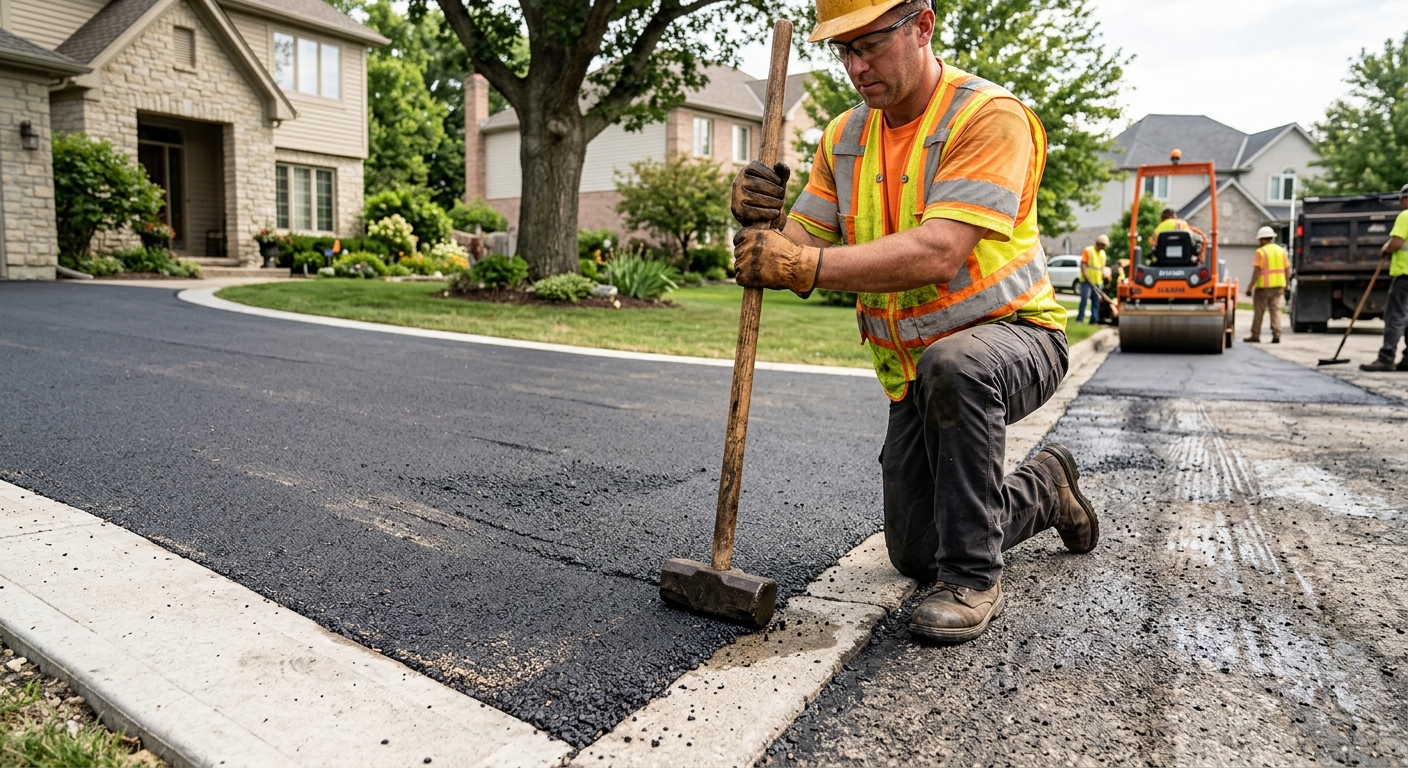
Driveway paving costs in Munhall — 2026
In Munhall, where 67.8% of homes are single-family and roughly two-thirds are owner-occupied (U.S. Census Bureau, ACS 2024), maintaining or replacing a driveway is a common project — but rarely a simple one. With our hilly terrain, heavy freeze-thaw cycle, and deep frost line, most driveways in Munhall are put to a tougher test than those just a county over. What most homeowners don’t realize is that the biggest difference between a high and low driveway paving quote comes from what happens below the surface, not from the asphalt mix or the top layer you can see. Local subgrade here is a mix of clay and shale, both of which demand thicker stone bases, proper drainage, and careful compaction. Skimp there, and the surface won’t last — no matter how good it looks the day it’s installed.
Here’s an honest breakdown of common driveway services and what you can expect to pay in Munhall:
| Service |
Best for |
Lifespan |
Price range |
| Asphalt — full replacement with new base |
failed base, structural cracking |
20–30 yrs |
$3,300–$8,500 |
| Asphalt overlay / resurfacing |
sound base, surface cracking only |
8–15 yrs |
$1,400–$4,200 |
| Sealcoating — single application |
preventive maintenance on sound asphalt |
2–4 yrs |
$200–$650 |
| Concrete — new installation |
long service life, low maintenance |
30–50 yrs |
$4,700–$11,500 |
| Crack filling and patching |
isolated cracks under a quarter inch |
1–3 yrs |
$200–$800 |
| Gravel driveway |
rural, budget, long runs |
5–10 yrs with upkeep |
$900–$3,500 |
Estimates for a typical Munhall driveway. Square footage and base condition drive these figures more than material choice.
How to tell if the base is gone
If you’re in Munhall and trying to figure out if your driveway needs a full replacement or just a little work, start with what you can see. Not all damage is the same, and your eyes can catch what a contractor’s sales pitch might gloss over. Alligator cracking — those wide areas of interconnected cracks that look like reptile skin — almost always means the stone base has failed. No overlay or quick resurfacing will fix it for long, because the movement below keeps working through. On the other hand, if you see a few long, straight cracks and the rest of the driveway is holding shape, you’re probably dealing with simple surface aging, not a failed base.
Depressions and persistent birdbaths signal bigger subgrade movement — water settling into the clay or shale base. Crumbling at the driveway edges means you never had real edge support, which is common on hilly properties around here. And when potholes form, water is already down to the base, where freezing in winter finishes the job.
If a contractor quotes for an overlay without checking the base — by either core-sampling or properly probing — they haven’t actually diagnosed your problem. For most Munhall homeowners, fixing the base costs more, but is money well spent. A cheap fix over a bad base is just buying it twice.
| What you see |
Likely cause |
Right fix |
Cost |
| Isolated cracks under 1/4 inch |
surface aging |
crack fill and seal |
$200–$650 |
| Alligator cracking over a wide area |
base failure |
full replacement |
$3,300–$8,500 |
| Depressions holding water |
subgrade movement |
excavate and rebuild that area |
$3,300–$5,200 |
| Crumbling edges |
no edge support |
edge repair, consider curbing |
$400–$1,500 |
| Potholes |
water into the base |
full-depth patch, then assess |
$250–$900 |
| Faded but sound surface |
oxidation only |
sealcoat |
$200–$650 |
Maintenance that actually works
If you want your Munhall driveway to last, simple, proactive maintenance does more than most big-ticket fixes after the fact. The most important is keeping cracks filled before water finds its way to the base — once water’s down there, freeze-thaw cycles in southwestern Pennsylvania will turn small cracks into bigger problems fast. Next, keep the driveway edges supported: parking off the edge or letting edges crumble exposes the base to water and collapse. Good drainage — making sure water flows off and away, not toward your house or down the middle of your drive — is crucial on our local clay and shale.
Large point loads, like never using jack stands or dumpsters on fresh asphalt, also help. For new asphalt, you should wait at least a week (longer if cool and cloudy) before parking, and avoid turning wheels while stationary — especially with heavy vehicles.
When it comes to de-icing, the choice matters by surface. Salt eats away at concrete, causing costly scaling and spalling. On asphalt, salt’s risk is more about the freeze-thaw cycling it causes, but it’s less likely to pit the surface. Sand or calcium chloride can be alternatives, though they cost more and have their own drawbacks. Here, with our 36-inch frost depth and frequent winter swings above and below freezing, the right maintenance — and a bit of patience — stretches your investment farther than any sealcoat ever will.
Local soil, drainage and driveway lifespan
Our hills in Allegheny County are built on a foundation of clay and shale, which has real consequences for driveways in Munhall. Clay holds water and expands when frozen, leading to heaving and cracking. Shale, when fractured, can settle and create voids under your driveway. The frequent freeze-thaw cycles here, combined with a frost depth pushing 36 inches, amplify any weaknesses in the stone base. A typical builder’s base from the 1945–1975 subdivision boom — which most Munhall homes predate (U.S. Census Bureau, ACS 2024) — was often thinner than today’s standards and put straight on the native subgrade. That’s why so many driveways in these parts need more than sealcoating; they’re due for a real structural overlay, or the base rebuilt from scratch.
With clay and shale underneath, driveways here should always get a thicker aggregate base than a flat-lot suburban job elsewhere. Cutting corners on base prep is why you’ll see driveways buckle or settle after a few winters, especially on sloped lots. Proper drainage, with water moved away from both the home and the drive, is mandatory. You can’t change the soil, but you can stack the odds by insisting on good prep — and not just a fresh top layer.
The honest case for and against sealcoating
Sealcoating draws a crowd in Munhall every few years, especially when a few houses on the street get freshly blacked-out driveways. It does have real benefits: it shields your asphalt from oxidation (the thing that makes it go brittle and gray in our sun and rain), slows down damage from oil and fuel drips, and simply looks better. But here’s the hard truth — it doesn’t add any strength, won’t fix cracks, and cannot give a failed driveway base a second life. If the pavement is structurally sound, a sealcoat can add a couple extra years and keep water out of small cracks, but it’s no cure-all.
Sealing too often is a mistake. Over-applying can cause layers to flake and peel, especially if the driveway wasn’t cleaned or dried properly, or if new asphalt hasn’t fully cured and is still outgassing oils. That’s why sealing shouldn’t be an annual ritual. Every three to four years is reasonable for most driveways. The first sealcoat should wait until the asphalt loses its oily sheen, often about 9–12 months after installation.
Crack filling matters more than sealing on its own. If the cracks are left open, water gets in — and on our Munhall clays and shale, that’s what destroys driveways fastest. Beware suspiciously low bids: a quick spray-on from a “knock on the door” crew at the low end of $200–$650 is mostly water and won’t last a season. A quality job uses genuine asphalt emulsion, is applied with a squeegee or brush, and fills cracks first.
Asphalt or concrete for a Munhall driveway?
Choosing between asphalt and concrete in Munhall isn’t about what looks nicest; it’s about surviving our climate. With freeze-thaw swings, asphalt — being flexible — bends and moves with the heaving that comes from our deep 36-inch frost depth. Concrete, though tougher and offering a 30–50 year potential lifespan, is brittle and prone to salt-induced spalling when winters get icy and homeowners inevitably throw down de-icing salt. That’s the silent killer for concrete in Allegheny County: our winters force the use of road salt, and few residents manage to consistently avoid it.
Asphalt is more forgiving of ground movement and a bit easier to patch, but it won’t live forever; plan on a new driveway every two decades, even with perfect care. For concrete, the up-front cost is higher, and owners who avoid salt can be rewarded with decades of peace — but most folks find that hard to sustain. Pavers perform well under freeze-thaw and allow for easy spot replacements, but the cost is extreme for most Munhall budgets. Gravel, still a fit for rural stretches or budget projects, drains well here and is easy to repair, but comes with tracking and dust.
| Option |
Installed cost |
Maintenance |
Freeze-thaw performance |
Lifespan |
| Asphalt — new install |
$3,300–$8,500 |
sealcoat every 3–4 yrs |
excellent, flexes |
20–30 yrs |
| Asphalt — overlay |
$1,400–$4,200 |
same |
good if base is sound |
+8–15 yrs |
| Concrete |
$4,700–$11,500 |
low, avoid de-icing salt |
fair, spalls with salt |
30–50 yrs |
| Pavers |
$7,500–$11,500 |
individual units replaceable |
good, settles gradually |
25–50 yrs |
| Gravel |
$900–$3,500 |
top-dress every 2–3 yrs |
excellent drainage |
indefinite with upkeep |
Driveway permits, approaches and stormwater rules
For most homes in Munhall, you won’t need a building permit for simply resurfacing or repaving your driveway in its original location, which avoids some paperwork. But where your driveway meets the public road — the approach — you’ll usually need a separate permit, and sometimes from an authority you wouldn’t guess. For work at the curb, sidewalk, or apron in Pittsburgh, permits come from the Department of Mobility and Infrastructure. State routes fall under the PennDOT District 11-0 Highway Occupancy Permit process. Outside these specific areas, driveway paving is often overseen at the municipal level.
Expanding your driveway or altering drainage may trigger local stormwater management requirements. Even if a permit isn’t required for the paving itself, directing runoff onto a neighbor’s property is a legal liability, and can lead to disputes or forced regrading. Always confirm your driveway plan doesn’t make water someone else’s problem — especially on hilly Munhall lots.
For consumer protection, Pennsylvania requires any contractor working on a home improvement project over $500 to carry a Home Improvement Contractor (HIC) registration, which can be verified at hic.attorneygeneral.gov. Employers must also carry workers’ compensation coverage; verify current status through WCAIS (wcais.pa.gov). For pre-1978 Munhall homes (the vast majority here), federal lead paint rules may come into play.
Frequently asked questions — driveway paving in Munhall
Does road salt damage driveways in Munhall?
Yes, road salt is a factor for every Munhall homeowner, especially during our winter freeze-thaw cycles. Salt rapidly accelerates surface damage on concrete, leading to flaking (spalling), while on asphalt it mostly increases freeze-thaw cycling that can widen cracks over time. If you’re considering concrete, be aware that using salt-based de-icers can shorten its lifespan dramatically — most costly repairs I see in the area are from years of winter salt. Asphalt holds up better to salt, but even then, it’s smart to minimize use and try sand or calcium chloride instead, though those are pricier. Repairs from salt-related scaling or widespread cracking can stretch well above $3,300–$8,500 for full concrete replacement here.
Is sealcoating a scam?
Sealcoating is not a scam when used correctly, but in Munhall, its value is often misunderstood. When applied to a sound driveway, it protects the asphalt from UV and chemical damage, and looks sharp. But it doesn’t fix base problems or extend a failing driveway’s life. Problems start when contractors push annual sealing, which causes layers to build up and crack, or when they offer cheap, thin applications that do little more than stain the surface. A proper job, at $200–$650, every three or four years, makes sense on solid asphalt. If your driveway's foundation is failing, no sealcoat fixes that.
When is the best time of year to pave in Munhall?
The best paving window in Munhall is late April through early October, when temperatures and ground conditions allow proper curing. Asphalt and concrete both need warm ground and consistent weather — not the cold snaps or heavy rains we get from late fall to early spring. Paving outside this window risks improper curing, which shortens driveway life and can cause immediate cracking or soft spots. Trying to save a few bucks on late autumn work may actually cost more if you’re redoing failed sections the next season. Prices are steady across the main season, but you should expect a driveway replacement to cost $3,300–$8,500 for asphalt or $4,700–$11,500 for concrete, so protect your investment by timing it right.
How deep should the aggregate base be here?
In Munhall and across Allegheny County, clay and shale subgrades mean a minimal base is a false economy. Standard practice here is at least 6–8 inches of well-compacted crushed stone for asphalt, and 8–10 inches for concrete on driveways seeing daily vehicle loads. On hillsides or problem soils, a thicker base is worth the extra money — it’s what stands between you and costly drive failure in freeze-thaw seasons. Skimping here just means you’ll be calling for another replacement (and paying $3,300–$8,500) sooner than you’d like.
How much does it cost to widen a driveway?
Widening a driveway in Munhall varies by size and surface material, but expect to budget for excavation, new base stone, edging, and the paving or concrete itself. A moderate widening, say adding 3–4 feet to one side, often costs in the lower end of full installation — roughly $1,400–$4,200 for asphalt (if you’re only resurfacing and can tie into existing base), but more like $3,300–$8,500 if you’re extending the base or working on challenging grades. Permit costs for curb cuts or approaches should also be factored in for homes on busier streets or state routes.
Are pavers worth the cost in southwestern Pennsylvania?
Pavers can be a solid investment in Munhall, offering great appearance, easy repair, and strong performance in our freeze-thaw climate — they settle individually instead of cracking like big slabs. The downside is initial cost: installed paver driveways run $7,500–$11,500 here, which is more than most asphalt or even concrete jobs. For high-end homes, or where money is less of a constraint, pavers are a smart long-term choice. They require little annual maintenance and don’t mind our heavy winter swings, but for most Munhall homeowners, the price pushes them out of reach.
Can I cancel a paving contract I signed at my door?
Yes, under Pennsylvania’s Home Improvement Consumer Protection Act (HICPA), you have a three business-day right to cancel any paving contract signed at your home, including in Munhall, as long as the contract is over $500. This right is absolute — the contractor cannot make you waive it or penalize you for using it. Before canceling, make sure you received a proper written contract (required by law) and check that the contractor’s HIC registration is valid at hic.attorneygeneral.gov. If you do cancel, do it in writing and keep a copy for yourself. Typical contracts in Munhall run from $3,300–$8,500 for full asphalt replacements.
Why are my driveway edges crumbling?
In Munhall, edge crumbling is usually a sign there was never enough base or support built out to the margins. Our hilly, clay-heavy terrain makes edge support critical — when water gets in or cars regularly drive or park off the side, the unsupported edges break down first. Patching the edge may run $400–$1,500, but in severe cases, wider repairs or total replacement may be needed to re-establish solid support. Installing curbing or just keeping traffic off the farthest few inches goes a long way toward slowing this local failure mode.
Is gravel a cheaper option in Munhall?
Gravel is still the most budget-friendly driveway option in Munhall, coming in at $900–$3,500 for an average-sized single-family drive. It works especially well on longer, rural lots, or where paving just doesn’t fit the budget. With our local quarries and short haul distances, gravel supply is good and keeping the surface in shape with periodic top-dressing is straightforward. The downsides: dust, regular maintenance, and more tracking onto roads and into the garage, especially during freeze-thaw. But as a way to keep costs down until a full asphalt or concrete replacement makes sense, it still has its place for Munhall homeowners.