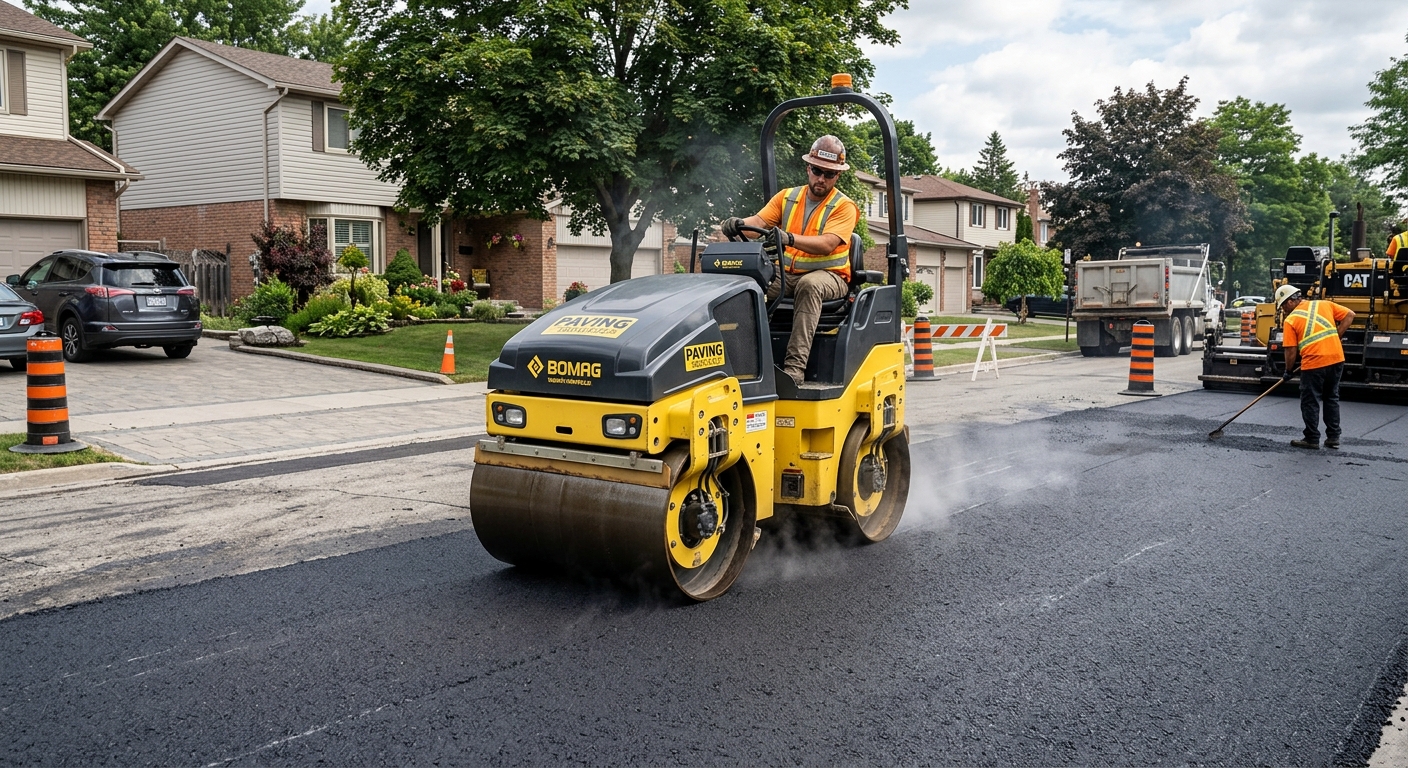
Patton paving prices by scope — 2026
In Patton, where nearly half of homes are single-family and the homeownership rate sits just above 52%, driveway maintenance is a real issue for many households. Centre County’s long winters, hard freezes, and common limestone-shale soils make local paving needs different from a mild climate. Those conditions mean more is going on beneath the surface than the top coat you see. Most of the price difference between two driveway quotes is in what lies underneath: the excavation, base type, thickness, and compaction process. Many driveways here are overdue for attention, especially those laid in post‑1950 subdivisions that now show base failure or recurring cracks.
Driveway costs depend more on square footage and the condition of what’s underfoot than on the visible surface material. Cutting corners on base thickness or skipping excavation can halve an upfront quote, but you’ll likely pay for it twice—once now, once again when the cheap job fails early in Patton’s freeze-thaw cycles.
| Service | Best for | Lifespan | Price range |
| Asphalt — full replacement with new base |
failed base, structural cracking |
20–30 yrs |
$3,400–$8,800 |
| Asphalt overlay / resurfacing |
sound base, surface cracking only |
8–15 yrs |
$1,450–$4,400 |
| Sealcoating — single application |
preventive maintenance on sound asphalt |
2–4 yrs |
$200–$700 |
| Concrete — new installation |
long service life, low maintenance |
30–50 yrs |
$4,900–$12,000 |
| Crack filling and patching |
isolated cracks under a quarter inch |
1–3 yrs |
$200–$800 |
| Gravel driveway |
rural, budget, long runs |
5–10 yrs with upkeep |
$900–$3,500 |
Estimates for a typical Patton driveway. Square footage and base condition drive these figures more than material choice.
What a real paving quote contains
When comparing paving quotes in Patton, the real value is in the details. Any proper proposal will clearly state your driveway’s measured square footage—not an estimate based on a glance. Excavation depth and disposal should be specified, so you know old asphalt and soft spots are actually coming out. For a new base, you want the type of stone and inches of thickness spelled out, with compaction performed in lifts to prevent settling—shale and limestone here demand it. Asphalt should be listed by courses (binder, surface) and thicknesses as compacted, not just “three inches” with no context.
Look for grading and drainage notes—direction of water flow, and edge treatment like hand-troweled or machine-finished edges. Cleanup, lawn restoration, and the payment schedule matter, too. Pennsylvania’s written contract requirement protects you: a real contractor wants you to understand exactly what you’re paying for. Most driveway warranties in Patton exclude surface cracking, even though it’s the problem homeowners expect to be covered—check what’s in writing, not what’s said. If you get a quote that is just a total and maybe “pave driveway,” you cannot compare it with any confidence. That kind of summary is the single most common way folks here overpay for rushed or underbuilt work.
| Line item | What to look for | Red flag if… |
| Area |
measured square footage stated |
eyeballed or absent |
| Excavation |
depth and disposal included |
'we'll pave over it' |
| Base |
aggregate type and depth in inches |
'proper base' |
| Compaction |
method, and done in lifts |
not mentioned |
| Asphalt |
courses and compacted depth |
'3 inches' unqualified |
| Drainage |
slope and water direction stated |
silent |
| Warranty |
what is covered and what is excluded |
verbal only |
| Payment |
modest deposit, balance on completion |
full cash up front |
Numbers, not adjectives
If you want your new driveway in Patton to last, focus on the numbers—not sales adjectives. A legitimate quote here lists the measurable thickness of every layer: how much is being excavated, the depth and type of the new aggregate base, compaction method, binder and surface asphalt thicknesses, and even the mix type numbers. Everything should be “as compacted,” not “as laid,” since hot asphalt can lose up to 25% of its height when compacted—a common spot for contractors to quietly cut corners.
Centre County’s winters, with regular frost to 36 inches and big swings around freezing, demand deeper and denser construction than parts of the country with milder weather. Limestone and shale soils settle and shift without enough base. “We’ll put down three inches” tells you almost nothing. Is that after compaction, or before? Is it all surface, or a base and a top? Without specifics, one contractor could be offering half the work of another for the same price.
- Excavation depth: removal down to solid, stable subgrade
- Aggregate base thickness: at least 6–8 inches (as compacted) in this soil
- Aggregate type: 2A limestone or equivalent, not recycled fill
- Compaction: vibratory roller, performed in multiple lifts
- Binder course asphalt: thickness after compaction—usually 2–2.5 inches
- Surface course asphalt: 1.5–2 inches after compaction
- Asphalt mix designation: (e.g., PennDOT 9.5mm)
- Edge treatment: hand-tamped or machine compacted, with clean cut
- Final grading: slope for drainage specified in percentage or inches per foot
- Cleanup and lawn restoration included
When paving can actually be done in Patton
Paving in Patton follows a fixed season, determined by climate and material supply. Hot-mix asphalt must be laid above a certain temperature—typically with air and surface temps at 50 °F and rising—so that it compacts before cooling. Centre County winters bring a winter design temperature of 2 °F and one of the longest heating seasons in Pennsylvania, so once fall settles in, the paving window slams shut. Asphalt plants in Bellefonte and College Avenue supply nearby jobs, but they close for the winter; it is simply impossible to buy hot-mix here from late November through late March.
Concrete presents its own problem: it can’t cure properly if it freezes before it sets, which is a real risk when ground and air temperatures drop quickly after sundown. None of this is flexible—working outside the proper season produces weak, porous, and short-lived surfaces, no matter what crew is willing to take your money.
If you want the best value, shoulder seasons—mid to late spring and early fall—are ideal: crews have more capacity, prices are steadier, and you avoid the midsummer rush, when every reputable contractor is booked solid for weeks. Be wary of anyone offering to pave in Patton after Thanksgiving: at best, you’ll get a rushed, inferior surface that will break apart with the first freeze-thaw. On the flip side, scheduling in April or September—just as the asphalt plants ramp up or before they close—often yields the most conscientious work.
What you need before paving in Patton
Paving a driveway in Patton does not usually require a building permit if you are replacing your driveway in its existing footprint—so most repaving jobs can proceed without municipal paperwork. But if you are changing where your driveway meets a public road (the approach), you do need a separate permit. In Centre County, the driveway approach to a state road falls under PennDOT District 2 in Clearfield, not your local township office. New or expanded driveways may also face runoff requirements if you increase impervious surface, and you cannot legally direct runoff onto a neighbor’s land, regardless of whether you got a permit—the liability is yours.
For contractors, Pennsylvania law requires Home Improvement Contractor (HIC) registration for any paving job over $500, which you can verify directly at hic.attorneygeneral.gov. Employers doing paving must carry workers' compensation, verifiable through the state’s WCAIS system (wcais.pa.gov); do not take verbal assurances. All contracts over $500 must be in writing and include your three business-day right to cancel—another layer of consumer protection that helps stop pressure sales and driveway scams.
Which surface survives Patton winters
If you want a driveway to stand up to a Patton winter, the material matters. Our region sees some of the highest snow loads in Pennsylvania, with ground freezing down to 36 inches. Every winter, driveways here flex, shift, and sometimes crack from repeated freeze-thaw cycles. Asphalt’s main advantage is its flexibility: it gives with the frost up-heave and settles back as things thaw. Concrete, on the other hand, is rigid—it won’t flex, but it can spall, pop, or scale if water gets in and freezes or if you use de-icing salts, which is common with our snow depth and long heating season.
Concrete lasts longer—decades longer if it’s cared for—but the caveat is real: de-icing salt will destroy an unsealed concrete driveway. That is why you see more distressed, pitted concrete on older Centre County homes built before 1980. Asphalt needs attention every few years—a $200–$700 sealcoat—but it is more forgiving of movement and easier (and cheaper) to patch.
Pavers hold up if the base is done right and are easy to repair one at a time, but can settle with the soils here. Gravel is absolutely viable in rural Patton, sheds water perfectly, and keeps cost low, but it needs routine raking and top-dressing.
| Option |
Installed cost |
Maintenance |
Freeze-thaw performance |
Lifespan |
| Asphalt — new install |
$3,400–$8,800 |
sealcoat every 3–4 yrs |
excellent, flexes |
20–30 yrs |
| Asphalt — overlay |
$1,450–$4,400 |
same |
good if base is sound |
+8–15 yrs |
| Concrete |
$4,900–$12,000 |
low, avoid de-icing salt |
fair, spalls with salt |
30–50 yrs |
| Pavers |
$7,900–$12,000 |
individual units replaceable |
good, settles gradually |
25–50 yrs |
| Gravel |
$900–$3,500 |
top-dress every 2–3 yrs |
excellent drainage |
indefinite with upkeep |
Grading and water management on a Patton driveway
In Patton, water is never a small detail. With our heavy winter snow and repeated freeze-thaw cycles, almost every driveway failure—cracks, settling, potholes—can be traced to poor drainage or bad grading. The minimum driveway slope for surface runoff is 2% (about a quarter inch per foot), but more is better if your site allows it. A straight driveway may be crowned in the center to drop water to both edges, while a side slope sends runoff in one direction. If your drive slopes toward your garage or house, that’s a red flag: water pooling at the foundation risks not just pavement but your home.
If grade alone can’t carry water away, trench or channel drains at the garage mouth or mid-drive can catch and redirect it. Daylighting—that is, running a pipe to a natural low spot—is ideal, but dry wells are a last resort if you have nowhere to go. With the area’s limestone and shale soils, settling is likely without a thick, compacted aggregate base to disperse water coming through or under the hard surface.
Be aware: you cannot direct new runoff onto a neighbor’s land—it’s a liability issue here, not a loophole. Good grading is more than a finishing touch; it’s what keeps your investment from heaving and breaking apart when next winter hits.
Frequently asked questions — driveway paving in Patton
Why are my driveway edges crumbling?
Edge crumbling is a common problem in Patton and across Centre County. It usually happens when the asphalt at the sides of the driveway isn’t supported by enough aggregate base underneath or wasn’t properly compacted during installation. Our frequent freeze-thaw cycles compound the issue: water seeps into the edges, freezes, and causes the asphalt to break apart with each cycle. Snow plows and lawn equipment—both common in Patton’s single-family homes—also put extra stress on unsupported edges. If only small sections are affected, a patching job in the $200–$800 range can buy time. For widespread failure, structural replacement is almost always needed, since overlays won’t fix a weak edge.
What slope does a driveway need for drainage?
In Patton, the minimum recommended slope for driveway drainage is 2%—that’s about a quarter inch of drop per foot—but more is better if your site allows. With our region’s long winters, big snow loads, and repeated freeze-thaw cycles, anything less increases the odds of ponding, infiltration, and eventual cracking. For long driveways or those abutting the house, proper slope prevents water from flowing toward your foundation, which can lead to basement leaks even in homes built after 1980. On flat lots, contractors may use a shallow cross-slope or a trench drain at the garage entrance. Don’t accept “it will drain”—you want a number in writing.
What does sealcoating cost in Patton?
Sealcoating a typical residential driveway in Patton generally costs between $200–$700, depending on driveway size and surface preparation needs. Most single-family drives land near the middle of that range—think $400 for a standard suburban home. The price goes up if extensive cleaning or minor crack filling is needed first. Sealcoating is preventive maintenance in our climate: it protects the surface from sun and salt, but it doesn’t fix structural cracks. Don’t sealcoat over a failed base; it’s not money well spent. With our freeze-thaw swings and snow load, routine sealcoating gives you another few years before you need full resurfacing.
Asphalt or concrete for a Patton driveway?
Both have their place, but most homeowners in Patton opt for asphalt due to how it performs in our freeze-thaw, high-snow climate. Asphalt flexes with ground movement and costs less—typically $3,400–$8,800 for a full job—making it the practical pick for many. Concrete, while tougher and longer lasting (up to 50 years), is prone to spalling and scaling if you use de-icing salt, which is hard to avoid in our winters. Concrete is more expensive—$4,900–$12,000—and demands good drainage and no salt use from the owner. If you value low maintenance and longevity and can commit to gentle winter care, concrete is solid. Otherwise, asphalt remains Patton’s usual surface.
Does sealcoating fix cracks?
Sealcoating does not fix cracks, especially in a climate like Patton’s. Think of sealcoating as a sunscreen and mild moisturizer for your driveway—it's a surface treatment, not a repair. It slows down fading from the sun and keeps surface oxidation and minor water infiltration at bay, but even small cracks need to be filled before sealcoating is applied. If you have visible cracks under a quarter inch, crack filling at $200–$800 is the right first step, followed by a sealcoat. Anything wider, or with sunken spots, means the underlying base is failing, and sealcoating alone is no longer worth the cost.
How far ahead should I book a paver in Patton?
In Patton, reputable paving contractors book up well in advance during peak paving season. For summer work, especially June and July, it’s wise to contact contractors two to four months ahead—spring and fall fill quickly, too, but you may find more openings. During the peak, prices tend to be steady but rarely discounted. If you want to get on the schedule for a full asphalt replacement ($3,400–$8,800), reach out in late winter or early spring for best availability and a shot at shoulder-season pricing. Crews willing to start “immediately” in September or November may be filling holes in their schedule for a reason—ask more questions.
What does an asphalt overlay cost in Patton?
Asphalt overlay, also called resurfacing, is often a smart choice if your existing driveway base is still solid. In Patton, the cost usually runs from $1,450–$4,400, with most homeowners landing near $2,900 for a standard single-family driveway. This is a big cost savings over a full replacement. However, overlays only make sense if there’s no significant base failure—covering up deep cracks or soft spots is only temporary. For overlays to last in Centre County’s climate, prep should include thorough cleaning, tack coat, and edge work to seal out water.
Can I cancel a paving contract I signed at my door?
Yes. In Pennsylvania, any home improvement contract (including paving) signed at your home comes with a three-business-day right of cancellation under the Home Improvement Consumer Protection Act. This rule is crucial in Patton, especially if you’re approached by unsolicited pavers. The law covers all contracts over $500—so if you agreed quickly to a job priced between $1,450–$8,800, know that you can cancel in writing within three business days without penalty. This helps protect homeowners from high-pressure tactics and rushed decisions. Any legitimate contractor should spell out this right and provide instructions to cancel.
What kind of soil is under Patton driveways?
Most driveways in Patton and the surrounding Centre County area sit atop a mix of limestone and shale soils. This base demands a thick, well-compacted aggregate layer to prevent settling and cracking—especially since our climate brings heavy snow and repeated freeze-thaw. If a contractor tries to save money by skimping on base depth, the driveway will show tire ruts and cracks early, regardless of how good the surface looks on day one. That’s a key reason why full reconstruction projects here cost in the $3,400–$8,800 range. Insist on written specs for excavation and base; cutting corners underneath always backfires in our part of Pennsylvania.