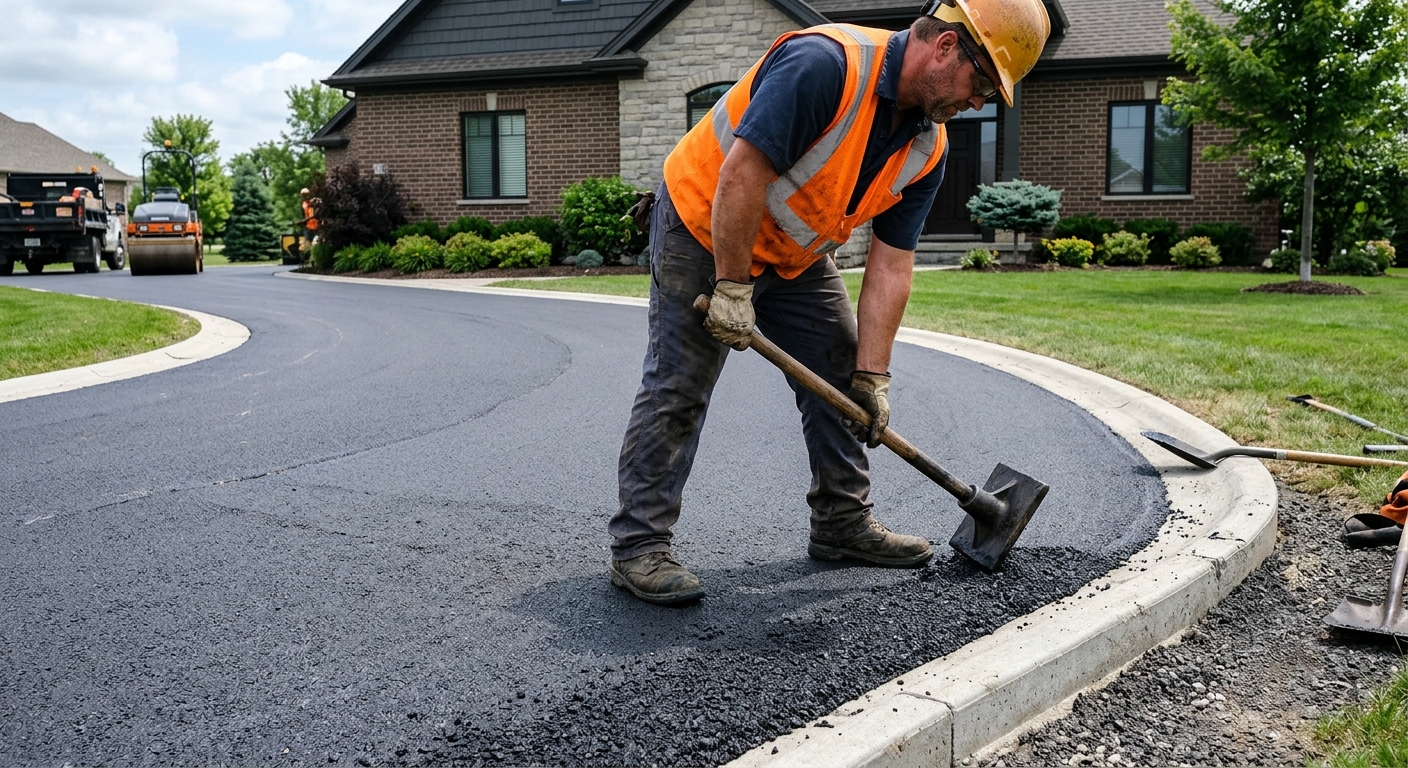
Penn paving prices by scope — 2026
Penn homeowners, like much of Lancaster County, are mostly owner-occupants living in single-family properties—meaning driveway paving is a real line-item expense for most (77.6% own, 67.8% single-family, U.S. Census Bureau, ACS 2024). In south-central Pennsylvania, the region’s pronounced freeze-thaw cycling and variable soils shape both prices and longevity. Whether you’re rebuilding a failed asphalt drive or just needing a fresh sealcoat, your outlay is driven less by the material on top and more by what’s done with the base below—work you can’t see after the crew leaves. With local limestone and occasional karst subgrade, some township jobs need thicker aggregate bases for stability, while city lots—often dating pre-WWII—may face underbuilt or shared driveways that need more than a simple overlay.
This table shows what to expect in 2026 for the range of paving options in Penn:
| Service |
Best for |
Lifespan |
Price range |
| Asphalt — full replacement with new base |
failed base, structural cracking |
20–30 yrs |
$3,500–$8,900 |
| Asphalt overlay / resurfacing |
sound base, surface cracking only |
8–15 yrs |
$1,500–$4,500 |
| Sealcoating — single application |
preventive maintenance on sound asphalt |
2–4 yrs |
$200–$700 |
| Concrete — new installation |
long service life, low maintenance |
30–50 yrs |
$4,900–$12,000 |
| Crack filling and patching |
isolated cracks under a quarter inch |
1–3 yrs |
$200–$800 |
| Gravel driveway |
rural, budget, long runs |
5–10 yrs with upkeep |
$900–$3,500 |
Estimates for a typical Penn driveway. Square footage and base condition drive these figures more than material choice.
How to tell if the base is gone
What’s under your driveway matters more than the surface, and it determines whether you need replacement or just a repair. The quickest way to check is by walking and inspecting key problem signs. Alligator cracking—areas where the surface looks like reptile skin—is a giveaway that the base beneath has failed. If you patch or overlay over these, the cracks return within months because the real problem is still hidden. Linear cracks here and there mean surface aging, and those can be filled and sealed. Depressions (“birdbaths”) signal that the stone or soil below has shifted or settled, while edge crumbles point to lack of support—often in drives without a solid border. Potholes mean water is already down in the base: filling just the hole is a short-term fix at best.
If a contractor recommends an overlay or patch without checking or probing the base, they haven’t done their homework. Overlays save money only when the base is intact. Paying for a quick fix over a bad foundation is just burning cash and putting off the real repair. Here’s how your symptoms translate to work and price in Penn:
| What you see |
Likely cause |
Right fix |
Cost |
| Isolated cracks under 1/4 inch |
surface aging |
crack fill and seal |
$200–$700 |
| Alligator cracking over a wide area |
base failure |
full replacement |
$3,500–$8,900 |
| Depressions holding water |
subgrade movement |
excavate and rebuild that area |
$3,500–$5,400 |
| Crumbling edges |
no edge support |
edge repair, consider curbing |
$400–$1,500 |
| Potholes |
water into the base |
full-depth patch, then assess |
$250–$900 |
| Faded but sound surface |
oxidation only |
sealcoat |
$200–$700 |
Why Penn driveways fail from the bottom up
The anatomy of a durable Penn driveway starts with the soil (subgrade), topped by a compacted aggregate base—typically crushed local limestone—and finally asphalt. Each layer works together: if one is weak, the rest won’t matter in Lancaster’s climate. Our pronounced freeze-thaw cycles mean water in the subgrade expands when frozen, pushing up and cracking driveways from beneath. That’s why base thickness and drainage are not just technicalities—they’re what keep your drive from disintegrating.
East Hempfield Township is built on limestone karst, making proper drainage and thicker bases even more crucial—otherwise, you’ll see settlement or sudden dips as the subgrade caves in. Skimping here is common on the lowest bids: shallow excavation (or skipping it), thin stone base, little or no compaction, and laying new asphalt over hidden problems. None of this is obvious on paving day; the evidence shows up in year three, not week three.
For any driveway in Penn, get the base specs in writing: at least 6–8 inches of compacted aggregate for most single-family drives on local soils (more if karst is likely), using crushed limestone (“2A modified” is typical), laid and compacted in lifts—not all at once. Demand that compaction be confirmed for each lift. That’s what you’re really buying—the asphalt only lasts as long as what’s under it.
Maintenance that actually works
The single most effective—and affordable—maintenance step for Penn driveways is crack filling before water gets into the base. Once water finds its way down, freeze-thaw cycles rapidly break up both concrete and asphalt. Second, keep driveway edges supported; unsupported edges in our climate break away fastest, especially on drives plowed or edged by mowers. Third, keep water draining away—clean gutters, maintain grade.
Avoid putting jack stands or dumpsters in one spot for more than a few days; even a well-built drive will rut or crack under a constant point load. On new asphalt, allow at least two to three days of curing before parking, and avoid turning the wheels on a stationary car for the first month.
For winter de-icing, salt should not be used on concrete; use sand or calcium chloride if you must, though both cost more than basic rock salt. For asphalt, salt is less damaging, but the bigger risk is from repeated freeze-thaw, not the salt itself. In Penn, our freeze cycles are just frequent enough that staying on crack filling and sealing is the better investment than heavy chemical deicer use.
Driveway permits, approaches and stormwater rules
If you live outside Lancaster city—in most Penn or township addresses—replacing or resurfacing your private asphalt drive does not usually require a municipal building permit. This saves you both fees and red tape. What does require a permit is any work at the end of your drive—where it meets the street. In Lancaster city, new driveway approaches and curb cuts are permitted by the City of Lancaster Bureau of Engineering; for state roads, it goes through PennDOT District 8-0. Most homeowners miss this, and end up retro-permitting later if they skip it.
If you increase the size of your driveway, adding more impervious area can trigger stormwater regulations. Water can’t be directed onto your neighbor’s land, and new or expanded drives can require drainage solutions, especially on older city lots or sloped properties—plan ahead to avoid neighbor disputes and enforcement headaches.
Every contractor for jobs over $500 must be registered as a Home Improvement Contractor (HIC) with the Pennsylvania Office of Attorney General—verify them at hic.attorneygeneral.gov. By law, all employers must carry workers’ compensation insurance, which can be checked at wcais.pa.gov.
Local soil, drainage and driveway lifespan
In East Hempfield Township and much of Penn, limestone karst dominates the subgrade. Limestone dissolves over time, creating voids and instability if not handled right—so a thicker aggregate base (think 8 inches or more) and careful drainage are non-negotiable. Unlike heavy clay, which holds water and is prone to frost heave, karst soils drain quickly but are prone to differential settlement. This subgrade means a drive that’s solid today can suddenly drop or crack if the stone base or drainage isn’t up to the local reality.
The 30-inch frost depth and frequent freeze-thaw cycling in south-central Pennsylvania are harsh on any poorly prepared drive, and old drives from the pre-1940 housing stock in Lancaster city often have minimal original base—making them regular candidates for full-depth replacement rather than quick overlays. If you’re dealing with a shared, narrow drive on an old city lot, expect that a patch approach probably won’t last; these were built when cars and codes were both lighter.
The driveway scams that work in Penn
Paving scammers target Penn, especially the rural parts of Lancaster County, because the jobs are visible, neighbors are far apart, and many homeowners have little recent experience with contractors. The most common pitch is the “leftover asphalt” story—someone claims to have material left from a “job down the road,” offers a better price for fast cash, and delivers a thin, poorly installed drive that falls apart within months. Other red flags: unmarked trucks with out-of-county plates, today-only discounts, pressure to pay cash up front, refusal to sign a contract, and promises that aren’t written down.
Thin oil-based spray, sold as full sealcoating but gone after one winter, is another staple scam—especially on long rural drives. All these are easier to pull off in Penn’s more rural markets where follow-up is tough, and word of mouth takes longer to catch up.
Under the Home Improvement Consumer Protection Act (HICPA), you’re entitled to a written contract for any job over $500, and you have a 3-business-day window to cancel. No legitimate contractor can ask you to waive this right or your insurance deductible—if they do, walk away. Use these rights: never give cash, always ask for the HIC registration and verify it online. Get copies of their workers’ comp coverage. Don’t be rushed into a deal by a “crew in the area.”
Before signing, check the contractor at hic.attorneygeneral.gov for registration and wcais.pa.gov for insurance. Read the contract—if it isn’t fully written out, do not proceed. Five minutes here can save you years of headaches.
Frequently asked questions — driveway paving in Penn
How much does driveway paving cost in Penn?
In Penn, the cost to pave a driveway depends on the scope of work and condition of your base. A full asphalt replacement with a new compacted aggregate base typically runs $3,500–$8,900 for most single-family drives. Simpler resurfacing (asphalt overlay) costs less, at $1,500–$4,500, if your existing base is sound. Concrete driveways range higher at $4,900–$12,000. The biggest price drivers aren’t always the square footage or the material, but rather what’s required under the surface—thicker base, excavation, site drainage, and haul distances from local quarries. With Penn’s local limestone and frequent freeze-thaw cycles, investing in base preparation up front is what protects you from paying double within a few years.
Do I need an approach permit where my driveway meets the road?
Yes—in Penn, whenever you’re building or modifying the approach (the section where your driveway meets the public street), you likely need a special permit, and it’s handled by different authorities depending on location. In Lancaster city, it’s the City of Lancaster Bureau of Engineering that issues driveway approach and curb cut permits. For properties on state routes, permits go through PennDOT District 8-0. Simply resurfacing an existing private drive inside your property lines in townships generally doesn’t require permits, but any work out by the road—expanding, moving, or cutting the curb—absolutely does. Always check before starting, because approach work without a permit can mean fines or being forced to rip out new work.
What does compaction in lifts mean?
Compaction in lifts is the proper way to build up the base for Penn driveways, especially in our limestone and freeze-prone soils. Instead of dumping the full thickness of aggregate at once, the base stone is placed in thin layers—usually 3–4 inches deep at a time. After each layer (each “lift”) is spread, it’s compacted with heavy rollers before the next lift goes down. This step-by-step method ensures that the base is solid and won’t settle later. Skipping this process or compacting just the top inch leaves soft spots that settle and crack after our wet winters. Getting “compaction in lifts” in writing protects you, and it’s the difference between a drive that lasts 25 years, not five. A full replacement with proper compaction runs $3,500–$8,900 in Penn.
Can I pave over my existing driveway?
You can put an asphalt overlay on top of an existing drive in Penn only if the base and sub-base are still solid—meaning no major cracks, potholes, or settling. If you’re just seeing faded asphalt or a few shallow cracks, resurfacing at $1,500–$4,500 can add 8–15 years of life at a lower cost than full replacement. But if there’s alligator cracking, large depressions, or edge failures, resurfacing just hides the problem for a season or two—then it all returns, and you’ll have paid twice. Always have the base condition checked before approving an overlay. In older Penn neighborhoods, especially in pre-1940 driveways or on limestone subgrade, many drives were never built on a solid base to begin with.
What causes driveway cracks in Penn?
In Penn, driveway cracks come from a mix of our local climate and subgrade conditions. Freeze-thaw cycles—where water in or under the base repeatedly freezes and expands—push asphalt or concrete apart, creating both linear and “alligator” cracks. Limestone karst subgrades in areas like East Hempfield mean settlement and occasional sudden dips if water finds its way underneath. Unsupported driveway edges, shifting subgrade after heavy rain, and lack of base preparation on older drives (especially Lancaster city’s pre-1940 housing) all contribute. Regular crack filling at $200–$700 helps keep water out and slows down the damage, but where cracks cluster or deepen, it’s usually a sign the base needs more attention.
Why are paving quotes in Penn so different from each other?
Pricing in Penn and the broader Lancaster County area swings so much because you’re usually not comparing identical work. The big expense is what’s under the asphalt—digging out bad soil, putting in the right depth of compacted limestone, and handling issues like limestone karst or poor drainage. One quote might be for a quick overlay without fixes (cheaper), another for full-depth reconstruction (costlier, but needed). Also, haul distances for aggregate or asphalt vary: sites outside Warwick and Manor have higher prices due to longer truck trips from plants near Lancaster. Finally, some operators skip base work or compaction to underbid but leave you with a drive that fails early. A thorough, honest quote for replacement should spell out specs and include a written contract and HIC registration. A rock-bottom price in Penn almost always means hidden shortcuts.
Are door-to-door pavers a problem in Penn?
Yes, transient paving crews are active in Penn and rural Lancaster County. They often show up in late spring or summer, offering leftover asphalt from another job or pushing for same-day, cash discounts. These scams work because the drive looks fine at first, but shortcuts in base prep, compaction, or material thickness mean it breaks down within a few seasons. Pennsylvania law protects you—any job over $500 requires a written contract and a 3-day cancellation period, and contractors must be registered with the Pennsylvania Office of Attorney General. Always check their HIC registration at hic.attorneygeneral.gov and ask for proof of workers’ comp at wcais.pa.gov. If the offer seems too fast or they refuse paperwork, it’s safer to pass—good pavers in Penn have nothing to hide.
How far ahead should I book a paver in Penn?
In Penn, paving crews book up fast—prime slots from late spring through early fall are often filled two to three months in advance. For a full replacement or concrete pour (especially at the $4,900–$12,000 range), book by April or May to guarantee a summer or early fall install. Smaller repairs or sealcoating can sometimes be scheduled in a matter of weeks, but crews prioritize larger jobs or those already on their route. Unusually wet weather in Lancaster County can bump timelines as crews wait for dry base conditions. If you get a next-day promise for a major replacement during peak season, be skeptical—thorough contractors in Penn are busy, not desperate.
Does sealcoating fix cracks?
In Penn, sealcoating is good preventive maintenance but won’t repair cracks wider than a hairline. Sealcoat adds a protective layer against UV and water, but any crack more than 1/8 inch must be filled first—or water will still seep down. Bundling crack filling with sealcoating (totaling $200–$700 for most drives) is the right move each cycle. If your drive has several deep, wide cracks, sealing alone will do little; it’s a band-aid, not a cure. In our region—where winter freeze-thaw relentlessly works on every small opening—regular crack sealing makes sealcoat last much longer and avoids the expensive need for replacement before its time.