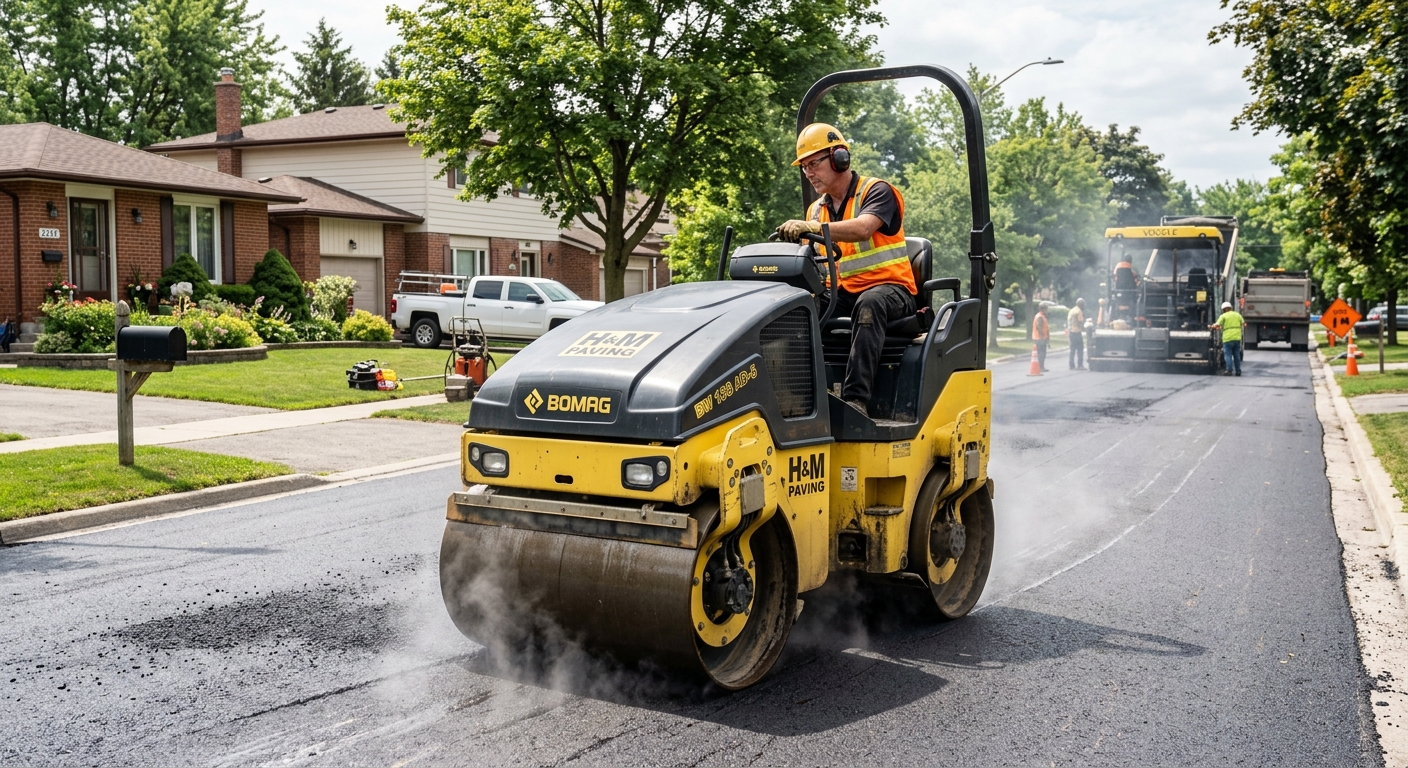
What a new driveway costs in West York
In West York, where only about a quarter of homes are single-family and homeownership sits just under 50% (U.S. Census Bureau, ACS 2024), driveway paving is a significant investment for detached homeowners. Pricing can swing wide, but the truth is most of what you pay for isn't the asphalt or concrete you see—it's what goes underneath. Out here, freeze-thaw cycles are pronounced and local shale subgrade is the norm, so skimping on base prep can mean paying twice down the line for repairs or a full redo.
Most price differences between quotes come down to whether the contractor is properly correcting the base and drainage or simply “putting on a new top.” In practical terms, poorer prep means cracks, heaving, and potholes after two or three winters. The big dollar decisions are made where you can’t see: how much is dug out, how deep the stone base goes, and whether water is moving away from the driveway. Here’s what it actually costs in West York:
| Service |
Best for |
Lifespan |
Price range |
| Asphalt — full replacement with new base |
failed base, structural cracking |
20–30 yrs |
$3,400–$8,600 |
| Asphalt overlay / resurfacing |
sound base, surface cracking only |
8–15 yrs |
$1,450–$4,300 |
| Sealcoating — single application |
preventive maintenance on sound asphalt |
2–4 yrs |
$200–$650 |
| Concrete — new installation |
long service life, low maintenance |
30–50 yrs |
$4,800–$11,500 |
| Crack filling and patching |
isolated cracks under a quarter inch |
1–3 yrs |
$200–$800 |
| Gravel driveway |
rural, budget, long runs |
5–10 yrs with upkeep |
$900–$3,500 |
Estimates for a typical West York driveway. Square footage and base condition drive these figures more than material choice.
Finding a legitimate paver in York County
Choosing the right paving contractor in York County is more than checking for a business card. In this market, you want someone who can demonstrate real roots: a verifiable local shop—not just a cell number and a P.O. box. A contractor working with real equipment, not just renting it for busy months, is less likely to disappear next year. Ask for references from driveways at least three years old to see how jobs hold up, since with our climate and shale subbase, poor prep only reveals itself after a few winters. If a contractor can’t tell you which York County quarry or asphalt plant they get their material from, you're dealing with a middleman or broker, not a paver with skin in the game.
- HIC registration from the Pennsylvania Office of Attorney General (check at hic.attorneygeneral.gov)
- Local business address — not just a mobile or out-of-town area code
- Owned (not only rented) paving equipment visible on the job
- Proof of workers’ compensation (check via WCAIS at wcais.pa.gov)
- References from at least three driveways completed three or more years ago
- Ability to name their York County aggregate or asphalt supplier without hesitation
- Written contract (required by Pennsylvania law for jobs over $500)
- No offer to "waive your deductible" or sidestep written paperwork
- Response from a real, office-based business line—not just inconsistent mobile numbers
- Jobsite signage and lettered trucks easily matched to the business name
- No pressure to pay in full before work begins
- Insurance certificate naming you as certificate holder
Red flags: anyone who can't provide or dodges any of the above; contractors offering a special "leftover material" deal; or wants most of the money upfront. These are all signs to walk away fast in York County.
Numbers, not adjectives
If you're comparing paved driveway quotes in West York, don't just look for the cheapest number—look for the right numbers. In this trade, "reliable," "solid," or "premium job" doesn’t mean a thing if you can’t see it in inches and compaction rates. On our local shale base and with regular freeze-thaw cycles, you need specs in writing. Quotes should show base excavation depth, type and thickness of stone, whether the base is compacted in lifts with a plate compactor or a larger roller, and how thick the binder and surface asphalt layers will be after compaction (since loose mats shrink by up to 25% as they’re rolled). "We put down three inches" is ambiguous: Is that hot mix or finished? Uncompacted or compacted layer?
This region's repeated winter freezing and wet-dry spells mean driveways without a deep enough base are doomed. Our soils demand thicker, tightly compacted stone, especially over the area's common shale. Insist on these numbers in your contract if you want your new drive to last a full York County winter.
- Total excavation depth (inches below existing grade)
- Aggregate base type (2A modified, etc.) and base thickness after compaction
- Base compaction method (vibratory plate, drum roller) and number of passes
- Binder course thickness after compaction (not before)
- Surface (wearing) course thickness after compaction
- Hot mix asphalt type or designation
- Edge treatment — hand-tamped, machine cutoff, or supported with stone
- Treatment of transitions to garage, sidewalk, apron
- Drainage plan — slope in percent or inches per foot
- Full written warranty on base and surface work
The honest case for and against sealcoating
Sealcoating gets pushed hard in West York because it looks sharp and, to an extent, helps your asphalt last. What sealcoat actually does: it limits UV and oxidation damage, keeps oil and fuel from breaking down the binder, and tidies up the appearance. But be clear: black shine does not mean added strength. Sealcoat is not a repair for failed driveways, doesn't fill deep cracks, and won't stop base movement. Too-frequent applications actually create their own problems here—trapped volatiles, ugly peeling, and soft surface layers that come off with shoveling or hot tires.
On new asphalt, you need to wait—at least a full season, sometimes as much as a year—before sealing, because you want the surface to fully cure and for any trapped chemicals to evaporate. Sealing every year is not just a waste in York County's climate, it shortens life by building up layers that crack sooner. Two to four years is a fair interval for most driveways. Crack sealing is where your money actually goes furthest: stopping water from getting under the pavement before freeze-thaw does its worst. But even crack fill must be done correctly: hot-applied material, routed out cracks, not just squeezed into place or splashed on with a sprayer.
For $200–$650, you should expect edges brushed, cracks treated separately, and a full two-coat application if it’s a larger job. A “discount” spray-over, done in an hour for cash, is mostly water and won’t hold through winter. If a price seems too low to believe, it probably is.
Getting thirty years out of a driveway
The best prevention is simple: keep water out and off the base. In West York, the number-one cause of premature driveway failure is water working down through neglected cracks. Regular crack filling before winter—every season if you see new gaps—stops freeze-thaw cycles from shoving the pavement apart. Just as important: keep the driveway edges well supported. Weak, crumbling edges mean water and vehicles will break things down faster.
Poor grading or blocked drains create lasting problems, so watch after heavy rain and correct pooling quickly. Avoid parking dumpsters, RV jacks, or even heavy trailers on the same spot, or you’ll be left with depressions and weak base areas. For new asphalt, wait at least three days before parking and longer before turning tires on hot days—those first weeks are critical for the surface’s early life.
On de-icing: road salt is a nonstarter for concrete, as it opens up the surface, causing scaling and flaking. For asphalt, the chief issue isn’t chemical but mechanical—constant melting and refreezing in our climate breaks down the surface and edges. Calcium chloride is less harsh, and plain sand does the safest work, though it’s less convenient and messy. There’s always a tradeoff, but for both surfaces, the best defense is timely clearing after storms and never letting water sit long enough to refreeze.
Widening, extending or adding a parking pad
If you’re looking to widen your West York driveway for a second vehicle, add a parking pad, or extend to a backyard garage, the most important factor isn’t the visible surface. You’re now paving over undisturbed soil, not already-compacted base. Unless the new area gets a full depth of stone and careful compaction, it will settle and crack. And the seam where new pavement meets old will always be a weak point—no contractor can make it as strong as factory-fresh asphalt. It can be reinforced, but movement is common with our frequent freeze-thaw cycles and heavy shale subsoil.
Be aware: Township or borough regulations may limit how much of your lot can be covered in hard paving—called impervious surface—and local rules set how close to a property line you can go. Adding width often triggers stormwater review or even an approach permit, especially if any changes are near the curb. For connections to state-owned roads, expect to deal with PennDOT District 8, while township authorities cover most local street approaches. Always clarify with your paver and municipality before breaking ground.
What you need before paving in West York
For most West York homeowners, repaving an existing driveway in the same footprint does not require a building permit, which means one less phone call. However, if you're changing your driveway’s width, adding length, or reconstructing the approach (the part that meets the public street), you usually will need a permit—sometimes from your township, but always from PennDOT District 8 if your curb cut meets a state-managed road. This catches people off guard, as approach permits aren’t issued by the same office that handles home additions or decks.
Any increase in paved area—whether asphalt or concrete—can trigger requirement reviews for stormwater runoff. You’re responsible for making sure new hard surface doesn’t send water onto your neighbor’s yard, regardless of whether you pulled a permit. York County's clay and shale soils don’t absorb runoff quickly, so correcting drainage with proper slope and swales is part of nearly every real paving job here.
Pennsylvania requires written contracts for paving jobs over $500 and mandates that contractors be registered Home Improvement Contractors with the Attorney General’s office—always verify at hic.attorneygeneral.gov. All workers on site must be covered by workers’ compensation insurance, which you can check via WCAIS (wcais.pa.gov). A reputable contractor will offer proof without hassle and will give you ample time to review and sign paperwork, never rushing the process.
Frequently asked questions — driveway paving in West York
What is the difference between binder and surface course?
In West York, proper asphalt driveways are typically built with at least two layers: binder course and surface course. The binder course is the thick, strong base layer made with larger aggregate, designed to provide most of the driveway’s structural strength—think of it as the “bones” of the pavement. The surface course, often referred to as the “wearing” course, is a thinner, smoother top layer that handles direct contact with cars, sun, ice, and the elements. While the binder takes the heavy loads, the surface course offers appearance and protects against moisture. Skipping the binder or skimping on surface thickness is one shortcut that keeps costs low in quotes, but rarely saves money over the life of the drive. For a proper full-depth West York driveway, budget around $3,400–$8,600 for both layers done right.
Does road salt damage driveways in West York?
Yes, salt plays out differently for concrete versus asphalt in West York’s climate. Salt accelerates scaling, spalling, and flaking in concrete—especially old slabs and those poured during wet or thawing weather. Once the top layer peels, it’s hard to get a long-term fix short of replacement. For asphalt, the bigger worry is that salt speeds up freeze-thaw cycles, melting snow that then refreezes underneath. This repeated expansion and contraction strains joints and cracks. While occasional use won’t ruin new blacktop overnight, regular heavy salting can lead to more patching and earlier overlays—typically $1,450–$4,300 for a resurfacing cycle here. Sand, and calcium chloride pellets are safer but require more cleanup in spring.
What does an asphalt overlay cost in West York?
If your existing driveway base is still solid but you're fighting with surface cracks, an asphalt overlay is often a practical fix. In West York, overlays generally run from $1,450–$4,300, with most jobs for standard residential drives landing near the middle. The price depends on the total square footage, ease of site access, and whether repairs or edge work are needed first. Overlays don’t solve deep base issues—so if your driveway is soft, sunken, or moving with every season, you’re better off budgeting for a full replacement at $3,400–$8,600. Always have your contractor show clear evidence that the base is sound before moving ahead with a topcoat.
How far ahead should I book a paver in West York?
In the West York area, paving is highly seasonal, with most work happening from late spring through mid-fall, thanks to local frost and frequent rain. For a standard asphalt or concrete project, expect reputable contractors to be booked 4–8 weeks ahead, especially during peak months. Last-minute openings can happen during dry streaks, but planning early means you’re not left overpaying or settling for whoever's available. For overlays or sealcoats—priced around $200–$650 for a typical single application—you might find quicker turnaround, but full replacement jobs demand lead time because of prep and scheduling plant deliveries from regional suppliers. Confirm start dates in writing and be ready for weather delays common here.
Do I need an approach permit where my driveway meets the road?
Yes, in West York and all of York County, the section of driveway that meets the street—often called the approach—can require a separate permit and it's usually handled by a different office than you’d expect. If your home fronts a state-maintained road, you’ll need a Highway Occupancy Permit from PennDOT District 8 even if you’re not widening or moving it. For local streets, check with your township or borough office first. Permitting for approach work helps protect curbing, sidewalks, and public water flow. These permits typically carry specific requirements for thickness, grade, and drainage—different from what a private drive might allow as long as water runs off. Getting it right means less risk of a costly do-over, which can run $3,400–$8,600 if the local authority insists on redoing work that doesn’t meet code.
Is gravel a cheaper option in West York?
Yes, gravel remains the budget pick for long or country drives in the West York area. Depending on the length, width, and prep work required, a properly installed residential gravel driveway runs $900–$3,500—a fraction of the cost of blacktop or concrete. Gravel is best for rural properties with longer runs or where access for heavy paving equipment is difficult. However, unlike paved drives, expect annual maintenance: fresh stone after winter plowing, raking to fill ruts, and occasional grading. With our pronounced freeze-thaw cycles and frequent clay pockets, you’ll want geotextile underlayment or heavy subgrade prep to keep the stone from disappearing into the soil. Gravel can be a smart option, but don’t underestimate the upkeep or the mud factor each spring.
What causes concrete to spall or flake in West York?
Concrete driveways in West York flake—what the industry calls “spalling”—mainly because of water, freeze-thaw cycles, and salt. Our local pattern includes repeated freezing and road de-icing, which together work water into the top layer of concrete. When water freezes, it expands and pops off flakes or chips over time. The issue is worse in older surfaces or in concrete with excessive finishing water. Using salt for de-icing accelerates the failure, as it chemically breaks down the surface and creates more cycles of wetting. To minimize spalling, always use a concrete-specific de-icer or even plain sand and keep surfaces sealed after curing. Repairing spalled driveways rarely brings back full strength, so a total replacement—typically $4,800–$11,500—is the only long-term fix for advanced damage.
Can I pave over my existing driveway?
In many West York cases, an asphalt overlay is possible but only under the right circumstances. The existing base must be solid—no soft spots, deep cracks, or drainage failures—or you’ll just be covering up the problem. A proper overlay should start with localized repairs, thorough cleaning and tack coating before any fresh asphalt goes down. If done right, it can last 8–15 years and cost $1,450–$4,300. Large cracks, repeating potholes, or sunken areas mean it’s time for a full replacement, which is pricier but puts a new structure under your drive. Never let a contractor “guarantee” an overlay without first showing proof the base is sound; shortcuts here lead to resurfacing again in only a few winters.
When can I seal a brand new asphalt driveway?
The wait is key for new asphalt in West York—sealing too early locks in oils and solvents that need to evaporate out for the drive to cure properly. Industry standard is to wait at least 90 days, but given our humid summers and shaded streets, letting the new surface age until the following spring or fall is safer. Sealing before it's ready can lead to soft, peeling layers that don’t truly protect. Expect to budget $200–$650 for your first sealcoat, and make sure cracks or seams are addressed separately before the main surface is coated. If in doubt, test by sprinkling water: if it still beads, hold off another month. Your patience in West York’s unpredictable weather will extend the life and look of your new drive.