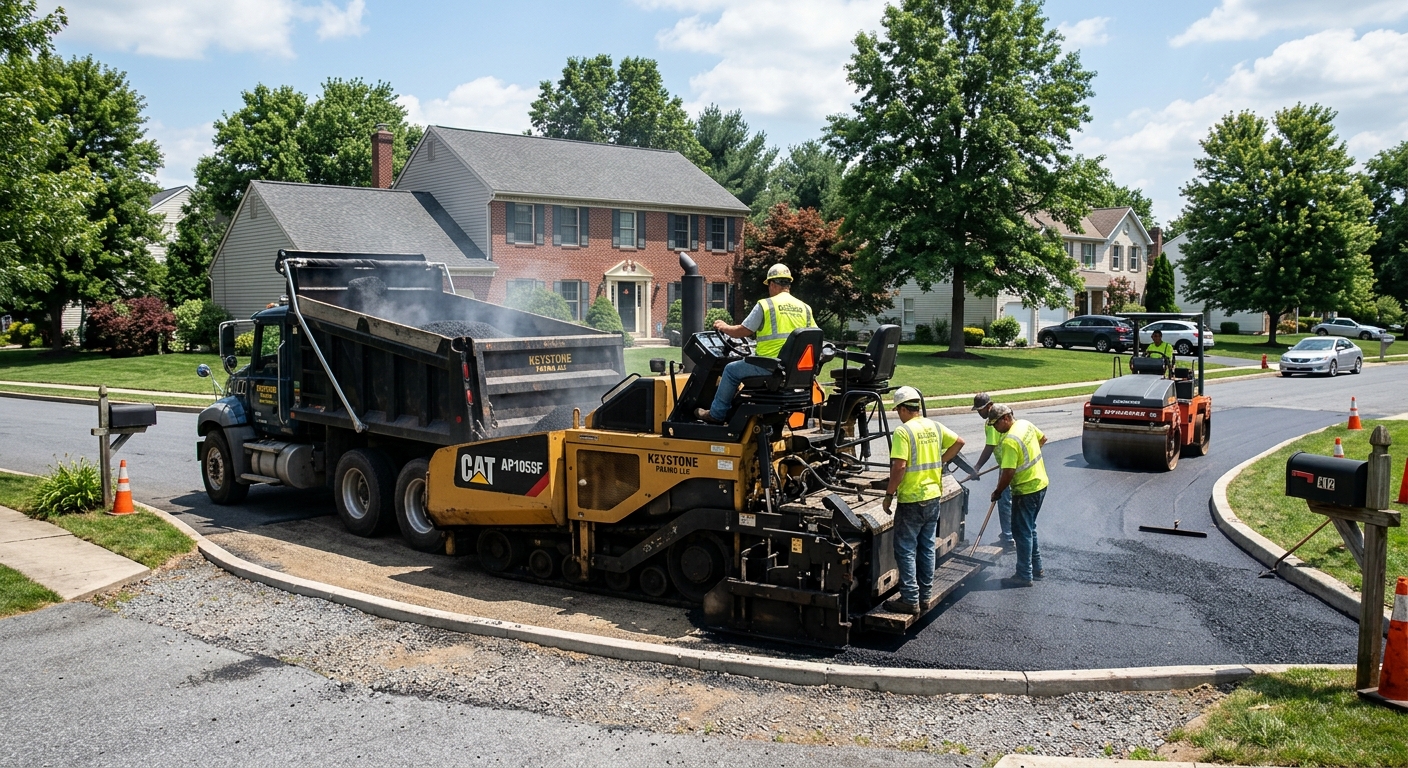
Driveway paving costs in Paradise — 2026
In Paradise, where 70.8% of homes are single-family and the homeownership rate sits at a strong 65.5% (U.S. Census Bureau, ACS 2024), the responsibility for driveway upkeep or replacement falls squarely on the homeowner. Driveway paving and maintenance here aren’t a matter of curb appeal alone—south-central Pennsylvania's pronounced freeze-thaw cycles and local soil matter, especially in neighboring townships with limestone karst underfoot, are forces that can surprise the unprepared.
The gap between the lowest and highest paving quotes in Paradise often isn't in the surface finish, but buried in what you can't see. A bid might save a thousand dollars by shaving the base depth below standard, skipping proper compaction, or substituting recycled millings where clean stone belongs, but those shortcuts set the clock ticking until settlement or cracks appear. Worn driveways in older areas, especially those laid before standards tightened, may never have had a proper base in the first place.
| Service |
Best for |
Lifespan |
Price range |
| Asphalt — full replacement with new base |
failed base, structural cracking |
20–30 yrs |
$3,600–$9,400 |
| Asphalt overlay / resurfacing |
sound base, surface cracking only |
8–15 yrs |
$1,550–$4,700 |
| Sealcoating — single application |
preventive maintenance on sound asphalt |
2–4 yrs |
$200–$750 |
| Concrete — new installation |
long service life, low maintenance |
30–50 yrs |
$5,200–$12,500 |
| Crack filling and patching |
isolated cracks under a quarter inch |
1–3 yrs |
$200–$800 |
| Gravel driveway |
rural, budget, long runs |
5–10 yrs with upkeep |
$900–$3,500 |
Estimates for a typical Paradise driveway. Square footage and base condition drive these figures more than material choice.
Sealcoating: what it does and what it doesn't
Sealcoating is often sold as a cure-all for asphalt driveways in Paradise, but a clear view helps set expectations. What sealcoating does well is shielding your driveway’s surface from UV exposure, oxygen, and household spills—things that break down the asphalt binder over the years. It also restores that black, even look most homeowners want out front.
But sealcoating is not magic. It doesn't add any real strength; if your driveway is already cracked or the base is giving way, sealcoating won’t fix it or buy you years of extra life. Done on crumbling surfaces, it’s just makeup on a structural problem.
Most important—and rarely said—sealing too often does more harm than good. Layer upon layer every year will start to crack and peel, trapping moisture in between and making future repairs trickier. New asphalt should never be sealed until it's had a full summer to cure, or trapped volatiles will make for a soft, failed surface.
The real maintenance priority is crack filling over sealcoating. When water finds a crack, it goes straight for the base layer. Filling cracks before winter makes the biggest difference in Paradise's freeze-thaw cycles. A proper sealcoat is done with a squeegee or brush at the right thickness; sprayers watered down with too much sealer are common in the lowest bids and don’t last even one season.
Price-wise, sealcoating costs $200–$750 for a standard Paradise driveway. When you see cut-rate offers, know that means thinner applications, cheap material, or no cleaning. That kind of job might look fine at first and then peel or wear off before the year is out.
Maintenance that actually works
The most cost-effective maintenance in Paradise is simple: keep water out of the base. Start with crack filling—stopping water from reaching the gravel below halts the freeze-thaw damage that ruins driveways in Lancaster County. Fresh cracks filled each fall before deep freezes are the best investment.
After that, stop the edges from crumbling. Asphalt or concrete needs soil tight to the border for support. Allowing the edge to drop off leads to raveling and breaks that travel inward. Gravel shoulders or grass right up to the edge both work.
Keeping water moving is next—gutters, downspouts, and grading should all steer water off the driveway and away from its base. Never allow puddling. Heavy loads cause ruts and cracks, so avoid parking dumpsters or using jack stands directly on the surface if possible.
New asphalt needs curing time, especially in the Paradise climate. Don’t park on it for at least three days after paving, and avoid turning the wheels while stationary for a few weeks during warm months.
With de-icing: salt damages concrete permanently in just one winter, so use sand, non-chloride de-icers, or gravel, though these cost more. For asphalt, melting and refreezing water is still a risk, as freeze-thaw cycles accelerate cracks, so remove snow promptly and use de-icers sparingly.
Why driveways behave differently in Paradise
Underneath every Paradise driveway is the real reason for its performance: soil type. In East Hempfield Township, for example, limestone karst is common, meaning driveways may settle or develop voids unless built on a thicker, stable aggregate base with careful drainage planning. The limestone drains well—but where water pools or finds a path, sudden settlement can appear overnight.
Combine that limestone base with our 30-inch frost depth and harsh freeze-thaw cycles, and you see why base thickness and drainage are not optional details—they’re essential. Water migrating into weak sections freezes, expands, and heaves the surface. This is a much bigger factor in driveway longevity than the paving material itself.
In central Lancaster County, especially in the city, another practical detail: with 55% of homes built before 1980, many driveways were poured or laid over thin or even nonexistent bases, especially where shared alleys or narrow aprons had little room. In those situations, merely resurfacing might be short-lived; replacement with a new base may be the only route to a lasting fix.
So, while a neighboring county with different subsoils might get away with minimal prep, in Paradise, understanding—and accommodating—the local subgrade and climate is the difference between a driveway that lasts a decade and one that fails before its time.
Driveway permits, approaches and stormwater rules
Homeowners in Paradise and most Lancaster County townships can replace or resurface their existing private asphalt driveway without pulling a special permit, as long as the work stays within the current footprint. This means most maintenance and even full-depth asphalt replacements move ahead faster, without the bureaucratic hold-ups common elsewhere.
But where your driveway meets the road—the approach, apron, or curb cut—a permit may be required, and not always from the authority you expect. In Lancaster city, new or altered approaches and curb cuts are managed by the City of Lancaster Bureau of Engineering. For driveways on state routes, PennDOT District 8-0 is the permitting body. Failing to check leads to headaches, especially if your work impacts sidewalks or public rights-of-way.
On the stormwater front, expanding your driveway (widening or increasing area) could trigger runoff or impervious area requirements, and, regardless of permit status, you are responsible for preventing runoff onto a neighbor’s property. Lancaster County’s pronounced freeze-thaw cycles mean sensible grading and well-placed drainage are essential, not optional.
Contractors working on driveways valued over $500 must be registered Home Improvement Contractors under Pennsylvania’s rules—look them up at hic.attorneygeneral.gov. Workers’ compensation is mandatory for all employees and can be checked at WCAIS (wcais.pa.gov). Skipping these steps is an open invitation for trouble.
Asphalt or concrete for a Paradise driveway?
In Paradise, where we see consistent freeze-thaw cycles and a winter design temp of 12 °F, asphalt and concrete behave differently. Asphalt’s real strength is its flexibility. As the subgrade moves or water freezes and thaws, asphalt flexes slightly, absorbing those stresses. You’ll see some small cracks and deformation over 20–30 years, but with maintenance (primarily $200–$750 sealcoating every few years), it handles movement gracefully.
Concrete outlasts asphalt when conditions are right, with a possible lifespan of 30–50 years. But those years come at a price—concrete installs cost more up front ($5,200–$12,500) and demand lower-maintenance behavior. De-icing salt is public enemy number one in this region. Concrete spalls and flakes rapidly under salt, so unless you can commit to non-salt de-icers, concrete’s advantages are wasted.
Pavers split the difference—costing more up front, but each brick can be lifted and reset if settlement occurs, and they weather freeze/thaw reasonably well. Gravel is cheapest and drains excellently, but requires regular top-dressing and doesn’t suit every Paradise property.
| Option |
Installed cost |
Maintenance |
Freeze-thaw performance |
Lifespan |
| Asphalt — new install |
$3,600–$9,400 |
sealcoat every 3–4 yrs |
excellent, flexes |
20–30 yrs |
| Asphalt — overlay |
$1,550–$4,700 |
same |
good if base is sound |
+8–15 yrs |
| Concrete |
$5,200–$12,500 |
low, avoid de-icing salt |
fair, spalls with salt |
30–50 yrs |
| Pavers |
$8,300–$12,500 |
individual units replaceable |
good, settles gradually |
25–50 yrs |
| Gravel |
$900–$3,500 |
top-dress every 2–3 yrs |
excellent drainage |
indefinite with upkeep |
How paving fraud actually operates
Paving fraud thrives in places like Paradise and Lancaster County, where moderate suburban density means jobs can be lined up quickly and word travels slower than in city neighborhoods. The classic scams are familiar: someone knocks and says they have leftover material from a “job down the road,” offers a steep discount for same-day work, rolls up in an unmarked truck with out-of-state plates, or asks for cash up front with a handshake quote.
Another frequent tactic is pitching a sealcoating job for a too-low price, then spraying a diluted oil-based product that washes off at the first rain. Thicker squeegee or brush-applied coats cost more ($200–$750), but thin spray jobs can wreck your driveway faster than doing nothing.
Rural areas, including the outer parts of the Lancaster metro, are especially targeted by these operators because verifying their legitimacy is harder and customers are less likely to compare notes. Even honest-looking crews sometimes operate for a season, then vanish, making warranty claims impossible.
Pennsylvania law tackles this head-on with the Home Improvement Consumer Protection Act (HICPA): for any contract over $500, you are entitled to a written contract and a three-business-day right of cancellation. It is illegal for a contractor to offer to waive your insurance deductible. If you’re pressured to skip paperwork or make snap decisions, walk away fast.
You can defeat almost every paving scam in five minutes: check the contractor’s HIC registration at hic.attorneygeneral.gov, verify their workers’ comp at wcais.pa.gov, and never pay upfront for work not in writing. A little homework matters more than any warranty pitch.
Frequently asked questions — driveway paving in Paradise
Is sealcoating a scam?
Sealcoating isn't a scam in itself—it's a legitimate maintenance step for asphalt driveways in Paradise. The problem is how it's sold. A proper application shields the surface from sun, water, and chemicals, keeping the asphalt binder healthy for longer. But sealcoating doesn't fix cracks or structural issues. If your driveway base already has problems, a $300 sealcoat (right in the $200–$750 range for this area) won't solve them, and repeated, thin spray jobs by door-to-door crews are money wasted. The sweet spot is a full coat every 2–4 years, not every season. What you want to avoid are offers that sound too cheap or promise years of life on a badly cracked surface.
Does Paradise have local asphalt plants?
Yes, Paradise and the surrounding Lancaster County area benefit from several local limestone quarries and asphalt plants situated near the city. For homeowners, this means most driveways are paved with fresh, hot-mix material brought directly from the plant, keeping both quality high and haul costs reasonable. In fact, unless you live on the outer edges of the metro area, plant-to-site travel doesn’t add much to the bid you get—often keeping prices in the typical $3,600–$9,400 range for a full asphalt replacement. Living here means you aren’t paying a premium just for delivery.
Can I pave over my existing driveway?
In many cases around Paradise, you can put an asphalt overlay over your existing driveway if the base is solid and the cracks are only on the surface. An overlay is cheaper—typically $1,550–$4,700—and adds 8–15 years of life if done right. But pavers will look for signs of base failure: deep cracks, alligatoring, and settled spots are red flags. Overlaying a driveway with a bad base guarantees you'll see old cracks reappear quickly. For older driveways especially (remember, over half of local homes were built before 1980 here), a proper inspection tells you if it’s worth the savings or a recipe for regret.
How much does a concrete driveway cost in Paradise?
A new concrete driveway in Paradise will usually fall between $5,200–$12,500 depending on size, site access, and finish. Most homeowners spend around $8,300 for a standard single-family home. Concrete's main advantage over asphalt is lifespan—if you stay off de-icing salt, it can last 30–50 years here. The upfront price is higher, but with minimal maintenance and careful winter care, it’s often the last driveway you’ll ever need. But, remember, if you use salt regularly, the longer lifespan promise won’t materialize.
What does an asphalt overlay cost in Paradise?
An asphalt overlay, or resurfacing, is usually the most cost-effective way to extend an aging driveway’s life in Paradise—provided the base is still in good shape. You’ll see prices from $1,550–$4,700 for a standard single-family drive, with most falling near $3,100. The key benefit is you get a fresh surface, increased curb appeal, and (if cracks are shallow) another 8–15 years of life. But if you have deep cracks, extensive heaving, or base movement (common in driveways installed before 1980 in this area), investing in a full replacement may be smarter in the long run.
Can asphalt be laid in cold weather?
Asphalt paving in Paradise and greater Lancaster County generally stops once consistent daytime highs drop below 45–50 °F. Cold weather cools down hot-mix quickly, making proper compaction tricky and leaving the surface rough or weak. If a contractor promises a deal in late fall or winter, be skeptical—poor compaction now means cracks by spring. That said, small patch jobs may be done with cold-mix in emergencies, but it isn’t a substitute for proper paving. For the standard $3,600–$9,400 full replacement, plan on work between April and October for best results.
How do I verify a paving contractor in Pennsylvania?
Verifying a paving contractor in Pennsylvania, including Paradise, is fast and smart. The state requires Home Improvement Contractor (HIC) registration for any work over $500—look up a business by name or number at hic.attorneygeneral.gov and see if they're active and complaint-free. For any job with a crew, check for workers' compensation coverage using the WCAIS site (wcais.pa.gov), which protects you if someone is hurt on your property. Finally, state law guarantees you a written contract and a three-day right to cancel for work above $500—never accept a handwritten or verbal quote for a job that could run $1,550–$12,500. These fast checks screen out most of the risk.
How deep should the aggregate base be here?
In and around Paradise, especially where limestone karst is common, the aggregate base under a new asphalt or concrete driveway should be at least 6–8 inches, and up to 12 inches on soft or poorly draining spots. This extra thickness fights settlement and frost heave—crucial with our 30-inch frost depth and frequent freeze-thaw cycling. Cheap bids often skimp on base depth, but that’s a false economy. For a standard driveway costing $3,600–$9,400 to replace, the “invisible” part below the surface is what separates a ten-year lifespan from twenty-plus.
What causes concrete to spall or flake in Paradise?
In Paradise, the main culprit for concrete spalling is the use of salt-based de-icers during our icy winters. Salt accelerates the freeze-thaw cycle at the surface, which breaks down the rigid top layer and leads to chips (spalling) or flakes. Paradise’s climate (average winter design temp of 12 °F and high freeze-thaw activity) makes this worse than in milder areas. Poor finishing during installation, using too much water in the mix, or placing concrete over a thin or poorly drained base speeds up flaking as well. Even a high-cost job (think $5,200–$12,500) won’t last unless you switch to sand or calcium chloride-based de-icers and clear snow quickly before it melts and refreezes.