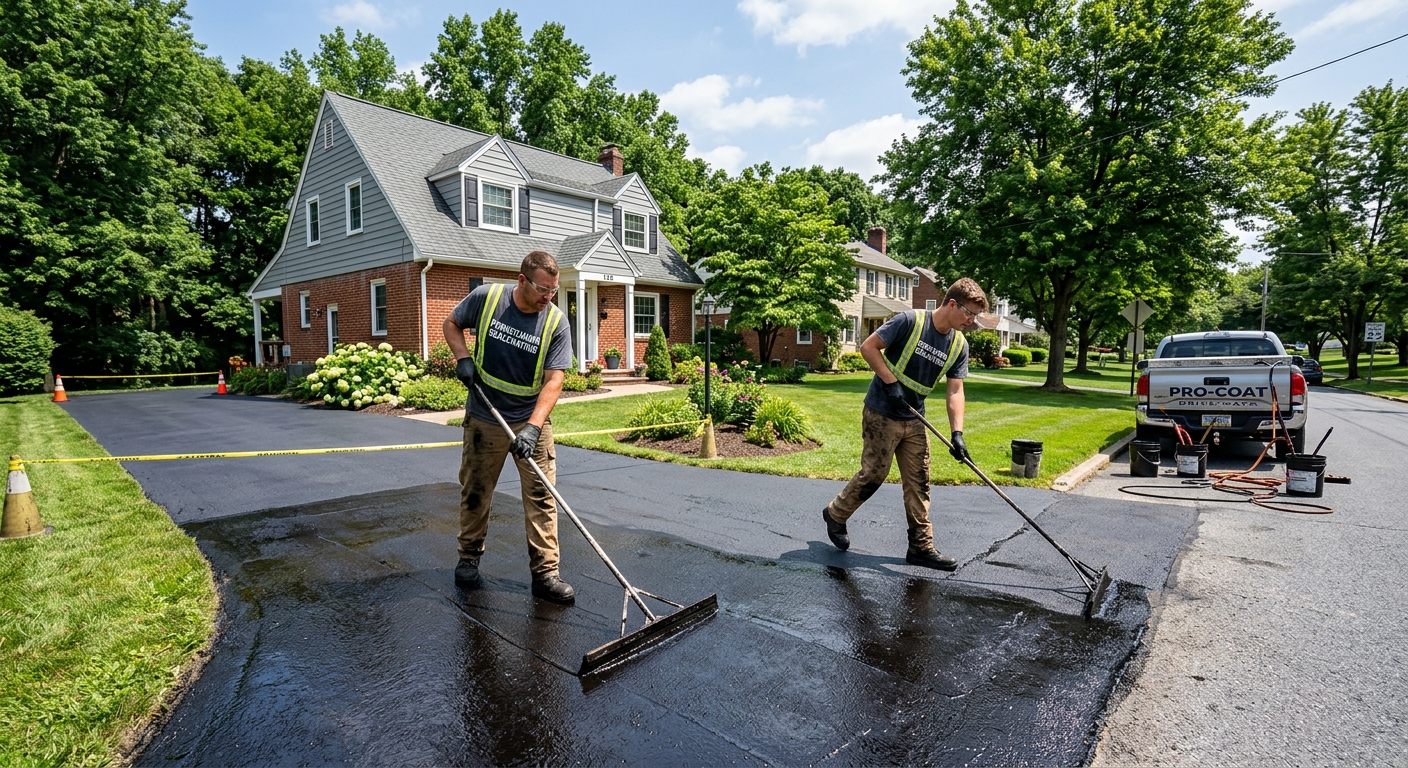
Salisbury paving prices by scope — 2026
In Salisbury, where 80.6% of homes are single-family and over 80% are owner-occupied (U.S. Census Bureau, ACS 2024), driveway paving is a major outlay that most homeowners eventually face. The region's regular freeze-thaw cycles and winter temperatures near 4 °F put every drive to the test, and local soils—particularly limestone karst in western Lehigh County—demand attention to base prep. Most of the cost difference between two quotes has nothing to do with the asphalt you see on day one. The crucial work—excavation, subgrade prep, type and thickness of aggregate, compaction, and drainage—lies beneath the surface, out of sight. This means the cheapest bid often skips the work that makes a Lehigh Valley driveway last. Most Salisbury driveways are old enough that patching doesn’t cut it any more, and when you do replace, what you can’t see under the paving matter more than the topcoat. Here’s what it actually costs in 2026:
| Service |
Best for |
Lifespan |
Price range |
| Asphalt — full replacement with new base |
failed base, structural cracking |
20–30 yrs |
$3,700–$9,500 |
| Asphalt overlay / resurfacing |
sound base, surface cracking only |
8–15 yrs |
$1,600–$4,700 |
| Sealcoating — single application |
preventive maintenance on sound asphalt |
2–4 yrs |
$200–$750 |
| Concrete — new installation |
long service life, low maintenance |
30–50 yrs |
$5,300–$12,500 |
| Crack filling and patching |
isolated cracks under a quarter inch |
1–3 yrs |
$200–$800 |
| Gravel driveway |
rural, budget, long runs |
5–10 yrs with upkeep |
$900–$3,500 |
Estimates for a typical Salisbury driveway. Square footage and base condition drive these figures more than material choice.
The specifications to demand in writing
Don’t focus only on price when choosing a paving contractor in Salisbury. What most affects driveway life here is what gets buried below the asphalt, especially with our harsh freeze-thaw cycles and complicated soil—karst in the west means void risk you don’t see from the surface. Minimum depths that would be enough in a mild climate won’t last a Lehigh County winter. That means any worthwhile quote will itemize, in numbers, what’s being installed: how deep excavation goes, type and depth of the stone base after compaction (not just “as spread”), compaction in lifts, finished thickness of each asphalt layer, and the actual mix used. “We’ll put down three inches” tells you nothing unless you know if it’s three inches before or after the rollers. The difference? Up to a quarter vanishes in compaction. Hand-waving about “plenty of stone” is just as bad. Without clear specs, it’s all trust.
- Excavation depth (inches below finished grade)
- Aggregate base thickness (compacted depth, not loose)
- Type and size of base stone, sourced locally
- Base compaction method, and number of passes
- Asphalt binder course thickness (compacted)
- Surface course thickness (compacted)
- Asphalt mix designation (e.g., PennDOT ID-2)
- Compaction plan (roller type, compaction target in tons/sq yd)
- Edge treatment (tapered, straight, or concrete curb)
- Drainage detail (pitch, swale, daylight location)
The honest case for and against sealcoating
Every drive in Salisbury eventually gets a flyer in the mailbox for sealcoating. Here’s the truth: a good sealcoat protects asphalt binder from sunlight and oil, slows oxidation, and gives the surface a dark, fresh look. It’s real maintenance if your base is still solid. But sealcoating doesn’t add any structural strength or fix cracks, and it cannot make up for a failing base or old crumbly top. Sealing a driveway that’s already lost, or applying it to concrete, is wasted money.
Many contractors won’t tell you that too-frequent sealing is just as bad. Piling layers on yearly traps moisture, builds soft spots, and soon peels and cracks. The surface should cure for at least a year after paving before the first sealcoat. After that, every 2–4 years is plenty. The crack filling step—forcing real sealant into open cracks—is more important for Lehigh County drives than the coating. Avoid the $99 spray jobs: a proper sealcoat costs $200–$750 for a typical Salisbury home, and takes preparation—a thorough cleaning, base repair, solid weather window, and brushing in edges and cracks by hand.
The bottom line: if your drive is structurally sound, sealcoating is smart, in moderation. If it looks like alligator skin or you see standing water, fix the root first. Otherwise, you’re just putting a shine on a problem.
How paving fraud actually operates
Paving brings out more than its share of traveling crews in Lehigh County. The ruse is familiar: a knock at the door, “leftover material” from a job, a price good for today only, an unmarked pickup, out-of-county plates, and a quote written in the air, not on paper. Once payment is in hand, the work is rushed—scraping instead of real base prep, thin spread of cheap oil, or spraying black paint in place of sealcoat. It looks fresh for a season, then disappears with the frost. In a saturated market like the Lehigh Valley, transients hunt rural and suburban neighborhoods, guessing that neighbors are far enough apart that word spreads slow and that homeowners may not know the law.
Pennsylvania’s Home Improvement Consumer Protection Act (HICPA) is your shield. You are entitled to a written contract for any work over $500, and you can cancel within three business days, no reason needed. Never hand over cash up front, never fall for “we’re in the area,” and never accept verbal promises—ask for it in writing. Thin, fast “oil seal” jobs at bargain prices do not pass for actual sealcoating. A reputable Salisbury contractor is registered with the state (check at hic.attorneygeneral.gov) and carries workers’ compensation (confirm at wcais.pa.gov).
Five-minute checks: verify the contractor’s HIC registration, ask for proof of workers’ comp, insist on a written and detailed contract, and walk away from pressure tactics. That’s all it takes to keep your money—and your driveway—secure.
What you need before paving in Salisbury
Most Salisbury homeowners won’t need a building permit just to resurface or repave an existing driveway, if they’re not changing its location or width. This is typical for much of Lehigh County—a big savings on hassle and fees. But anytime you want to expand your driveway footprint, cut in a new curb, or alter where it meets the street, you trigger reviews for zoning and drainage. For driveways connecting to state routes, the required approach permit is from PennDOT District 5-0, not the township. That catches people off guard. Local township offices handle approach permits for non-state roads.
Stormwater management is another local trigger. Increasing the amount of paved (impervious) surface may trip runoff requirements—Salisbury gets its share of heavy storms, and even an old drive directed the wrong way can put you at odds with your neighbor if water runs off your property. Permits or not, you are on the hook for correcting any runoff problems you cause.
When hiring, Pennsylvania law requires that contractors doing work over $500 be registered as Home Improvement Contractors. Check their HIC number with hic.attorneygeneral.gov. All employers must carry workers’ compensation insurance; you can verify their status in five minutes at wcais.pa.gov. Don’t move forward until both are confirmed in writing.
Diagnosing a failing Salisbury driveway
If your Salisbury driveway is cracking, crumbling, or holding water, you can save yourself a lot of money by figuring out what’s wrong before you call anyone. Alligator cracking—tight, interlinked cracks over a wide area—means the base is shot; patching or overlaying will fail in a couple of winters. Isolated straight cracks, especially near joints, usually mean the surface is aging but the base is still solid. Depressions or “birdbaths” are a giveaway that the subgrade has shifted or wasn’t compacted right—typical in the limestone-heavy parts of Lehigh County. Crumbling at the edges signals there’s no structural support, common for drives built narrow in the 1950s–1970s and never widened for today’s heavier vehicles. Potholes form when water gets to the base and the freeze-thaw cycle hammers it apart.
Any contractor who offers an overlay or “simple resurfacing” without probing the base (by core-drilling or at least digging a small test pit) is skipping the only check that matters. Put money into surface patching only if your problems are isolated and small. Here’s what you can expect:
| What you see |
Likely cause |
Right fix |
Cost |
| Isolated cracks under 1/4 inch |
surface aging |
crack fill and seal |
$200–$750 |
| Alligator cracking over a wide area |
base failure |
full replacement |
$3,700–$9,500 |
| Depressions holding water |
subgrade movement |
excavate and rebuild that area |
$3,700–$5,800 |
| Crumbling edges |
no edge support |
edge repair, consider curbing |
$400–$1,500 |
| Potholes |
water into the base |
full-depth patch, then assess |
$250–$900 |
| Faded but sound surface |
oxidation only |
sealcoat |
$200–$750 |
Which surface survives Salisbury winters
For Salisbury homes, winter speed-bumps and potholes are familiar. Our snow load (40 psf) and deep frost line (36 inches) set the bar. Asphalt is the local favorite because it flexes—when the subgrade heaves or settles, the asphalt bends rather than cracks. That’s critical through Lehigh County’s freeze-thaw cycles and on soils with void risk. Concrete, which can last twice as long if cared for, sees its biggest threat from salt and ice-melt chemicals, not the cold itself. In a region that sees real snow and highway de-icing, concrete surfaces pit, flake, and spall unless the owner is meticulous about using only approved, non-chloride de-icers and cleaning up after plowing. Most people don’t—or can’t—keep up, which shortens concrete’s life in practice. Asphalt needs resealing every few years but tolerates minor movement without splitting.
Paver driveways are legitimate for upper-end homes or when aesthetics win, and gravel is still smart for rural, budget-friendly, or extra-long drives. Each has a downside—pavers can settle unevenly, and gravel needs regular top-dressing—but both handle local drainage and freeze-thaw far better than poorly installed asphalt or concrete.
| Option |
Installed cost |
Maintenance |
Freeze-thaw performance |
Lifespan |
| Asphalt — new install |
$3,700–$9,500 |
sealcoat every 3–4 yrs |
excellent, flexes |
20–30 yrs |
| Asphalt — overlay |
$1,600–$4,700 |
same |
good if base is sound |
+8–15 yrs |
| Concrete |
$5,300–$12,500 |
low, avoid de-icing salt |
fair, spalls with salt |
30–50 yrs |
| Pavers |
$8,400–$12,500 |
individual units replaceable |
good, settles gradually |
25–50 yrs |
| Gravel |
$900–$3,500 |
top-dress every 2–3 yrs |
excellent drainage |
indefinite with upkeep |
Frequently asked questions — driveway paving in Salisbury
Does Salisbury have local asphalt plants?
Salisbury homeowners benefit from local aggregate supply. The Lehigh Valley, which includes Salisbury, is served by several nearby quarries and asphalt production plants, which means you aren’t paying extra for haul distance or remote material sourcing. That keeps paving costs reasonable in this market compared to rural or isolated areas. The local supply chain helps stabilize prices and ensures fresh hot-mix, which is critical—spread time matters for durability. When you get a quote for an asphalt driveway replacement, expect most of the cost, $3,700–$9,500, to go toward site preparation and labor, not trucking the material across the state.
How much does it cost to widen a driveway?
Widening a driveway in Salisbury almost always costs more per square foot than simply overlaying the existing path. That’s because widening involves excavation, base prep, matching the grade, and integrating new material with old—not just paving over what’s already there. If you’re adding a modest two-vehicle width to a typical Salisbury driveway, expect a cost similar to a section of full-depth replacement: the band is $3,700–$9,500 depending on how much width you add, site access, and drainage needs. Expansion also may trigger a zoning or stormwater review, especially for homes with the original narrow 1950s–1970s drives now undersized for today’s vehicles.
Do I need a permit to repave a driveway in Salisbury?
In most Lehigh County townships, including Salisbury, you usually do not need a building permit just to resurface or repave your driveway, as long as you don’t change its location or widen it. Expanding a driveway or adding a new curb cut, however, does require a review for zoning and drainage. When your driveway meets a state road, you need an approach permit from PennDOT District 5-0. Salisbury and surrounding municipalities each handle driveway permits slightly differently, so it pays to check. Repaving in place without changes can save time and money, keeping your project in the lower cost bands—resurfacing runs $1,600–$4,700.
How long before I can drive on a new asphalt driveway?
After paving a new asphalt driveway in Salisbury, patience pays off. While asphalt cools within a few hours, it takes at least 24–48 hours before it’s safe for car traffic under typical Lehigh County late spring or early fall conditions. In the heart of summer, softer pavement can be damaged for several days if weight is applied too soon. For concrete, wait at least a week before regular use. That startup wait protects the surface from rutting and scarring that can permanently mark your investment—especially with a new drive costing $3,700–$9,500 for asphalt or $5,300–$12,500 for concrete. Light foot traffic is usually fine after the first evening, but ask your contractor based on current weather.
Are pavers worth the cost in northeastern Pennsylvania?
Paver driveways are gaining ground in Salisbury and across northeastern Pennsylvania for their looks and the fact that you can replace individual stones if needed. Upfront, they cost more—expect $8,400–$12,500 for a two-car Salisbury driveway—but require little beyond occasional weed removal and resetting shifting units after heavy rains. Pavers handle our region’s freeze-thaw cycles well because each unit moves independently. If curb appeal, drainage, and high-end aesthetics are driving your decision, pavers are worth it; but for seeing the most years per dollar, asphalt and gravel still win out when maintenance is kept up.
How deep should the aggregate base be here?
In Salisbury and most of Lehigh County, the aggregate base for a driveway needs to be deeper than in warmer or milder regions, thanks to winter freeze-thaw and areas of void-prone limestone soil. The minimum for asphalt driveways is typically 6–8 inches of compacted, crushed stone base, more in spots with poor drainage or over known limestone deposits. For concrete, most contractors will specify 4–6 inches, but more is better on weak subsoils. Skimping on base prep is the #1 reason Salisbury driveways fail early, and all of that is baked into the price—full-depth replacement runs $3,700–$9,500 in Salisbury, in part because the proper base is not cheap.
Why does my driveway have depressions that hold water?
Depressions or “birdbaths” showing up in your Salisbury driveway typically point to subgrade movement below the paved surface. In Lehigh County, this is often caused by improper compaction at installation, water washing away fine materials under the base (a risk in karst areas), or driveway edges that have softened and settled after years of Pennsylvania freeze-thaw cycles. These low spots usually require targeted excavation and rebuilding—a temporary patch won’t last. The cost to permanently fix depressions usually aligns with partial replacement, falling in the $3,700–$5,800 range for a moderate area, based on recent Salisbury jobs.
What is the difference between crack filling and sealcoating?
Crack filling and sealcoating are two different maintenance steps for Salisbury driveways. Crack filling involves cleaning out individual cracks—usually those less than a quarter inch wide—and injecting flexible sealant. This seals out water and prevents further freeze-thaw damage. Sealcoating, in contrast, is a protective surface layer brushed or sprayed over the entire asphalt drive. It guards against sun and chemical damage but does nothing to strengthen the pavement or fill wide cracks. For Lehigh County winters, crack filling is the first priority. Both should be budgeted: crack filling tends to cost between $200–$800, while a proper sealcoat application runs $200–$750 on a standard drive.
What does an asphalt overlay cost in Salisbury?
An asphalt overlay, or resurfacing, is only as good as the base beneath it. If your Salisbury driveway’s sub-base is still solid, an overlay can buy you 8–15 years of additional service life at less cost than a full replacement. For 2026, the price for resurfacing a typical home driveway in Salisbury falls in the $1,600–$4,700 band. The wide range reflects varying driveway sizes, edge repairs, removal of high spots, and any crack prepping needed. If your base is soft, overlaying is no bargain—it’s just money lost. Make sure your contractor diagnoses the base before suggesting this option.