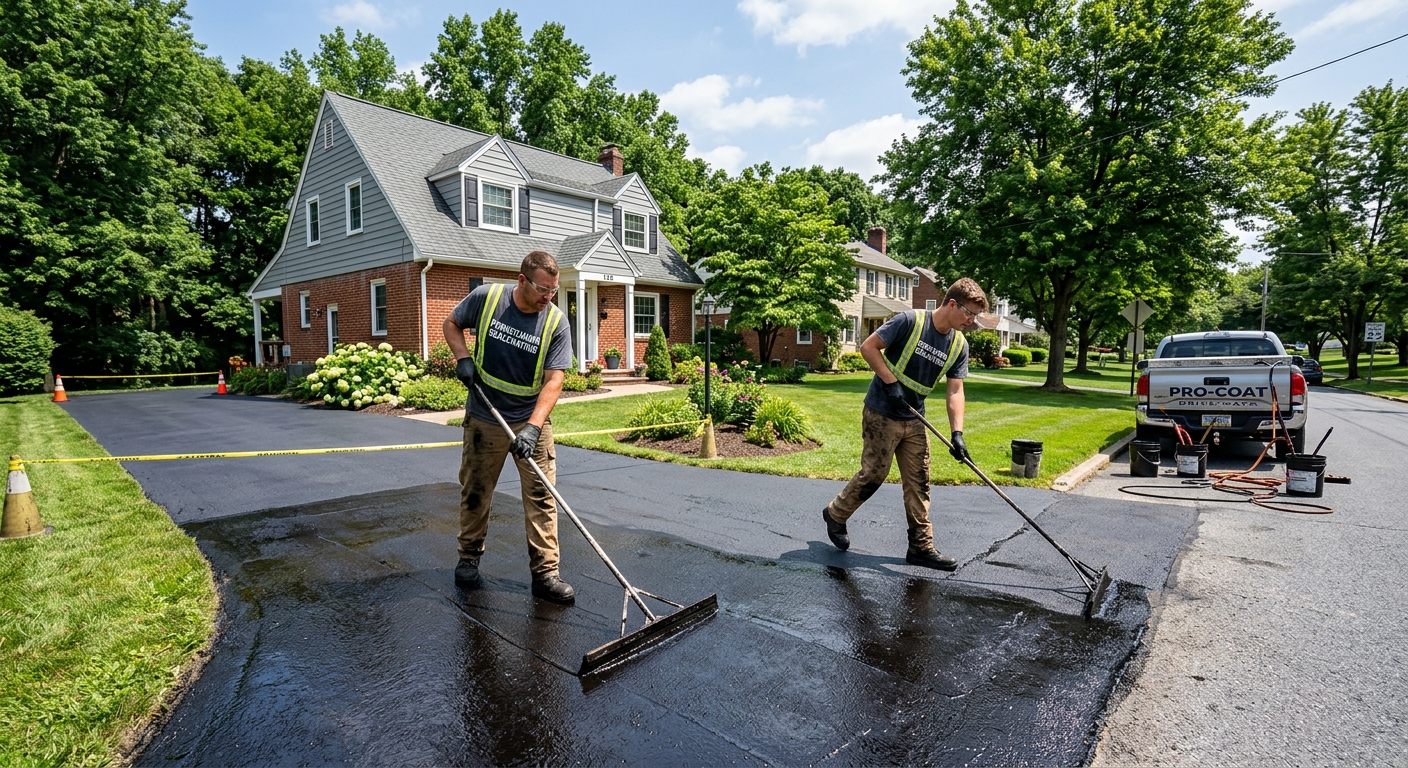
Driveway paving costs in Salisbury — 2026
Salisbury’s driveways are typical of Lancaster County: three-quarters of homes here are owner-occupied, and nearly 80% are single-family dwellings (U.S. Census Bureau, ACS 2024), so driveway work is one of the most common heavy exterior expenses. Whether you need a small repair or a full replacement, most of what you’re paying for isn’t material—it’s the labor and base prep that happens after the old surface is removed but before you see fresh blacktop or concrete. In our freeze-thaw climate, what’s below ground matters even more.
Lancaster County sees pronounced freeze-thaw cycling and moderate snowfall, pushing prices on the high end if thicker bases or better drainage are needed. In parts of the county like East Hempfield Township, limestone karst subgrade means extra stone, while homes built before 1980 (nearly half in this area) may have sub-bases that weren’t engineered from the start. When comparing quotes, remember the biggest price differences are literally buried—usually under the base you won’t see.
| Service |
Best for |
Lifespan |
Price range |
| Asphalt — full replacement with new base |
failed base, structural cracking |
20–30 yrs |
$3,600–$9,200 |
| Asphalt overlay / resurfacing |
sound base, surface cracking only |
8–15 yrs |
$1,550–$4,600 |
| Sealcoating — single application |
preventive maintenance on sound asphalt |
2–4 yrs |
$200–$700 |
| Concrete — new installation |
long service life, low maintenance |
30–50 yrs |
$5,100–$12,500 |
| Crack filling and patching |
isolated cracks under a quarter inch |
1–3 yrs |
$200–$800 |
| Gravel driveway |
rural, budget, long runs |
5–10 yrs with upkeep |
$900–$3,500 |
Estimates for a typical Salisbury driveway. Square footage and base condition drive these figures more than material choice.
Choosing a paving company
Selecting a paving contractor in Salisbury is about more than a low bid. With driveway work, what lasts isn’t always visible—so a reputable contractor should be able to prove their credentials up front. Pennsylvania requires Home Improvement Contractor (HIC) registration for any work over $500; you can check a contractor’s status yourself at hic.attorneygeneral.gov. Confirm their workers’ compensation through WCAIS, not just a paper certificate, because this protects both you and the workers.
Lancaster County’s proximity to multiple limestone quarries and regional asphalt plants means a local contractor should have no trouble naming where they get materials. If they can’t, they’re likely a broker, not a builder. Ask for references from 3 to 5 years ago: any fresh asphalt looks great, but Salisbury’s climate will show shortcuts by year three. Owned equipment, not rented, and a real business address show skin in the game.
- HIC registration verified at the state site
- Workers’ comp confirmed via WCAIS
- Local business address, not just a mobile number
- References on driveways installed 3+ years prior
- Their own skid steer, paver, and rollers on site
- Specific aggregate and asphalt supplier named
- Clear written contract over $500, as per law
- Payment schedule with modest deposit, not cash only
- Proposal includes square footage and material specs
- No waiving of your insurance deductible—illegal here
- Explains approach for drainage and edge support
Red flags: vague proposals, only recent jobs as references, no business address, or “we work statewide.” Beware of companies unwilling to detail where their material comes from or refusing to pull local references—they’re often just passing the job to someone else.
Permits and approvals for paving in Salisbury
For most paving projects in Salisbury—including resurfacing an existing private asphalt driveway—there’s generally no need to pull a permit in Lancaster County townships if you’re not modifying the driveway’s footprint or its connection to the road. This saves most homeowners the time and fees of a permit trip. However, if you’re building a new driveway approach or altering the area where the driveway meets the street, that work is permitted not by the county, but by the City of Lancaster Bureau of Engineering for city streets—or by PennDOT District 8-0 if your property connects to a state route.
Keep in mind: expanding your driveway, or adding square footage of impervious surface, can trigger stormwater management requirements. Even without a permit, you’re liable for drainage—directing runoff onto your neighbor’s property can cause legal headaches. In the limestone subgrades common to East Hempfield Township and surrounding areas, poor drainage quickly causes base failure and costly repairs.
By law, contractors must hold Home Improvement Contractor registration (verify at hic.attorneygeneral.gov) and provide written contracts on projects over $500. For your protection and theirs, check that their workers’ compensation insurance is active at WCAIS (wcais.pa.gov) before signing. These verifications matter more than any logo or flyer.
How often should a Salisbury driveway be sealed?
Most of what you read about driveway sealcoating is either sales pitch or old wives’ tale. In Salisbury, sealcoating helps protect the asphalt’s binder from oxidation, sun, oil, and gasoline. It slows surface wear and gives a crisp black look—but it doesn’t make a soft driveway harder, fix cracks, or add years to pavement that’s already failing. A single application of quality sealer runs $200–$700 for an average drive.
Too-frequent sealing is actually a problem: every coat adds thickness, and layering sealcoat every year creates buildup that eventually cracks and flakes. For most Salisbury driveways, once every 2–4 years is plenty if you want that clean new look. After a fresh asphalt install, wait at least 90 days—or up to the following spring—before applying any sealer, so the pavement can finish curing and allow oils to escape.
Crack filling is a bigger deal than sealing here. Water entering small cracks through Salisbury’s freeze-thaw cycles is what wrecks the base and leads to real problems. Well-done crack fill—a neat, flexible band over every gap—beats a thin, sprayed-on sealcoat every time.
If a “deal” is under $200, you’re likely getting a watered-down spray that will wash off or peel by next spring. On the other hand, if your asphalt has major cracks or depressions, no amount of sealer will save it; putting off needed repair only raises the real bill next year.
Reading a driveway proposal
Comparing driveway quotes in Salisbury is more than lining up totals. You’ll want to see measured square footage, depth and type of excavation, the kind of base material, how deep it will be, and exact specs for compaction—especially in lifts, not all at once. Good proposals include the number and thickness of asphalt courses, detail edge treatment (to prevent crumbling), show how water will be handled so it doesn’t end up in your basement, and spell out restoration of the lawn edge if any is torn up.
Payment should be a reasonable deposit up front (often under 20%), with the balance due on completion—not cash before work starts. Warranty language matters: most do not cover cracks, and any promise to the contrary should be on paper. If a proposal has just a total and one line—no breakdown, specs, or details—it can't be compared and probably shouldn’t be trusted. Many Salisbury homeowners overpay for underbuilt work because of vague quotes.
| Line item |
What to look for |
Red flag if… |
| Area |
measured square footage stated |
eyeballed or absent |
| Excavation |
depth and disposal included |
'we'll pave over it' |
| Base |
aggregate type and depth in inches |
'proper base' |
| Compaction |
method, and done in lifts |
not mentioned |
| Asphalt |
courses and compacted depth |
'3 inches' unqualified |
| Drainage |
slope and water direction stated |
silent |
| Warranty |
what is covered and what is excluded |
verbal only |
| Payment |
modest deposit, balance on completion |
full cash up front |
Why Salisbury driveways fail from the bottom up
No matter how much asphalt you see on top, a driveway in Salisbury is only as good as its base. The assembly always starts with the subgrade—the soil native to your property. It’s compacted, then comes an aggregate base (crushed stone, usually limestone in this market), then hot-mix asphalt applied in one or more courses.
Each layer’s job is to spread the load so the forces that hit your driveway (delivery trucks, freeze-thaw movements, everyday traffic) don’t crack the final surface. If any layer below isn’t done right—especially in Lancaster County, where limestone karst soils and 30-inch frost depth are facts of life—frost heave will lift and break your driveway. That means water in the subgrade freezes, expands, and pushes slabs unevenly, which cracks the asphalt from underneath. This is why driveways here often fail much sooner than the warranted lifespan if corners were cut below grade.
Here’s the reality: cheap quotes cut corners where you can’t see. Skipping proper excavation, installing shallow or poorly compacted base, using substandard stone, or skipping compaction testing are why a job goes bad in three winters. The crew’s truck leaves, and in two or three years you’re calling for repairs nobody will warranty.
Insist on these details, in writing:
- Minimum 6–8 inches of compacted limestone base (12 inches in weak subgrade areas)
- Aggregate must be specified by type and source—ask for local quarry stone
- Compaction done in two or more lifts, with every lift checked
Everything above the surface is secondary if these aren’t followed. That’s where 90% of failure starts.
Overlay, patch or full replacement?
Almost every homeowner asks: can I just resurface, or do I need a new driveway? The answer depends on what’s happening below, not on the surface. You can inspect your Salisbury drive yourself: broad areas of “alligator” cracking—tight, scaly cracks—mean the base has failed. No overlay will last if the base moves with every freeze-thaw. Linear cracks or a faded but solid surface indicate the base is probably still sound; these can be crack filled and sealed. Depressions holding water show subgrade movement, not just surface wear. Crumbling edges tell you there’s no support—fixing them may mean curb or edge reinforcement.
Potholes mean water has already penetrated to the base, and patching is needed. Be honest with yourself: overlays on a weak or wet base are a short-term fix. A quote for overlay work should include core sampling or test pits. If your contractor isn’t looking at base conditions before bidding, they’re guessing—which means you’re the one gambling.
| What you see |
Likely cause |
Right fix |
Cost |
| Isolated cracks under 1/4 inch |
surface aging |
crack fill and seal |
$200–$700 |
| Alligator cracking over a wide area |
base failure |
full replacement |
$3,600–$9,200 |
| Depressions holding water |
subgrade movement |
excavate and rebuild that area |
$3,600–$5,600 |
| Crumbling edges |
no edge support |
edge repair, consider curbing |
$400–$1,500 |
| Potholes |
water into the base |
full-depth patch, then assess |
$250–$900 |
| Faded but sound surface |
oxidation only |
sealcoat |
$200–$700 |
Frequently asked questions — driveway paving in Salisbury
How much does driveway paving cost in Salisbury?
A new asphalt driveway in Salisbury typically costs $3,600–$9,200 for a full replacement with a new stone base, while a basic overlay on a driveway with a sound base falls in the $1,550–$4,600 range. Most detached homes here are single-family (U.S. Census Bureau, ACS 2024), so these figures apply to standard two- or three-car driveways—not narrow shared drives or gravel lanes. What drives the final price is the amount of excavation and base prep needed. Limestone subgrades in areas like East Hempfield Township may mean more stone and higher cost, while driveways built on good, firm ground stay closer to the middle of the range. Don’t be fooled by “per-square-foot” rates alone—the quality and depth of base work matter more.
How often should I sealcoat my driveway in Salisbury?
For most homes in Salisbury, a 2 to 4 year interval between sealcoating is plenty. A single job for an average driveway runs $200–$700. Sealing every year, as some companies recommend, does more harm than good by building up layers that can peel or crack in our local freeze-thaw cycle. It’s critical to let new asphalt cure for at least a full summer before sealing—otherwise, you’ll trap oils and risk early damage. Fill cracks yearly to keep water out, but don’t treat sealing as a substitute for real maintenance or repairs. On older driveways, sealcoat improves appearance, but if the base or surface is failing, it won’t extend the pavement’s life.
What does an asphalt overlay cost in Salisbury?
An asphalt overlay—sometimes called resurfacing—costs between $1,550–$4,600 for a standard Salisbury driveway. The lower end applies when the existing base is solid and only surface cracks are present. If your driveway has patches, shallow depressions, or minor repairs, budget toward the higher end because more prep is needed. Overlays only work if the base is stable; prepping a failing base or tying into existing aprons could push you into full replacement territory. In neighborhoods with older housing stock, it’s important to check that the original base wasn’t underbuilt; an overlay there may not last even a decade.
Is an overlay worth it or should I start over?
In Salisbury, overlays only last if your existing base is stable—no alligator cracking or subsurface movement. Surface wear, a few minor linear cracks, and some fading are good candidates for overlay, at $1,550–$4,600. But if you see deep cracks throughout, sunken spots, or recurring potholes, the base has failed and you’re better off with a full replacement ($3,600–$9,200). An overlay on a bad base can look great for six months and then start to break up—an expensive short-term fix. The right contractor will probe your base first; anyone quoting overlay without checking is guessing, not diagnosing.
What causes driveway cracks in Salisbury?
Salisbury’s climate is hard on driveways: our freeze-thaw cycles make water in the base expand and contract, which pushes up through the pavement. The limestone-rich subgrade in much of Lancaster County doesn’t help, as water can travel and collect under the slab. Most cracks, especially alligator-style or wide ones, begin with a weak or wet base. Linear surface cracks usually result from regular aging, shrinkage, or minor movement. Filling small cracks promptly (under 1/4") is key, especially since our winters can split those minor cracks into big ones in a single season. Ignoring cracks leads to water infiltration and ultimately, more costly repairs. Plan to invest in regular maintenance every few years, such as crack filling ($200–$800 for most driveways).
Do I need a permit to repave a driveway in Salisbury?
Most driveway resurfacing jobs in Salisbury don’t require a permit if you’re just working within your property’s original footprint, especially in Lancaster County’s townships. But if you modify the driveway approach—where your driveway meets the public street—you’ll need to get approval from the City of Lancaster Bureau of Engineering, or PennDOT District 8-0 for state roads. Always check before pouring sidewalks or curbs at the apron. Expanding or adding a new driveway may trigger stormwater controls or runoff review, even if a permit isn’t required. If in doubt, call the relevant office before beginning any major paving job.
What is the difference between binder and surface course?
Binder and surface course refer to the two main layers in a quality asphalt driveway install. The binder course is the “meat”—an intermediate, thicker asphalt layer with more aggregate, designed for strength and load distribution. Surface course is finer, giving a smooth black finish and weather resistance. In Salisbury, a good install uses at least 2 inches compacted binder, topped by 1–1.5 inches surface course. Some low bids skip or skimp on the binder, leaving you with a less durable drive that can fail early in our freeze-thaw winters. Always ask your contractor to write both courses—and compacted thickness—into the proposal. For a full replacement, this should fall in the $3,600–$9,200 range.
Does Salisbury have local asphalt plants?
Yes—Salisbury and greater Lancaster County benefit from local limestone quarries and asphalt plants, especially near the city itself. Contractors serving Salisbury should be able to name which plant they buy from; it’s a basic vetting step. Sites in outer townships like Warwick or Manor may see higher prices due to longer truck hauls, but getting material locally generally keeps costs competitive. If your paving company can’t say where their asphalt is produced, that’s a sign they may be brokering work or outsourcing, with little local accountability. For a typical driveway, expect materials to factor into the $3,600–$9,200 total cost.
How long does a driveway installation take?
For an average-size asphalt driveway in Salisbury, installation typically takes two to three days: one for excavation and base prep, a second for laying the asphalt, and possibly a third for finish work and cleanup. Weather can delay work—rain or very hot days slow the schedule. Concrete jobs usually need one extra day for curing. Most crews will tell you to keep vehicles off new asphalt for at least 48 to 72 hours after paving, while concrete should cure a full week before heavy use. It’s a fast process, but keep in mind: rushing tamping or paving to “get it done in a day” leads to failures down the line, something a proper Salisbury install—at $3,600–$9,200—should prevent.