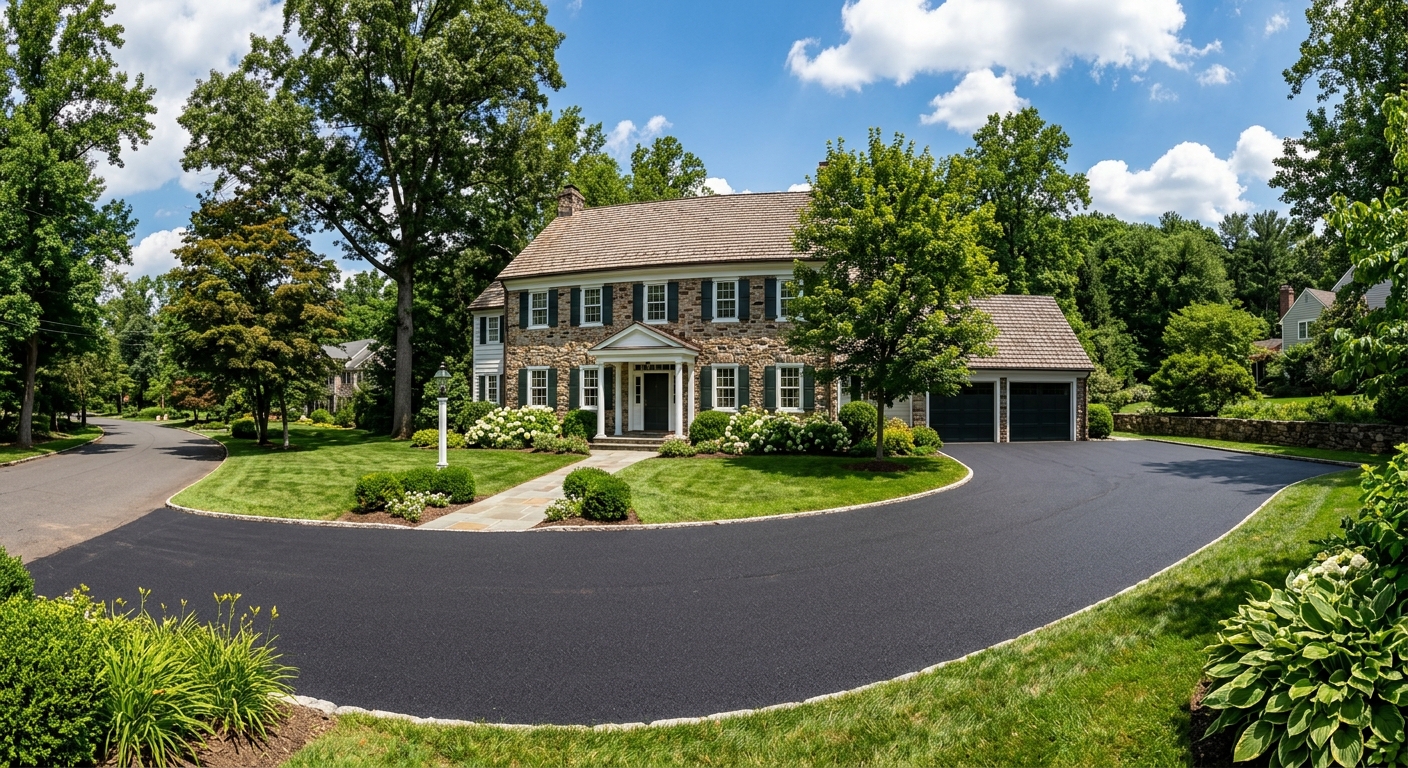
Driveway paving costs in Shaler — 2026
Shaler is overwhelmingly made up of single-family homes, and with 88.0% of households owning their homes (U.S. Census Bureau, ACS 2024), most repairs and improvements fall to the homeowner. A driveway is a classic detached-home expense in this area, and the outlay in 2026 reflects many variables you can't see from the surface. In Shaler, asphalt paving costs are heavily influenced by freeze-thaw cycles and the local subgrade of clay and shale. These ground conditions demand a thicker, better-compacted base, which drives up both the actual lifespan and the price tag compared to places with sandy or stable soil.
Two bids for the "same" driveway in Shaler can differ by thousands, and that difference usually reflects what goes on below the asphalt: how many inches of stone, how well it was compacted, and whether the base was redone or just paved over. In our hills, with notorious clay and shale stretching under most homes, taking shortcuts under the surface is a recipe for early failure—heaving, cracking, or depressions—so a visually perfect job is only half the story.
| Service |
Best for |
Lifespan |
Price range |
| Asphalt — full replacement with new base |
failed base, structural cracking |
20–30 yrs |
$3,600–$9,200 |
| Asphalt overlay / resurfacing |
sound base, surface cracking only |
8–15 yrs |
$1,550–$4,600 |
| Sealcoating — single application |
preventive maintenance on sound asphalt |
2–4 yrs |
$200–$700 |
| Concrete — new installation |
long service life, low maintenance |
30–50 yrs |
$5,100–$12,000 |
| Crack filling and patching |
isolated cracks under a quarter inch |
1–3 yrs |
$200–$800 |
| Gravel driveway |
rural, budget, long runs |
5–10 yrs with upkeep |
$900–$3,500 |
Estimates for a typical Shaler driveway. Square footage and base condition drive these figures more than material choice.
Sealcoating: what it does and what it doesn't
Sealcoating is frequently pushed as a cure-all for pavement, but it is only one piece—and not the most important—of ongoing driveway care in Shaler. Applied right, a sealcoat protects new or solid older asphalt from oxidation, sunlight, and minor oil or fuel drips. It does improve appearance, giving a consistent black finish. But sealcoating does not add any structural strength and will not stop spreading cracks or fix low spots or base failure. If your driveway is already alligator-cracked or holding water in depressions, sealcoating does nothing for those problems.
Most people don't hear the downsides because they aren't in the business of talking themselves out of a sale. Sealing too often—especially annually—builds up brittle layers that are prone to peel and split, making things worse in our freeze-thaw climate. A new asphalt driveway needs six months to a year to cure before its first seal—do it early and you trap solvents, leading to a soft or patchy surface. The right frequency is every few years, not every season.
Crack filling is actually more critical than sealing for a Shaler driveway: those open joints let water in, leading to frost heaves and worse damage once winter sets in. Proper crack filling means cleaning out the joint, sometimes routing it, and using hot-pour material, not just spraying sealer over the top. A proper sealcoat, done by hand and squeegee, runs toward $400 for a typical double driveway, while a cheap spray job often lasts less than a year and may not even include crack prep. Never sealcoat to "fix" a bad surface—you’ll just waste money and time.
When paving can actually be done in Shaler
Paving in Shaler isn't just a matter of preference—it's physically limited by Pennsylvania's climate and the way hot-mix asphalt works. With a winter design temperature of 8 °F and more than 30 freeze-thaw days most years, the paving window is bounded by both weather and supply. Hot-mix asphalt must be laid and compacted when air and ground temperatures are high enough to keep the mix workable; below about 45–50 °F, it stiffens too fast and can't be properly compacted, guaranteeing a short lifespan and early failures. Concrete also needs above-freezing temperatures to cure well—cold slows the process and increases risk of surface flaking.
Local asphalt plants in the Pittsburgh area shut down over winter, usually from mid-November through March, which means material simply isn’t available, even if you could find a crew willing to work in the cold. Crews in Shaler are busiest in summer, and prices are usually highest from late May through August when demand surges. Spring and early fall are when contractors have more time, and there's less risk of rush jobs or scheduling delays. If someone offers to pave your driveway in December or promises a new surface during an early spring snow, they're not following industry standards for this region—and the work won't last.
How to vet a paving contractor in Shaler
Getting a good driveway in Shaler means checking deeper than a business card or a low price. Start by confirming that any contractor you consider is registered for home improvement work with Pennsylvania’s Office of Attorney General, especially for contracts over $500. For this trade, it's wise to look for a local business address (not just a cell phone), owned trucks and equipment, and not just a PO box or rental gear. The best test of real experience? Ask for addresses of jobs they installed in Shaler or the rest of Allegheny County 3–5 years ago. Newly paved driveways all look good—older ones prove whether they build to last.
Allegheny County’s high contractor density and local asphalt plants mean most legitimate contractors buy their mix within the county. If someone can’t tell you which plant supplies their asphalt, that’s a sign they may be a broker or fly-by-night outfit, not a proper local operator. Chain-of-custody matters, because cheap out-of-area mix is rarely up to local standards.
- Confirm HIC registration at hic.attorneygeneral.gov
- Verify workers' compensation coverage through WCAIS
- Check for a physical address in Allegheny County
- Ask for at least three addresses of driveways installed 3+ years ago
- Request contact info for past customers
- Insist on a written, itemized contract
- Require confirmation of asphalt source (local plant name)
- Request proof of owned equipment
- Ask if they provide both base and surface work—not just “top jobs”
- Inquire about insurance and supplier references
- Avoid contractors who only provide a mobile number and no office
Red flags: pressure for cash up front, refusal to show prior work, no written contract, or inability to name their asphalt supplier. You don't want your home to be a practice run.
The specifications to demand in writing
If you want a driveway that truly lasts on Shaler's clay and shale slopes, what matters most isn't the brand of sealer or even the paving crew—it's what's on the quote in hard numbers. Many jobs here fail early because the base was too thin, stone wasn't compacted right, or the asphalt depth quoted was "as laid," not "as compacted." Asphalt compresses up to 25% during rolling. If someone says "we'll put down three inches," make sure you know if they mean after compaction—the only number that matters for longevity in this climate.
The freeze-thaw cycles and heavy subgrade in Allegheny County require more aggregate base than in places with milder winters or sandy soil. It's also common here to need thicker binder courses to withstand settlement and heaving. Your contract should state every depth in writing and specify the exact mix (e.g., 25mm binder, 9.5mm wearing), not just "asphalt."
- Excavation depth — specify how many inches below existing grade
- Aggregate base depth in inches, type (crushed limestone or equivalent)
- Base compaction method and if done in lifts (more than 4" should be compacted in layers)
- Asphalt binder course thickness (compacted)
- Asphalt surface (wearing) course thickness (compacted)
- PA Department of Transportation mix designation for both binder and surface
- Edge treatment—such as hand-tamped or supported with additional base
- Drainage plan or slope for runoff
- Joint and seam details, especially tying into existing pavement
- Detailed warranty terms (years, what’s covered)
Demand these points in writing before work begins. It's your best (and often only) defense if things go wrong later.
Driveway permits, approaches and stormwater rules
For most private driveway resurfacing in Shaler or neighboring Ross Township, you usually do not need a building permit if you're not changing the driveway's footprint or tying into the public right-of-way. This is typical in many Allegheny County municipalities, saving you the time and cost of permitting for basic replacements. However, where your driveway meets a public street—the approach or apron—a permit is almost always required, and not from the township but from PennDOT District 11-0 if your approach connects to a state route. If you are in Pittsburgh, any work that touches a curb, sidewalk, or apron in the right-of-way needs a permit from the Department of Mobility and Infrastructure.
Adding to or widening your driveway can trigger reviews under runoff or stormwater rules. Expanding the amount of impervious surface means more water running off during storms, and channeling water off your property and onto a neighbor’s land can land you in legal trouble no matter what permits you might have. Drainage should keep stormwater on your own lot or tie into approved systems.
Always verify the contractor’s Home Improvement Contractor registration at hic.attorneygeneral.gov and make sure they have active workers’ compensation listed with WCAIS. These are mandatory for all employers in Pennsylvania.
Widening, extending or adding a parking pad
When you want to make changes beyond simply replacing what’s already there—like widening for another car, adding a parking pad, or extending your driveway to reach a new garage—the scope and the requirements change. Any time you pave a new footprint in Shaler, you're working with untouched clay and shale subgrade. That makes base preparation even more critical, with thicker stone and careful compaction required to avoid settlement and future cracks.
You should know that the seam where new paving meets old will always be a stress point; expect some minor separation there over time, especially with repeated freeze-thaw. Check locally for impervious surface limits—some municipalities in Allegheny County restrict the amount of hard surface to manage stormwater and drainage, and you’ll be on the hook if stormwater runoff crosses onto a neighbor’s property as a result.
If your extension or new pad connects to a public road, review whether you need an approach permit from the appropriate agency, especially PennDOT District 11-0 if the street is a state route. Even if a permit isn’t officially required for the rest, following base and drainage best practices is your best insurance against future problems.
Frequently asked questions — driveway paving in Shaler
How many freeze-thaw cycles does Shaler get?
The Shaler area faces heavy freeze-thaw conditions each winter, with temperatures commonly swinging above and below freezing dozens of times per season. This constant expansion and contraction puts all types of driveways under stress, especially asphalt and concrete laid over clay or shale, which are typical subgrades here. Over 30 freeze-thaw cycles each year isn’t unusual. That makes base preparation—using enough compacted stone and proper drainage—a must. Skipping those details is why some driveways in Shaler start to heave, pop, and crack after just a few years. These climate demands explain why a full asphalt replacement here costs $3,600–$9,200, with the price reflecting the extra work needed to survive our winters.
What slope does a driveway need for drainage?
In Shaler, driveway drainage isn’t just about avoiding puddles—it’s about protecting your investment from freeze-thaw damage and legal headaches from runoff. A minimum slope of 2% (about a quarter inch per foot) is the industry standard, enough to keep water moving off the surface. With our hilly terrain and clay-heavy subgrade, letting water puddle leads to faster deterioration. Sometimes, existing driveways don’t drain properly because of settling or poor grading, which can lead to early resurfacing costs—typically $1,550–$4,600 for an asphalt overlay. Proper grading is vital: the few hundred dollars to get it right beats thousands in long-term repair.
Why does my driveway have depressions that hold water?
Depressions that hold water, sometimes called "birdbaths," are a common issue on Shaler driveways—mostly from inadequate base prep, poor compaction, or repeated freeze-thaw cycles shifting the clay and shale underneath. Our soils move with the seasons, and if the original driveway wasn't built with enough stone or was paved over a weak spot, you'll see settling. Water that stands in these low spots works into the pavement, worsening cracks and causing more heaving once it freezes. Unfortunately, a simple sealcoat—which runs $200–$700—won’t fix these depressions. Depending on depth and extent, proper repair often means either patching or resurfacing with new asphalt after regrading.
Is gravel a cheaper option in Shaler?
Gravel driveways in Shaler can be a cost-effective choice, especially for long or lightly traveled runs. The up-front price is lower than asphalt or concrete—expect $900–$3,500—but there are tradeoffs. With our region’s hilly lots and clay base, gravel needs regular maintenance to keep ruts and washouts in check, and isn’t ideal for high-traffic main driveways or steep slopes. Many homes here have switched from gravel to pavement for cleaner access in winter, but if you’re on a tight budget, and don’t mind annual grading and the occasional load of stone, it’s a practical alternative.
Why are paving quotes in Shaler so different from each other?
In Shaler, it’s common for two paving quotes on the same driveway to range by thousands of dollars—much more than the material alone would explain. The hidden factor is always what’s done under the surface: how much old base is removed, how deep and well-compacted the stone base is replaced, and how thick the final asphalt is after rolling. Cheaper quotes often skip base replacement, use less stone, or specify asphalt thickness “before compaction”—not enough for our freeze-thaw cycles and clay subgrade. A full asphalt replacement that does it right here runs $3,600–$9,200, and cutting corners shows up in a few years as cracks, low spots, or heaving.
Does sealcoating fix cracks?
Sealcoating is meant to protect your driveway from the sun and chemicals—not to act as a crack filler. In Shaler, sealed over cracks actually tend to get worse: water still seeps in, freezes, and expands, making cracks wider every winter. If your main concern is cracks, proper crack filling using a hot-applied, rubberized material does more good than any sealcoat, and can last a couple of years per repair. For typical minor repairs like this, costs are around $200–$800. Never let anyone convince you a cheap spray-on seal will solve actual structural or drainage issues; all it does is make the blacktop look better for a season or two.
How do I verify a paving contractor in Pennsylvania?
Verifying a paving contractor in Pennsylvania means going beyond just asking for a card or a handshake. For any driveway project over $500 in Shaler, the contractor must have a Home Improvement Contractor (HIC) registration from the Office of Attorney General—check this at hic.attorneygeneral.gov. Ask to see proof of workers’ compensation insurance and compare their status on the WCAIS system. For best protection, ask for addresses of prior jobs done in Shaler 3+ years ago and check their references. A reputable company for a full asphalt replacement—running $3,600–$9,200—won’t mind you doing all these checks.
When is the best time of year to pave in Shaler?
The best paving window in Shaler runs from late spring through early fall, when both nighttime and daytime temperatures reliably stay above 50 °F. Asphalt must be laid and compacted while it’s still hot enough to bond; local plants typically close from November until March. Concrete also needs warm weather to cure well. Avoid scheduling just before deep winter or during heavy spring rains, as cold weather or water can ruin curing and compaction. If a contractor offers to pave in December, that’s a warning sign. Early- and late-season jobs are often less expensive—sometimes a few hundred dollars off $1,550–$4,600 for overlay—but quality and timing matter more.
Can I pave over my existing driveway?
In some situations, paving over an existing asphalt driveway (overlay or resurfacing) is a good value for Shaler homeowners, provided the base is still stable, cracks are minor, and there’s no structural failure underneath. This option costs less—typically $1,550–$4,600—and can refresh a tired-looking drive for another 8 to 15 years. But if the base is already soft or heaving, an overlay will only cover up trouble for a couple of freeze-thaw cycles at best. Don’t be tempted by the lowest price if cracks are wide, the driveway flexes under foot, or you’ve got standing water—these are signs a full replacement with new base is the better long-term (and safer) bet.