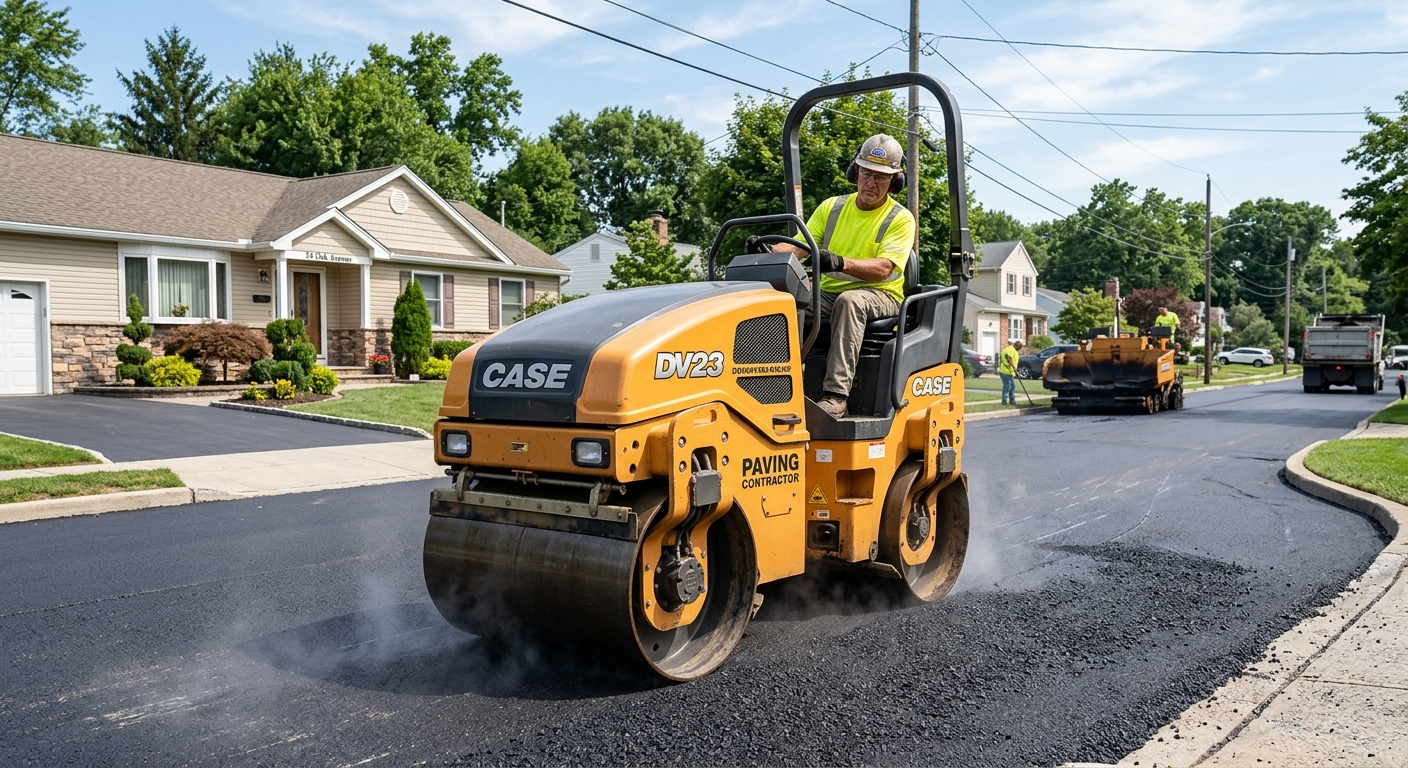
What a new driveway costs in Delaware
Delaware’s driveways are a homeowner’s responsibility, and with homeownership at 88.5% and nearly all properties being single-family homes (97.5%) in this part of Pennsylvania, this is an expense most households will eventually face. Pricing here reflects not only the size or material, but the underlying preparation. The region’s deep winter frost and glacial till subgrade require more aggregate and thicker pavement than in southern counties — that deeply influences both cost and longevity. One quote’s bargain can hide shortcut prep below the surface.
Why does this matter? In areas with severe freeze-thaw — such as Delaware and surrounding Pike County — driveways are constantly tested by frost heaving and water infiltration. The soil beneath your drive is often rocky till, demanding special attention to grading, drainage, and base thickness. Most of a driveway’s strength and its ability to survive two or three decades is established before any blacktop is ever laid down. So when you see a price difference, know that it’s likely buried one to two feet below that top surface — in excavation, quality of stone base, and drainage setup. Shopping by price alone leaves homeowners at risk of a fast-failing job you cannot see until it’s too late.
| Service |
Best for |
Lifespan |
Price range |
| Asphalt — full replacement with new base |
failed base, structural cracking |
20–30 yrs |
$3,500–$8,900 |
| Asphalt overlay / resurfacing |
sound base, surface cracking only |
8–15 yrs |
$1,500–$4,400 |
| Sealcoating — single application |
preventive maintenance on sound asphalt |
2–4 yrs |
$200–$700 |
| Concrete — new installation |
long service life, low maintenance |
30–50 yrs |
$4,900–$12,000 |
| Crack filling and patching |
isolated cracks under a quarter inch |
1–3 yrs |
$200–$800 |
| Gravel driveway |
rural, budget, long runs |
5–10 yrs with upkeep |
$900–$3,500 |
Estimates for a typical Delaware driveway. Square footage and base condition drive these figures more than material choice.
What to put in a Delaware paving contract
If you want your driveway investment to last in Delaware, do not settle for a hand-shake deal or a quote that reads like an ad. The key is in the written specs: your contract should describe every work step and material, not just “new blacktop.” Local freeze-thaw cycles and Pike County’s deep frost (down to 36 inches) demand greater base depth than southern Pennsylvania, so how thick the contractor builds up—and how they compact it—determines how soon you’ll see cracks and potholes. Remember: “We’ll put down three inches” means almost nothing unless they specify whether that’s loose or compacted thickness, and how it’s split between binder and surface course. The numbers under your drive should be explicit.
Out here, the rocky glacial till soil is less forgiving than flat land. Too little base, or lazy compaction, means early failure—sometimes by next spring. Require each of these in writing:
- Total area and exact outline of drive to be paved
- Depth of old material to be excavated (in inches)
- Type and thickness of new aggregate base, described as compacted depth
- Number of lifts (layers) and method of compaction for each
- Asphalt mix designation (e.g., 25mm or 9.5mm) for both binder and surface courses
- Compacted depth for both binder and surface course, not loose-laid numbers
- Edge restraint method (such as tamped edges, curb, or gravel collar)
- Drainage measures (minimum 2% slope, swales, channel drains if needed)
- References to highway standards if the approach touches a state route
- Full cleanup, haul-off, and warranty terms in plain language
Why driveways behave differently in Delaware
The ground under most Delaware driveways is glacial till—a rocky, variable mix hauled down by ancient ice. Unlike smooth soils a few counties south, till can be compact but poorly draining, and often hides boulders or dense pockets of clay. The impact? Water drains unevenly, collects in low spots, and is prone to freeze-thaw damage with our harsh northeast Pennsylvania winters and 36-inch frost depth. That’s why, in this market, a thin base or shallow excavation won’t hold up: heaving and cracking will show up fast, especially after a wet winter.
Pike County’s wave of 1970s–2000s vacation and second homes brought many driveways with minimal prep, especially on steep slopes. Those older drives often lack the thickness and grading now required to withstand winter expansion and spring thaw. Where the original builder skimped—just scraping the sod and laying gravel, for instance—patches or resurfacing will almost always fail early unless the underlying base is remade. These are problems you may not see until it’s too late, but a contractor who knows Delaware’s glacial till can read the clues: soft edges, reflective cracking, or chronic puddling.
Nearby counties with easier soils can get away with lighter work, but here, what’s under your driveway determines both the cost and what survives the local climate.
What you need before paving in Delaware
Most homeowners in Delaware won’t need a building permit for routine patching or resurfacing their driveway, provided the size and layout stay the same. In most Pike County townships, minor patching or pothole repair proceeds without a building permit—one less call to make. But if you’re replacing the driveway completely or adding a new one, in places like Lackawaxen Township, plan to file for a local building or zoning permit. The biggest oversight is the approach: where your drive meets the state road. There, the PennDOT District 4, not the local township, issues the required Highway Occupancy Permit. You’ll need this for any work at the road entrance—whether asphalt, concrete, or even just changing the width.
Stormwater rules matter more than most think. Expanding your driveway can increase runoff, and directing water onto a neighbor is a liability issue regardless of permits. If you change the drive’s footprint, check with both your local planning office and carefully grade the surface so water stays on your lot. For work over $500, Pennsylvania law requires a written contract with a clear three-day cancellation period—no exceptions.
Always check your contractor’s Home Improvement Contractor registration at hic.attorneygeneral.gov and confirm current workers’ compensation coverage using WCAIS (wcais.pa.gov). This is not optional; hiring uninsured crews risks both legal and financial trouble for you as a homeowner.
Choosing a paving company
Hiring in Delaware means going beyond the logo on the side of a truck. The right paving company will provide a fixed local business address (not just a cell phone), own their rollers and paver, and supply references from jobs at least three years old—the only way to judge how their work lasts. Ask who supplies their asphalt and stone. In Pike County, material comes mainly from plants in Scranton or Lackawanna County; a contractor who can’t name their supplier is often a middleman, not a true jobsite crew. With travel surcharges common here, especially for rural runs, you want a company that knows local logistics and geology, not someone bidding sight unseen.
- Verify Home Improvement Contractor registration at hic.attorneygeneral.gov
- Check workers’ compensation is current and valid at WCAIS
- Insist on a local office address, not just a phone or PO box
- Confirm they own the major paving equipment—they shouldn’t be renting for basic jobs
- Ask for three or more references from work three or more years old, and check them
- Ask directly: Who supplies your asphalt and where is the plant?
- Get insurance certificates (liability and auto) sent from the agent, not the contractor
- Review a written contract with full specs, not a “one-pager” or receipt
- Look for membership in regional trade associations (some are valuable, but not proof alone)
- Ask about warranty details: both labor and material
- Make sure the estimator explains drainage and base prep, not just surface numbers
- Pay by check to the registered company name; never cash to an individual
Be wary if a contractor quotes by square foot sight unseen, can’t answer where their asphalt comes from, or rushes you to sign with a “today only” discount. If they won’t put every promise in writing, do not hire.
Beyond replacement: layout changes
Not every Delaware driveway project is a simple tear-out and replace. If you plan to widen for a second vehicle, add a turnaround, reach a detached garage, or upgrade a long gravel run to asphalt, you face a different set of challenges. Expanding the footprint means putting a new base over soil and glacial till that hasn’t been compacted by years of use. This new-old seam—where fresh paving meets the older drive—is permanently weaker and needs extra attention to join and seal properly.
Municipal rules often kick in when you expand: impervious surface limits may block oversized pads, and zoning setbacks restrict how close you can pave to property lines—especially near roads or streams. For work close to a public road, remember every driveway approach change needs permission from PennDOT District 4, not just your township office.
Plus, adding pavement can worsen stormwater runoff. Increasing hard surface area can require added drainage or even stormwater retention measures. Always confirm with the local planning department before signing a contract—these aren’t the sort of “fixes” you want to argue about after the work is done.
Grading and water management on a Delaware driveway
Most cracked and failing driveways in Delaware can be traced to water problems, not the blacktop itself. Out here in Pike County, where we see deep frost and glacial till below, water has nowhere to go if the base isn’t graded right. A driveway needs a continuous slope of at least 2% (that’s a quarter inch per foot) away from the garage, house, or any structure. Steep slopes common in local 1970s–2000s-era developments make it even more critical: one low spot and the freeze-thaw cycles will lift and break the pavement. Don’t let anyone tell you grading is just for show—it’s the only real defense against heaving and early failure.
You’ll see two approaches: a crown down the center for wide drives, or a cross-slope to one edge for narrower ones, both pushing water to daylight. Where the ground simply can’t be regraded, trench drains or channel drains set in concrete across the drive can intercept runoff and send it to a safe spot. Heavy clay pockets in the glacial till hold water tightly, meaning even well-compacted bases can fail if water can’t escape. A properly daylighted drain or, where impossible, a dry well is essential—don’t let a contractor discharge water onto a neighbor’s property, as that can land you with legal trouble, not just bad feelings.
With our region’s deep freezes, lingering puddles soak into the base, freeze, expand, and apply enormous pressure upward—resulting in those telltale cracks and bumps you see every March. Water management is as important here as the pavement itself.
Frequently asked questions — driveway paving in Delaware
Why are paving quotes in Delaware so different from each other?
The biggest reason for wide price differences on Delaware paving jobs is the detail you can’t see: the subgrade and base work. Our local glacial till soil demands a thicker stone base and more precise grading than many other counties. One contractor may quote for a proper 6–8 inch compacted aggregate base, while another “low-ball” bid might scrape away the topsoil and lay asphalt directly on top. Labor, travel distances (since Pike County sits outside the Scranton–Wilkes-Barre metro), and material haul from plants in Lackawanna County also factor in. On paper, it’s all a “new driveway,” but only one price includes work suited for our freeze-thaw cycles. That’s why quotes for a full asphalt replacement can span from $3,500–$8,900 for the same address.
Is sealcoating a scam?
Sealcoating is legitimate preventive maintenance—if the driveway is structurally sound and you’re working with a reputable crew. In Pike County, freeze/thaw cycles degrade even good blacktop, and a high-quality sealer can slow down cracking from weather, salt, and sunlight. But sealcoating will not “fix” bad cracks, potholes, or a crumbly surface. Some outfits in Delaware push it as a miracle repair for drives that should be replaced or patched instead. The right project: a single sealcoat application every 2–4 years on a young asphalt drive, with proper cracks filled first, priced $200–$700 for a typical home. Anyone claiming it will double your pavement’s life is overselling—ask for the last three jobs they did and see for yourself.
What kind of soil is under Delaware driveways?
Most Delaware-area drives sit on glacial till, which is a mix of gravel, sand, compacted clay, and rock left behind by glaciers. Unlike pure clay or sandy loam found farther south, this ground type drains unpredictably and can contain large boulders just below the surface. For driveways, this means you need a deep and well-compacted aggregate base—otherwise, our deep winter frost (with frost depth to 36 inches) will push up and break anything built too thin. A good paving contractor knows how to check the till before setting thickness specs.
What does sealcoating cost in Delaware?
For a typical single-family home in Delaware, a thorough sealcoating application runs from $200–$700, depending on your driveway’s size and layout. With nearly all homes in this area being single-family and on larger lots, most drives trend toward the higher end. Be cautious of low “coupon” deals that don’t address cracks first, and insist on a written proposal laying out which repairs, if any, are included before the sealer goes down. Prices here are mid-range for Pennsylvania due to longer travel distances and local labor rates.
Do I need an approach permit where my driveway meets the road?
Yes, you do—especially in Pike County, which includes Delaware. Even if your paving work does not require a township building permit, any changes where your driveway meets a public (state) road requires a Highway Occupancy Driveway Permit from PennDOT District 4. This applies even if you’re just widening or resurfacing the approach. The rules don’t change based on whether you use asphalt, gravel, or concrete. Ignoring this step can bring penalties or even a stop-work order, so always check before starting a project that costs $3,500–$8,900 for full replacement.
Can asphalt be laid in cold weather?
In Delaware and all of Pike County, asphalt paving typically shuts down from late fall through early spring. Our high-elevation winters often bring overnight temps below 40°F, and proper compaction requires both the ground and the mix to be warm enough for the asphalt to set before it cools. Laying pavement in cold weather traps moisture, prevents full compaction, and shortens the life of your drive. If someone offers to pave in winter for half the usual cost—say, less than $1,500–$4,400 for overlay—be cautious. Wait for proper weather for lasting results.
What causes concrete to spall or flake in Delaware?
Concrete spalling and flaking happen here due to repeated freeze-thaw cycles and use of road salt, especially when water seeps into surface pores and then freezes. Delaware’s 36-inch frost depth and northeastern Pennsylvania’s long, wet winters mean more freeze cycles than elsewhere in the state. In older Pike County homes, concrete sometimes wasn’t air-entrained or finished correctly, making it much more likely to flake. Sealers can help, but a new concrete driveway (at $4,900–$12,000) finished by a local crew familiar with our winters is less likely to spall prematurely.
Asphalt or concrete for a Delaware driveway?
If you’re debating asphalt versus concrete in Delaware, weigh both local climate and budget. Asphalt tolerates freeze-thaw cycles better and is less likely to crack badly when the glacial till underneath moves. Concrete lasts longer overall—up to 50 years—but is susceptible to spalling and costs more up front: $4,900–$12,000 compared with $3,500–$8,900 for a full-depth asphalt replacement. In rural Pike County, winter plowing is easier on asphalt as well. Concrete makes sense for low-maintenance, high-traffic uses; asphalt for budget and cold weather durability—just don’t skimp on the base with either.
What is the difference between binder and surface course?
The binder course is the bottom, thicker layer of asphalt. It uses larger aggregate and provides structural strength—it holds up against our region’s deep frost and rocky glacial till. The surface course is the smoother, finer top layer you drive on, designed for weather resistance and a clean finish. In Delaware and Pike County, a typical full installation would be 2–3 inches (compacted) binder topped with 1–1.5 inches surface course (also compacted), but the best split will be detailed in your contract. Pricing in this area for a full-depth replacement: $3,500–$8,900. Always get both layers specified in writing.