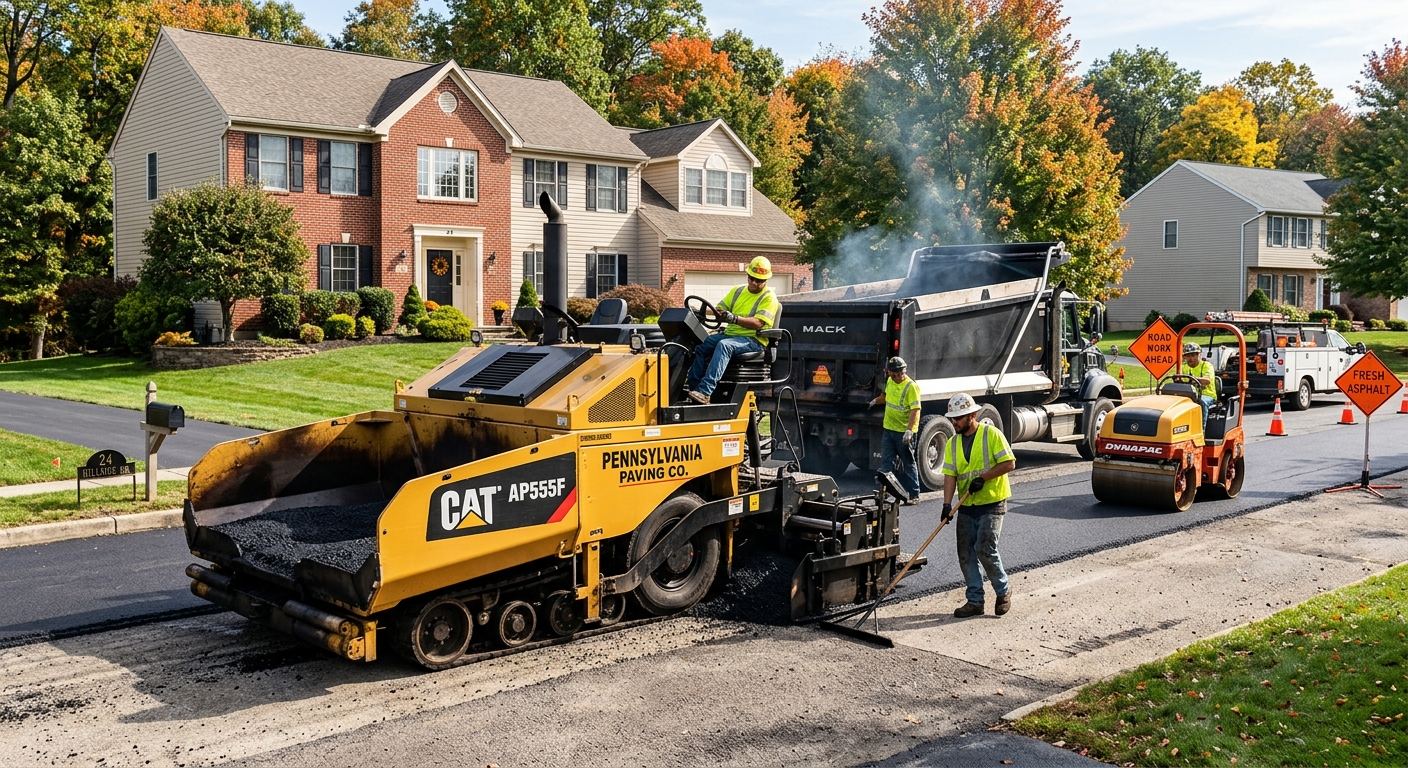
Driveway paving costs in Bern — 2026
In Bern, driveway paving is a real investment—more than 89% of homes here are single-family structures and the homeownership rate is 91.0% (U.S. Census Bureau, ACS 2024). If you own your home, you likely pay for your own driveway replacement, not some distant landlord or HOA. With our pronounced freeze-thaw cycles and mix of shale and limestone soils in eastern Berks County, the build under the surface matters as much—if not more—than what you see on top. It’s those unseen layers that account for most of the price difference between one contractor’s quote and another’s. Good work in Bern means thick aggregate bases to resist settling and careful grading so water drains away, not toward your garage. Subdivision driveways poured in the 1960–1980 boom are reaching end-of-life and many need more than a band-aid. Prices for the options most local homeowners see are in the table below.
| Service |
Best for |
Lifespan |
Price range |
| Asphalt — full replacement with new base |
failed base, structural cracking |
20–30 yrs |
$3,800–$9,800 |
| Asphalt overlay / resurfacing |
sound base, surface cracking only |
8–15 yrs |
$1,650–$4,900 |
| Sealcoating — single application |
preventive maintenance on sound asphalt |
2–4 yrs |
$225–$750 |
| Concrete — new installation |
long service life, low maintenance |
30–50 yrs |
$5,500–$13,000 |
| Crack filling and patching |
isolated cracks under a quarter inch |
1–3 yrs |
$200–$800 |
| Gravel driveway |
rural, budget, long runs |
5–10 yrs with upkeep |
$900–$3,500 |
Estimates for a typical Bern driveway. Square footage and base condition drive these figures more than material choice.
The honest case for and against sealcoating
Sealcoating is one of those services sold in every Berks County driveway, but homeowners deserve the truth: it’s neither a waste nor a miracle. When applied properly and at sensible intervals, sealcoating does what it claims: it puts a layer between your asphalt and the sun, air, fuel drips, and winter salt. This slows oxidation and hardening of the asphalt binder, and a fresh coat brings back that deep black look that many in Bern want.
But it does not add strength. If your driveway is already cracked or the base is failing, no amount of sealcoat will fix that. In fact, sealing too often—once a year or by companies running spray rigs as fast as possible—leads to build-up that cracks or peels in sheets come winter. Applied too soon after new asphalt work, it can trap oils and do more harm than good. A proper schedule in Bern is every 3–4 years, or once the gray has returned and the surface is dry—not every spring. For new driveways, wait until the surface is fully cured and free of oily sheen.
Crack filling is actually the higher-impact maintenance step. Water is the enemy: when it seeps in through cracks, freeze-thaw cycling in this region creates bigger problems fast. Filling cracks with hot rubber and then sealing is worth the investment. A quality sealcoat is squeegeed or brush-applied, not sprayed on in 15 minutes. The cost for a real job in Bern is $225–$750 for a single application. If you see a quote at the lowest end or get flyers offering a full driveway for a couple hundred dollars, expect a thin spray, not something that will last through two winters. Sometimes it makes sense to say no to another round of sealcoating if the structure beneath is going—fix the base first.
How to tell if the base is gone
The base is what decides the fate of your driveway in Bern. Before calling any contractor, walk your driveway to assess what you truly need. If you see widespread alligator cracking—a quilted network of cracks across large stretches—that almost always means the stone base underneath has failed or settled. An asphalt overlay over this will look okay for a short spell, then crack right along with the base; this is throwing good money after bad. Isolated, long, straight cracks running across sound pavement are usually age in the surface layer only—these can be filled and covered. Depressions, “birdbaths,” or low spots that hold water indicate movement in the subgrade and will keep coming back until they’re cut out and rebuilt. Crumbling edges scream of thin or missing stone along the sides, which is very common in 1960s–1980s construction in Berks—patching helps, but deeper rebuilds solve it. Potholes mean water reached the base. If your bidder doesn’t probe these suspect areas with a test rod or core, you should doubt any quote at all.
| What you see |
Likely cause |
Right fix |
Cost |
| Isolated cracks under 1/4 inch |
surface aging |
crack fill and seal |
$225–$750 |
| Alligator cracking over a wide area |
base failure |
full replacement |
$3,800–$9,800 |
| Depressions holding water |
subgrade movement |
excavate and rebuild that area |
$3,800–$6,000 |
| Crumbling edges |
no edge support |
edge repair, consider curbing |
$400–$1,500 |
| Potholes |
water into the base |
full-depth patch, then assess |
$250–$900 |
| Faded but sound surface |
oxidation only |
sealcoat |
$225–$750 |
Drainage: the failure nobody plans for
In Bern, as throughout Berks County, almost every driveway failure traces back to water. The rule of thumb is simple: without drainage, even a perfect build won’t last one freeze-thaw cycle. Your drive needs a minimum 2% slope (at least a quarter inch per foot) away from structures or to the sides—never toward your garage. Cross-slope or crowning (a slight rise in the center) helps sheet water off, especially on wider or flat driveways.
If the lay of the land can’t push water away on its own, trench or channel drains at the garage or in low spots become mandatory. But even these drains must empty somewhere: daylighting to a lower spot on your property beats dumping into a dry well (which will fill up during a wet Berks winter). Heavy clay isn’t a primary problem in eastern Berks County, but shale and limestone make bases prone to shifting if water enters and freezes, so the standard local practice is to install generous base depth and positive drainage from the start.
Don’t even think about running water onto a neighbor’s lot—even if a permit ignores it, Pennsylvania property law will not. Between settlement issues and liability, the short cut is never worth the cost. Invest in proper grading so you aren’t buying the same job twice when your drive lifts and cracks after next winter’s cold snap.
Driveway permits, approaches and stormwater rules
For most Bern homeowners, resurfacing or repaving an asphalt driveway in its current spot doesn’t require a building permit. Regulators in Berks County townships rarely demand paperwork for overlays unless you’re changing the driveway’s footprint. But the approach—the end of the driveway where it meets a public road—is the exception. If your drive connects to a state route, you need a Highway Occupancy permit from PennDOT. For drives onto township roads, check with your local township, as they control those aprons directly.
If you’re expanding your driveway or adding a new one, stormwater rules come into play in places like Spring Township: more than 5,000 square feet of new impervious surface or an acre of earth disturbance will require permits, plus a runoff management plan. No permit, however, lets you direct water onto a neighbor’s land; you’ll be liable if you do, permit or not.
When hiring, Pennsylvania law requires your contractor to hold a Home Improvement Contractor registration if the job is over $500—always check at hic.attorneygeneral.gov. For businesses with employees, workers' compensation is mandatory—verify coverage at WCAIS (wcais.pa.gov). Don’t risk hiring anyone who can’t show both.
The specifications to demand in writing
In Bern, the difference between a cheap, short-lived drive and twenty years of worry-free parking is what’s on paper—not just the price. Demand detailed specifications from every bidder, because that’s your only protection. A quote that says “three inches asphalt” can mean two when compacted and three before rolling, or worse. Ask for numbers, in writing, measured as compacted depth only. Here, with daily freeze-thaw cycles, and local shale and limestone base conditions that settle if left thin, the build up matters more than in mild climates.
- Excavation depth below final grade, stated in inches
- Aggregate base depth (minimum 6–8" locally), stone type, and grading method
- Proof of mechanical compaction in lifts, not just surface rolling
- Asphalt binder course (base) and wearing course (surface), with compacted thickness stated separately (e.g., “2" binder, 1.5" surface, compacted”)
- Job-specific asphalt mix design
- Edge treatment: stone shoulder, curbing, or other protection
- Positive drainage plan and final slope, with direction specified
- Restoration plan for disturbed lawn edges and sidewalks
- Cleanup of debris and haul-off included
- Warranty terms, stating what’s covered (heaving, settlement) and excluded (cracking, if not covered)
If your quote doesn’t tell you these details, you aren’t getting a comparable price.
Comparing paving estimates in Bern
In Bern, no two paving quotes are the same—unless they’re both too vague to mean anything. A solid proposal always spells out actual measured square footage (never a guess). You want the depth of excavation stated, plus who hauls away the old material. The stone base: its composition, its thickness in compacted inches, and how it’ll be compacted—in lifts, with a plate or roller. For asphalt, the type, number, and compacted thickness of courses. Edge treatments (curbing or gravel shoulders) are rarely mentioned but matter for longevity. Grading and drainage: how water will run off, away from your house and not onto the neighbor's. Restoration: what happens to your lawn edge or sidewalks. Payment: a modest deposit, balance on satisfactory completion—never all up front. And the warranty—most only cover workmanship, not future cracking. A one-line “asphalt driveway $X” bid cannot be compared and is often the most costly “bargain” in the long run. Here’s what to look for:
| Line item |
What to look for |
Red flag if… |
| Area |
measured square footage stated |
eyeballed or absent |
| Excavation |
depth and disposal included |
'we'll pave over it' |
| Base |
aggregate type and depth in inches |
'proper base' |
| Compaction |
method, and done in lifts |
not mentioned |
| Asphalt |
courses and compacted depth |
'3 inches' unqualified |
| Drainage |
slope and water direction stated |
silent |
| Warranty |
what is covered and what is excluded |
verbal only |
| Payment |
modest deposit, balance on completion |
full cash up front |
Frequently asked questions — driveway paving in Bern
What does an asphalt overlay cost in Bern?
For a typical single-family driveway in Bern, an asphalt overlay or resurfacing runs $1,650–$4,900, with the typical job hitting about $3,300. This is only possible if your existing driveway has a solid stone base and no signs of widespread base failure (like alligator cracking or big depressions). If those issues are present, a full replacement is needed and costs more. Square footage and the prep required drive the price most, not the amount of asphalt alone.
Why are paving quotes in Bern so different from each other?
The big reason is what’s going on under the surface. Two quotes for what seems like the same job can differ by thousands of dollars if one contractor plans to dig out and rebuild the base and the other wants to put a thin layer over old, broken-up stone. Bern’s mix of shale and limestone soils and strong freeze-thaw cycles mean local contractors have to build deeper than in some other parts of Pennsylvania, and costs follow. Pay careful attention to what’s actually included—if two estimates for a new driveway range from $3,800–$9,800, the cheapest is likely skipping base work or using lighter aggregates.
Can I cancel a paving contract I signed at my door?
In Pennsylvania—including Bern and all of Berks County—the Home Improvement Consumer Protection Act gives you three business days to cancel a home improvement contract signed at your home. This applies if your contract is over $500, which almost all paving jobs are. The contractor must provide written notice of this right to you. If they haven’t, your cancellation right may be longer. Don’t let a contractor tell you otherwise. Even if you shook hands on a $1,650–$4,900 asphalt overlay, the law gives you time to reconsider.
How long does a driveway installation take?
In Bern, most standard driveway replacements take 2–4 days depending on weather, square footage, and whether a new base is being excavated. Rebuilding with a new aggregate base and two layers of asphalt runs longer than a resurfacing job. After paving, you’ll want to keep vehicles off for at least 2–3 days, especially in summer, to let the asphalt set properly. Concrete driveways (priced at $5,500–$13,000) add a few days for curing before vehicles can drive on. Weather delays are common, especially with spring or fall freeze-thaw cycles.
How many freeze-thaw cycles does Bern get?
Bern, like all of Berks County, lives through pronounced freeze-thaw cycling thanks to our local climate. This means the ground routinely freezes and thaws—sometimes dozens of times each winter. Each cycle stresses pavement and base, widening cracks and, over time, driving water into the stone and soil underneath. For this reason, driveways here are built with deeper aggregate bases than the national average. Quality jobs cost a bit more but last longer—typically $3,800–$9,800 for full-depth asphalt replacement.
Why are my driveway edges crumbling?
Crumbling edges are a sign that the original builder didn’t extend the aggregate base wide enough or compact it firmly to the edges. This was common in Berks County subdivision drives built between 1950 and 1980. Without that stone support, asphalt gets brittle at the edge, then splits and falls apart from car tires and freeze-thaw movement. Edge repair or installing some type of curbing is the solution, and patching costs $400–$1,500 depending on how far it has spread.
Is sealcoating a scam?
Sealcoating itself isn’t a scam if done properly and at reasonable intervals—every 3–4 years makes sense for most Bern driveways. It’s meant to shield the asphalt binder from sun and chemicals, not to make weak pavement strong or fix base problems. What is a scam is when outfits push annual coatings, spray on a quick, watery mix and charge for protection that won’t last a single Berks County winter. A proper sealcoat job should cost $225–$750 and involve crack filling and at least a squeegee or brush application, not just a spray.
How deep should the aggregate base be here?
Because Bern sits atop shale and limestone soils and faces regular freeze-thaw, the standard here is at least 6 inches—8 is better—of compacted, clean stone base under the asphalt. This is thicker than you’ll see quoted in parts of the country with milder weather and better-draining soils. Skimping on the stone is the top cause of driveway failure here, so insist on a written spec. You’re paying for years of service—most new driveways cost $3,800–$9,800 and the base is what you’re really buying.
Asphalt or concrete for a Bern driveway?
Both materials have a place in Bern. Asphalt is the norm and costs less—$3,800–$9,800 for a full rebuild with a new base. It stands up to freeze-thaw well when built deep, and patching is easier and cheaper. Concrete lasts longer (30–50 years) and needs less routine maintenance; the trade-off is higher up-front cost—$5,500–$13,000—and it can crack if not jointed properly on our local subgrade. If your priority is longevity and you’re okay with the initial outlay, concrete makes sense. If you’re on a budget or expect to do surface maintenance every few years, go with asphalt.