Bloomsburg paving prices by scope — 2026
In Bloomsburg, driveway paving is a specialized investment that makes sense for single-family homeowners. While only about 35.8% of homes here are detached (U.S. Census Bureau, ACS 2024), and with the homeownership rate under 40%, paving is most often a consideration for those who plan to stay put awhile. Our north-central Pennsylvania winters hit driveways hard: freeze-thaw cycles and the alluvial soils near the Susquehanna River mean a basic blacktop might look similar above ground, but below, base thickness and excavation separate quotes by thousands of dollars. Soft, silty subgrade is common here, meaning your true cost is determined more by what gets built under the surface than by the brand of asphalt mentioned on a flyer.
When you compare estimates, know that the difference rarely lies in what you see: two smooth, black driveways can age drastically differently if one sits on thin or poorly compacted base. Old driveways in Columbia County often need reconstruction, especially if widening for modern vehicles—older, shared drives weren’t designed for today’s loads. The most common price gaps are not padding or gimmickry, but the reality that some crews skimp below grade.
| Service |
Best for |
Lifespan |
Price range |
| Asphalt — full replacement with new base |
failed base, structural cracking |
20–30 yrs |
$3,100–$7,900 |
| Asphalt overlay / resurfacing |
sound base, surface cracking only |
8–15 yrs |
$1,300–$4,000 |
| Sealcoating — single application |
preventive maintenance on sound asphalt |
2–4 yrs |
$175–$600 |
| Concrete — new installation |
long service life, low maintenance |
30–50 yrs |
$4,400–$10,500 |
| Crack filling and patching |
isolated cracks under a quarter inch |
1–3 yrs |
$200–$800 |
| Gravel driveway |
rural, budget, long runs |
5–10 yrs with upkeep |
$900–$3,500 |
Estimates for a typical Bloomsburg driveway. Square footage and base condition drive these figures more than material choice.
How often should a Bloomsburg driveway be sealed?
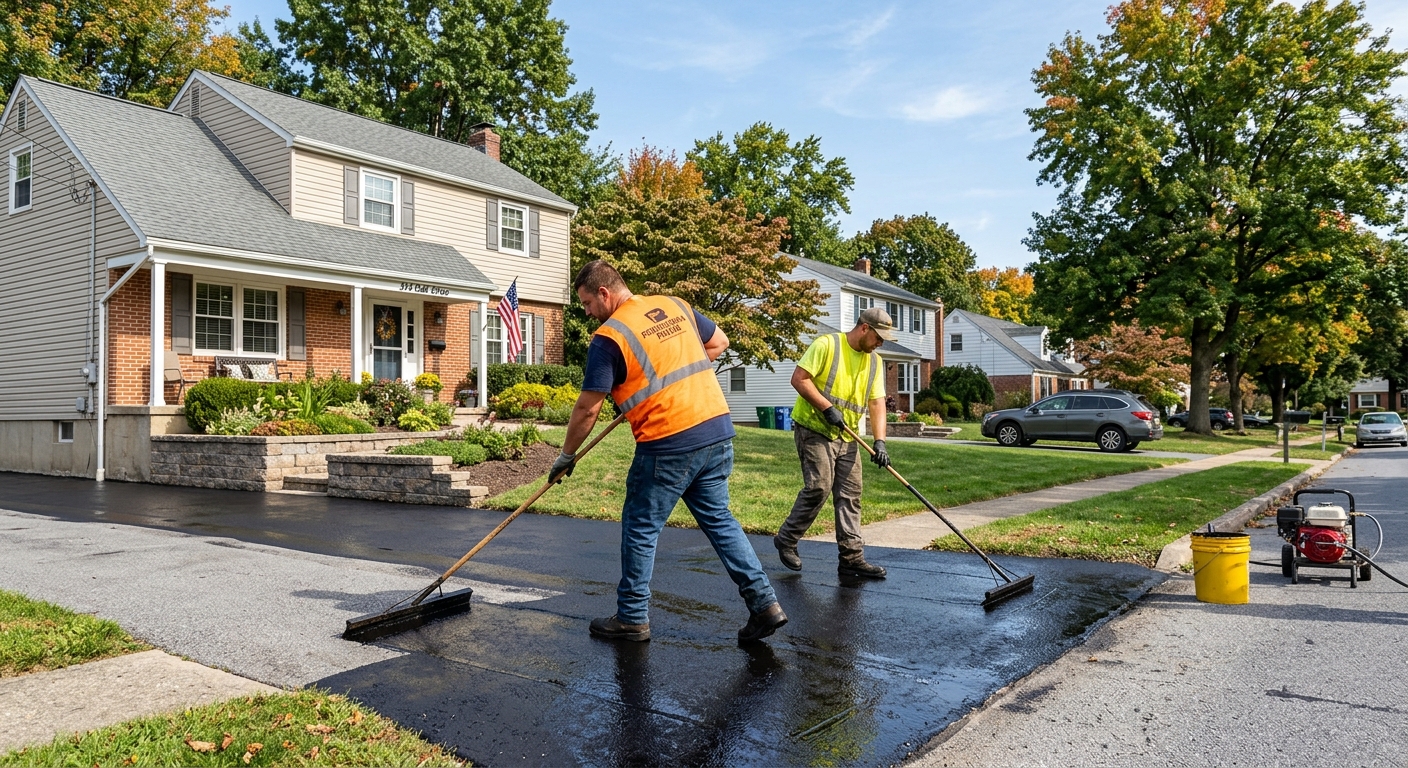
Most companies recommend sealing your driveway as often as possible, but in Bloomsburg’s climate, that’s not only unnecessary—it’s often counterproductive. Sealcoating is not magic: it protects the surface from oxygen, water, and fluids, delays fading, and cleans up the look, but it won’t make weak pavement solid or patch true damage. The sealcoat is a sacrificial layer; it weathers away so your asphalt binder underneath lasts longer in our rough freeze-thaw cycles. On the downside, resealing too soon—especially on curbing contractors’ schedules rather than following your driveway’s needs—leads to heavy buildup. That buildup cracks, peels, and in the worst cases, traps volatiles in new pavement, keeping it from curing.
A realistic interval is every 2–4 years for most Bloomsburg homes—anyone selling annual sealing is selling waste. For new asphalt, you should wait a full year, or at least until the binder is set and the surface has weathered. Sealcoating will not fix cracks or soft spots; those need separate attention. In fact, prompt crack filling (with proper hot-pour or rubberized fillers, not cold patch in a caulk gun) does more to extend pavement life here than any surface treatment.
A proper sealcoat costs $175–$600. If you’re being offered a $99 rush job, what you’re getting is a thinned, oil-based spray that looks good for a week and then flakes. Expect squeegee or brush application in Bloomsburg—not just a light, fast spritz—if you want real value.
Base preparation: the part you pay for and never see
In Columbia County, what you can’t see under your driveway determines whether it lasts ten years or just three. A proper driveway starts with the subgrade (the undisturbed native soil), followed by a compacted aggregate base, with the asphalt surface on top. Each layer is there to distribute load. Many driveways around Bloomsburg are built over soft, silty alluvium from the Susquehanna, which means the base must be deeper than in rocky or sandy areas. If the builder skimps here—by laying too thin a base or skipping compaction—frost heave will find the weakness.
Frost heave is our local curse: in winter, water in the soil freezes, expands, and lifts the driveway unevenly. Cracking from below is the surest sign. This is why correct base depth (at least 8 inches over silty areas, sometimes more for heavy use), clean crushed stone or “2A Modified” aggregate (not unwashed bank run), and compaction in 3–4 inch lifts matter much more in Bloomsburg than in a milder part of the state.
A cheap quote nearly always means shortcuts you’ll never see on the day the trucks leave: inadequate excavation, thin or poorly compacted base, skipping proof rolls or plate tamping between base layers, or even overlaying on a base that’s already pumping water. Insist on seeing the written proposal detail: base depth in inches, aggregate material (“2A Modified crushed limestone” is the regional standard), and a statement that all compaction is done in lifts. If it’s not in writing, it’s not happening, and if you can’t get a straight answer, that’s the only warning you’ll need.
Widening, extending or adding a parking pad
Jobs that go beyond straight replacement—like widening for two vehicles, adding a pad for guests, or paving to a newly built garage—are common in Bloomsburg’s older housing stock. These homes often have narrow, shared, or gravel drives from a time before today’s larger cars. Any project that increases the paved area is more than just “laying more asphalt”: each new section needs new base over untouched subgrade, and the joint where old meets new will always be a weak point. Proper saw-cuts, jagged edges (not straight vertical joins), and fresh base tie-ins are critical; done poorly, expect future cracking along the seam.
Be aware of impervious surface rules—adding paved area may trigger stormwater review, especially within Bloomsburg or Berwick. The approach, where your driveway meets a state road, is always subject to PennDOT District 3‑0’s Highway Occupancy Permit. Even if you’re only adding a parking pad, any increased runoff must not flow onto a neighbor’s property, or you risk a complaint or even a stop-work order, permit or none.
In rural Scott Township, a simple gravel-to-asphalt resurfacing can sometimes be done with no local permit, but always check if your work area’s rules have changed.
Permits and approvals for paving in Bloomsburg
For most single-family driveways in Bloomsburg, if you’re just resurfacing in the same footprint, a building permit is not typically required—saving you time and fees. Different towns around Columbia County run their own code offices, but this is the general rule. In Berwick Borough, however, any new or expanded paved surface tied to a subdivision or land development likely triggers formal review.
What almost always needs a permit is the driveway approach—the first 10–20 feet where your driveway meets the road. If your drive connects to a Pennsylvania state route, it’s PennDOT District 3‑0 you need, not your town clerk. This Highway Occupancy Permit is required for any new connection, widening, or change in grade at the road edge.
Stormwater management is the next hurdle. Expanding hard surface can trigger local requirements for runoff management, and as a practical matter, you cannot legally direct runoff onto your neighbor’s land, regardless of permit status.
For your protection, anyone you hire for a contract over $500 must have a Pennsylvania Home Improvement Contractor registration (check at hic.attorneygeneral.gov), and if they use any employees at all (not just subs), you can and should verify their workers’ compensation coverage via WCAIS (wcais.pa.gov). Never skip the check.
The driveway scams that work in Bloomsburg
Bloomsburg and the rest of Columbia County, with its scattered towns and rural, lower-density population, present an easier market for traveling paving crews and fly-by-night operators. You’ll see the classic tricks: a truck pulls up, “leftover asphalt from a job down the street” on offer if you act today, an unmarked truck with out-of-town plates, or a worker pushing for full payment in cash before the job is done. “You won’t get a better deal” usually means you’ll get little warranty or follow-up, and sometimes, no real work at all.
The other old standby: a written bid is “not needed,” or you get a one-line verbal quote. For sealcoating, thin black spray—much cheaper than real sealer—is offered at a price that seems too good: it is. Just as dangerous is accepting a contract from someone who doesn’t show you a Pennsylvania Home Improvement Contractor registration.
Pennsylvania’s Home Improvement Consumer Protection Act is your friend here: for any project over $500, you are legally entitled to a written contract, and you have three business days to cancel for any reason. Never waive your right—this is meant to protect people from impulsive decisions in just this scenario. And if anyone offers to help you “get around” your insurance deductible, know that is illegal here.
Take five minutes: check the HIC registration (hic.attorneygeneral.gov) and workers’ compensation (wcais.pa.gov), write down the truck plate, and insist on your three-day right to cancel in writing. These simple steps cut scam risk to nearly zero in Columbia County.
How to tell if the base is gone
The single most important call in driveway repair is whether the base is solid or failed. Since most Bloomsburg-area driveways are decades old, many rest on subgrades that have shifted or on bases that weren’t designed for today’s vehicles. You don’t need a PhD to spot the warning signs. Broad, interconnected “alligator” cracking (looks like a dried mud flat) is almost always a sign of failed base—the surface has lost all structural support. Isolated straight cracks, less than a quarter-inch wide, usually mean surface aging, not failure. Depressions where water pools after rain (birdbaths) point to subgrade movement underneath. Crumbling along the edges is a sure sign of insufficient edge support—common on older, narrow Bloomsburg driveways. Potholes mean water has broken through to the base and started pumping out fines.
If a contractor recommends an overlay or simple patch without checking the strength of the base—either by core sampling or at least probing—they aren’t doing their job. Putting new asphalt over a failed base is money down the drain: it’ll look great for a year, then crack and settle right through.
| What you see |
Likely cause |
Right fix |
Cost |
| Isolated cracks under 1/4 inch |
surface aging |
crack fill and seal |
$175–$600 |
| Alligator cracking over a wide area |
base failure |
full replacement |
$3,100–$7,900 |
| Depressions holding water |
subgrade movement |
excavate and rebuild that area |
$3,100–$4,800 |
| Crumbling edges |
no edge support |
edge repair, consider curbing |
$400–$1,500 |
| Potholes |
water into the base |
full-depth patch, then assess |
$250–$900 |
| Faded but sound surface |
oxidation only |
sealcoat |
$175–$600 |
Frequently asked questions — driveway paving in Bloomsburg
When can I seal a brand new asphalt driveway?
In Bloomsburg, it’s important to wait before sealcoating new asphalt. Our region’s paving season is short, so many driveways are laid late spring or midsummer. You should allow fresh asphalt to cure through at least one full warm season—usually 6 to 12 months—before applying any sealcoat. Sealing too early traps the oils and volatiles that need to evaporate for the pavement to fully harden; this makes the surface more prone to scuffing and peeling. A proper sealcoating service, timed after the initial curing, should cost you between $175–$600 for a standard residential driveway. Patience here matters more than marketing: if a contractor wants to seal within weeks of installation, get another opinion—it’s just not needed in the Bloomsburg climate.
What is the difference between binder and surface course?
Every properly installed asphalt driveway in Bloomsburg includes at least two “lifts”: the binder and the surface course. The binder is a coarser, thicker layer that forms the structural backbone; it’s designed to flex slightly and absorb some movement from Bloomsburg’s freeze-thaw cycles. The surface course is a finer mix that seals out water and delivers a smoother, tighter finish for appearance and tire contact. Reputable contractors will spell this out in their contract—if your written bid doesn’t define both courses (and their thicknesses), you can’t know what you’re getting. A new driveway with both layers and proper base will run $3,100–$7,900; beware bids that only mention a single lift, as these may skip essential structure.
What causes driveway cracks in Bloomsburg?
In Bloomsburg, cracks form because of weather, water, and subgrade soil. Our region’s high ground snow load (40 psf) and 36-inch frost depth means that every freeze-thaw cycle expands water in the soil, lifting and dropping pavement. Soft, silty subgrades along the Susquehanna also invite movement. Common driveway cracks include alligator (base failure), linear (age and shrinkage), and edge cracking (weak sides). Surface cracks under a quarter inch can be treated with crack filling and sealcoating for $175–$600, but repeated or wide cracking signals it’s time to rebuild the base.
Is gravel a cheaper option in Bloomsburg?
Absolutely, gravel is usually the most budget-friendly option if you live outside Bloomsburg town or in one of Columbia County’s rural stretches. It’s often used for long driveways, farm lanes, and areas not needing year-round vehicle access. Costs for a properly graded and compacted gravel drive in this area run from $900–$3,500, which is less than even the lowest asphalt job. However, gravel requires ongoing maintenance—regular topping and grading every few years due to rutting and washout. For permanent homes with frequent winter plowing, paved options usually become cheaper in the long run.
What does an asphalt overlay cost in Bloomsburg?
An asphalt overlay—sometimes called resurfacing—means placing new asphalt over a driveway whose base remains solid, but the top shows cracks or weathering. In Bloomsburg, overlays typically cost $1,300–$4,000 for an average home. The price varies with square footage and edge repair needs, but keep in mind that overlays only work if the base hasn’t already failed. If there’s broad alligator cracking, dips, or soft spots, an overlay will only mask the problem for a short time. Always have the base probed before spending money on any overlay.
How far ahead should I book a paver in Bloomsburg?
It’s wise to schedule your paving or replacement project as early as possible in Bloomsburg. Because Columbia County is a thin rural market, most established contractors fill their summer and early fall calendars by late spring. Six to eight weeks’ lead time is typical to get both a good price and your preferred date, especially if you want to avoid late-season work when weather can spoil installation quality. If a contractor promises immediate availability during the heart of paving season and quotes a price below $3,100–$7,900 for a full replacement, check credentials carefully—it could signal a lack of other clients, or worse, a non-local operator.
Does Bloomsburg have local asphalt plants?
Yes—Bloomsburg’s paving contractors rely on regional asphalt plants located near Bloomsburg and Berwick, which helps control material quality and cost for most local projects. Occasionally, when plants are down or demand is high, materials must be trucked in from further away, increasing both costs and the risk of asphalt cooling in transit. This is one reason you may see travel or trucking surcharges reflected in your quote—particularly for jobs under about $3,100–$7,900. Always ask your contractor which plant is supplying your job and how far materials are hauled; shorter distances yield better pavement.
How do I verify a paving contractor in Pennsylvania?
Pennsylvania law requires all home improvement contractors taking jobs over $500—including paving crews in Bloomsburg—to be registered with the Office of Attorney General. You can look up a contractor’s Home Improvement Contractor registration for free at hic.attorneygeneral.gov. If anyone employed (not just the owner) is working on your project, confirm active workers’ compensation coverage through the state’s WCAIS portal (wcais.pa.gov). Both checks take only minutes and should be done before you sign a contract or pay any deposit. A legitimate job—such as an asphalt replacement at $3,100–$7,900—will always come with a written contract and proof of registration as required by the Home Improvement Consumer Protection Act.
Can I pave over my existing driveway?
In some cases, yes—you can resurface (overlay) an existing driveway in Bloomsburg if the base is still sound and there’s no major cracking or settlement. This is a common option for driveways showing only surface wear, with jobs running $1,300–$4,000. But be careful: laying new asphalt over a failing base is throwing good money after bad, as underlying weaknesses will crack through within a few seasons. A reputable contractor will always probe or cut test holes to check what you can’t see before recommending an overlay. If they don’t, you should ask why—or find a contractor who will.