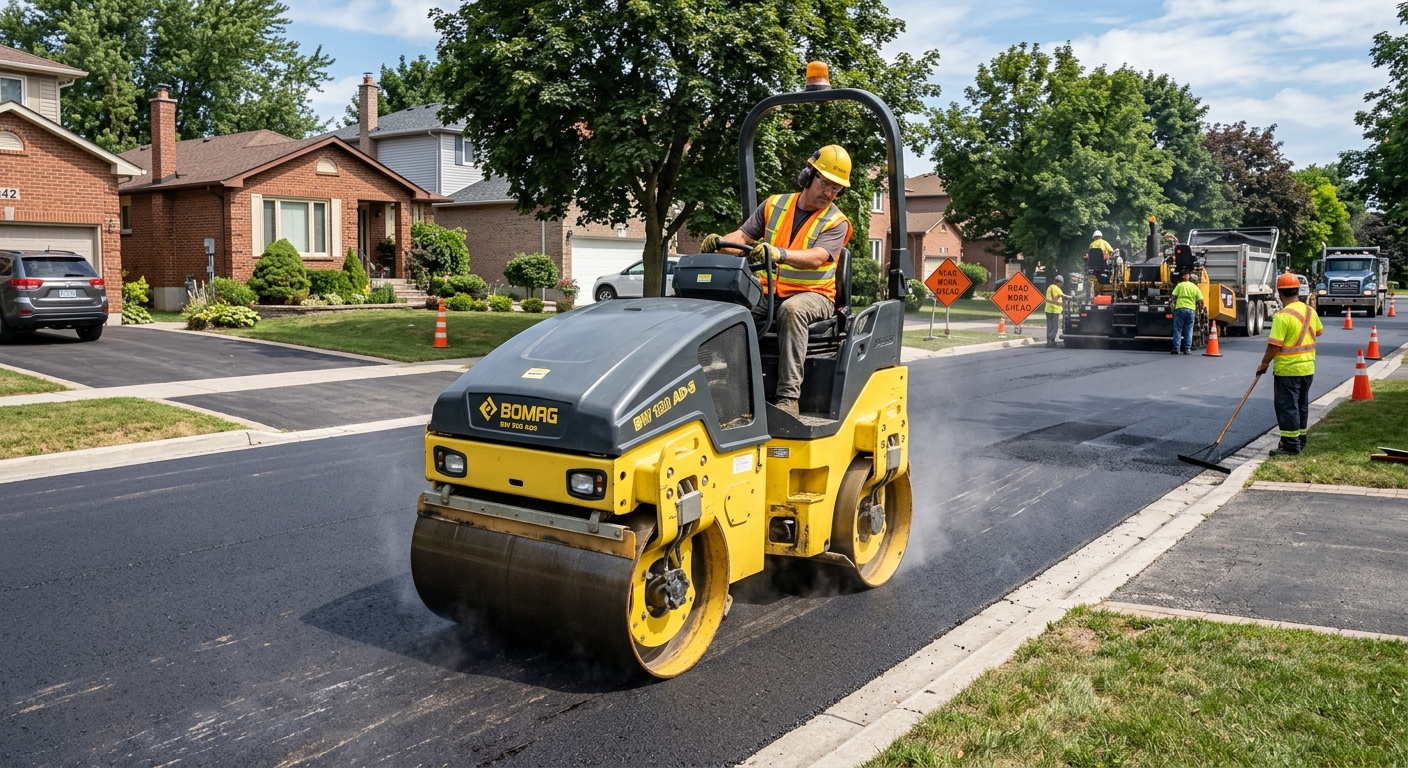
Clifton Heights paving prices by scope — 2026
Clifton Heights has a much higher rate of homeownership than you see in the city, and nearly a quarter of homes are single-family (U.S. Census Bureau, ACS 2024), so driveway upkeep is a common out-of-pocket expense. Most driveways here are at least forty years old, and many were built before paving standards were established. Our climate — moderate freeze-thaw cycles and humid summers — combines with the area's glacial till and compacted urban fill soils to drive up demands on driveway construction. That's why one crew's "good deal" can turn into patchwork repairs only a few years later if the base doesn't hold up.
Most of the price you pay for paving in Clifton Heights is buried under what you will never see: the excavation, the stone base, and whether the soil was graded and compacted right before a single shovel of asphalt or concrete goes down. Surface material does play a role, but if you are deciding on price alone, you are betting blind on what is truly important. Here’s what you can expect for common driveway services in the local market:
| Service |
Best for |
Lifespan |
Price range |
| Asphalt — full replacement with new base |
failed base, structural cracking |
20–30 yrs |
$3,400–$8,700 |
| Asphalt overlay / resurfacing |
sound base, surface cracking only |
8–15 yrs |
$1,450–$4,300 |
| Sealcoating — single application |
preventive maintenance on sound asphalt |
2–4 yrs |
$200–$700 |
| Concrete — new installation |
long service life, low maintenance |
30–50 yrs |
$4,800–$11,500 |
| Crack filling and patching |
isolated cracks under a quarter inch |
1–3 yrs |
$200–$800 |
| Gravel driveway |
rural, budget, long runs |
5–10 yrs with upkeep |
$900–$3,500 |
Estimates for a typical Clifton Heights driveway. Square footage and base condition drive these figures more than material choice.
Driveway permits, approaches and stormwater rules
Repaving your existing Clifton Heights driveway in the same footprint generally does not require a building permit. This saves you a trip to the local code office as long as you are not expanding or changing the layout. However, the point where your driveway touches the public street — the driveway approach, or apron — often falls under a completely different permit process. If your approach is on a state road, you’ll need a Highway Occupancy Permit from PennDOT District 6; for local streets, township offices handle those permits. Many homeowners are caught off guard by the need for this extra step when replacing or repairing the concrete at the apron.
Expanding your driveway or changing its configuration can trigger stormwater management requirements. Any increase in impervious area can mean rules to manage runoff, often requiring you to prevent extra water from leaving your lot. Even with permits in hand, you are liable if runoff from your new or expanded driveway creates a drainage problem for your neighbor down the line.
It is your responsibility to verify that your paving contractor holds a valid Pennsylvania Home Improvement Contractor (HIC) registration for any contract over $500. You can check this at hic.attorneygeneral.gov. For any company with employees, Pennsylvania mandates active workers' compensation insurance, verifiable at WCAIS (wcais.pa.gov) before work begins.
The specifications to demand in writing
In Clifton Heights, durable driveways come down to what is beneath the blacktop, not just the thickness you see. Specifications in writing are your best protection, because without them, even a high price means nothing. Every proposal should explicitly state: how deep the excavation will go, how thick the new aggregate base will be (after compaction), what material will be used for the stone, whether compaction is done with a roller or plate and in how many lifts (layers), as well as the intended depth of both the asphalt binder and surface courses — again, measured after compaction, not as laid. Mix designation (such as ID-2 or Superpave) matters, especially as the region's freeze-thaw cycles will test the flexibility of your paving. Edge support — whether with concrete, stone, or simply squared treatment — extends longevity, particularly given the region’s glacial till and urban fill soils, which shift more than pure sand or gravel.
When a contractor tells you "we'll put down three inches," ask if that’s before or after compaction. Three inches as-laid usually compacts down to about two and a quarter, which is a world of difference in Pennsylvania’s winter climate. Glen till beneath many older driveways here calls for more substantial bases than you might see in milder regions.
- Excavation depth: specify in inches, typically 8–12 inches in this area
- Aggregate base depth after compaction: at least 6–8 inches
- Type of base stone (e.g., 2A modified, clean stone, DOT approved)
- Number of base and surface lifts, each compacted separately
- Compaction equipment to be used (roller, plate, tonnage specified)
- Asphalt binder course depth after compaction: 2–2.5 inches
- Asphalt surface course depth after compaction: 1.5–2 inches
- Asphalt mix designation for both binder and surface courses
- Edge treatment detail: squared, sloped, or with placed curb
- Drainage slope and finish grading to be confirmed with final inspection
Choosing a paving company
When hiring a paving contractor in Clifton Heights or Delaware County, due diligence goes beyond checking online reviews. Reliable companies will have a fixed local business address — avoid anyone who operates only from a mobile number or a PO box. Equipment ownership says a lot: a reputable outfit owns its rollers and dump trucks rather than renting for the day. Ask for references from jobs done at least three years ago; driveways can look fine for the first year or two, so only an older job proves quality. The best test is to ask which asphalt plant supplies their jobs. Eddystone and South Philadelphia both feed this area and any hesitation or blank stares mean you’re dealing with a broker, not a builder.
- Verify HIC registration at hic.attorneygeneral.gov
- Check workers' compensation at wcais.pa.gov
- Get a physical local business address — not just a mobile phone
- Ask where they get their aggregate and asphalt (should answer Eddystone or South Philadelphia)
- Ask for references from driveways at least 3, preferably 5 years old
- Confirm equipment ownership: rollers, trucks, graders
- Require written specifications with numeric values (thickness, base, compaction)
- Request proof of insurance coverage and certificates
- Obtain a written contract per the Home Improvement Consumer Protection Act
- Check that payment terms don’t require large upfront deposits
- Review project photos or site visits, especially on jobs similar in age and location
- Ask about crew experience and length of employment — high turnover is a red flag
Red flag: anyone who can “start tomorrow” in peak season, can’t name their supplier, or who hesitates to provide insurance and registration proof. If a price is unusually low, ask what is being left out underground.
Grading and water management on a Clifton Heights driveway
Water is the number one enemy of every Clifton Heights driveway. Grading for surface drainage is essential, not just a detail to handle at the very end. A minimum slope of 2% (a quarter-inch per foot) is required to direct water off your driveway — anything less, and you risk ponding. On wider driveways, crowning the surface (raising the centerline) and letting water run off both sides is an option, but on the narrower, older driveways common east of I-476, a consistent cross-slope does the job.
If your driveway slopes back toward the garage or house (common in older properties), you need a new drainage plan. Sometimes the only answer is to add a trench drain or channel drain at the low point, tied to a daylight outflow or a drywell. In glacial till or heavy urban fill, drainage is extra tricky — water will sit against the stone base, eventually finding its way through and leading to freeze-thaw heaving in winter. Every frost cycle expands trapped water, breaking up the pavement above. Ponded water means the base is absorbing too much moisture and will lose strength each freeze.
It’s also a liability to let runoff empty onto your neighbor’s lot, no matter what local rules say. That’s your responsibility as a property owner, with or without a permit. Proper grading is the best insurance policy against costly surprises down the line.
Overlay, patch or full replacement?
You can make a good first pass yourself before even calling a contractor. The single biggest question is whether your driveway has a solid base or not, since that determines whether repair or full replacement makes sense — and it’s the detail most easily skipped by a bidder in a rush.
Here are the tells: "Alligator" cracking (a web of small cracks) across wide areas means the stone base has failed — overlays here are wasted money. Long, isolated cracks usually point to surface aging, which can be fixed with crack-filling and sealing. Depressions or birdbaths that hold water indicate the subgrade has shifted or settled. Edges that crumble show the pavement lacks structural support on the sides. A single or few potholes can sometimes be patched, but if potholes are appearing all over, water has clearly penetrated to the base, and a full replacement is best. Faded but otherwise solid asphalt is just oxidized: a sealcoat freshens it up cheaply.
If a contractor quotes an overlay or patch job without probing the base — digging or coring down to stone — they’re guessing at best or simply bidding to be the lowest number. Don’t spend $1,450–$4,300 on a resurface when base failure is obvious.
| What you see |
Likely cause |
Right fix |
Cost |
| Isolated cracks under 1/4 inch |
surface aging |
crack fill and seal |
$200–$700 |
| Alligator cracking over a wide area |
base failure |
full replacement |
$3,400–$8,700 |
| Depressions holding water |
subgrade movement |
excavate and rebuild that area |
$3,400–$5,300 |
| Crumbling edges |
no edge support |
edge repair, consider curbing |
$400–$1,500 |
| Potholes |
water into the base |
full-depth patch, then assess |
$250–$900 |
| Faded but sound surface |
oxidation only |
sealcoat |
$200–$700 |
Why driveways behave differently in Clifton Heights
Driveways in Clifton Heights sit, more often than not, on glacial till and urban fill — these are stone, silt, and clay mixtures left behind by ice ages or layered on by years of construction. Unlike the sandy soils of parts of Chester County, glacial till holds water in pockets, while urban fill can be inconsistent and unstable. That means the base beneath your driveway may not drain as efficiently as in other regions, increasing the risk of frost heave and settlement.
Our local frost depth runs to 30 inches, and every winter, repeated freeze-thaw cycles force water trapped in or under the base to expand, buckling pavement that was never reinforced correctly. Inner-ring suburbs like Upper Darby and Haverford, built from 1920 to 1960, supplied many of the original driveways without much sub-base at all — clay or whatever fill was handy. As a result, many properties now need thicker, more stable bases and conscious drainage design to ensure new asphalt or concrete will last. It’s not enough to copy the specs from a neighbor two towns over; the soil and subgrade here demand their own approach.
Frequently asked questions — driveway paving in Clifton Heights
How far ahead should I book a paver in Clifton Heights?
During the spring and summer, reputable paving companies in Clifton Heights can book up quickly — sometimes several months in advance, especially if you need a full replacement or concrete work. If you want your driveway done between late April and September, aim to contact contractors by early March to secure your spot. Emergency patching and small crack-fill jobs can sometimes be slotted in on shorter notice, but full replacement jobs in the $3,400–$8,700 range are almost never available on a next-week basis. Planning ahead gets you more bids, better scheduling, and avoids being stuck with whoever is left, which is rarely the right answer for an investment this size.
How much does driveway paving cost in Clifton Heights?
For most single-family homes in Clifton Heights, a complete asphalt driveway replacement with a new stone base runs between $3,400–$8,700. Resurfacing with an asphalt overlay, provided the base is sound, typically falls between $1,450–$4,300. Concrete driveways cost more, from $4,800–$11,500. Beware of bids much lower than these ranges — in this market, the only way a job comes in far under standard price bands is by cutting corners under the surface, where problems won’t appear until a few winters pass. Always demand written specs so you know what you’re actually buying.
Why are paving quotes in Clifton Heights so different from each other?
Most of the difference between paving quotes in Clifton Heights comes from what is done under the surface — and whether it’s done at all. Our local base materials (glacial till and urban fill) are unpredictable and can require deep excavation and more stone, which drives up cost. Some contractors quote only surface material and skip out on proper sub-base prep, betting you won’t notice until the first frost heave or rut. Top-tier crews detail their excavation and base work and work with local asphalt plants in Eddystone or South Philadelphia, which keeps prices competitive within the $3,400–$8,700 full replacement range but not suspiciously low. If a bid is much cheaper, corners are being cut below ground.
Do I need an approach permit where my driveway meets the road?
Yes, in Clifton Heights the section of your driveway that meets the public street (the "approach" or "apron") almost always needs a separate permit, even if your main repaving job does not. For state roads, PennDOT District 6 issues Highway Occupancy Permits; township offices handle local streets. Replacing or altering just the apron without the right permit can delay your project or even force you to redo the work. The cost to re-do an unpermitted apron, especially if the township requires concrete, will far exceed any paperwork fee — expect up to $1,500 for a typical apron if you have to rip and replace.
How often should I sealcoat my driveway in Clifton Heights?
In Clifton Heights, with our humid summers and freeze-thaw winters, sealcoating should be considered every two to four years for sound asphalt surfaces. Sealcoating protects against oxidation, weather, and the minor fuel spills that eat at the binder, but it won't fix structural cracks or base failure. For a typical-sized driveway, expect to pay $200–$700 per single application. If your driveway is less than two years old, hold off — sealing too soon can do more harm than good by trapping moisture before the pavement fully cures.
Does Clifton Heights have local asphalt plants?
While there are no asphalt plants directly in Clifton Heights, the area is supplied by plants in Eddystone and South Philadelphia. Short material hauls mean cost savings compared to rural Pennsylvania, and most contractors serving Clifton Heights run multiple loads a day from these plants. If your contractor can’t name where their asphalt comes from, especially for jobs in the $3,400–$8,700 range, that’s a bad sign. Knowing your mix source is a basic expectation in Delaware County.
What does compaction in lifts mean?
Compaction in lifts refers to the process of laying pavement in several layers, each one rolled and compacted separately, rather than dumping down the full thickness all at once. In Clifton Heights and the Delaware County area, this is crucial because local glacial till and fill soils can shift. Each "lift" — usually about 2 inches thick after compaction — is packed tightly to lock out air and lock in longevity. If someone says “we’ll put down three inches,” demand to know if that means after compaction and whether it’ll be done in one or more lifts. Over time, proper compaction is what lets a $3,400–$8,700 investment survive more than a few winters.
Can I pave over my existing driveway?
Paving over an existing driveway (an overlay) is only a good idea if the base is still solid and there are no signs of alligator cracking, deep potholes, or subgrade movement. In Clifton Heights, many older driveways are overdue for a base rebuild — without it, an overlay in the $1,450–$4,300 range will fail quickly, often within a few years. Always have a contractor assess the base condition with cores or test holes before considering resurfacing. If they recommend overlay without checking, walk away.
Why are my driveway edges crumbling?
Crumbling driveway edges are a regular problem in Clifton Heights, often caused by insufficient support along the sides. Many driveways here were built narrow to maximize yard space, with little to no stone extending beyond the asphalt. Freeze-thaw cycles and local glacial till soils shift the unsupported edges, breaking them off over time. The fix may be edge repair or adding a concrete curb, with jobs running $400–$1,500 depending on length. Without this support, new pavement will crack and break away at the borders well before the main surface wears out.