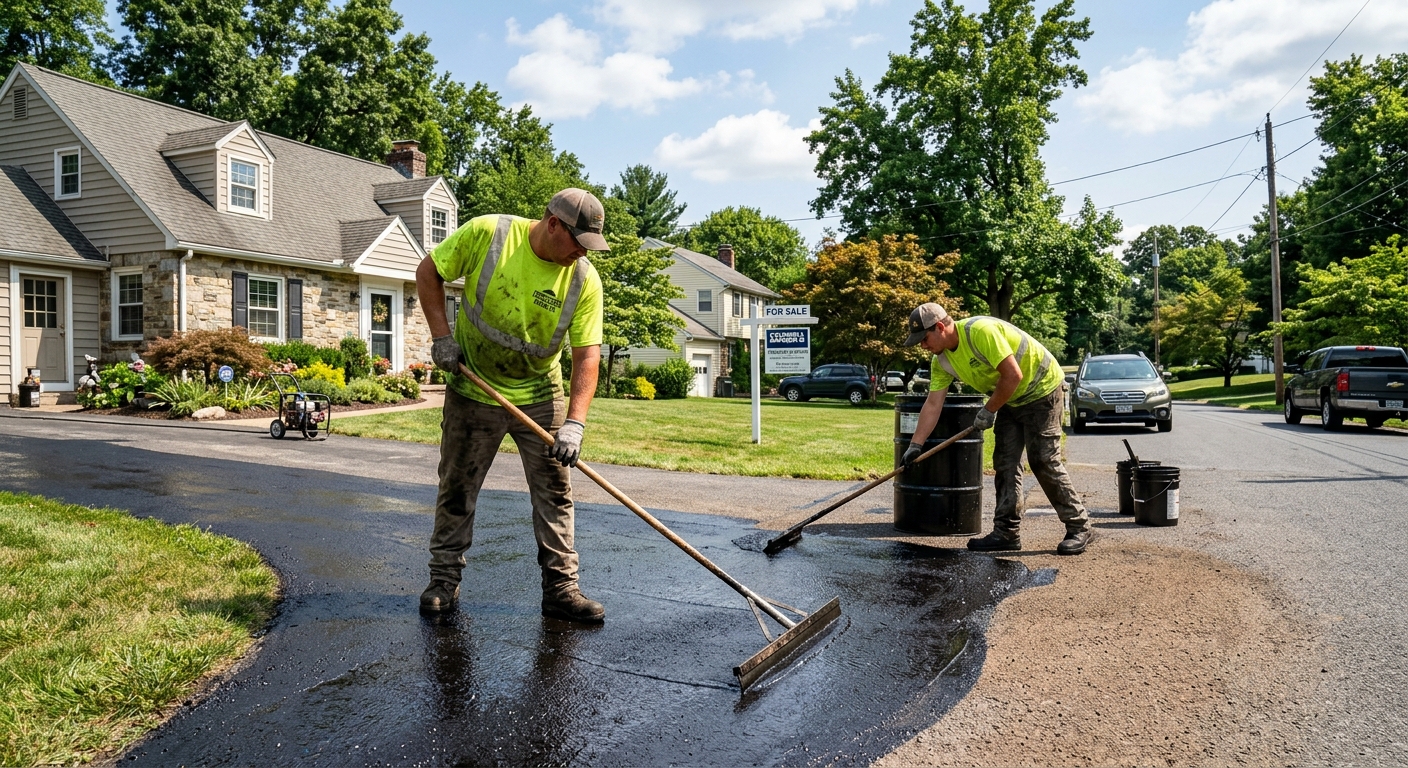
Peters paving prices by scope — 2026
Peters is a township where 88.6% of homes are single-family (U.S. Census Bureau, ACS 2024) and an overwhelming 95% of households own their property, so almost every driveway is the homeowner’s responsibility. In Peters, the price to pave or maintain a driveway reflects more than just surface material. Our winters drop to 8°F, and the region’s heavy freeze-thaw cycle puts real demands on the paving process. The ground here is mostly clay and shale, both prone to holding water—the enemy of any pavement. That means more of your cost goes, and should go, into what’s below: excavating old material, correcting drainage, adding and compacting the right base layers. This hidden work is why two quotes can look wildly different; short-cutting below the surface is common but guarantees early failure. Material choice matters, but square footage and base prep are the main drivers of price. The service options below fit the needs, budgets, and climates specific to single-family homeowners in Peters.
| Service |
Best for |
Lifespan |
Price range |
| Asphalt — full replacement with new base |
failed base, structural cracking |
20–30 yrs |
$3,700–$9,600 |
| Asphalt overlay / resurfacing |
sound base, surface cracking only |
8–15 yrs |
$1,600–$4,800 |
| Sealcoating — single application |
preventive maintenance on sound asphalt |
2–4 yrs |
$200–$750 |
| Concrete — new installation |
long service life, low maintenance |
30–50 yrs |
$5,300–$12,500 |
| Crack filling and patching |
isolated cracks under a quarter inch |
1–3 yrs |
$200–$800 |
| Gravel driveway |
rural, budget, long runs |
5–10 yrs with upkeep |
$900–$3,500 |
Estimates for a typical Peters driveway. Square footage and base condition drive these figures more than material choice.
The paving season in southwestern Pennsylvania
For homeowners in Peters and the surrounding areas, paving is a true seasonal business. You simply cannot pave here year-round. Hot-mix asphalt—the standard for driveways in Peters—must be placed and compacted while it’s still hot. If the air or ground is too cold, the asphalt mix loses temperature too quickly and never compacts tightly, leaving a porous and weak surface that won’t survive more than a few winters. This is critical in a zone where our winter design temperature is 8°F and we experience constant freeze-thaw. Local asphalt plants align their schedules accordingly and typically close operations through the colder months, making the product unavailable until at least mid-spring. For concrete, above-freezing weather is required for proper curing, or you risk a surface that powderizes and crumbles in its first freeze. All of this means the local paving season in Peters runs from late April through October. When possible, schedule resurfacing or replacement projects in spring or early fall: crews have more schedule flexibility, and prices track with demand, which dips outside of the summer rush. Mid-summer is the peak, and early booking fills a crew’s calendar. If someone is offering to pave in late November, you should ask why—they might be cutting corners with cold mix or off-spec material, and you risk paying for a job that fails its first winter. Quality paving here always follows the season, no exceptions.
What's under the asphalt matters more than the asphalt
The most important part of any driveway in Peters—and where the money really goes, even if you never see it—is below the surface. Proper driveway construction in Washington County starts at the subgrade: typically dense clay and shale in this region. These soils hold water and can shift under freeze-thaw, so the first step is to excavate and re-shape the subgrade for drainage. Over that, a compacted aggregate base—#2A modified stone is the local standard—should be installed at least 6 to 8 inches deep for asphalt, thicker for clay soils. The final asphalt layer is usually 2.5 to 3 inches after compaction, but its thickness means nothing if the base isn’t right. Each layer should be compacted in “lifts”—two or three layers, each rolled thoroughly, not dumped all at once. This prevents settling and avoids the potholes, alligator cracking, and heaving common in Peters after a few freeze-thaw cycles.
Frost heave is a real problem in Peters. When water in the clay and shale freezes, it expands, lifting the drive unevenly and cracking the surface from below. Once water gets in, the freeze-thaw cycle only compounds the damage. This is why shortcuts—skipping excavation, reusing a failed base, laying minimal or untested aggregate, or skipping compaction—will always show up within a few years. A suspiciously low bid almost always means these steps are skipped or rushed. Ask for these figures in writing: 6–8 inches of #2A modified stone base, compacted in lifts, with at least 2.5 inches of hot-mix asphalt on top after compaction. Get written assurance that base compaction will be tested, not guessed.
What you need before paving in Peters
If you’re resurfacing or repaving your driveway in Peters—without changing the existing dimensions—you usually don’t need a building permit. That’s one less hassle for most homeowners. But where many are caught off guard is at the street: the approach, where your driveway meets the public road, almost always requires a permit. In Peters, this is handled by the township if you’re on a local street; if your driveway connects to a state route, PennDOT issues what’s called a Highway Occupancy Permit. Expanding or re-routing your driveway may also invite review for runoff: whenever you add impervious surface, you take on responsibility for stormwater management, regardless of your permit status. Directing water onto a neighbor’s land isn’t just poor manners—the liability is yours.
Pennsylvania requires contractors to be registered as Home Improvement Contractors for any job over $500. Always verify at hic.attorneygeneral.gov. Workers’ compensation is mandatory for any employer on your site—check via WCAIS (wcais.pa.gov). And for work on homes built before 1978, lead paint rules apply—a reputable contractor will be able to show EPA certification.
Getting thirty years out of a driveway
Longevity starts with the basics: fill cracks as soon as they appear, before water can reach and weaken the base. This is the lowest-cost, highest-impact maintenance step—crack filling and patching costs far less than replacing failed sections ($200–$800 per visit for isolated repairs). Keep driveway edges supported by backfilling with soil and gently sloping away—unsupported edges crumble fastest. Good grading keeps water off the surface and away from the base, which is critical in Peters given our region’s freeze-thaw cycles. Avoid letting cars park at the very edge, putting jack stands, or dropping dumpsters on new pavement.
For new asphalt, wait at least three days before driving on it—more if temperatures are below average. For de-icing, be careful: salt attacks concrete chemically, leading to surface spalling and shortened lifespan. On asphalt, salt doesn’t attack, but melting and refreezing ice drives water into tiny cracks, accelerating the freeze-thaw effect. Alternatives like calcium magnesium acetate and sand are safer but more expensive. Using the right maintenance routine here is the difference between replacing a driveway at 15 years and coasting past 30.
Where the water goes
Grading and drainage are where most driveway failures in Peters begin and end. A paved surface must slope at least 2% (a quarter-inch per foot) to ensure reliable runoff. The usual approach is to slope the drive away from structures and toward a swale, drainage ditch, or storm inlet—crowning the center for wide drives, or setting a cross-slope for narrower ones. If an existing driveway slopes toward the garage or house, a channel or trench drain at the base may be necessary, but this is a fix, not ideal design. Wherever possible, the goal should be to direct water to a “daylight” point away from foundations, not into a dry well unless that’s the only responsible outlet.
In Washington County, heavy clay subgrade just doesn’t drain well; water that accumulates under the pavement sits, freezes, expands, and heaves the surface, cracking it from below. Any patch of standing water is more than an eyesore—it’s a warning flag for early failure. A regrading or drainage correction that prevents this is worth far more than another inch of surface. Lastly, Pennsylvania law is clear: you take on civil liability if you direct runoff onto your neighbor’s property, even if your permit is in order. Plan and inspect drainage before the paver ever rolls in.
Door-knocking crews and leftover material
Paving scams find Peters—a mostly suburban area with open space between homes—an easy target. The pitch is usually the same: “We have leftover asphalt from a job down the road and can give you a discount if you act today.” They’ll often drive unmarked pickups with plates from outside the area and ask for cash or a big deposit before work starts. Sometimes there’s no written quote, just a handshake and a vague promise. Sealcoating scams are even more common: a quick spray of thin, oily material incorrectly sold as real sealcoat. The job looks shiny at first, but it’s gone with the first rain or freeze.
Why here? In a county with spread-out homes, it’s harder to verify a neighbor’s experience, and crews know there’s less chance of getting caught quickly. That’s why Pennsylvania law requires a written contract for any home improvement over $500 and gives you three business days to cancel for any reason—no excuses, no fees—for exactly these situations. Never pay cash up front. Demand the contract, and take the time to check the company’s Home Improvement Contractor registration and workers’ compensation insurance at the official state websites named above. Anyone who suggests you should waive your homeowner’s deductible is offering to break the law: don’t hire them. These five-minute checks will block any scam—verify their registration, check their address, read their contract, and never be rushed to decide on the spot.
Frequently asked questions — driveway paving in Peters
How much does it cost to widen a driveway?
Widening a driveway in Peters can cost as little as $1,600–$4,800 for a simple asphalt overlay if the base remains solid and minimal excavation is needed. But if you’re expanding onto undisturbed ground—especially our local clay or shale soils—expect to pay closer to full replacement rates, as the new section needs excavation, fresh aggregate base, and full compaction. That runs $3,700–$9,600 for asphalt or even more for concrete. Be wary of any price much below this, as it likely means shortcuts under the surface where you can’t see them. Expansion almost always involves new grading and sometimes permit checks for driveway approaches, so include those in your planning.
Does road salt damage driveways in Peters?
In Peters, salt is used heavily during winter to control ice, and its impact depends on the material. For concrete driveways, salt accelerates surface scaling and spalling, which can seriously reduce a driveway’s life—one reason why some Peters homeowners invest in premium sealers or avoid concrete near the street edge. Asphalt is chemically unaffected by salt, but the biggest risk is how salt-induced meltwater refreezes, seeping into cracks and then expanding with our frequent freeze-thaw cycles. This can open up the pavement base earlier than expected, leading to repairs in the $200–$800 range each time. Sand or calcium magnesium acetate are alternatives, though each has its own price and drawbacks.
How long before I can drive on a new asphalt driveway?
For Peters homeowners, plan to wait at least three days before driving on fresh asphalt—longer if the weather is colder or rainy. The surface will still be soft and can rut or scuff from turns in place or heavy vehicles. If you opted for full replacement ($3,700–$9,600), this curing period is key to a long life. After three days, normal traffic is usually safe, but avoid parking heavy vehicles, using jack stands, or placing dumpsters for several more weeks. Turning wheels while stationary can leave marks on hot days for up to a month. The first season is critical for avoiding premature surface distress.
What are the signs of a failing driveway base?
Watch for deep, spreading cracks, “alligator cracking,” depressions that collect water, or soft, spongy spots that flex underfoot—these are classic signs the base has failed, not just the surface. Patching or sealcoating ($200–$750) won’t solve these problems for long, because freeze-thaw will continue working on the weak spots below. In Peters’ soils, once water gets into the base and is trapped by clay or shale, the frost can heave and shatter any pavement above. At that point, a full tear-out and replacement is almost always cheaper than repeated patching.
How do I verify a paving contractor in Pennsylvania?
You should always check for two things before hiring a paving contractor in Peters. First, verify their Home Improvement Contractor (HIC) registration at hic.attorneygeneral.gov to ensure they are legally registered for contracts over $500. Second, check that their workers’ compensation coverage is active via the WCAIS system (wcais.pa.gov). Reputable contractors will supply this information up front. If you are concerned about older homes (pre-1978), ask about EPA lead certification. Never skip the step of getting a signed contract, which is required under Pennsylvania law and triggers your three-business-day right to cancel. Taking these steps protects you much more effectively than shopping for the lowest price alone—even for small jobs like sealcoating in the $200–$750 range.
How much does driveway paving cost in Peters?
For a typical single-family driveway in Peters, full-depth replacement with a new asphalt base runs from $3,700–$9,600, with most jobs around $5,800. Resurfacing (overlay on a solid base) is less: $1,600–$4,800. Concrete drives start a bit higher, at $5,300–$12,500, but last longer with less maintenance. Patch and crack repairs range from $200–$800. Your lot size, driveway length, and especially the condition of the base will push the cost up or down. Material transport is rarely a factor here, thanks to nearby asphalt plants in the Pittsburgh–Washington corridor.
Is an overlay worth it or should I start over?
In Peters, an asphalt overlay is often cost-effective—typically $1,600–$4,800—when the base is still stable and you only see surface cracks or weathering. But overlays only last if the underlying base is solid. If there are deep cracks, soft spots, or ponding, putting new asphalt over the problem will buy maybe 2–3 more winters before failure returns. In that case, a full replacement ($3,700–$9,600) is the better investment—especially in our clay soils where freeze-thaw quickly exploits hidden defects. If in doubt, ask for a core sample or compaction test before deciding.
What slope does a driveway need for drainage?
In Peters, a driveway should have at least a 2% slope—about a quarterinch per foot—to ensure water runs off and doesn’t sit or pool. Crowning (a gentle hump in the middle) can help shed water on wider drives, but for most single-family homes, a consistent cross-slope away from the house is enough. If your driveway slopes toward your garage, a trench drain at the threshold may be necessary but isn’t ideal. The cost for proper grading and drainage corrections depends on the extent but is often included in a full repaving job ($3,700–$9,600). With our local clay holding water, good drainage isn’t optional—it’s what keeps driveways in service past the first few freeze-thaw cycles.
Does sealcoating fix cracks?
No, sealcoating alone does not fix cracks in your driveway. In Peters, where freeze-thaw cycles are harsh, sealcoating will protect against sun and minor moisture but won’t stop water from entering existing cracks and damaging the base. All significant cracks should be cleaned and filled before sealcoat is applied. Expect to pay $200–$750 for professional sealcoating on most single-family drives, with extra for supervised crack-filling beforehand. Relying on sealcoat to fix cracks is a false economy; water penetration through cracks causes expensive surface and base failures in just a few winters.