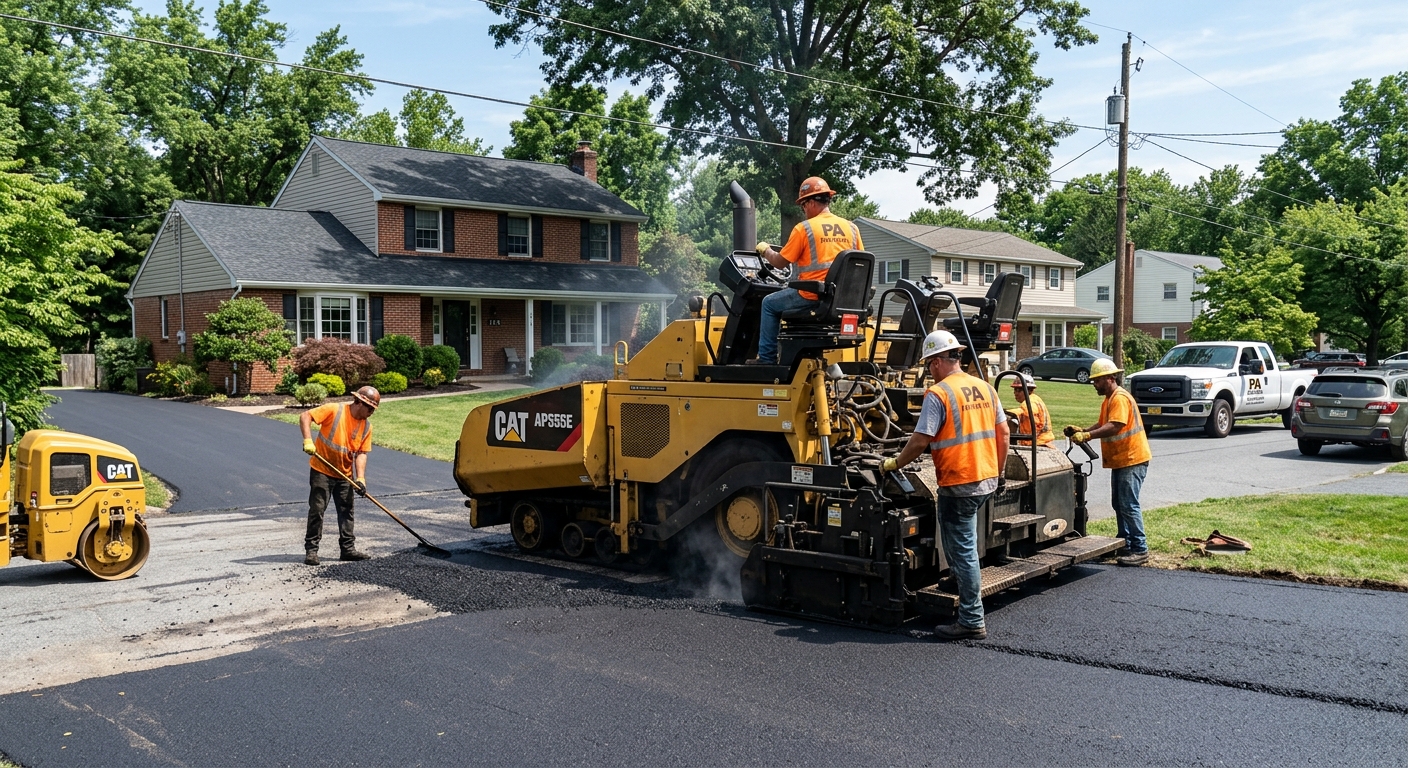
What a new driveway costs in Lower Saucon
In Lower Saucon, where 79.6% of homes are single-family and 88.7% are owner-occupied (U.S. Census Bureau, ACS 2024), a driveway is an expense nearly every homeowner faces. The rolling freeze-thaw cycles and limestone karst subgrade native to Northampton County mean cost is about more than just picking the cheapest quote. What separates a $3,900 job from a $10,000 one isn’t just the surface—it's what’s below, and that’s something you can’t see from the curb.
Most price variation is buried underground. The difference between a driveway that lasts two winters and one that sees your property through the next three decades is hidden in subgrade preparation, base thickness, and proper drainage—all tricky to judge after the trucks pack up. A cut-rate bid almost always comes at the expense of these hidden essentials. Asphalt prices may seem interchangeable, but skimping on excavation or base depth quickly shows in the finished product’s lifespan and appearance, especially in this region.
| Service |
Best for |
Lifespan |
Price range |
| Asphalt — full replacement with new base |
failed base, structural cracking |
20–30 yrs |
$3,900–$10,000 |
| Asphalt overlay / resurfacing |
sound base, surface cracking only |
8–15 yrs |
$1,700–$5,000 |
| Sealcoating — single application |
preventive maintenance on sound asphalt |
2–4 yrs |
$225–$800 |
| Concrete — new installation |
long service life, low maintenance |
30–50 yrs |
$5,600–$13,500 |
| Crack filling and patching |
isolated cracks under a quarter inch |
1–3 yrs |
$200–$800 |
| Gravel driveway |
rural, budget, long runs |
5–10 yrs with upkeep |
$900–$3,500 |
Estimates for a typical Lower Saucon driveway. Square footage and base condition drive these figures more than material choice.
Lower Saucon's ground and what it means for paving
The foundation beneath your Lower Saucon driveway is limestone karst—the same geology that shapes much of Northampton County’s landscape. This subgrade drains freely but is prone to subsurface settlement and sinkholes if undermined by water. Paired with our 36-inch frost depth and heavy freeze-thaw cycles, it means driveways need careful base preparation and drainage solutions built in, not tacked on.
Older homes—common here with much of the region built before 1980—rarely have the robust gravel bases today’s standards require. Many driveways from the 1900–1940 era around Easton and Bethlehem sit on thin or inconsistent bases laid for Model Ts rather than SUVs. When those thin bases meet a wet spring or a harsh winter, the limestone can settle unpredictably, leading to cracked and uneven pavement.
The right fix for Lower Saucon is not just thicker pavement, but a base matched to the subgrade: sufficient depth, plenty of compaction, aggregate that locks together well, and drainage that sends water away from the driveway, not under it. Skimp here, and you’ll spend more fixing settlement and heaving than you ever saved up front.
How paving fraud actually operates
Driveway paving brings out transient outfits looking to take advantage of uncertainty—especially in a region like Lower Saucon, where properties are often a little further apart and word-of-mouth doesn’t travel as quickly. The pitches are classic: “We have leftover asphalt from a job down the street,” “Today only—cash price,” unmarked trucks (sometimes from clear across Pennsylvania or out of state), demands for payment before any work starts, and scribbled-down verbal quotes with nothing in writing about thickness or prep. Another common ripoff is a thin, shiny oil-based spray-on sold as “sealcoating” for a price that’s too good to be true.
The Lehigh Valley’s saturated market draws both established contractors and fly-by-night crews. Being a thinly populated county, Lower Saucon is a soft target: it's easy for an operator to slip in, lay down a paper-thin layer, pocket your money, and move on before a neighbor catches on. The problem is, the real defects (like inadequate base, no compaction, or cut corners on drainage) won’t even surface until after a year or two of weather, far too late for recourse.
Pennsylvania’s Home Improvement Consumer Protection Act (HICPA) exists for exactly these situations. Any job over $500 requires a written contract, which also includes your three-business-day right to cancel. You are legally entitled to both regardless of what anyone says at your door, and you should never let work start—much less pay anything down—without these.
If you do nothing else, take five minutes to check HIC registration at hic.attorneygeneral.gov and workers’ compensation coverage through WCAIS (wcais.pa.gov). The scams fail every time someone checks before signing.
Sealcoating: what it does and what it doesn't
Sealcoating in Lower Saucon makes driveways look sharp again, but its real function is to protect the asphalt binder from oxygen, sun, and chemical spills. A good application shields old pavement from surface wear and slows down the process where the top dries out and gets brittle. Visually, it darkens and freshens up faded blacktop, which can add curb appeal in a neighborhood full of single-family homes.
But there are boundaries. Sealcoating will not cover or bridge cracks, strengthen weak areas, or do anything for a driveway whose base is already compromised—it’s just a coat on top. Over-sealing as an annual habit actually does more harm than good. Multiple coats pile up, begin cracking and peeling, and can even trap moisture—or, if the pavement is too new, volatile oils under the fresh surface, leading to soft spots or early failure. On fresh asphalt, you should wait at least one full season before applying anything.
Crack filling is a better investment in the long run if you're trying to keep water from getting below a sound surface. It’s the freeze-thaw cycles here that open up minor cracks into wide crevices and potholes. A proper hot-applied crack fill with prep and routing lasts, where a quick squirt or a too-thin spray-on “sealer” does little to prevent water intrusion. Suspiciously low-priced jobs—say, under $225–$800 for a sizeable drive—usually mean cut product, dilution, or not enough material to last a year. If that’s the only bid you're seeing, walk away.
Why Lower Saucon driveways fail from the bottom up
A driveway’s strength comes from the unseen layers beneath the surface. In Lower Saucon, that means building on top of limestone karst subgrade—a porous, variable foundation that requires careful handling. The standard assembly is this: first, the natural subgrade; above that, a compacted aggregate (crushed stone) base; and only then the asphalt or concrete surface. Each layer spreads out loads and keeps the structure stable.
Our climate pushes these layers hard. With a frost depth of 36 inches and frequent freeze-thaw cycles, any moisture in the subgrade expands when it freezes. This “frost heave” lifts sections unevenly, cracks the asphalt from beneath, and lets water get in deeper with every temperature swing. When a contractor rushes the job—reusing a failed old base, skipping excavation, dumping down too-thin or poorly compacted stone—they’re gambling with consequences you’ll see in year three, not year one.
In this region, you should get in writing: a minimum of 4 to 6 inches of compacted aggregate base (often more over weaker soils or heavy traffic), crushed limerock or PennDOT 2A stone (not round river rock or soil fill), and compaction done in lifts (layers)—not just at the end. Compaction should be confirmed with at least a plate compactor or roller after each lift. If your quote doesn’t spell out these numbers, or suggests “one heavy layer” of stone with no mention of thickness or compaction equipment, that’s where corners are being cut.
Limestone karst needs good drainage, too. Any shortcut here—no slope, no side swale, or a base built too close to grade—sets you up for settlement or frost damage the first wet winter. The short money saved today can mean a full redo much sooner than you’d planned.
What you need before paving in Lower Saucon
If your plans in Lower Saucon call for repaving an existing driveway in the same footprint, you usually won’t need a building permit. That’s true in much of Northampton County, except when expanding or installing a driveway—especially in places like Bethlehem, where new paved surfaces often trigger zoning or building review. But for the spot where your driveway meets the public road—the approach or curb cut—a distinct permit is nearly always required. On state roads, this comes from PennDOT District 5-0, while local township offices handle permits for local streets. Neglecting this step can force you to redo the approach, and may even lead to fines.
Another concern is stormwater. Expanding the paved area can trigger runoff controls, including requirements not to direct water onto neighboring properties or public rights-of-way. Regardless of whether the township asks for plans, you as the property owner are still liable for improper drainage. Getting this right is as important as the paving itself.
Before hiring any contractor, verify their Home Improvement Contractor (HIC) registration through hic.attorneygeneral.gov, and confirm that workers’ compensation coverage is active using WCAIS (wcais.pa.gov) if they have employees. These checks are quick, straightforward, and required by state law for any project over $500 in Pennsylvania.
Getting thirty years out of a driveway
In Lower Saucon’s climate, the biggest factor in a long-lasting driveway is drainage and timely crack filling. Once water finds its way through small gaps, the freeze-thaw cycles—especially harsh here—do the real damage, lifting pavement and breaking apart the base underneath. Filling cracks before winter, not after, blocks water and extends life more than any other single action. Keeping driveway edges supported—by grading soil up or installing stone shoulders—prevents crumbling from vehicles running off the edge.
Avoid point loads, like jack stands, dumpsters, or heavy trucks parked in one spot for days. Those will leave depressions, even on properly built drives. For new asphalt, allow at least three days before regular parking, and two to four weeks before turning wheels while stationary, to prevent surface scuffing while the oils cure.
As for snow management, Pennsylvania winters drive people to use salt, but on concrete, it speeds up surface scaling and spalling. On asphalt, the trouble is more about encouraging meltwater to seep in and refreeze, opening up cracks. Calcium chloride or magnesium chloride are safer alternatives, but they cost more. For most Lower Saucon homes, shoveling promptly and using sand for traction is a safe, low-damage approach for both materials.
Frequently asked questions — driveway paving in Lower Saucon
What does sealcoating cost in Lower Saucon?
For a typical residential driveway in Lower Saucon, you can expect a sealcoating job to cost between $225–$800 per application, depending on size and condition. Most homeowners pay around the middle of that range for an average single-family driveway. Lower Saucon’s combination of mature neighborhoods and heavy freeze-thaw cycles means sealcoating is a smart way to maintain the appearance and surface protection, but it’s not something you need to do yearly. Look for a contractor who preps cracks properly and uses at least one full coat—not just a thin spray. Suspiciously low bids often signal diluted product or skipped prep, which results in a coating that barely lasts through the next winter.
What does an asphalt overlay cost in Lower Saucon?
An asphalt overlay, sometimes called resurfacing, generally costs $1,700–$5,000 for a standard Lower Saucon driveway. This service is best if your base is still sound but the surface is cracked, rough, or faded. It’s a way to get 8–15 more years out of your driveway without the cost of full replacement—especially appealing in neighborhoods with solid 1970s–80s blacktop bases. It’s important to know that overlays only work where the base hasn’t failed or settled—if you lay over a bad base, all the same problems will come back quickly. Always verify the contractor inspects for signs of deep settlement or heaving before recommending an overlay.
Do I need a permit to repave a driveway in Lower Saucon?
Repaving an existing driveway in the same shape and location in Lower Saucon usually does not require a building permit, saving you paperwork and time. But there’s a catch: if you’re changing the entrance, expanding the footprint, or altering drainage, a permit is very likely needed—especially in neighboring Bethlehem. Also, wherever your driveway meets the public road, you’ll likely need a separate approach or curb cut permit, handled by PennDOT District 5-0 for state roads or your township for local ones. Failing to get this can lead to removal orders or fines. Always ask your contractor about permits at the proposal stage and confirm their HIC registration before signing any contract over $500.
Can asphalt be laid in cold weather?
Asphalt needs to be installed while it’s still hot enough to compact properly—a challenge in Lower Saucon’s colder months, especially as temperatures approach or drop below freezing. Most local contractors cut off paving jobs for the season once overnight lows consistently hit the 40s. Laying asphalt in too-cold weather results in poor compaction, weak bonds, and driveway surfaces that won’t survive the first hard winter. For the typical project cost of $3,900–$10,000 (new asphalt with full base), rushing the job late in the season risks wasted money. The best windows for paving are spring through early fall.
Is an overlay worth it or should I start over?
In Lower Saucon, overlays make sense if the old driveway’s base is stable and you just have surface cracking or worn blacktop. With costs between $1,700–$5,000, overlays are about half the price of a full replacement. However, overlays don’t solve deep base failure, drainage problems, or major settlement—these require digging out and rebuilding from the bottom up, at costs closer to $3,900–$10,000. For older homes (pre-1980), bases are often thin or poorly drained, so overlays are a temporary fix. Get a contractor who checks for base movement before recommending an overlay; otherwise, you’ll spend again soon.
How thick should asphalt be for a residential driveway in Lower Saucon?
For Lower Saucon’s climate and limestone karst soils, the standard is two layers (“lifts”) totaling at least 3 inches of compacted asphalt for regular vehicle traffic. Heavier or longer residential drives can benefit from 4 inches. Underneath, a well-compacted aggregate base of 4 to 6 inches is needed to handle winter frost heave and prevent settlement. These depths matter much more than topping thickness alone. Cutting corners on base thickness is tempting because it’s hard to see, but it’s the quickest way to end up spending another $3,900–$10,000 for a full redo. Make sure thickness specifications are written into your contract.
Does Lower Saucon have local asphalt plants?
Lower Saucon is close to multiple asphalt plants and quarries clustered around Bethlehem and Easton, so supply is not a constraint and transportation costs are low. Asphalt used for local driveway paving comes from nearby within Northampton County, which helps keep costs steady—expect the standard full replacement price of $3,900–$10,000. This short haul distance means hot-mix asphalt stays at the right temperature during delivery and paving, which is a real advantage compared to more rural counties where mix can start to cool before it gets to the job site.
Does sealcoating fix cracks?
Sealcoating does not fix cracks, regardless of what it looks like on day one. For Lower Saucon’s climate, crack filling is the actual maintenance that prevents water from getting into the base and causing frost heave—sealcoat alone just covers the surface and can actually let cracks widen underneath. A sealcoat is the top coat; it helps keep the sun and oil out, but any visible cracks should be cleaned and filled with proper crack filler before sealing. Professional crack filling runs $200–$800 and, when done right, is a better investment if you’re looking to prolong the life of your driveway.
Why are my driveway edges crumbling?
Crumbling edges are common on older Lower Saucon driveways—especially those built before wider standards took hold—because the base layer doesn’t extend wide enough, or the soil has washed away, leaving the asphalt unsupported. When vehicles drive close to or off the edge, or runoff erodes the sides, the unsupported asphalt fractures and breaks off. Repair involves patching and sometimes widening the stone base. If the damage is minor, edge patching usually falls in the $200–$800 range. For recurring problems, especially with heavy snowplow use or lawn equipment, consider building up the sides with compacted stone or even adding a concrete ribbon edge during repaving.