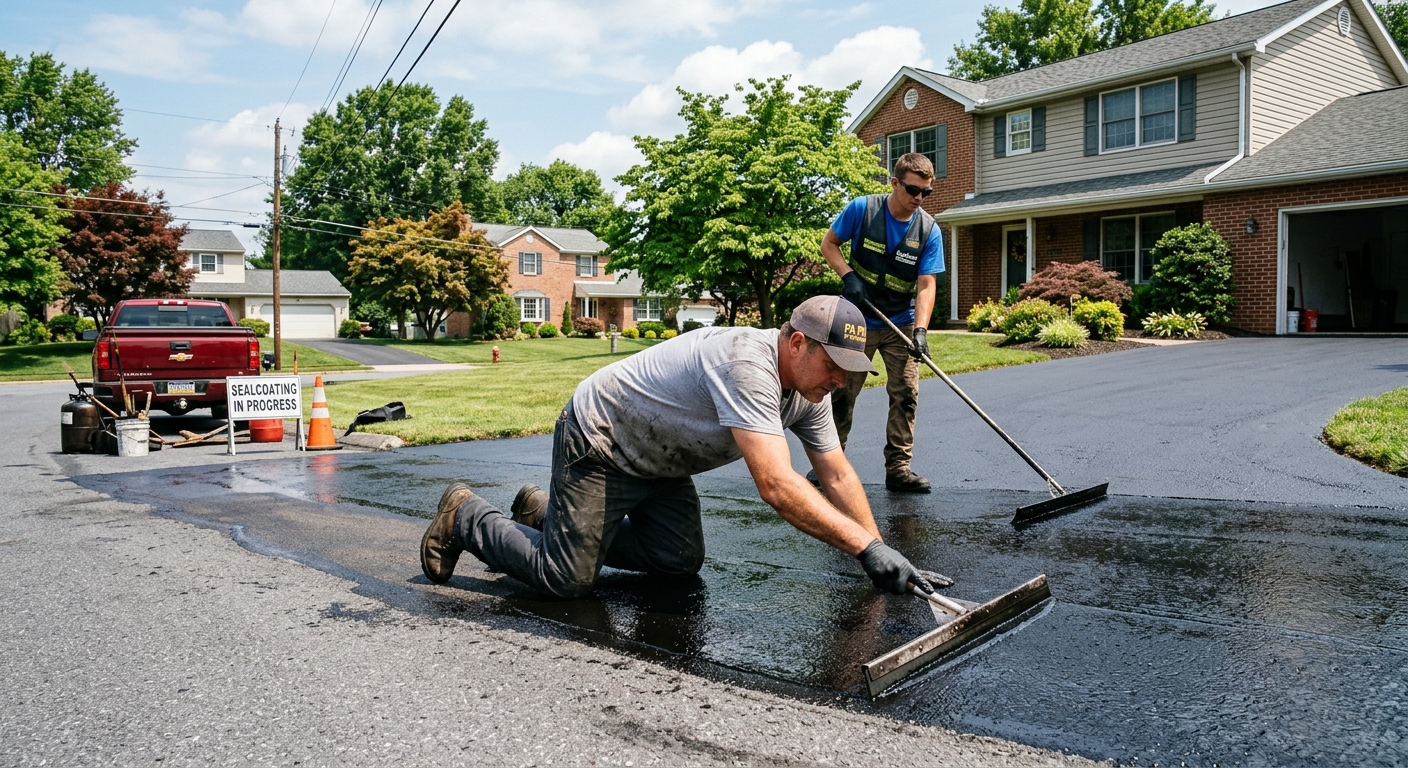
Lower Burrell paving prices by scope — 2026
Lower Burrell homeowners, with single-family houses making up 82.8% and an 82.7% owner-occupied rate (U.S. Census Bureau, ACS 2024), see driveway paving costs as a real investment—often as significant as a new roof or HVAC system. In this part of Westmoreland County, most driveways were installed with the home, and those predating the 1980s may never have had a proper base. The region’s heavy freeze-thaw cycle, hilly lots, and clay/shale subgrade make base quality and water management far more important than square footage alone.
If you collect two quotes and see thousands of dollars in difference, the reason is almost never obvious above ground. The main cost driver is what gets built beneath the surface—base depth, soil preparation, and how thick and compacted each layer is. Lower Burrell’s climate means cutting corners below the pavement, or paving over old problems, will show up as cracks or heaves well before the driveway “age” you expect.
| Service |
Best for |
Lifespan |
Price range |
| Asphalt — full replacement with new base |
failed base, structural cracking |
20–30 yrs |
$3,500–$9,000 |
| Asphalt overlay / resurfacing |
sound base, surface cracking only |
8–15 yrs |
$1,500–$4,500 |
| Sealcoating — single application |
preventive maintenance on sound asphalt |
2–4 yrs |
$200–$700 |
| Concrete — new installation |
long service life, low maintenance |
30–50 yrs |
$5,000–$12,000 |
| Crack filling and patching |
isolated cracks under a quarter inch |
1–3 yrs |
$200–$800 |
| Gravel driveway |
rural, budget, long runs |
5–10 yrs with upkeep |
$900–$3,500 |
Estimates for a typical Lower Burrell driveway. Square footage and base condition drive these figures more than material choice.
Base preparation: the part you pay for and never see
Every driveway in Lower Burrell, whether asphalt or concrete, is only as good as the foundation below it. Here’s how that assembly works: First is the natural subgrade, which around Lower Burrell is mainly clay and shale. This base material is notorious for holding water, swelling when frozen, and shrinking in dry months—setting the stage for frost heave and slab movement. Above this, a properly installed compacted aggregate stone base spreads the load and drains water away. On top of that, the asphalt or concrete takes the direct wear.
In southwest Pennsylvania, the ground freezes to 36 inches, and the winter brings dozens of freeze-thaw cycles. When water trapped in the subgrade freezes, it expands and lifts any pavement not resting on a deep, well-drained stone base. If the aggregate layer is too thin, or isn’t compacted in several passes (“lifts”), it will settle unevenly. Cracks form as soon as the pavement flexes more than it's built to absorb.
This is where cheap bids get their low numbers. Skipping subgrade excavation, laying new asphalt over a soft or broken base, using an inch or two of stone when you need four to eight, or failing to compact each layer—these shortcuts can all be invisible until the first or second winter.
For your protection, insist in writing on details:
- Base depth (stone): at least 6–8 inches of 2A modified stone for asphalt on clay or shale soils
- Aggregate type: 2A modified limestone, not recycled material or millings unless fully blended and compacted
- Compaction: Each layer compacted in 2–4 inch lifts with vibratory equipment; ask for proof if possible
These are the differences that decide if your driveway lasts twenty years or five.
Maintenance that actually works
The single cheapest and most effective maintenance task for any Lower Burrell driveway is preventing water from reaching the base. Sealing cracks before they widen lets the surface keep water out, which slows down freeze-thaw damage. For $200–$800 (
$200–$800), crack filling is money well spent if done early. Next, keep driveway edges supported with topsoil or stone—exposed edges break down faster. Ensure water drains away from the drive and doesn’t pool next to the pavement.
For new asphalt, wait 3–6 months before sealing—rushing this traps volatile oils, causing flaking or “alligator” cracking later. Don’t park heavy vehicles or turn power steering wheels in place until the surface is fully cured (over 6 weeks, longer in cool or wet weather). Place plywood under jack stands and Dumpsters to spread load and avoid dents.
De-icing is a local issue: rock salt damages concrete rapidly, so calcium magnesium acetate or sand are safer. On asphalt, salt accelerates melt-refreeze cycles, which can hasten crack formation, especially on older pavement. Alternatives cost more, but sometimes patience and shoveling beat chemical de-icers. Lower Burrell’s winters make these precautions worth a few extra steps.
Why driveways behave differently in Lower Burrell
Lower Burrell and much of Westmoreland County sit on subgrades of clay and shale—which strongly shape how driveways age. Clay holds water, making it prone to frost heave. When winter comes and that water freezes, it expands and pushes the driveway upward in spots, leading to cracks and uneven settling come spring. Shale layers can hold less water, but the pockets of clay still control drainage and movement below the paving.
A 36-inch frost depth and frequent freeze-thaw cycles in this region put any driveway to the test. In much of the city’s housing stock, especially in post-1960 subdivisions, driveway bases were often built to the code minimum—or less. Older drives may sit on just a few inches of gravel, which isn't nearly enough under today’s climate demands. That’s partly why resurfacing, not total replacement, is the norm in these neighborhoods: the top wears faster than the base, but if base problems are left unaddressed, overlays don’t last.
In rural areas, longer driveways mean more places for water to pool and run downhill, so robust drainage and thicker bases matter even more. What works in sandy or limestone soils one county over will not stand up to Lower Burrell’s clay.
What you need before paving in Lower Burrell
In Lower Burrell, you typically do not need a building permit just to resurface or patch an existing driveway within its footprint. Sealcoating, likewise, generally proceeds without municipal paperwork if you are not changing the size or drainage pattern—saving you a phone call and a fee.
However, if you are changing the curb opening, affecting sidewalks, or adjusting drainage, you will likely trigger a zoning or building permit, especially in neighboring Greensburg. Any time you touch the driveway approach (where your drive meets a public or state-maintained road), a permit is almost always required. In Lower Burrell and throughout Westmoreland County, approach permits come from PennDOT District 12, not your municipality—many homeowners find this out the hard way when approached after the fact.
Stormwater management also comes into play. Adding pavement increases impervious surface, so if you expand your driveway, you may be responsible for handling extra runoff to avoid liability for flooding a neighbor’s property.
When hiring a paving contractor, Pennsylvania law requires anyone working over $500 to be registered under Home Improvement Contractor (HIC) regulations—check their status at hic.attorneygeneral.gov. All contractors with employees must carry workers’ compensation insurance, verifiable through the state’s WCAIS database. Always request proof before work begins.
How to vet a paving contractor in Lower Burrell
Start by verifying the contractor’s Home Improvement Contractor (HIC) registration at hic.attorneygeneral.gov. Legitimate paving businesses provide a local mailing address—not just a mobile number—and can supply references for jobs done in Lower Burrell or Westmoreland County at least three years ago. Driveway work is about longevity: a job that looked great in year one tells you little, so make sure you check projects that have survived a few winters here.
Ask where they buy their asphalt—Lower Burrell is served by local Hempfield Township asphalt plants, and aggregate is commonly hauled from Greensburg-area quarries. If a contractor can’t name their regular supplier, they may be brokering out your job or using inconsistent materials.
Rented equipment is not always a red flag, but owned and maintained machines typically mean the company is local and invested. Finally, ask what their base preparation process is; if they gloss over excavation and compaction details, keep looking.
- Check Home Improvement Contractor registration for contracts over $500 (hic.attorneygeneral.gov)
- Require proof of workers’ compensation coverage (WCAIS)
- Request a written, itemized estimate with specifics
- Get references from local jobs 3–5 years old
- Confirm local business address with physical location
- Ask where they source their asphalt (should know Hempfield-area plants)
- See proof of owned or regular-use paving equipment
- Demand written scope for base prep, compaction, and drainage
- Insist on a contract with the 3-day cancellation notice (HICPA)
- Avoid companies offering to “work for your deductible”—it’s illegal
- Refuse to pay in full or mostly upfront
- Watch for unmarked trucks with out-of-county plates
Red flags include vague estimates, inability to prove registration or insurance, pushy sales tactics, and any effort to “beat the permit.” Most problems in Lower Burrell stem from these corners being cut.
Reading a driveway proposal
A proper driveway proposal is your best defense against misunderstanding and overpaying. The proposal should lay out the measured square footage—never “eyeballed,” as this affects every other line item. Excavation depth and whether the old material is removed and hauled away should be front and center. Next, base details: the type of aggregate, the exact depth in inches, and whether compaction will be performed in multiple “lifts.” The asphalt section must clarify how many courses and what the compacted depth in each layer is.
Look for how they plan to finish the driveway edges and restore disturbed areas. Drainage is crucial—a proposal should state how the surface will be pitched and where water will go. Cleanup and restoration of lawn borders is not automatic; make sure it’s included. The payment schedule should require only a modest deposit, with the balance due after a satisfactory walkthrough. Warranties are usually limited—a written warranty will almost always exclude cracking, though that is the main concern for most owners.
A one-line quote with just a total and “new driveway” isn’t a bid—it’s a gamble. Those jobs are the ones that cost more per year because they fail early.
| Line item |
What to look for |
Red flag if… |
| Area |
measured square footage stated |
eyeballed or absent |
| Excavation |
depth and disposal included |
'we'll pave over it' |
| Base |
aggregate type and depth in inches |
'proper base' |
| Compaction |
method, and done in lifts |
not mentioned |
| Asphalt |
courses and compacted depth |
'3 inches' unqualified |
| Drainage |
slope and water direction stated |
silent |
| Warranty |
what is covered and what is excluded |
verbal only |
| Payment |
modest deposit, balance on completion |
full cash up front |
Frequently asked questions — driveway paving in Lower Burrell
Asphalt or concrete for a Lower Burrell driveway?
In Lower Burrell, asphalt and concrete both have a place, but the right answer comes down to your property and expectations. Asphalt is less expensive up front—a typical replacement runs $3,500–$9,000—and is more forgiving to install and patch on clay/shale soils. Asphalt drives flex with freeze-thaw, are less vulnerable to rock salt, and are quicker to repair here than concrete. Concrete, though more costly initially ($5,000–$12,000), can go twice as long before needing major work and stands up to long-term rutting if properly installed with a deep base. On Lower Burrell’s clay, either needs a good foundation. For most, asphalt wins unless you demand a 30+ year lifespan with little maintenance, but base prep trumps material in this neighborhood.
How much does a concrete driveway cost in Lower Burrell?
The cost to install a new concrete driveway in Lower Burrell typically falls between $5,000–$12,000. For an average suburban lot, most homeowners spend around $8,000 for a standard-width two-car driveway. The final number depends on total square footage, thickness (at least 4 inches recommended here for regular vehicles), and the amount of compacted stone base required—which matters greatly in Lower Burrell’s clay and shale soils. If heavy trucks or RVs are part of your routine, or the slope is steep, thicker pours and deeper base push the price to the upper end.
Why does my driveway have depressions that hold water?
Depressions or “birdbaths” in Lower Burrell driveways almost always come from an inadequate or uneven base below the surface. In this area’s heavy clay, water settles and forms soft spots. During freeze-thaw cycles, these pockets expand and contract, letting certain areas settle more than others. Over time, this results in low spots that collect water. If the base wasn’t built with enough compacted stone—especially for older drives—these issues show up within a few years. Fixing this properly typically means either full replacement for $3,500–$9,000 or, in mild cases, a patch and asphalt overlay at $1,500–$4,500.
How far ahead should I book a paver in Lower Burrell?
Spring through early fall is peak season for driveway paving in Lower Burrell. Given the short warm weather window and the popularity of local asphalt plants, expect reputable contractors to book out 3–8 weeks, sometimes longer, especially if you’re hoping for a spot in June or July. Because Westmoreland County’s climate restricts work to milder months, planning ahead is wise. If a contractor can slot you in immediately in midsummer, be wary—or expect to pay at the very top of the local price bracket ($3,500–$9,000 for full replacement) for rush scheduling.
When can I seal a brand new asphalt driveway?
In Lower Burrell, you should wait at least 90 days before sealcoating a new asphalt driveway—sometimes longer if the summer is cool and damp. Fresh asphalt contains oils that need to cure and harden, and premature sealing locks those in, causing early cracking and surface issues. For most homeowners, budgeting for a first sealcoat in the fall after a spring or early summer install makes the best use of the climate and gives the surface a chance to stabilize. Sealcoating typically costs $200–$700 per application.
Do I need an approach permit where my driveway meets the road?
Yes, if you are replacing, enlarging, or modifying the approach where your driveway meets a public, and especially a state-maintained, road, you need a driveway approach permit. In Lower Burrell and throughout Westmoreland County, this comes directly from PennDOT District 12, not your local borough office. Skipping this step can lead to fines or demands to redo the work at your expense. Basic driveway resurfacing set back from the street seldom requires a permit, but any approach work is closely watched.
Does road salt damage driveways in Lower Burrell?
Road salt is tough on all driveways, but in Lower Burrell it’s concrete that suffers most. Rock salt accelerates surface scaling and shortens service life, especially on newer pours. Asphalt is more tolerant, but repeated melting and refreezing along cracks or edges can worsen expansion and cracking, particularly in our heavy freeze-thaw climate. Safer (though pricier) alternatives include calcium magnesium acetate or simple sand. Sealing concrete helps, but you may still see some damage over time. For those with concrete, even replacement at $5,000–$12,000 means avoiding salt if you want a full lifespan.
Why are paving quotes in Lower Burrell so different from each other?
Most differences in paving quotes—sometimes thousands of dollars—come from what’s included below the surface. In Lower Burrell, with its clay and shale soils, a proper base costs more, but skipping excavation, drainage, or stone depth shaves a lot off a quote. Two jobs that look identical on day one can age very differently, especially after a couple of freeze-thaw cycles. One contractor might offer a resurfacing (“overlay”) at $1,500–$4,500 when the base really needs to be rebuilt for an extra few thousand. Always compare bids line by line, and don’t be fooled by vague or one-line “cheap” proposals.
How deep should the aggregate base be here?
In Lower Burrell and the surrounding Westmoreland County area, you need a minimum of 6–8 inches of compacted 2A modified stone for asphalt driveways on clay and shale soils. Older driveways are often thinner than this and suffer early failure from frost heave and rutting as a result. For concrete, 4–6 inches is the recommended minimum base depth, though 8 inches is not overkill on sloped or heavy-use sites. Skimping on base depth may cut $1,000–2,000 off the upfront cost, but you’ll pay it back in repairs or full replacements ($3,500–$9,000 for asphalt) much sooner.