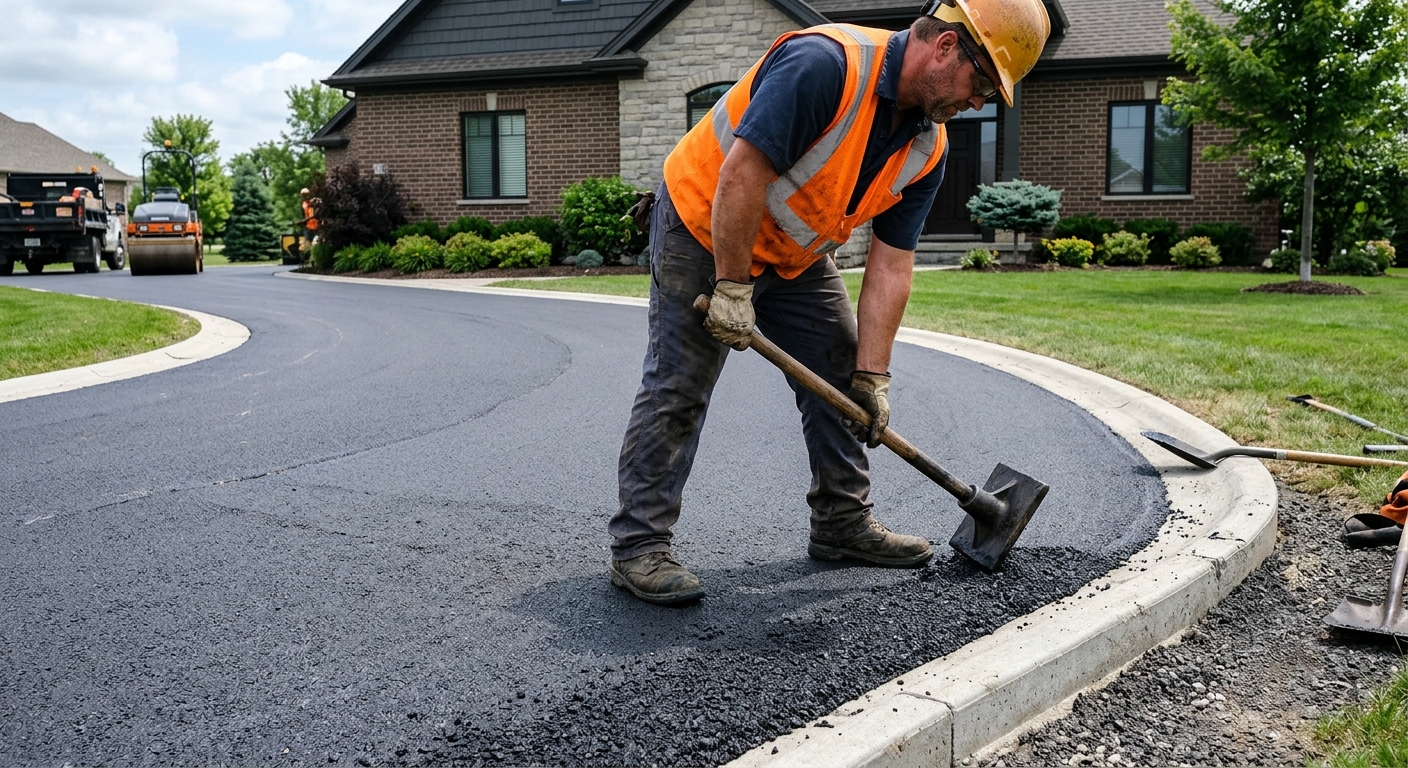
What a new driveway costs in Derry
Derry homeowners face the same fundamental expense decisions as much of Westmoreland County, where 81.0% of homes are single-family and the homeownership rate sits at 79.1% (U.S. Census Bureau, ACS 2024). That means most driveways here are full-length, detached-home projects—not short city aprons. What many don’t realize is how little of the price difference between two quotes is due to the visible surface. In Derry, where freezes are harsh and the clay and shale subgrade is unforgiving, most of the cost is under your wheels. The quality and thickness of the compacted stone base, the prep work, and drainage all matter far more than the mix of asphalt or concrete poured on top.
In regions like ours, where freeze-thaw cycles are severe and the soil holds water, cutting corners below the surface is tempting for some outfits. That’s how you get two bids that look worlds apart on price—one with proper excavation and base, one skipping steps you’ll never see until year three. It’s not about maple leaf patterns or the type of roller; it’s about whether that subgrade was dug out deep enough, stoned, and compacted for Pennsylvania’s climate. Here’s what you can realistically expect to pay in Derry for common driveway options:
| Service |
Best for |
Lifespan |
Price range |
| Asphalt — full replacement with new base |
failed base, structural cracking |
20–30 yrs |
$3,300–$8,400 |
| Asphalt overlay / resurfacing |
sound base, surface cracking only |
8–15 yrs |
$1,400–$4,200 |
| Sealcoating — single application |
preventive maintenance on sound asphalt |
2–4 yrs |
$175–$650 |
| Concrete — new installation |
long service life, low maintenance |
30–50 yrs |
$4,700–$11,000 |
| Crack filling and patching |
isolated cracks under a quarter inch |
1–3 yrs |
$200–$800 |
| Gravel driveway |
rural, budget, long runs |
5–10 yrs with upkeep |
$900–$3,500 |
Estimates for a typical Derry driveway. Square footage and base condition drive these figures more than material choice.
Driveway permits, approaches and stormwater rules
In most of Derry and Westmoreland County, repaving your driveway within the existing layout—what contractors call a “mill and fill” or overlay—usually does not require a building permit. The exception comes when you expand the footprint, alter drainage, or disturb roadside features. If your project affects the driveway’s approach (the part meeting a state road), you’ll need a separate permit from PennDOT District 12, handled through the Westmoreland County maintenance office. Many homeowners are surprised to find this is not a township or borough matter, but a state one.
Any time you’re adding impervious surface—a wider drive, a parking pad, or converting gravel to asphalt—local governments may review the impact on stormwater. Even if a permit is granted, Derry residents can still be held responsible if runoff from a new driveway flows onto a neighbor’s property and causes damage. Drainage is not just a paperwork issue; it’s potential legal trouble.
For your protection and the law’s requirements, always verify your contractor’s Home Improvement Contractor (HIC) registration through the Pennsylvania Office of Attorney General at hic.attorneygeneral.gov. Anyone you hire should carry mandatory workers’ compensation insurance—confirm this via the WCAIS system (wcais.pa.gov) before signing. By Pennsylvania law, any contract over $500 must be in writing, and you hold a three-day right to cancel. If you aren’t offered a contract, walk away.
Why Derry driveways fail from the bottom up
Driveway longevity in Derry comes down to what’s beneath the asphalt or concrete. Every driveway is a three-layer assembly: the subgrade (your native soil), a compacted aggregate base, then the pavement itself. Each layer is supposed to distribute weight to the one below. For us in southwestern Pennsylvania, the subgrade is usually a heavy clay or shale (especially near Greensburg), which saturates easily and doesn’t drain water well.
This matters because our region endures heavy freeze-thaw cycles. When water accumulates in that clay subgrade, it freezes—and as it does, it expands and pushes the driveway upward. This is frost heave, and it cracks the slab from beneath, never from above. The visible asphalt could be two inches or five; if the base is bad, it won’t save you. That’s why we need both a thick compacted stone base and good drainage—a detail that cheaper crews will cut right past.
Here’s where the low bids hide their shortcuts: Little or no excavation (maybe they just skin the top). Thin, poorly-compacted stone base. Skimping on the correct aggregate size. No compaction testing, no building in layers (“lifts”). All are invisible when the trucks leave but painfully obvious by year three, when alligator cracks, potholes, and undulations appear. You only get one shot to do the base right—resurfacing on top of failure won’t buy you time.
In Derry, you should see a written commitment to at least 6 inches of compacted, clean aggregate base—sometimes more in clay-heavy spots. The base should be built and compacted in 2–3 inch lifts (layers), not all at once. Specify PennDOT 2A or 2B stone as the aggregate, and don’t accept “we’ll see” as an answer. Get these specs on paper before any money changes hands.
Widening, extending or adding a parking pad
If you plan to widen for an extra car, run a new turnaround, or replace a gravel extension with solid asphalt, the process is more involved than a simple overlay. Any expansion creates new impervious surface—a concern in Derry’s clay soils, where runoff can quickly become a neighbor or township headache. New footprints demand fresh excavation to undisturbed subgrade and a full-depth aggregate base beneath the new section. The seam between old and new will always be the weak point, so make sure your contractor properly bonds the edges and matches both base and pavement thickness.
Adding a parking pad or extending closer to a side lot means checking on setback rules—many townships restrict how close you can pave to your property line. Whether you’re widening or reshaping, you could face stormwater requirements and will likely need to address the driveway approach, especially if connecting to a state road managed by PennDOT District 12. Even if no building permit is needed for routine resurfacing, changing the driveway’s area or tie-in can trigger review. Always ask your local code office and PennDOT early, since permit surprise is worse than project delay.
Where the water goes
Water is public enemy number one for any Derry driveway. Grading and drainage are not finishing touches—they are critical to a pavement that survives more than a few freeze-thaw cycles. To keep water moving off the surface, a minimum slope of 2% (about a quarter inch per foot) is needed. Most driveways here use a steady cross-slope or slight crown to shed water. If your drive pitches toward the house or garage, it’s a red flag: surface and subsurface water will eventually find its way into the foundation or under the slab, guaranteeing frost heave.
In areas where grade cannot be changed—maybe you have just a few inches from garage floor to street—trench or channel drains are the answer, directing runoff to daylight or into a dry well. Because Westmoreland County’s clay-heavy soils do not perk well, water tends to linger against the base unless you provide a clear exit.
Surface ponding means water infiltrates the base, and come winter, that water freezes and elevates the slab unpredictably. Over time, this leads to cracks, heaving, and the kind of patchwork fixes no homeowner wants to pay for. No matter what, redirecting water onto a neighbor’s property is a liability. Whether the permit covers it or not, it can create legal and neighbor disputes, so always play it safe and send water to the street or appropriate drainage—not next door.
Overlay, patch or full replacement?
Most Derry homeowners want to know if they can stretch another five years with a resurfacing, or if it's time for a full replacement. The answer depends on your base. Here’s a field test you can do: If you see alligator (checkerboard) cracking over wide areas, that’s usually base failure—a new layer on top is money burned. Those cracks flex, let water in, and the same pattern returns quickly. Isolated, narrow cracks under a quarter inch? That’s mostly surface aging—crack filling and sealcoating buys you a little time. Depressions or puddles (“birdbaths”) signal the subgrade has sunk or shifted. Edge crumbling says the sides were never supported or the base didn’t go wide enough, and potholes mean water’s been at the stone layer for some time.
If a contractor offers an overlay without inspecting the base—maybe poking a screwdriver into the cracks, or digging a test hole—be wary. The right repair matches the defect. Here’s how common driveway symptoms in Derry break down:
| What you see |
Likely cause |
Right fix |
Cost |
| Isolated cracks under 1/4 inch |
surface aging |
crack fill and seal |
$175–$650 |
| Alligator cracking over a wide area |
base failure |
full replacement |
$3,300–$8,400 |
| Depressions holding water |
subgrade movement |
excavate and rebuild that area |
$3,300–$5,200 |
| Crumbling edges |
no edge support |
edge repair, consider curbing |
$400–$1,500 |
| Potholes |
water into the base |
full-depth patch, then assess |
$250–$900 |
| Faded but sound surface |
oxidation only |
sealcoat |
$175–$650 |
The paving season in southwestern Pennsylvania
Paving season in Derry and the surrounding area is a hard stop, not just a suggestion. Hot-mix asphalt must be laid at proper temperatures—ideally air and ground both above 50°F—because below that, the mix loses heat too quickly to be compacted tight. The result is a porous, rutted driveway that will not survive our 8°F winter design temp or the freeze-thaw cycles. Compounding that, our local asphalt plants in Hempfield Township shut down completely through late fall and winter. If you miss that window, you simply cannot get hot-mix delivered, even if someone offers.
Concrete paving has its own cutoff. Pouring concrete in cold weather means slow curing, surface flaking, and long-term durability problems unless special techniques and additives are used—which drives up cost and risk for a residential project.
Westmoreland County’s aggregate supply benefits the Derry area during the paving season, with short hauls from Greensburg-area quarries. Most years, paving starts in April and winds down in October or early November—later than that, and quality goes down. The shoulder seasons (spring and fall) are when crews have calendar space and prices are steadier. If someone’s offering to pave after Thanksgiving here, they’re either out of work for a reason, or they don’t plan to stand behind their job. Wait for the right slot—it’s not worth getting a driveway installed wrong just to shave a month off scheduling.
Frequently asked questions — driveway paving in Derry
What are the signs of a failing driveway base?
In Derry, where clay and shale are the native subgrade, the earliest warning signs of base failure show up as widespread “alligator” cracking, deep depressions, and persistent potholes—even after patching. You might also notice that the edges crumble away or develop soft spots after rain. Unlike small, hairline surface cracks (which are mostly cosmetic and can often be solved with crack fill and sealcoating for $175–$650), a failing base causes the whole driveway to flex, shift, and hold water. You’ll see uneven surfaces, recurrent birdbaths, or large cracks that never fully close. These aren’t just age—our heavy freeze-thaw means water under the pavement expands and contracts, breaking down the base fast. If you see these symptoms, an overlay probably won’t help, and a full replacement is worth considering to avoid endless patching.
Does Derry have local asphalt plants?
Yes, Derry benefits from the proximity of asphalt plants based in Hempfield Township—locally within Westmoreland County. This keeps haul distances short for most driveway projects here, which matters because longer truck hauls raise material costs and risk asphalt cooling before it's installed. Rural jobs closer to Unity Township or outside town may draw aggregate from quarries around Greensburg, so you're still in the production region. Fast turnaround from plant to your drive means better installation and higher quality, no matter if you’re getting a single course patch for $250–$900 or a full replacement. It’s one of the logistical advantages to paving in Derry compared to more remote spots in southwestern PA.
When can I seal a brand new asphalt driveway?
If you’ve just paved new asphalt in Derry, patience is your friend—wait until the following paving season before applying any sealcoating. Newly laid asphalt needs at least 60 to 90 days to cure, allowing volatile oils to evaporate and the surface to harden before any sealer is put down. With our summer/fall paving window, that often means waiting until the next spring to seal. Sealing too early can trap oils, making the drive sticky, soft, and prone to marking. Proper sealcoating, typically $175–$650 for a residential drive, acts as preventive maintenance, but only once the surface is fully cured. In the meantime, keep debris and vehicles with sharp edges off the new surface, and address any standing water with rapid drainage solutions.
How long before I can drive on a new asphalt driveway?
In Derry’s climate and with standard hot-mix asphalt, you typically need to wait at least three full days before driving a passenger car on a brand new driveway. For trucks, trailers, or RVs, I'd recommend waiting a full week, especially in summer when new asphalt stays soft longer. Cooler fall weather helps the material harden up quicker, but it’s always better to err on the side of caution. Parking too early can create depressions and tire marks that won’t disappear. Remember, even after those first few days, avoid turning your wheels in place or setting heavy equipment in one spot. Protect your investment that initially runs from $3,300–$8,400 by taking it easy the first week.
How much does driveway paving cost in Derry?
The cost for driveway paving in Derry depends most on the condition of your base—not just the material finish. Full removal and new base on a standard two-car drive typically falls in the $3,300–$8,400 range. If your base is sound and you just need resurfacing (an overlay), you’re likely looking at $1,400–$4,200. Concrete runs higher, and a basic install ranges from $4,700–$11,000. Sealcoating, on the maintenance side, is the low-cost way to extend life at $175–$650 per try. Size, shape, drainage needs, and the amount of prep work all matter. Get a fixed quote with a written specification so you can compare apples to apples.
What does compaction in lifts mean?
Compaction in lifts is the practice of building your driveway’s stone base (and sometimes the asphalt itself) in thin layers, usually two to three inches thick at a time, rather than dumping the entire base at once. In Derry, with clay and shale soils that hold water, compacting each lift ensures the finished base is dense and stable—giving your driveway the structural support it needs to survive winter freeze-thaw. If a contractor skips this, you get future ruts and heavy settling. Ask your installer to detail their lift thickness and compaction equipment in writing. Skipping this step may give you a low quote, but you’ll pay later—especially if you’re budgeting for a new install in the $3,300–$8,400 range.
Is an overlay worth it or should I start over?
Overlays make sense for Derry driveways only if your current base is solid—meaning no widespread alligator cracking, major depressions, or mushy spots. If your surface shows only minor, linear cracks and some color fading, resurfacing (an overlay, typically $1,400–$4,200) can add up to 10 years of life. If you see structural failures—cracking everywhere, potholes, or the driveway moving underfoot—you’ll burn money on an overlay because the problem’s already in the base. A careful contractor will verify the base condition, possibly by drilling or cutting test holes. In Derry’s climate, putting new asphalt over a failed base is asking for repeat repairs within a couple of years, and makes full replacement (at $3,300–$8,400) inevitable anyway.
Are there stormwater rules on paving in Derry?
Yes, stormwater matters for any Derry driveway expansion or project that increases impervious surface. When you widen a drive, add a parking pad, or pave a gravel section, extra runoff can create issues for both local infrastructure and your neighbors. Homeowners are liable if drainage from a new driveway damages adjoining properties, regardless of permit status. If your new drive connects to a state-managed road, PennDOT District 12 will also review stormwater impacts before issuing an approach permit. Even if your township does not require a formal stormwater plan, you’ll want to incorporate grading and possibly swales or drains. Drainage design can impact project cost, sometimes adding hundreds to even a base repair project (like edge repair for $400–$1,500), but protects you against future headaches.
What does sealcoating cost in Derry?
For a typical residential driveway in Derry, professional sealcoating falls in the $175–$650 range per single application. The cost is tied to driveway size and current surface condition—heavier crack filling before sealing increases price, as does a large or heavily shaded area that needs extra prep. With Derry’s share of homes built before 1980 and our high homeownership rate (U.S. Census Bureau, ACS 2024), regular sealcoating is a good investment in this freeze-thaw-prone climate. Keeping up on it every few years helps prevent water from sinking into the base, which is far cheaper than future patching or early replacement. Always hire a contractor with proper insurance and HIC registration; sealcoating is simple but you still want coverage on your property.