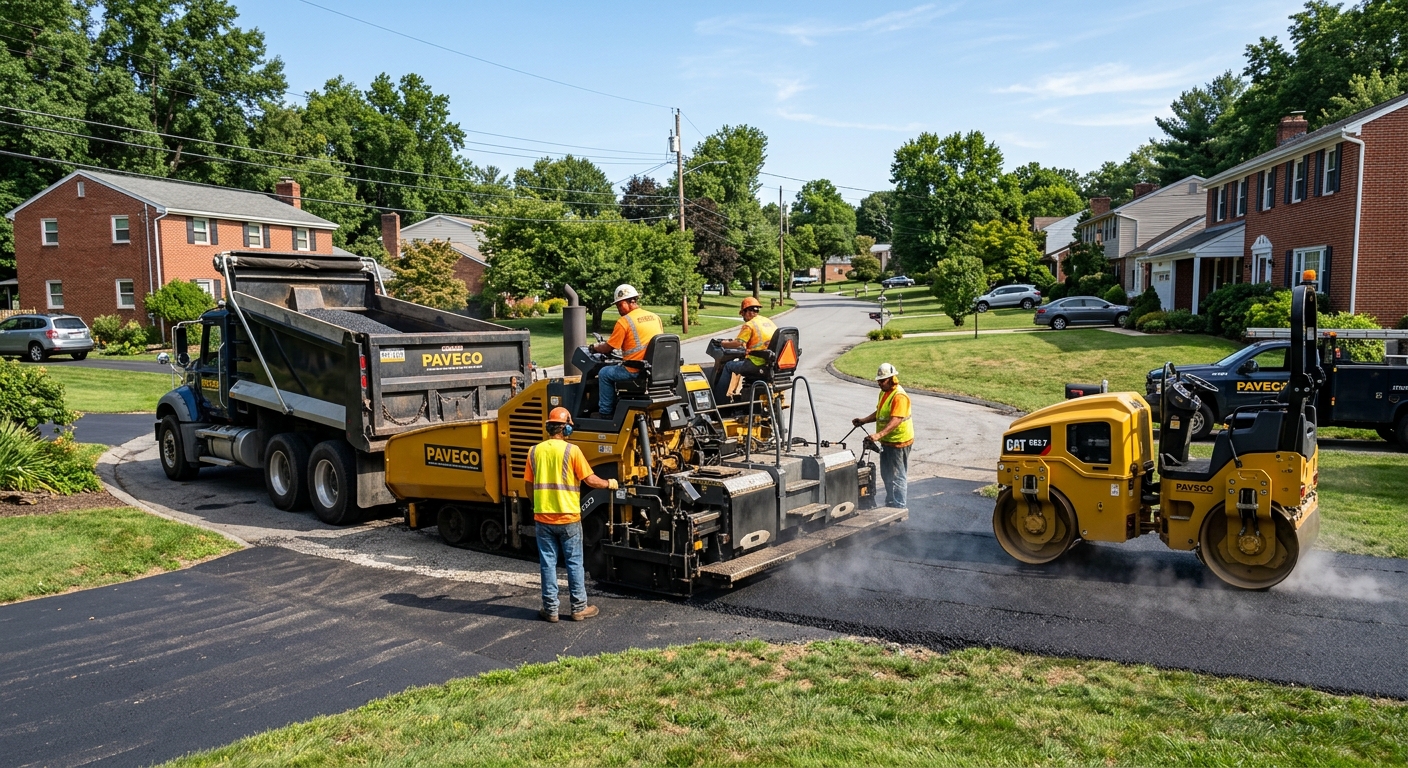
Driveway paving costs in O'Hara — 2026
In O'Hara, where 78.7% of homes are single-family and the homeownership rate stands at 87.3% (U.S. Census Bureau, ACS 2024), driveway paving is a common upgrade and a significant expense for many owners. Most homes in O'Hara sit on hilly, clay-heavy subgrades that demand careful prep and specific base construction — a point that distinguishes Allegheny County from flatter or drier regions. Combined with the area's harsh freeze-thaw cycles, these ground conditions put unusual stress on driveways and accelerate wear if the job isn't done right from the ground up.
The biggest cost differences in paving quotes rarely have much to do with the asphalt or concrete you see on top. Instead, most of your money goes into what’s below: excavation, aggregate, drainage, and base compaction. Cutting corners beneath the surface saves a contractor money in ways that aren't obvious until your driveway cracks, heaves, or puddles in later winters. This is why two quotes can differ by thousands, and why cheap is so often expensive in the long run here in O'Hara. Make sure you’re comparing apples to apples — specs and base work, not just materials — when reviewing contractor bids.
| Service |
Best for |
Lifespan |
Price range |
| Asphalt — full replacement with new base |
failed base, structural cracking |
20–30 yrs |
$3,900–$9,900 |
| Asphalt overlay / resurfacing |
sound base, surface cracking only |
8–15 yrs |
$1,650–$5,000 |
| Sealcoating — single application |
preventive maintenance on sound asphalt |
2–4 yrs |
$225–$750 |
| Concrete — new installation |
long service life, low maintenance |
30–50 yrs |
$5,500–$13,000 |
| Crack filling and patching |
isolated cracks under a quarter inch |
1–3 yrs |
$200–$800 |
| Gravel driveway |
rural, budget, long runs |
5–10 yrs with upkeep |
$900–$3,500 |
Estimates for a typical O'Hara driveway. Square footage and base condition drive these figures more than material choice.
What to put in a O'Hara paving contract
If you’re comparing prices for a driveway in O'Hara, don’t stop at the dollar signs. Two quotes for the “same” job can hide big differences in what actually gets built. Paving contracts should spell out the numbers: how deep is the old driveway getting excavated, exactly how many inches of compacted aggregate base will be installed, and what compaction method or equipment will be used? Is base material crushed limestone or recycled? Are asphalt binder and surface courses each listed by their compacted depth (not loose thickness), since asphalt compresses by about a quarter when rolled? Did the contractor specify the PennDOT mix number, so you know what you’re getting?
O'Hara’s tough freeze-thaw cycles and its clay-shale subgrade mean base depth and compaction specs here should be more robust than those used in milder climates. “We’ll put down three inches” is a red flag: three inches before rolling might end up as two inches after, which isn't enough for these soils. Push for details in writing — that’s your only real protection in this market.
- Excavation depth in inches (old material to be removed)
- Aggregate base depth (compacted), in inches
- Type and gradation of base aggregate
- Compaction method and number of passes
- Asphalt binder course thickness, compacted
- Asphalt surface course thickness, compacted
- PennDOT mix specification for both courses
- Number of layers (lifts) for both base and asphalt
- Edge treatment: hand-tamped, machine-rolled, sealed
- Drainage plan and minimum finished slope away from buildings
Where the water goes
Drainage is the quiet difference between a driveway that lasts in O’Hara and one that fails within a few winters. Whether you’re sloping a new asphalt surface or replacing concrete, a minimum slope of 2% (about 1/4 inch per foot) is needed to reliably shed surface water. For wide driveways, a center crown can shed water to each side, or a steady cross-slope can direct all runoff away from structures. If a driveway slopes toward your garage or house, water infiltration becomes a serious risk — that’s where trench or channel drains, tied to daylight or a dry well, may be needed.
The region’s regular freeze-thaw cycles, paired with local clay soils, double down on drainage problems. Heavy clay doesn’t let water percolate quickly, so any ponding will linger and seep into the base. Once winter hits, that trapped moisture freezes and expands, heaving the base and cracking your pavement. Adding gravel or aggregate doesn’t fix bad drainage; it just hides the problem — at least until the next thaw.
Don’t let runoff cross onto a neighbor’s property, even if your permit doesn’t address it. You can be found liable for water damage caused by redirected stormwater, so include this in your contractor’s scope. Legal and durable driveway projects in O'Hara start with thoughtful drainage plans that deal with water first, not last.
How to tell if the base is gone
Your whole driveway’s fate depends on what’s under the surface. You don’t need to be an expert to spot signs of base failure on your O’Hara property. If you see widespread alligator cracking — a pattern that looks like reptile skin, covering a broad area — that's the clearest signal the base has given out. An overlay would only mask the symptom, not fix the cause, and any new pavement will split the same way in just a year or two. In contrast, a few isolated, linear cracks usually mean the surface is aging, not that the foundation is gone.
Other warning signs include depressions and “birdbaths,” which trap water after rain — these indicate the subgrade has shifted, likely from freeze-thaw cycles in the local clay. Crumbling driveway edges point to inadequate lateral support from the base. Potholes mean water has already made its way through the surface courses into the base, starting a cycle of washout and collapse.
Never accept a contractor’s recommendation for an overlay without seeing them dig a test pit or probe the base. If they’re not inspecting the foundation, you’re being sold a temporary fix that won’t survive our Allegheny County winters.
| What you see |
Likely cause |
Right fix |
Cost |
| Isolated cracks under 1/4 inch |
surface aging |
crack fill and seal |
$225–$750 |
| Alligator cracking over a wide area |
base failure |
full replacement |
$3,900–$9,900 |
| Depressions holding water |
subgrade movement |
excavate and rebuild that area |
$3,900–$6,100 |
| Crumbling edges |
no edge support |
edge repair, consider curbing |
$400–$1,500 |
| Potholes |
water into the base |
full-depth patch, then assess |
$250–$900 |
| Faded but sound surface |
oxidation only |
sealcoat |
$225–$750 |
Why O'Hara driveways fail from the bottom up
In O'Hara and across Allegheny County’s rolling hills, driveway failures rarely start at the surface. The real structure is a three-part assembly: undisturbed subgrade, carefully compacted aggregate base, and then the asphalt or concrete you see. Each layer has a different job. The subgrade bears the weight and resists movement. The aggregate base distributes load and lets water drain away from pavement, so freeze-thaw cycles can’t crack it from below. The top layer takes direct wear but only performs as well as what’s under it.
Local clay and shale soils trap moisture close to the base. In winter, water in these layers freezes, expands, and lifts (heaves) portions of the driveway unevenly — a process called frost heave. It creates cracks you can’t seal and dips you can’t patch. Because our frost depth runs 36 inches, base prep here must be more robust than in regions with milder winters and sandier soils.
This is where a cheap quote usually cheats: excavating less (or not at all), spreading too little aggregate, skipping compaction or doing it in one thick lift instead of several thin ones, or laying new asphalt over a failed base. These shortcuts can’t be seen the day your driveway gets installed, but the damage starts showing by year three.
For Allegheny County, get these in writing: a minimum 6–8 inches of compacted 2A modified aggregate base (limestone is typical and best), applied in 2–3 compacted lifts, vibration rolled. The asphalt should be no less than 2.5 inches compacted binder plus 1.5 inches compacted surface. If you see anything less on paper, start asking questions.
Choosing a paving company
With O’Hara’s saturated paving market, it’s easy to get overwhelmed by choices — some legitimate, others less so. Start at hic.attorneygeneral.gov to check for a valid Pennsylvania Home Improvement Contractor (HIC) registration for any bid over $500. For employees (not just the owner), verify workers’ compensation coverage using WCAIS at wcais.pa.gov. Skip any company that can’t provide these basics.
Ask for a business address you can drive past, not just a cell number — fly-by-nights use PO boxes or out-of-state mail drops. Companies with local yards own their equipment, while brokers and itinerants rent or subcontract, often with poor results. If a contractor can’t name their regular asphalt plant or throws out generic “from the supplier,” keep shopping. Allegheny County has several asphalt plants and quarries that serve the market; legit outfits know their sources.
- Valid HIC registration (hic.attorneygeneral.gov)
- Verify workers’ comp at wcais.pa.gov
- Business with a physical local address
- Owned paving and compaction equipment
- References from jobs 3+ years old
- Proof of current general liability insurance
- Asphalt supplier name and contact
- Written, itemized contract for any job over $500
- 3-day right to cancel in all contracts per HICPA
- List of recent jobs in O’Hara or surrounding municipalities
- Clarity on who supervises the crew (not just a salesperson)
- No demands for large cash deposits
Red flags include out-of-area numbers, door-to-door pitches, pushy “today-only” pricing, and refusal to specify materials or suppliers. Trust only what’s written, not what’s promised on site.
Driveway permits, approaches and stormwater rules
In most Allegheny County municipalities, resurfacing or replacing a private driveway in its existing footprint doesn’t require a building permit. That means in O’Hara, you typically don’t need to file for township approval just to redo a driveway on your own property. However, if your project includes changing, widening, or rebuilding the driveway approach — the part connecting to the public road — you need to contact PennDOT District 11-0. They handle Highway Occupancy Permits for approach work on state roads, and the rules are stricter than for work entirely on private land.
Expanding your driveway’s paved area can increase stormwater runoff, which isn’t just a permit issue—it’s a liability one. Directing water onto a neighbor’s property can land you in hot water legally, even if you followed all permit protocols.
For contractor compliance, Pennsylvania law requires written contracts for all jobs over $500 (per the Home Improvement Consumer Protection Act). Make sure your contractor is HIC registered, which you can check at hic.attorneygeneral.gov. Workers’ compensation coverage is mandatory for any contractor with employees, and you can confirm coverage on wcais.pa.gov before anyone starts work.
Frequently asked questions — driveway paving in O'Hara
What causes driveway cracks in O'Hara?
Cracks in O'Hara driveways are most often caused by the region’s aggressive freeze-thaw cycle and the heavy clay and shale soils under most homes. Water gets into surface imperfections or unsealed joints, seeps down, and when it freezes, expands and pries the pavement apart. Poor surface drainage, low spots (birdbaths), and insufficient base thickness accelerate the issue. Many driveways in O'Hara were built during the postwar housing booms (when 70.3% of homes were built before 1980), and their original construction may not account for modern traffic or today's wet winters. If you notice cracks spreading or connecting across wider areas, the solution can range from crack-filling and sealing at $225–$750 to full base replacement if deeper damage is present.
What is the difference between binder and surface course?
In O'Hara, asphalt driveways are typically built with two distinct layers: the binder course and the surface (or wearing) course. The binder is the thicker, rougher underlayer — its job is to support loads and tie the structure together. The surface course is a thinner, finer mix placed on top, giving you a smoother finish that's resistant to the elements. Both are measured compacted, not loose, so get exact thicknesses in your contract. The surface course resists water and ultraviolet damage, while the binder handles the pounding from cars and the movement caused by winter frost. On a typical new installation, you’ll see 2.5 inches of binder and 1.5 inches of surface atop a deep base, giving you 20–30 years of service at $3,900–$9,900 installed.
How long does a driveway installation take?
Most O'Hara driveway projects are completed within 1 to 5 days, depending on the scope. A simple asphalt overlay can be done in a day if the weather is clear and your base is sound. Full replacement, which involves excavation and new aggregate base, usually takes 2–4 days to allow time for each lift to be compacted and, if needed, to contend with wet or clay-heavy local soils. Concrete driveways require additional curing time — plan for a week before parking on new concrete. Complexity, existing damage, and rain can add delays. Expect contractors working to proper specs in Allegheny County to take more time than those taking shortcuts; don’t be rushed into accepting a fast but shallow job, even at $3,900–$9,900.
How much does it cost to widen a driveway?
Widening a driveway in O’Hara depends on how much area you add, the prep required, and whether you’re matching asphalt or concrete. Typical costs run from $1,650–$5,000 for an asphalt extension if the subgrade is stable and you don’t need major drainage changes. If you’re changing the apron at the public road, a Highway Occupancy Permit from PennDOT District 11-0 may be needed, adding time and permit fees. For large additions or difficult slopes, expect the price to trend toward the higher end. Always include matching your existing surface and proper compaction, or new sections will settle and crack.
What kind of soil is under O'Hara driveways?
Most driveways in O'Hara are built on a mix of clay and shale subgrade. These soils are native to Allegheny County’s hilly terrain and present special challenges for paving contractors. Clay holds water, drains poorly, and amplifies freeze-thaw damage in winter. Shale, while more stable when dry, can become slick and unstable when wet. This is why proper excavation, a deep aggregate base, and solid drainage are critical. Cutting corners on the base invites heaving and cracks — issues that can cost you a full replacement at $3,900–$9,900 long before a driveway’s normal lifespan.
Why are paving quotes in O'Hara so different from each other?
Quote differences in O'Hara often come down to unseen specs: how much old material gets removed, what kind of base is installed, depth and compaction of that base, and the actual thickness of the asphalt or concrete after rolling. Some contractors pad their profits by cutting corners underground — a serious problem with the area’s clay and freeze-thaw cycles. Legitimate companies give detailed, itemized contracts covering excavation, base, thickness, compaction, and drainage. If you see wildly different prices for the “same” work, dig into the specs before choosing. Overlays may range from $1,650–$5,000, but what’s below the topcoat controls how long your driveway lasts.
Should I repair or replace my O'Hara driveway?
If your O'Hara driveway has cosmetic cracks, isolated spots, or faded but intact surfaces, repair and sealcoating (typically $225–$750) may give you several more years of service. Alligator cracking, base movement (dips, birdbaths), or edge collapse signals it’s time for full replacement. Repairs over a failed base are a temporary bandage — water will work its way back in underneath, and you’ll spend more in the long run. Have a contractor probe the base before making a decision: if it’s soft or saturated, replacement is the only fix that will last through Allegheny County’s winters.
How do I verify a paving contractor in Pennsylvania?
Start with the Pennsylvania Home Improvement Contractor (HIC) registry at hic.attorneygeneral.gov — every contract over $500 requires registered status, which protects your consumer rights. Next, check workers’ compensation coverage at wcais.pa.gov, since it’s mandatory for any business with employees. Ask for business references from jobs done in O’Hara or nearby towns at least three years ago. Insist on a written contract (as required by HICPA) and make sure it spells out the compaction, base depth, and drainage specs. Any contractor who won’t show proper documentation isn’t serious, no matter how low the price.
When can I seal a brand new asphalt driveway?
In O’Hara’s climate, you should wait at least 90 days before applying the first sealcoat to a new asphalt driveway — longer if the weather’s cool and the surface still feels oily. Let the new pavement cure over a good stretch of dry, warm weather if possible. Sealing too soon can trap oils and interfere with bonding, leading to premature peeling or uneven color. When your pavement is ready, a properly applied sealcoat will run $225–$750 and help protect your investment from water and salt.