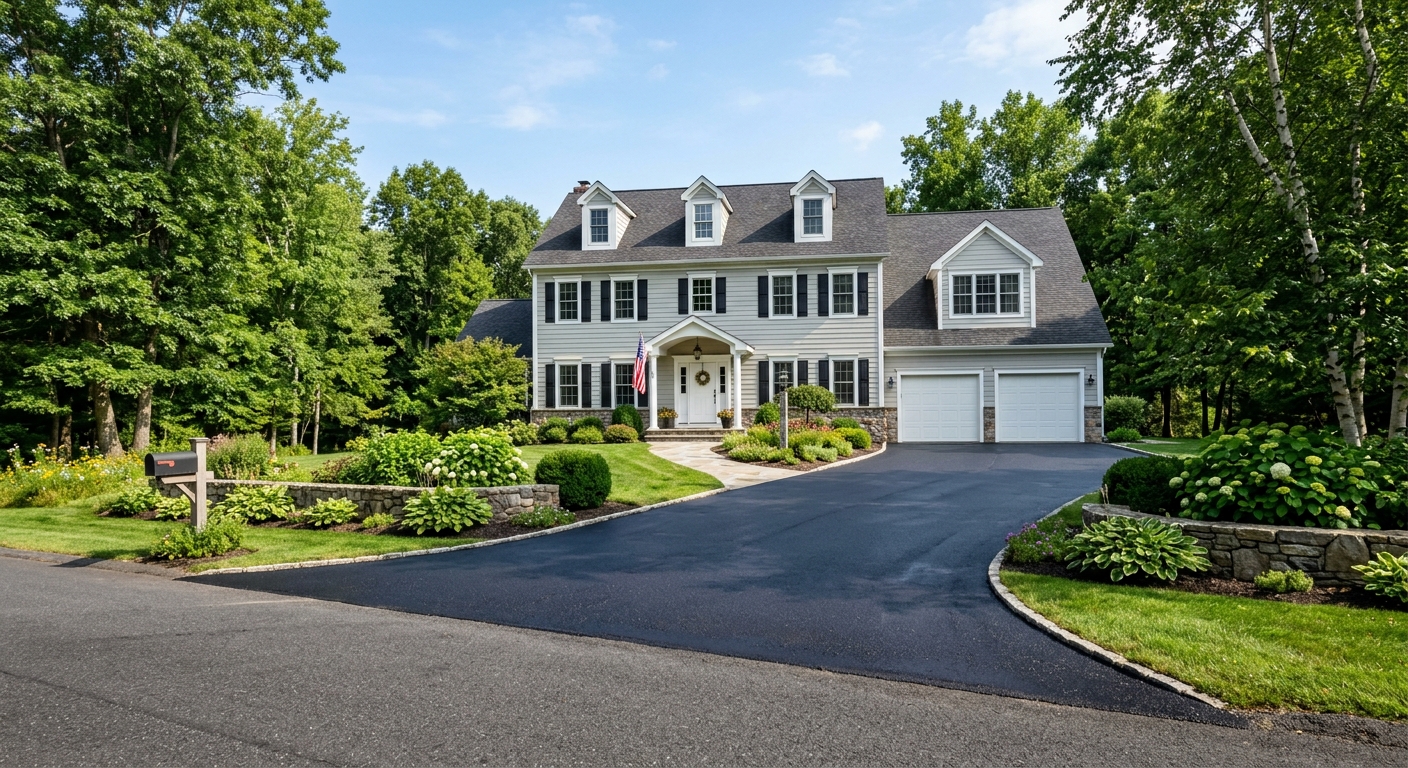
East Coventry paving prices by scope — 2026
In East Coventry, where 67.0% of homes are single-family and the homeownership rate stands at 81.5% (U.S. Census Bureau, ACS 2024), most residents are responsible for the upkeep, repair, or replacement of a private driveway. This is not a trivial expense—paving sits among the larger planned maintenance costs for a suburban homeowner. Southeastern Pennsylvania’s moderate freeze-thaw cycles and underlying limestone bedrock mean paving jobs here require careful preparation beneath the surface, which is usually what separates a cheap job from one that lasts.
The most significant driver of price between contractor quotes is what gets done to the base—the layers you never see again. Some bids are just for topping; others replace or rebuild failed sub-base materials, which costs more but may be truly necessary. Surface material does affect price, especially between asphalt and concrete, but if the base isn't right, neither will last. For that reason, the cheapest quote isn’t usually the best value, especially for driveways over older fills or on properties where water sits after rain.
| Service |
Best for |
Lifespan |
Price range |
| Asphalt — full replacement with new base |
failed base, structural cracking |
20–30 yrs |
$3,900–$10,000 |
| Asphalt overlay / resurfacing |
sound base, surface cracking only |
8–15 yrs |
$1,700–$5,100 |
| Sealcoating — single application |
preventive maintenance on sound asphalt |
2–4 yrs |
$225–$800 |
| Concrete — new installation |
long service life, low maintenance |
30–50 yrs |
$5,600–$13,500 |
| Crack filling and patching |
isolated cracks under a quarter inch |
1–3 yrs |
$200–$800 |
| Gravel driveway |
rural, budget, long runs |
5–10 yrs with upkeep |
$900–$3,500 |
Estimates for a typical East Coventry driveway. Square footage and base condition drive these figures more than material choice.
Driveway permits, approaches and stormwater rules
If you’re repaving a driveway in the same footprint on your East Coventry property, you’ll likely avoid a building permit, saving you a round of municipal paperwork and inspection. In Chester County, resurfacing a residential driveway that stays out of the public right-of-way usually does not trigger a driveway permit requirement. But the driveway approach—the section connecting your drive to a public road—is a different matter. For any changes at the approach, especially on state routes, you’ll need a Highway Occupancy permit from PennDOT Engineering District 6-0, rather than your township’s code office. This catches many homeowners off guard, as municipal and state jurisdictions overlap at your curb cut.
Expanding your driveway or adding impervious area can bring stormwater management into play. Even without a formal permit, redirecting runoff toward your neighbor, or into the right-of-way, makes you liable for resulting drainage problems. Be prepared for added engineering or grading work if your project increases runoff or alters flow direction.
Before signing a contract over $500, Pennsylvania law requires you to verify contractor registration. Check the Home Improvement Contractor (HIC) registration at hic.attorneygeneral.gov, and confirm workers' compensation coverage for any company with employees through the WCAIS system at wcais.pa.gov. Both steps protect you as a consumer and a homeowner.
Asphalt or concrete for a East Coventry driveway?
In southeastern Pennsylvania’s moderate freeze-thaw climate, the choice between asphalt and concrete matters because ground movement is unavoidable. Asphalt is flexible—when the limestone and dolomite subgrade heaves slightly each winter, asphalt moves with it, so it resists cracking. This is a major reason why most East Coventry driveways are asphalt. Concrete is more rigid and, if it survives the cycles, lasts several decades. But our region uses salt on pavement all winter, and concrete’s common failure mode here is surface spalling from salt exposure—especially on older mixes or when improper de-icing is used.
Concrete costs more to install—$5,600–$13,500 versus $3,900–$10,000 for a new asphalt driveway—but potentially lasts longer if well maintained and no salt is used. That last condition is hard to meet, and most homeowners do use salt after an ice storm. Concrete’s up-front cost is best justified when you’re committed to careful winter maintenance. Asphalt, by contrast, requires periodic sealcoating and crack filling, but forgives occasional neglect, especially given our climate’s moderate but real freeze-thaw stresses.
Pavers are an attractive option for looks and drainage, but come with a high price tag and require proper base preparation. Gravel may still be the right choice for long, rural drives, given our local supply of crushed stone and affordable installation.
| Option |
Installed cost |
Maintenance |
Freeze-thaw performance |
Lifespan |
| Asphalt — new install |
$3,900–$10,000 |
sealcoat every 3–4 yrs |
excellent, flexes |
20–30 yrs |
| Asphalt — overlay |
$1,700–$5,100 |
same |
good if base is sound |
+8–15 yrs |
| Concrete |
$5,600–$13,500 |
low, avoid de-icing salt |
fair, spalls with salt |
30–50 yrs |
| Pavers |
$9,000–$13,500 |
individual units replaceable |
good, settles gradually |
25–50 yrs |
| Gravel |
$900–$3,500 |
top-dress every 2–3 yrs |
excellent drainage |
indefinite with upkeep |
East Coventry's ground and what it means for paving
East Coventry, like much of central Chester County, sits on limestone and dolomite bedrock (karst). This subgrade demands attention. Limestone’s tendency to settle unevenly makes a strong, well-compacted aggregate base absolutely necessary; otherwise, reflective cracking and sinking will show up in a few years. Contractors familiar with this region usually specify a deeper base—crushed stone compacted in multiple lifts—compared to what might be done in a neighboring county on shale or glacial till. Skimping on base depth here is false economy and leads to failures that show up within a few freeze-thaw cycles.
The frost depth in southeastern Pennsylvania is about 30 inches, and our moderate freeze-thaw winters mean the ground cycles frequently enough to damage any poorly built drive. Add to that the fact that over half the housing stock (50.6%) was built before 1980 (U.S. Census Bureau, ACS 2024), and many existing driveways were laid with thinner bases or even directly on fill. For replacements or overlays in these older neighborhoods around Exton and West Goshen, full-depth base reconstruction is often necessary—not a sales pitch, but a local reality if you want longevity.
The honest case for and against sealcoating
Sealcoating is widely sold in East Coventry, and for good reason: it protects the asphalt binder from air and water, slows oxidation, shields against gasoline and oil drips, and brings back a clean, deep-black appearance. With typical jobs running $225–$800, it’s the lowest-cost curb appeal boost most homeowners buy.
But sealcoating is not a cure-all. It won’t fix structural issues, add strength, or stop major cracks. If your base is failing or if deep cracks already exist, sealing does little more than keep things tidy for another season. Worse, applying sealant too soon after paving, or reapplying annually, can trap volatiles beneath the surface or create buildup that eventually peels and cracks. A new driveway should cure for a full season before seeing its first coat, and reapplication should be every 3–4 years, not every year. That’s the rhythm that works in East Coventry’s climate, given our freeze-thaw cycles and summer humidity.
What really extends driveway life here is timely crack filling—stopping water from getting into the base, where freeze-thaw damage starts. A high-quality job means proper cleaning, filling, and squeegee application, not a thin sprayed-on coat. If a price is well below $225, expect a quick spray and short-lived results. Sealing has its place, but only as part of a thoughtful broader maintenance plan.
When paving can actually be done in East Coventry
Paving isn’t possible year-round in East Coventry due to our climate and the realities of the trade—this isn’t a matter of preference, but of physics. Hot-mix asphalt needs to be placed and compacted while well above freezing; if the temperature drops, the mix stiffens and can’t be compacted into a dense, durable surface. Local asphalt plants, including those near Downingtown and Coatesville, shut down in winter: once the ambient temperature drops below paving specs or the demand isn’t there, there’s simply no material available, no matter what a contractor may promise.
Concrete has similar constraints: it can’t cure properly in freezing conditions. The winter design temperature here is 14 °F, and though it rarely stays that cold for long, any real paving season runs from April through early November. Shoulder seasons—spring and fall—offer more contractor availability and sometimes lower prices. By mid-summer, when demand peaks, reputable crews are booked solid weeks out. If someone promises to pave your new drive in late November or early March, that's a red flag in southeastern Pennsylvania.
Most projects must fit between plant schedules, ground conditions, and the forecast. It’s best to plan ahead, get on a reputable company’s early-season calendar, and avoid anyone offering off-season discounts for work that simply cannot be done right.
What to put in a East Coventry paving contract
Most East Coventry homeowners shop on price, but for any paving job, what’s in the contract matters more than a few hundred dollars off the total. In our freeze-thaw climate, on limestone-dominated ground, the specification details are what make a driveway last. If a contractor says “we’ll put down three inches,” ask: “Three inches before or after compaction?” There’s a big difference. You want every material and depth identified, and the base build spelled out, since this is where the cheap jobs save (and fail).
Your written quote should specify what gets dug out, the exact aggregate type and depth (as compacted, not loose), the thickness of each asphalt or concrete layer after compaction, and the mix used. Edge treatment is particularly important—driveways with unreinforced edges in our region start to unravel in just a few years.
- Excavation depth and areas to be dug out
- Aggregate base material (e.g., 2A modified stone)
- Aggregate base depth (as compacted), usually 6–10 inches here
- Compaction method, and if base is placed in lifts
- Binder course thickness (compacted)
- Surface course thickness (compacted)
- Asphalt mix designation (e.g., 19mm base, 9.5mm surface)
- Edge treatment (e.g., topsoil flush, stone, or concrete)
- Joint and cold seam handling
- Grading to direct runoff away from structures
Requiring these in writing is your best defense in a dense, competitive market like Chester County’s.
Frequently asked questions — driveway paving in East Coventry
How do I verify a paving contractor in Pennsylvania?
In Pennsylvania, any drive paving contract over $500 requires the contractor to hold a Home Improvement Contractor (HIC) registration through the Office of Attorney General—this applies in East Coventry and all of Chester County. The process is simple: go to hic.attorneygeneral.gov and enter the company name or registration number. For companies with employees (not solo operators), you should also confirm active workers' compensation using the state’s WCAIS system at wcais.pa.gov. This verification protects you against both unregistered outfits and the risk of liability for jobsite injuries. For a typical paving job—whether you’re spending $3,900–$10,000 or just getting small repairs—you want documentation before work begins, not after there’s a problem.
What causes concrete to spall or flake in East Coventry?
Concrete spalls or flakes in East Coventry mainly because of de-icing salts used in winter. Our moderate freeze-thaw cycles put repeated stress on driveways; when salt melts ice and seeps into the concrete, it speeds up surface breakdown. This process—called scaling—starts with tiny pits, then flakes, and over time exposes aggregate. Older concrete mixes or improperly cured surfaces are most vulnerable, but even new concrete can suffer if salt is used in the first winter or if the finish traps water near the surface. The repairs for scaling are expensive and don’t restore the original look. With a replacement cost of $5,600–$13,500, preventing salt exposure is the best long-term move for local concrete driveways—use sand for traction and avoid chemical melters to maximize the surface life.
What is the difference between binder and surface course?
Every asphalt driveway in Pennsylvania—East Coventry included—should have at least two asphalt layers: a binder (base) course and a surface (top) course. Binder is coarser and thicker, laying the structural foundation of the drive. It provides strength and absorbs some of the movement from freeze-thaw cycles. Surface course is a finer mix that creates a smooth, weather-resistant finish. The binder is installed thicker (inches compacted), while the surface layer is thinner but crucial for sealing. Using the right mix for each layer, and getting the compaction right, has more impact on your driveway's durability than the total thickness alone. A proper full replacement, starting at $3,900–$10,000, will always specify both courses and their depths in writing.
How much does it cost to widen a driveway?
Widening a driveway in East Coventry depends on how much extra space you want, your driveway’s total size, and whether you’re expanding onto lawn or removing old pavement. If the work is simply cutting back turf and extending the existing drive with new pavement and a solid base, you’re likely looking at the same price per square foot as a new install: $3,900–$10,000 for full-depth asphalt replacement, or $1,700–$5,100 if your base is sound and an overlay is possible. Added engineering for grading or stormwater, especially near the property edge or right-of-way, may increase cost. Always check local requirements for permits, particularly at the street approach. Having a reputable contractor assess drainage and base prep will keep costs from ballooning due to preventable issues.
What does sealcoating cost in East Coventry?
Sealcoating a typical East Coventry driveway costs anywhere between $225–$800. The wide range comes from variations in driveway size, prep work, and whether any crack filling is included beforehand. Don’t be tempted by prices far below this—those jobs are usually quick spray-ons, with little or no cleaning, which peel or wash away within the year. A thorough job means power cleaning the surface, patching or filling cracks, and squeegee-spreading the sealant for an even coat. Expect to pay closer to the middle or upper end of the range for quality work that lasts two to four years. Frequent reapplication isn’t needed; every three to four years fits the local freeze-thaw cycle and keeps your driveway in good shape.
What kind of soil is under East Coventry driveways?
Most driveways in East Coventry rest on limestone or dolomite bedrock, with a top layer of crushed stone aggregate as the base. This limestone “karst” can settle unpredictably and is more prone to movement than harder shale or clay seen elsewhere in Pennsylvania. Because of these conditions, local contractors often specify a deeper, well-compacted aggregate base than you’d see one county over—usually six to ten inches of 2A modified stone. Skimping on the base in this region means the pavement settles, cracks, or develops potholes far faster, especially with the 30-inch frost depth and frequent freeze-thaw cycles we expect in Chester County. The right base is where local experience pays for itself.
How long before I can drive on a new asphalt driveway?
For a new asphalt driveway in East Coventry, you should wait at least 48 to 72 hours before driving on it, depending on summer temperatures and humidity. The first week is critical: the surface is still curing, and tight turns or stationary tires can permanently mark the driveway. If it's hot and humid, wait the full three days. Even after you start using it, avoid parking heavy vehicles in one spot for the first month. The waiting period applies whether you’ve done a full replacement ($3,900–$10,000) or a resurfacing ($1,700–$5,100). Following these timelines lets the asphalt set up and helps avoid early scuff marks and indentations—issues that will show for years to come.
Are pavers worth the cost in southeastern Pennsylvania?
Pavers bring a high-end look, good drainage, and individual repairability, but at a significant price: $9,000–$13,500 for most East Coventry driveways. Their main advantage is that they flex and settle gradually with ground movement, unlike poured concrete that cracks. That makes them well-suited to the limestone soils and freeze-thaw cycles we deal with in Chester County. Still, pavers require the same deep, well-compacted stone base as asphalt or concrete—if you skimp here, you’ll have dips and weeds. Maintenance means sweeping sand and the occasional reset of shifted units, but there are no blacktop stains or peeling sealant. For homeowners seeking longevity and curb appeal (and willing to budget for them), pavers are a legitimate investment in southeastern Pennsylvania.
How often should I sealcoat my driveway in East Coventry?
In East Coventry, with our moderate freeze-thaw, you should sealcoat your asphalt driveway every three to four years—not annually. Too-frequent sealing leads to surface buildup that can peel and crack. Wait until your driveway is fully cured—usually a full summer after installation—before the first sealcoat. Properly spaced applications protect against UV, oxidation, and oil, especially with the region's humid summers. The cost is reasonable: $225–$800 per application, depending on size. What truly matters is that cracks and edge breaks are filled before sealing. Sticking to the right interval, with prep and edge work included in the job, is what keeps your drive looking sharp and lasting through the Chester County seasons.