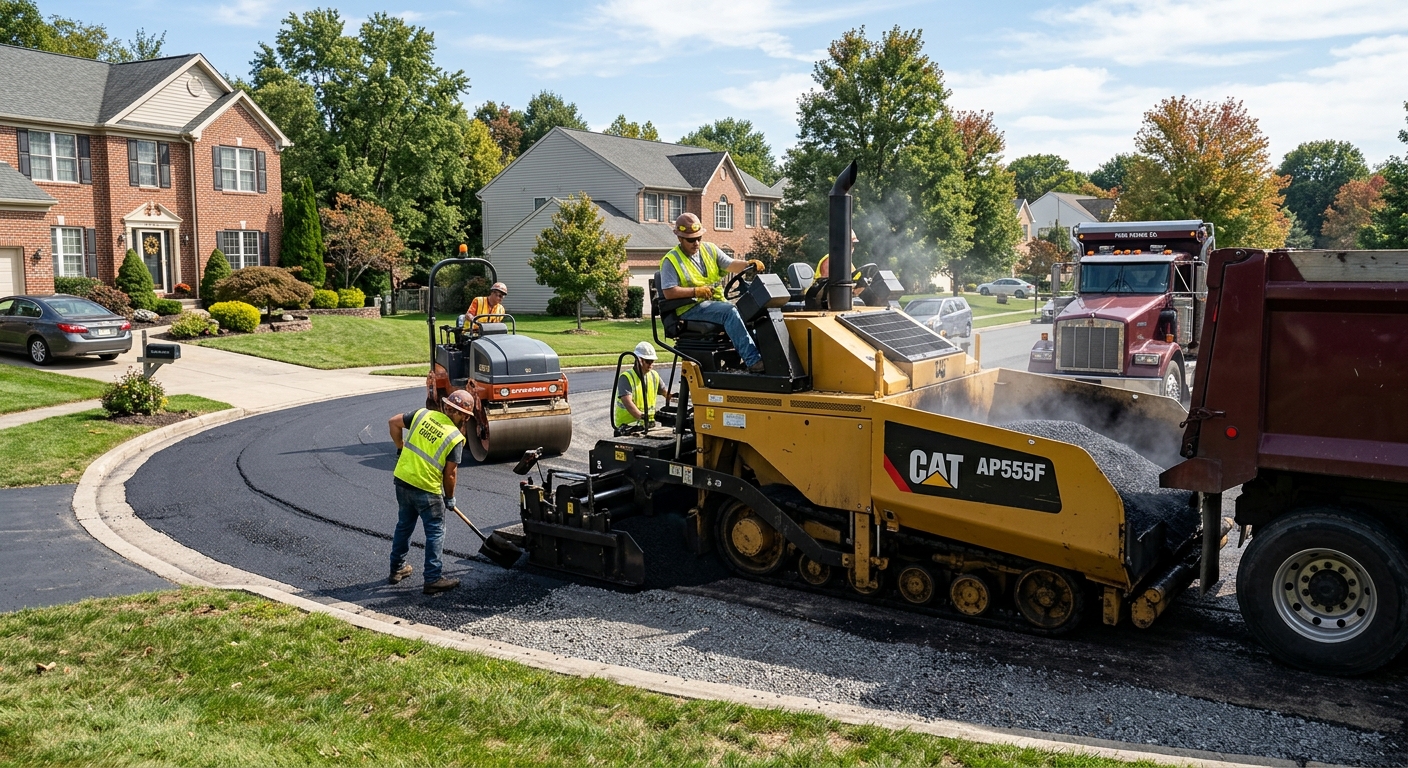
Driveway paving costs in Milford — 2026
Milford, set within Bucks County’s dense network of Levittown-era and newer single-family homes, is a place where a driveway isn’t just a parking spot—it’s one of the most visible (and widely shared) homeowner expenses. In this town, nearly 81.3% of houses are detached, and with a homeownership rate of 95.2% (U.S. Census Bureau, ACS 2024), driveway paving isn’t rare maintenance but a fact of life. Most costs here come from what you don’t see: the labor and materials for drainage, grading, and especially sub-base preparation under the surface. In southeastern Pennsylvania’s moderate freeze-thaw climate, with local subgrade conditions ranging from glacial till to silty clay, the depth and handling of your stone base is what sets apart a job that holds for 20 years from one that fails in five.
Contractors in the Bucks County market pull aggregate and hot asphalt from regional Delaware Valley plants, keeping haul distances modest but making the supply reliable enough that big price swings mean something is being cut—usually under the surface. No matter how uniform the street view, if one estimate is much lower than another, expect less base, thinner material, or undersized stone. Spend your money where it matters: soil prep and drainage, not decorative finishes.
| Service |
Best for |
Lifespan |
Price range |
| Asphalt — full replacement with new base |
failed base, structural cracking |
20–30 yrs |
$4,000–$10,500 |
| Asphalt overlay / resurfacing |
sound base, surface cracking only |
8–15 yrs |
$1,700–$5,200 |
| Sealcoating — single application |
preventive maintenance on sound asphalt |
2–4 yrs |
$225–$800 |
| Concrete — new installation |
long service life, low maintenance |
30–50 yrs |
$5,700–$14,000 |
| Crack filling and patching |
isolated cracks under a quarter inch |
1–3 yrs |
$200–$800 |
| Gravel driveway |
rural, budget, long runs |
5–10 yrs with upkeep |
$900–$3,500 |
Estimates for a typical Milford driveway. Square footage and base condition drive these figures more than material choice.
Drainage: the failure nobody plans for
Water destroys more driveways in Bucks County than any truck or snowplow. Proper grading has to be built in from the start, not treated as a last step. To shed water efficiently, driveways should have a minimum slope of at least 2% (about a quarter inch per foot) toward the street or towards a swale. Crowning the center so water runs off both sides works for wide, straight drives, while a cross-slope (one directional pitch) is used for tight or curving lots.
If your driveway slopes toward the garage or home, you are inviting water to settle near your foundation—never a good result in this region’s clay-rich soils. When you can’t achieve enough slope for gravity drainage, trench or channel drains across the drive at the point of entry are the next line of defense. These drains collect runoff and move it to daylight (where water exits to a visible, lower area) or a dry well (an underground basin). In Lower Bucks especially, heavy silty clay means sub-surface water builds up, so underdrains or thicker stone bases may be necessary—there’s no substitute for getting the water away from both house and driveway.
Freeze-thaw cycles compound the problem: trapped water in the base will freeze, expand, and heave the surface, causing premature cracking and potholes. Also remember, it’s your job as an owner to deal with your own runoff—a drive that dumps water onto the neighbor’s yard can put you on the hook for damages, permit or not.
Choosing a paving company
In Bucks County’s crowded market, picking the right paving contractor starts with non-negotiable checks. For driveways over $500, Pennsylvania requires every contractor to hold valid Home Improvement Contractor (HIC) registration from the Office of Attorney General—verify at hic.attorneygeneral.gov. If your contractor employs a crew, you can confirm their workers’ compensation coverage through WCAIS (wcais.pa.gov).
Local experience matters: expect a permanent business address (not just a mobile phone), owned equipment (not rentals), and references for driveways laid at least three years ago. Why? In this trade, a just-finished job tells you nothing—quality only shows up later, after the Bucks County freeze-thaw does its work. Ask who supplies their asphalt and aggregate—anyone who can’t name a Delaware Valley plant or quarry is not hands-on; they’re a paper broker.
- Confirm HIC registration for contracts over $500 (hic.attorneygeneral.gov)
- Verify workers’ compensation (wcais.pa.gov)
- Check for a permanent, local business address
- Insist on written contracts with clear, measurable scope
- Demand references from driveways at least three years old
- Ask if equipment is owned or rented—rented suggests instability
- Request supplier names for asphalt and aggregate
- Get proof of insurance, not just a certificate
- Require a line-itemed quote, not a bottom-line offer
- Check contract compliance with the right of cancellation by law
- Walk away from anyone who wants cash up front or only gives verbal bids
Red flags: out-of-state or unmarked trucks, mobile numbers only, “leftover asphalt” offers, unclear scope, or refusal to identify supplier. In Bucks County, these signs usually mean no warranty, no recourse—and no finished driveway worth the cost.
Asphalt or concrete for a Milford driveway?
Milford driveways bear the brunt of southeastern Pennsylvania’s freeze-thaw cycles and humid summers, which shape every material decision. Asphalt is flexible—it can move without breaking as the subgrade shifts through winter freezes and spring thaws. This ability to flex is why a well-built asphalt drive will outlast almost anything rigid in Bucks County; small surface cracks heal with sealcoating, and failures are gradual and repairable.
Concrete is rigid: it lasts much longer—30 to 50 years—but when it fails, it’s almost always from spalling or scaling, not cracking. The local use of de-icing salts, especially in snow years, causes surface breakdown in concrete far faster than most owners expect. If you can reliably avoid salt (which, honestly, almost no Milford homeowner does), concrete is a great option. If not, expect patch repairs or eventual full replacement. Up front, concrete costs more and needs a thicker, tightly compacted stone base given the region’s clay soils and frost depth.
Pavers and gravel have their place here too: pavers are attractive, drain well, and allow for easy spot repair, but cost approaches or even exceeds concrete for the same square footage. Gravel works for long or rural drives—with regular maintenance, it sheds water perfectly but does track and rut with use.
| Option |
Installed cost |
Maintenance |
Freeze-thaw performance |
Lifespan |
| Asphalt — new install |
$4,000–$10,500 |
sealcoat every 3–4 yrs |
excellent, flexes |
20–30 yrs |
| Asphalt — overlay |
$1,700–$5,200 |
same |
good if base is sound |
+8–15 yrs |
| Concrete |
$5,700–$14,000 |
low, avoid de-icing salt |
fair, spalls with salt |
30–50 yrs |
| Pavers |
$9,200–$14,000 |
individual units replaceable |
good, settles gradually |
25–50 yrs |
| Gravel |
$900–$3,500 |
top-dress every 2–3 yrs |
excellent drainage |
indefinite with upkeep |
Numbers, not adjectives
The only way to compare estimates in Bucks County’s driveway market is by numbers, not promises. Ask every bidder for written, measurable quantities—don’t accept “we use plenty of stone” or “three inches of blacktop.” Depths, materials, and compaction details all matter, especially in Milford’s freeze-thaw climate and with the heavy, often poorly draining subgrade near the Delaware.
A quote should spell out: how many inches will be excavated and hauled away; the depth and gradation of the new stone base; how and how many times that base is compacted (in lifts, with what equipment); the thickness of the asphalt binder (base) and surface (wear) courses—listed as compacted, not loose, since compaction often shrinks material by over a third; the asphalt mix designation; and the detail for driveway edges. Here, 6 inches of compacted stone and 3 to 3.5 inches of total compacted asphalt is ordinary—less is false economy, especially over clay.
“We’ll put down three inches” is meaningless unless it’s stated whether that’s before or after rolling, and whether it’s one lift or two. The difference could be half the lifespan of your driveway.
- Excavation depth (inches removed and disposed)
- Stone base depth and material (e.g., 2A modified, 6 inches compacted)
- Number and thickness of base compaction lifts
- Type of compaction equipment used
- Asphalt binder course thickness (compacted)
- Asphalt surface course thickness (compacted)
- Mix designation (e.g., ID-2 wearing, ID-2 base)
- Edge treatment (taper, shoulder, or concrete)
- Slope and drainage direction
- Warranty period and coverage terms
Door-knocking crews and leftover material
Every spring and summer, Bucks County gets its share of door-knockers with pitches like: “We have leftover asphalt from a job down the street and can cut you a deal,” or “We’re only in town today—act now.” They offer lowball prices, push for immediate cash payment, show you only a phone number and an unmarked pickup, and sometimes even spray a thin coat of oil—selling it as sealcoating—to make the drive look freshly paved.
These operators target places like Milford because the home density is lower and crews can operate under the radar. Even so, it’s easy to protect yourself with five minutes’ checking: the Home Improvement Consumer Protection Act requires a written contract for any job over $500 and guarantees you a three-business-day right of cancellation. Never waive your right to a written agreement; by law, you can cancel without penalty if anything seems off. Waiving your insurance deductible (as some crews offer) is illegal—don’t get talked into it.
Scammers avoid anything that ties them down: contracts, registration, real addresses, references. They vanish before the defects appear—which, on a thin or cold-laid driveway, is usually the next freeze-thaw cycle. Never pay cash up front; never accept today-only pricing; and never agree to work based on a verbal description or a “special deal.” Checking HIC registration and workers’ comp status are free and public.
Takeaways: Ask for HIC registration (hic.attorneygeneral.gov), verify insurance and comp, get a written contract, and take your three-day right to reconsider. Door-knockers run from paperwork—that’s your shield.
Permits and approvals for paving in Milford
If you’re just repaving your existing driveway in Milford—same footprint, same entry point—a building permit is usually not required in Bucks County. But changing the layout, widening, or replacing a failed base can trigger reviews, especially in Bensalem Township, where the Building and Planning Department handles driveway permits.
The one spot almost everyone overlooks is the driveway approach—the part that meets the street. For driveways joining a state route in Bucks County, a Highway Occupancy Permit comes from PennDOT District 6, not your local township. This is true even if you’re only paving the apron, not the whole drive.
If your plans add more impervious surface (making the drive bigger or wider), you may need to demonstrate how you’ll handle the extra runoff. Draining more water onto the street or a neighbor’s property is a liability, even if the township doesn’t object—water damage claims are your problem.
For contractors, make sure they carry valid Home Improvement Contractor registration (check at hic.attorneygeneral.gov) and, for any employer using a crew, verify current workers’ compensation status through WCAIS (wcais.pa.gov). These verifications are your first and best defense.
Frequently asked questions — driveway paving in Milford
How long does a driveway installation take?
For a typical Milford driveway, installation time comes down to size, weather, and preparation needed. A full asphalt replacement (including old driveway removal and new stone base) usually takes two to four days for most single-family homeowners. Most of that time isn’t spent paving, but waiting—specifically, letting the stone base and each asphalt layer compact and cure between stages. In Bucks County’s humid summers and variable spring weather, rain can lead to delays, as every surface must be dry before paving resumes. For a concrete driveway, add a day or two: after the pour, it should cure undisturbed for at least three full days before you drive on it. Smaller overlays or basic resurfacing jobs often finish in one day if the weather cooperates. Always check with your contractor for a firm schedule, and remember: faster isn't always better—it may mean corners are being cut. For reference, a full asphalt driveway replacement here costs $4,000–$10,500, but the process demands careful timing more than muscle.
How much does driveway paving cost in Milford?
In Milford, driveway paving costs vary based on size, base preparation, and the material you choose. A typical single-family asphalt driveway replacement runs $4,000–$10,500. Basic resurfacing or an overlay (if the base is still good) costs much less—usually $1,700–$5,200. Concrete comes at a higher initial price: $5,700–$14,000 is normal for a new installation. Square footage is the dominant factor, but the soil here—often heavy in clay and prone to poor drainage—means more prep work than many homeowners expect. Don’t be tempted by a rock-bottom price; most big cost differences are hidden beneath the surface, in stone depth or drainage that you’ll never see until trouble starts. Always ask for a detailed, written bid covering base work as well as paving thickness and drainage.
What is the difference between binder and surface course?
In Bucks County (and throughout Pennsylvania), driveways are built in layers for stability and resilience. The binder course is the thicker, rougher base layer of asphalt—laid first over the compacted stone—designed to provide most of the structural strength. The surface course (or wearing course) is the top, finer layer that you actually see and drive on. Binder provides strength and handles ground movement; the surface course adds smoothness and weather resistance. For a typical Milford install, a proper driveway might have 2–2.5 inches of compacted binder and 1–1.5 inches of compacted surface course. Anyone offering just a single layer usually means less lifespan—don’t accept it. Getting both layers, compacted to spec, is what makes an $4,000–$10,500 job last two or three decades in our freeze-thaw climate.
Does Milford have local asphalt plants?
While you won’t find an asphalt plant within Milford itself, Bucks County is surrounded by Delaware Valley plants and aggregate suppliers—many within a modest trucking distance. This means your paving contractor should have no trouble naming the plant or quarry where they get their hot mix or stone from. Haul distances here are short enough that asphalt arrives hot and ready to compact. If a paving crew can’t quickly tell you which plant supplies them, that’s a red flag—they may be using cold or leftover material, which dramatically reduces lifespan. Local supply is reflected in the stable price bands you see for driveways: $4,000–$10,500 for full asphalt replacement is standard, not subject to big shipping surcharges.
How do I verify a paving contractor in Pennsylvania?
In Pennsylvania, and especially in places like Milford, you have free access to both contractor and workers’ compensation registries. To check a paving company’s Home Improvement Contractor (HIC) registration, use the Pennsylvania Attorney General’s public site at hic.attorneygeneral.gov. If the business has employees (nearly all do for paving), search for active workers’ compensation coverage at wcais.pa.gov. This simple check weeds out most unqualified and fly-by-night outfits. Beyond paperwork, ask for references from jobs done at least three years ago—since driveway problems often take years to show up. A reputable crew will know their supplier and give you a detailed, written contract—including total price (expect $4,000–$10,500 for a new asphalt driveway). All these checks matter in Milford, where visible work and neighborhood word-of-mouth shape who lasts in the market.
Can I pave over my existing driveway?
Sometimes. If your Milford driveway’s base is sound—meaning no soft spots, major cracks, or drainage issues—you can often do an asphalt overlay. This process adds a fresh wear layer over what’s there, at a lower cost ($1,700–$5,200) and less disruption. However, overlays only work if underlying problems are minor. If your base is failing, or the surface is alligator-cracked, the new asphalt will crack and fail along with it—fast. Overlaying over root heaves or settled sections only hides a problem until it resurfaces, and can worsen drainage by raising elevation. Never accept an overlay where a full replacement ($4,000–$10,500) is needed. Always ask the contractor to prove, with a core or test spot, that your base is up to par before signing on.
Is sealcoating a scam?
Properly done, sealcoating is real preventive maintenance on Milford driveways—it keeps water and UV out and can extend the lifespan of sound asphalt. The real scam is spray crews selling it as permanent resurfacing, or using cheap oil-based sprays that do nothing for durability. For a typical drive, a quality single coat costs $225–$800 and lasts two to four years. Sealcoating works as a supplement, not a substitute for real repairs. If a crew tells you sealcoating will “fix” cracks or structural flaws, walk away; it won’t. Only use sealcoating on a driveway in generally good shape, and insist on a proper brush or squeegee application, not a two-minute spray. In Milford’s market, you get what you pay for: bargain-basement sealcoating is often worse than nothing, as it hides problems you should be fixing.
Is gravel a cheaper option in Milford?
For many rural or extra-long driveways in Milford, gravel is the lowest up-front cost: an install runs $900–$3,500 depending on length and thickness. Gravel is also forgiving—you can regrade it as needed, drain water easily, and patch soft spots inexpensively. Some Bucks County soils (especially silty clay) do well with gravel, provided you keep up with annual or semi-annual dressing and keep runoff channeled. Downsides: you need to maintain ruts, control weeds, and sweep stray stones. It’s not as neat or clean as asphalt or concrete, but if you’re outside dense neighborhoods, or have a long private lane, gravel is the solution with the least up-front investment. Just go in knowing maintenance is ongoing.
Why are my driveway edges crumbling?
Driveway edge failure is a persistent issue in Milford, mainly tied to improper base prep and site drainage. In our climate, where freeze-thaw cycles put pressure on every joint, edges with thin or no base underneath have nothing to resist the pounding from tires—or from water that seeps in and freezes, pushing the asphalt or concrete out. Often, the original install skimps on stone beyond the visible width, leaving a sharp drop-off where cracks start. Bucks County’s heavy, silty clay amplifies this: water sits against the base, freezes, and the edge crumbles away. The fix is labor, not patch: you need a 6- to 12-inch shoulder of stone base under the edge, ideally finished flush or feathered into the lawn. For spot repairs, expect $200–$800. Anything less is a temporary Band-Aid in our soil and weather.