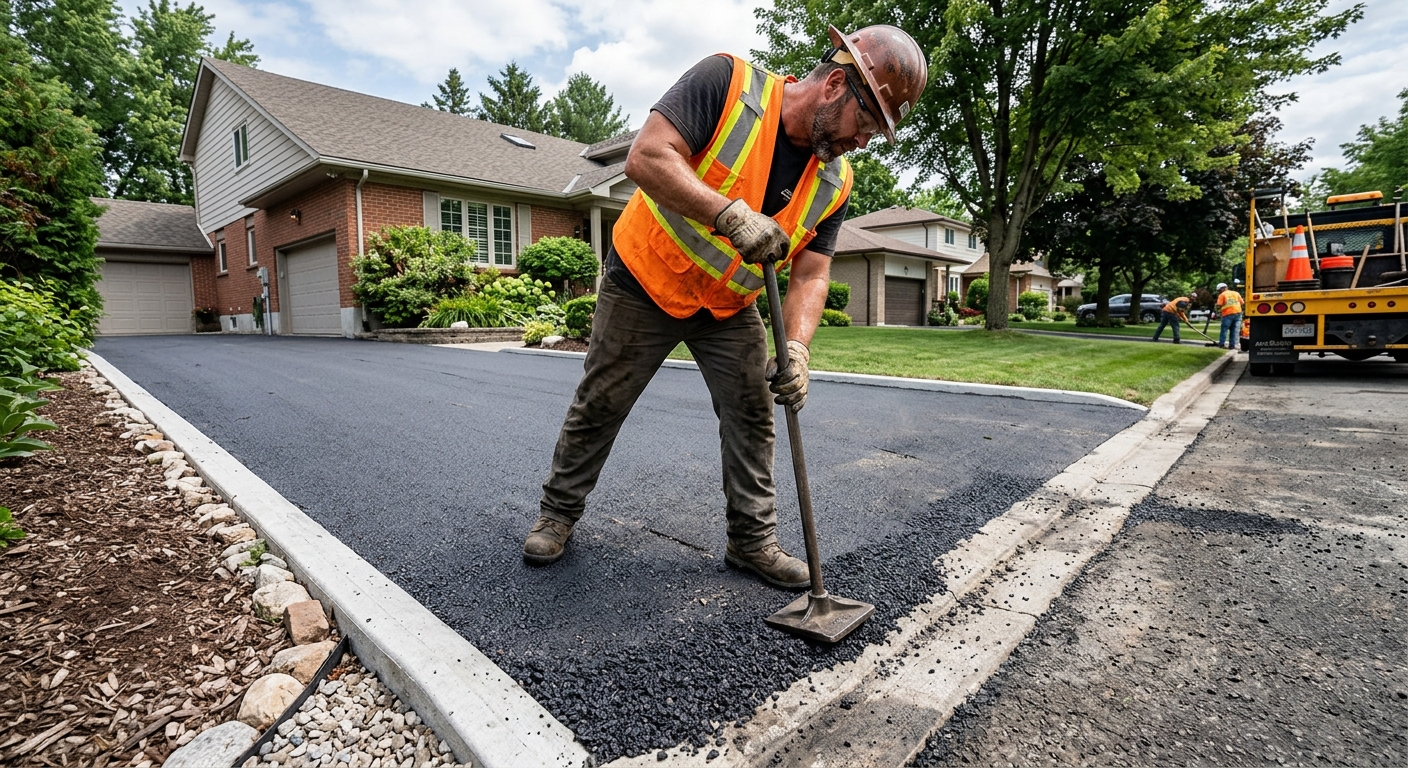
Longswamp paving prices by scope — 2026
In Longswamp, where 70.8% of homes are single-family and the homeownership rate tops 78.9% (U.S. Census Bureau, ACS 2024), driveway paving is a common, necessary investment. Most driveways here were poured or laid between 1950 and 1980, and many are now showing their age. If you’re budgeting for new pavement or repairs, understand that the true cost driver isn’t the material or the width you see from the street—it’s the work beneath the surface and how well the existing base deals with Berks County’s freeze-thaw cycles.
In eastern Berks, many driveways rest on a subgrade of shale and limestone, which means your project often calls for a thicker aggregate base than in areas with deeper topsoil. While the material—be it asphalt, concrete, or gravel—affects the appearance and some maintenance, most of the price difference between two contractor quotes comes down to unseen details: base preparation, excavation depth, proper compaction, and drainage corrections.
| Service |
Best for |
Lifespan |
Price range |
| Asphalt — full replacement with new base |
failed base, structural cracking |
20–30 yrs |
$3,500–$8,900 |
| Asphalt overlay / resurfacing |
sound base, surface cracking only |
8–15 yrs |
$1,500–$4,500 |
| Sealcoating — single application |
preventive maintenance on sound asphalt |
2–4 yrs |
$200–$700 |
| Concrete — new installation |
long service life, low maintenance |
30–50 yrs |
$5,000–$12,000 |
| Crack filling and patching |
isolated cracks under a quarter inch |
1–3 yrs |
$200–$800 |
| Gravel driveway |
rural, budget, long runs |
5–10 yrs with upkeep |
$900–$3,500 |
Estimates for a typical Longswamp driveway. Square footage and base condition drive these figures more than material choice.
Permits and approvals for paving in Longswamp
If you’re repaving an existing asphalt driveway in Longswamp without expanding its footprint, you can usually proceed without a building permit. Berks County townships generally treat this as maintenance, not new construction, saving you paperwork. What many homeowners overlook is the approach—the connection where your driveway meets the public road. For driveways that tie into a state route, the permit comes from PennDOT, not the township, and they review for sight lines, drainage, and surface material. On local township roads, apron or approach permits are usually handled by the township office itself.
If you’re thinking about widening your driveway or adding extra parking, you might trigger stormwater requirements. Adding impervious area increases runoff, and local rules may require you to manage stormwater on-site. Regardless of permits, you can be held liable if your new driveway sends water onto a neighbor’s property or public right-of-way—so plan grading and runoff routing carefully from the start.
For any contract over $500, Pennsylvania law requires your contractor be registered with the Office of Attorney General under the Home Improvement Contractor (HIC) program. You can verify at hic.attorneygeneral.gov. If the paving crew is not a sole proprietor, the business must carry workers’ compensation insurance (check via WCAIS at wcais.pa.gov). Get written confirmation before work begins; reputable local operators won’t mind providing proof.
Widening, extending or adding a parking pad
When you’re ready to widen your Longswamp driveway for a second vehicle, extend it back to a detached garage, add a turnaround, or pave a gravel lane, the project becomes more involved. Any expansion that increases the footprint means you’re working with undisturbed subgrade rather than the packed gravel beneath your old drive. That new area requires excavation, fresh base stone, and careful compaction; otherwise, settlement and surface cracking will form at the seam between old and new.
Adding pavement may also run up against local impervious surface limits. If the new work will significantly increase hard surface or involve notable grading (over 5,000 square feet or a substantial change in runoff), Berks County townships may require permit review for stormwater. Make sure your layout respects side and rear setbacks; every township in Berks has its own rules restricting how close you can pave to a property line or utility easement.
Don’t forget the approach—if your new driveway meets a PennDOT-maintained highway, you’ll need a Highway Occupancy Permit. For township roads, check with your local office before breaking ground to avoid issues later.
Diagnosing a failing Longswamp driveway
Driveway troubles in Longswamp are almost always about what’s happening below the surface. With so many local driveways dating back decades, understanding base condition is what separates a lasting fix from a short-term patch. Before you call anyone, walk your drive and look for these signs—because a contractor benefits from steering you to replacement or patching regardless of your real need.
Alligator cracking (those interconnected cracks that look like reptile skin) in wide areas means your base is shot. No amount of overlay will fix this long-term; the underlying problem will reflect through. By contrast, if you see isolated linear cracks, that’s usually surface aging—a good candidate for crack filling and sealcoating. Depressions and standing water (“birdbaths”) are subgrade issues, possibly due to poor compaction or unstable underlying soils. Edge crumbling means your driveway wasn’t properly supported at the margins, which is a common result of cost-cutting during the initial build. Potholes mean water is getting into the base layer, speeding up failure.
If a contractor proposes an overlay without probing the base for softness, voids, or moisture, they’re setting you up for a short-lived result—in this climate, that’s money burned. Insist that the assessment includes core sampling or at least digging down with a spade at troubled spots.
| What you see |
Likely cause |
Right fix |
Cost |
| Isolated cracks under 1/4 inch |
surface aging |
crack fill and seal |
$200–$700 |
| Alligator cracking over a wide area |
base failure |
full replacement |
$3,500–$8,900 |
| Depressions holding water |
subgrade movement |
excavate and rebuild that area |
$3,500–$5,500 |
| Crumbling edges |
no edge support |
edge repair, consider curbing |
$400–$1,500 |
| Potholes |
water into the base |
full-depth patch, then assess |
$250–$900 |
| Faded but sound surface |
oxidation only |
sealcoat |
$200–$700 |
The specifications to demand in writing
In the Longswamp market, you protect your driveway dollars by becoming a specification shopper, not a bargain hunter. Contractors may say, “We’ll put down three inches,” but that’s ambiguous. Three inches when? Uncompacted or after the roller is finished? There’s a big difference, especially when repeated freeze-thaw cycles and challenging local soils (often shale and limestone) require robust construction. A strong driveway here often needs more base depth than you’d see in warmer, drier states.
Your quote should spell out specific numbers for each stage—excavation down to what depth, how much aggregate base (and what type), compaction method, and separate depths for the binder and surface courses of asphalt after compaction. ‘As laid’ thickness can shrink by over a third after rolling. The mix being used (not just “hot mix”) and how edges are finished also change how long your driveway will last and how soon problems might show up.
- Excavation depth: how deep to subgrade, in inches
- Aggregate base: thickness (compacted), type (e.g., 2A modified stone)
- Base compaction: method (roller or plate), compaction in lifts
- Binder course: thickness after compaction, in inches
- Surface course: thickness after compaction, in inches
- Asphalt mix designation (e.g., ID-2, 9.5mm, 19mm)
- Edge treatment: straight cut, shoulder stone, or curb
- Drainage: finished grade and water flow direction
- Joint/seam treatment (if abutting existing work)
- Cleanup and lawn restoration details
Reading a driveway proposal
A detailed proposal is your most effective tool for holding your contractor accountable. Don’t settle for a one-line quote with just a total: you need the measured square footage, excavation depth (and confirmation that haul-off is included), base material and thickness, compaction details, and layer-by-layer asphalt specs with compacted thickness. Edge treatment, grading, and full cleanup should be spelled out, not assumed.
Drainage language matters—does the quote note which direction runoff will go? What steps will correct low spots or road pitch? Payment schedules in Berks County are rarely more than a small deposit with the remainder due on completion. Most warranties on driveway jobs are narrow; they often exclude the very things likely to go wrong, like base cracking. Get those exclusions in writing.
If a proposal skips these details, you can’t compare it to anything and the door is open for shortcuts that you won’t notice until the first winter. This is the single most common way Longswamp homeowners overpay for underbuilt work.
| Line item |
What to look for |
Red flag if… |
| Area |
measured square footage stated |
eyeballed or absent |
| Excavation |
depth and disposal included |
'we'll pave over it' |
| Base |
aggregate type and depth in inches |
'proper base' |
| Compaction |
method, and done in lifts |
not mentioned |
| Asphalt |
courses and compacted depth |
'3 inches' unqualified |
| Drainage |
slope and water direction stated |
silent |
| Warranty |
what is covered and what is excluded |
verbal only |
| Payment |
modest deposit, balance on completion |
full cash up front |
Drainage: the failure nobody plans for
Water doesn’t just shorten the life of a driveway in Longswamp—it devastates it. Grading for proper drainage isn’t simply a finishing touch, but a fundamental build requirement. Every drive needs a minimum slope—typically at least 2% (about a quarter inch per foot)—to move rain off the surface, preventing ponding that soaks into the base. On straight runs, a slight crown in the middle or a consistent cross-slope ensures runoff stays off the surface.
If your drive slopes toward your garage, house, or any building, you risk long-term foundation and water intrusion problems. When regrading is impossible, trench drains or channel drains at the low end can intercept water, but these are only as good as their outlet—make sure they discharge away from structures and don’t just dump water at your neighbor’s property line. “Daylighting” (outletting water to open ground) is preferred, but sometimes a dry well is needed for infiltration.
Freeze-thaw cycles in Berks County’s climate amplify all these issues. Water that seeps into the base freezes, expands, and heaves the pavement—then leaves voids behind after thawing, making cracks and potholes worse every winter. With the local shale and limestone subgrade, water also travels laterally, aggravating edge cracks and settlement if the base is undersized or poorly drained.
Redirecting water onto neighboring property is a liability, whether or not your permit addresses it. Good drainage is your best insurance for a long-lasting surface in Longswamp.
Frequently asked questions — driveway paving in Longswamp
What are the signs of a failing driveway base?
The main indicators of a failing base in Longswamp are alligator cracking (widespread, interconnected cracks), deep depressions that hold water after rain, and recurring potholes, especially if they reappear after patching. Edge crumbling often hints at poor base or lack of support at the margins. In Berks County’s climate, where freeze-thaw cycles are intense, these issues quickly worsen if left unaddressed. If you notice your driveway flexing underfoot or feel soft spots when parking a car, the base has likely lost its structural support. Surface-only issues like isolated thin cracks or fading are less urgent and can be treated with crack filling or a sealcoat, which usually ranges from $200–$700 for a basic driveway. For base failure, a full dig-out is the only lasting fix.
Do I need a permit to repave a driveway in Longswamp?
In most cases, simply resurfacing or replacing your asphalt driveway in Longswamp, as long as you do not expand the footprint, does not require a township building permit. This is consistent across Berks County townships, so you can usually skip a call to the office for a straight replacement. However, the tie-in at the road—known as the approach—does require a permit. If your driveway connects to a state road, PennDOT reviews and issues those permits; for local roads, check with your township. Expansion or additional hard surface might trigger additional review if you’re altering drainage. Always get written confirmation from your township before starting an expansion, as rule changes sometimes occur. An asphalt replacement typically ranges from $3,500–$8,900 depending on size and base work needed.
Can asphalt be laid in cold weather?
In Longswamp, laying hot-mix asphalt is a seasonal job. For quality results, most paving contractors shut down new installations when overnight lows regularly fall below 40°F—usually November to March. Cooler temperatures cause the mix to cool and harden before it can be properly compacted, resulting in poor bonding and future cracks. While patching or emergency work is sometimes done during cold snaps, full driveways should wait for warmer weather. If a contractor offers you a cut-rate job off-season, know what you’re risking. Delaying until spring gives you the best long-term value. A properly installed asphalt drive will last 20–30 years here (with replacement costs running $3,500–$8,900), while winter work often lasts half as long.
How much does driveway paving cost in Longswamp?
For most Longswamp homeowners, a typical driveway tear-out and replacement with asphalt—including new base—runs between $3,500–$8,900. Simple overlays (where the base is still sound) are lower, between $1,500–$4,500. If you’re considering a new concrete driveway, expect $5,000–$12,000, depending on size and decorative elements. Smaller repairs such as crack filling or sealcoating run from $200–$800. Actual price depends mainly on square footage, thickness of new base required, access for equipment, and surprises below the surface. While gravel installations remain an option for longer rural runs, most single-family homes choose either asphalt or concrete because of appearance and maintenance needs.
Does sealcoating fix cracks?
In Longswamp, sealcoating is meant to protect an asphalt surface from UV damage and water intrusion, not to structurally repair cracks. Very fine, hairline cracks (under 1/8 inch) may get filled and hidden with a sealcoat, but anything wider requires dedicated crack filling before sealing. Sealcoating alone won’t stop water from reaching and damaging the driveway base in our freeze-thaw climate. If you have widespread cracks or areas where gravel is visible, you’re well past what sealcoating can solve. As preventive maintenance on a stable surface, sealcoating generally costs $200–$700 per application in Longswamp. For proper repairs, ask your contractor if they plan to use hot-pour rubber for cracks and only sealcoat after cracks are treated.
Are door-to-door pavers a problem in Longswamp?
Yes, and it’s not unique to Longswamp—they show up every spring across Berks County pushing “extra” asphalt for a bargain price. These operators rarely have a registered Home Improvement Contractor (HIC) number or workers’ comp coverage, which is required for any legal paving contract over $500 in Pennsylvania. Their work is notorious for skipping base preparation, poorly compacting the asphalt, and leaving no warranty—if you even get a receipt. Many local homeowners called in the following season for patching jobs on drives paved by traveling crews. A full driveway replacement should range $3,500–$8,900 here; if someone offers to “seal” or “coat” your drive for a few hundred dollars without registration, move on. Always verify credentials at hic.attorneygeneral.gov before hiring for significant work.
Can I pave over my existing driveway?
In certain cases, yes. If your current asphalt driveway in Longswamp has only surface-level aging and the base is stable (no wide cracks, depressions, or potholes), an asphalt overlay is a cost-effective repair. This process, ranging $1,500–$4,500, involves cleaning the old surface, filling cracks, and applying new hot-mix asphalt over top. However, if you pave over a failing base—signaled by widespread alligator cracks or soft spots—the overlay will break up within a few seasons. In our freeze-thaw climate, hidden base issues come through even faster. Always insist on a base assessment before overlay is quoted, or you’re throwing good money after bad.
Why are paving quotes in Longswamp so different from each other?
The price swing for the same visible work can be significant in Longswamp and Berks County because the most expensive part—base preparation and thickness—is out of sight to the homeowner but makes or breaks the longevity of the drive. Some quotes use minimal base or skip proper compaction to reach a low number, leaving you with a surface that won’t hold up to freeze-thaw cycles. Others may include thorough excavation, correct lift depths, and drainage correction, justifying a higher price. Always compare written specs: for a standard replacement here, expect to see $3,500–$8,900 as a range. Don’t judge by price alone—ask about the details under the top layer, and avoid one-page contracts with few specifics.
What does compaction in lifts mean?
Compaction in lifts is a crucial step in driveway construction in Longswamp’s climate. Instead of dumping and rolling all the aggregate base or asphalt in one go, the material is placed in layers—usually two to four inches thick—and each layer (“lift”) is compacted separately by heavy rollers or compactors. This prevents hidden voids, weak spots, and future settlement. Given our freeze-thaw cycles and limestone/shale subgrade, compacting in lifts ensures the base can shed water efficiently and remain stable for decades. If you see “compaction in lifts” (rather than “compacted after placement”) on your quote, that’s a good sign. For a typical replacement, count on $3,500–$8,900 depending on scope; shortcuts here can double your cost later in repairs.