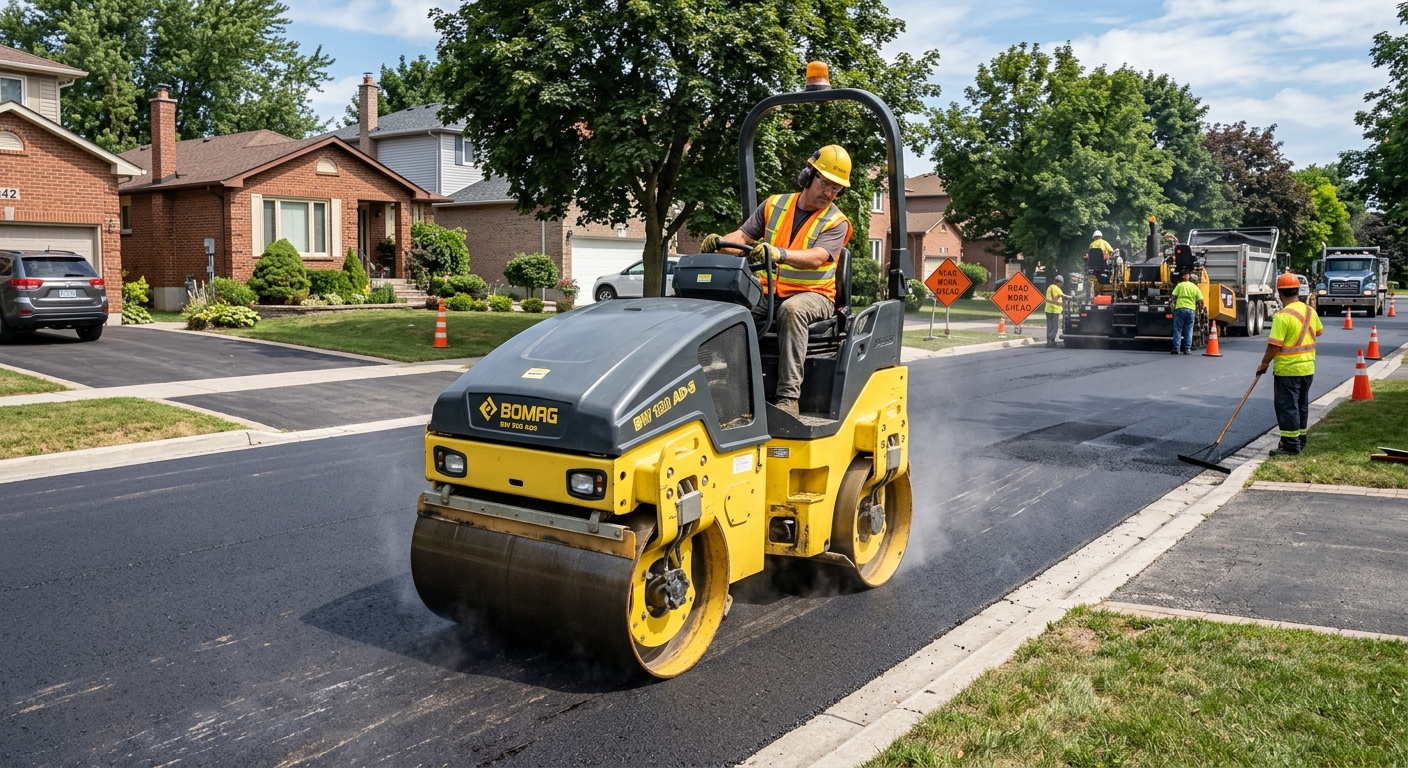
Greenville paving prices by scope — 2026
In Greenville, driveway work is a fact of life for homeowners—73.0% of the housing stock is single-family and most owners (57.2%) are responsible for their own maintenance. Our severe freeze-thaw cycles and glacial till subgrade make this a region where paving isn’t just surface work: what’s under the driveway is just as important as what you see. Local prices for driveway paving in 2026 reflect this, with most of the difference between quotes hidden in the unseen layers below.
The majority of Greenville driveways were built well before 1980, which means most have original base materials, old curb lines, and drainage problems that resurface with time. Short-term fixes often do not last here. Haul distance from local suppliers in Greenville or Sharon keeps delivery within range, but the real price driver is whether the contractor addresses base prep, thickness, and grading—not just the surface material.
Below is a table comparing cost bands for common driveway projects around Greenville, along with when each is appropriate and their typical lifespan. The key takeaway: talk specifics about the layers beneath before signing for any work.
| Service |
Best for |
Lifespan |
Price range |
| Asphalt — full replacement with new base |
failed base, structural cracking |
20–30 yrs |
$3,200–$8,100 |
| Asphalt overlay / resurfacing |
sound base, surface cracking only |
8–15 yrs |
$1,350–$4,100 |
| Sealcoating — single application |
preventive maintenance on sound asphalt |
2–4 yrs |
$175–$650 |
| Concrete — new installation |
long service life, low maintenance |
30–50 yrs |
$4,500–$11,000 |
| Crack filling and patching |
isolated cracks under a quarter inch |
1–3 yrs |
$200–$800 |
| Gravel driveway |
rural, budget, long runs |
5–10 yrs with upkeep |
$900–$3,500 |
Estimates for a typical Greenville driveway. Square footage and base condition drive these figures more than material choice.
Grading and water management on a Greenville driveway
Managing water is the most important—and most often overlooked—part of any driveway project in Greenville. A driveway needs a minimum slope of 2% (about a quarter inch per foot) to keep water moving off the surface before it can pool, seep into the base, and cause frost heave. In most cases, a gentle crown in the center or a cross-slope away from buildings does the job, but if your driveway slopes toward your garage or home, the risk is high: meltwater and rain will always find their way toward the warmest, lowest spot.
Northwestern Pennsylvania gets extreme seasonal snowfall and freeze-thaw stresses. If water lingers, it penetrates below the asphalt or concrete, then expands as it freezes, slowly prying the base and surface apart with each cycle. Our local glacial till subgrade can be heavy and clay-rich, which means poor drainage unless you shape and compact the base deliberately and channel water away.
Where slope corrections aren’t practical, trench or channel drains can be set into the driveway to capture surface runoff before it reaches the garage or foundation. These drains need to discharge somewhere—either daylighted to a safe lower spot on your property or, if that’s not possible, into a dry well. One thing the permit can’t fix: whatever you do, don’t send your runoff toward a neighbor, since that puts you on the hook even if you followed the paperwork.
Numbers, not adjectives
When choosing a paving contractor in Greenville, focus on numbers—never on adjectives like “thick” or “solid.” The only defense a homeowner has is to demand the details, in inches and pounds, not promises. A typical quote that just says “three inches of asphalt” is missing half the story: was that three inches after compaction or before? Was it all binder, all surface, or both? Was the base replaced or just patched? In our climate, northwestern Pennsylvania’s frost reaches down 36 inches and the snow load is 45 psf—much more demanding than milder areas. Those numbers mean your driveway needs more, not less, when it comes to base support.
Demand to see these numbers in writing—don’t settle for less. The job isn’t just an asphalt mat, but an assembly of compacted layers, each one doing its share to keep the driveway stable through freeze-thaw and heavy use. Here’s what to see, itemized in your contract or quote:
- Total excavation depth (inches below finished grade)
- Aggregate base thickness (inches, compacted in lifts)
- Type of base stone (e.g., PennDOT 2A, clean or with fines)
- Proof of base compaction (pass/fail, by load or density test)
- Binder asphalt layer thickness, compacted (inches)
- Surface asphalt layer thickness, compacted (inches)
- Asphalt mix designation (by state or supplier spec)
- Edge restraint details (hand-tamped, curb, or stone edge)
- Final surface slope and drainage direction (in % or inches/foot)
- Joint treatment at street and sidewalk (hot seam, cold joint, sawcut)
Maintenance that actually works
The best way to extend your driveway’s life in Greenville is to act early and keep water out. Crack filling—done in the first season you see any cracks—costs little and buys years by keeping water away from the base. Keeping the driveway edges supported, by backfilling with gravel and not letting soil erode, matters more than most realize. Make sure water still runs off as intended, and clear leaves, dirt, or debris that can dam up the surface or edges. Avoid parking dumpsters or setting jack stands directly on the driveway, as point loads will sink and crack even new surfaces, especially right after installation.
Fresh asphalt should cure for 3–7 days in Greenville’s normal mid-summer weather before you park on it. Turning wheels while stationary—especially during the first two months—can scuff or tear the surface.
For de-icing, salt is a risk: on concrete it can cause spalling and surface damage, while on asphalt the bigger threat is freeze-melt cycles accelerating cracks. Calcium chloride or magnesium chloride pellets are safer for both surfaces but cost more than plain rock salt. In an average snowy Greenville winter, sand or traction grit is often a better option on both surfaces—cheap, safe, and easy to sweep up when spring returns.
Overlay, patch or full replacement?
When deciding how to address an aging driveway in Greenville, you need to figure out whether the problem is on the surface or deeper down. You don’t need an engineer to do a first pass—just inspect carefully. If you see large areas of interconnected cracks resembling alligator skin, the base has failed and a full replacement is required. A contractor who quotes an overlay here is setting you up for a surface that looks nice the first year, then returns to the same problem, only with your money lost in the process.
Isolated, straight cracks usually mean just the surface is aging—these can be filled and sealed. Depressions or birdbaths that hold water point to movement in the base or subgrade, which needs excavation and rebuilding in that area, not just patching. Crumbling along the edges is almost always due to lack of support; it’s best fixed by rebuilding those edges, possibly with added curbing. Potholes mean water has gotten into the base and caused it to sink—patching can help, but you’ll want an honest assessment of what’s happening beneath. If the asphalt just looks dull or faded but is still intact, a sealcoat refresh is reasonable.
| What you see |
Likely cause |
Right fix |
Cost |
| Isolated cracks under 1/4 inch |
surface aging |
crack fill and seal |
$175–$650 |
| Alligator cracking over a wide area |
base failure |
full replacement |
$3,200–$8,100 |
| Depressions holding water |
subgrade movement |
excavate and rebuild that area |
$3,200–$5,000 |
| Crumbling edges |
no edge support |
edge repair, consider curbing |
$400–$1,500 |
| Potholes |
water into the base |
full-depth patch, then assess |
$250–$900 |
| Faded but sound surface |
oxidation only |
sealcoat |
$175–$650 |
Why Greenville driveways fail from the bottom up
Every driveway in Greenville is only as good as what lies beneath it. Here, success is measured in layers: the subgrade (native soil), the aggregate base, and then the asphalt or concrete surface. Our local glacial till subgrade is often clay-rich, holding water and draining slowly—bad news during our endless freeze-thaw cycles. If water sits in the subgrade and freezes, it expands and heaves the pavement, cracking it from below and breaking the surface bond. Frost depth here reaches 36 inches, so any shallow, unprepped driveway base is a ticking clock.
A healthy driveway starts with excavation down to stable soil, followed by at least 6 to 8 inches of compacted aggregate base stone for asphalt (more for concrete or under heavy vehicles), built up in two or three lifts with each compacted separately. The aggregate should be locally-sourced, well-graded (often PennDOT 2A); packing clean stone in thin, wetted layers is worth every hour spent. Asphalt goes down in a binder course, then a surface course, both compacted in place.
Where a quote gets cheap in Greenville is always underground: skipping excavation, laying new asphalt over a failed or wet base, skimping on aggregate depth, failing to compact each lift, or walking away without a compaction test. None of this is visible on day one, but by year three you’ll have soft spots, cracks, and a driveway that looks much older than its paperwork. You should require, in writing, a specified base depth (in inches), type of aggregate, and a statement that compaction was performed in lifts.
Driveway permits, approaches and stormwater rules
In most of Mercer County, including Greenville, you do not need a building permit just to repave a driveway within its existing footprint. For expansions, check with your specific municipality—Hermitage is the exception where a permit is triggered by new or expanded paving tied to site work. If your project includes replacing or altering the driveway approach—the portion that connects your driveway to the public roadway—this is a separate permit, and not from your town; PennDOT District 1-0 issues the highway occupancy driveway approach permit for state roads.
If you expand your driveway or add new pavement, remember that increasing impervious surface can mean you are responsible for managing stormwater runoff. Even if your permit is approved, local liability remains: you cannot legally redirect extra water onto neighboring property.
By Pennsylvania state law, any contract over $500 requires a written agreement and Home Improvement Contractor (HIC) registration—verify at hic.attorneygeneral.gov. All employers must provide workers’ compensation coverage; you can confirm this at WCAIS. For homes built before 1978, federal EPA Lead RRP rules may apply on jobs that disturb painted surfaces.
Frequently asked questions — driveway paving in Greenville
What is the difference between crack filling and sealcoating?
Crack filling and sealcoating are two different types of maintenance, each serving a critical role in keeping your Greenville driveway healthy. Crack filling targets individual cracks—usually under a quarter inch wide—and uses a rubberized material to stop water infiltrating down to the base. Timely crack filling is the first and most cost-effective step in slowing down major damage, costing between $200–$800 depending on the size and length of cracks. Sealcoating, on the other hand, is a thin surface treatment applied over the entire driveway. While it won’t fix structural problems or deep cracks, it reduces oxidation from sun, seals hairline cracks, and restores appearance, costing $175–$650 per application. In a climate like Greenville’s, both are important: do the cracks first, then sealcoat, not the other way around.
Should I repair or replace my Greenville driveway?
The decision to repair or replace comes down to what’s hiding under the surface. If your Greenville driveway has isolated surface cracks and is otherwise firm with no soft spots or sinking, targeted repairs—crack filling and sealcoating—can stretch its life for hundreds, not thousands, of dollars. If you see wide areas of alligator cracking, depressions holding water, or lots of potholes, these are strong signs of base or subgrade failure. In those cases, repairs are a Band-Aid, and you’ll be chasing new problems each spring. A full replacement in Greenville runs $3,200–$8,100 for asphalt, but pays for itself in lifespan and fewer headaches down the road. Never agree to an overlay without an honest base inspection—it’s an expensive mistake here thanks to our freeze-thaw cycles.
How much does it cost to widen a driveway?
Widening a driveway in Greenville involves more than just extra paving material—it almost always means excavation, additional aggregate base, and sometimes permits for increased impervious surface. If you’re simply adding a few feet along the length, expect costs to be similar, per square foot, to a full install: typically $3,200–$8,100 for a standard-size asphalt project. Smaller “bump out” parking pads or short extensions may run on the lower end of that range, but the total depends heavily on whether grading and drainage need to be modified. Any tie-in to the public road may also require a new driveway approach permit from PennDOT District 1-0. For concrete, expect costs between $4,500–$11,000 if starting from scratch.
How long before I can drive on a new asphalt driveway?
After your new asphalt driveway is installed in Greenville, you should generally wait at least 3 days before parking vehicles on it, and up to 7 days in cooler or overcast weather. Heavy equipment and turning wheels while stationary should be avoided for the first 14 days. With our frequent summer showers and the strong temperature swings in Mercer County, it’s smart to err on the side of caution—especially if the surface still feels soft to the touch. Parking too soon can cause surface ruts, dents, or premature wear. A typical asphalt driveway costs $3,200–$8,100, so letting it cure fully pays off in years, not just weeks, of added lifespan.
Why does my driveway have depressions that hold water?
In Greenville, driveway depressions—also known as “birdbaths”—usually signal one of two problems: poor subgrade prep or chronic water infiltration into the base. Our glacial till soils hold water, and with freeze-thaw cycles, this leads to movement beneath the driveway. Small depressions can sometimes be patched, but if water pools every spring, it means the base has lost compaction or settled. For a permanent fix, the affected area typically needs to be saw-cut, the unsuitable base soil replaced, and new base and surface installed. Expect costs to mirror partial replacement, running $3,200–$5,000 for major repairs. It’s worth checking gutter downspouts, surface grading, or leaking utilities too—fixing those first can sometimes slow further settling, saving you money in the long run.
Does Greenville have local asphalt plants?
Yes, Greenville’s paving contractors have access to local Mercer County aggregate and asphalt plants, with supplies also hauled in from Sharon and occasionally further. Haul distance matters: the closer the plant, the fresher the hot mix and less risk of “cold seams” in your driveway. This local supply keeps delivery costs reasonable and scheduling flexible, helping keep the typical full asphalt replacement in the $3,200–$8,100 range. What matters more, though, is that contractors schedule pours close to plant hours and don’t cut corners on base prep—hot mix can’t fix a cold, wet, or improperly graded base. If the crew is waiting on trucks from an hour away, ask for details on timing and delivery before work starts.
What slope does a driveway need for drainage?
In Greenville, standard practice is to build driveways with a minimum slope of 2%—that’s about a quarter inch per linear foot—so rain and meltwater run off rather than sit and seep in. For a 20-foot-long driveway, that means at least 5 inches of fall end-to-end, either sloped out toward the street or crowned in the center for wider pads. Flat spots lead to ponding, and with our heavy winter snow and freeze-thaw cycles, ponded water is the enemy: it infiltrates, freezes, and heaves the slab or asphalt from below. If there isn’t enough room to create this slope, trench drains tied to daylight or dry wells are often necessary. Getting the drainage right often costs less than major repairs down the line—patching a depression starts at $3,200–$5,000 locally.
Are there stormwater rules on paving in Greenville?
Yes, expanding impervious surface on your property—whether a new driveway or widening an old one—can trigger stormwater management rules in Greenville and greater Mercer County. Even if you aren’t required to pull a permit for a straight repave, if you add new hard surface you may need to show how runoff stays onsite or is safely managed, especially if your property borders neighbors downhill. Directing water onto an adjacent property isn’t just inconsiderate; it can expose you to liability even if your work meets permit requirements. Proper grading and drainage planning, sometimes involving trench drains or dry wells, is essential in our clay-heavy soils and heavy snow region. Up-front attention here can save you from expensive disputes or repairs later—edge repairs for runoff damage run $400–$1,500.
How much does a concrete driveway cost in Greenville?
In Greenville, concrete driveways cost more upfront but offer unmatched longevity and low maintenance—especially important with the heavy snowfall and runoff we get each winter. For a standard-size driveway, expect costs between $4,500–$11,000 in 2026. Variables include total square footage, base preparation (crucial in our glacial till soils), and the thickness poured. Concrete lasts 30–50 years with proper care, but it does require careful curing, control joints, and strict drainage design to avoid heaving. If you want exposed aggregate or decorative finishes, costs can go even higher, but most local homeowners find that basic broom-finish concrete priced between those bands is a good long-term investment—especially for homes that may see long Michigan and Lake Erie winters.