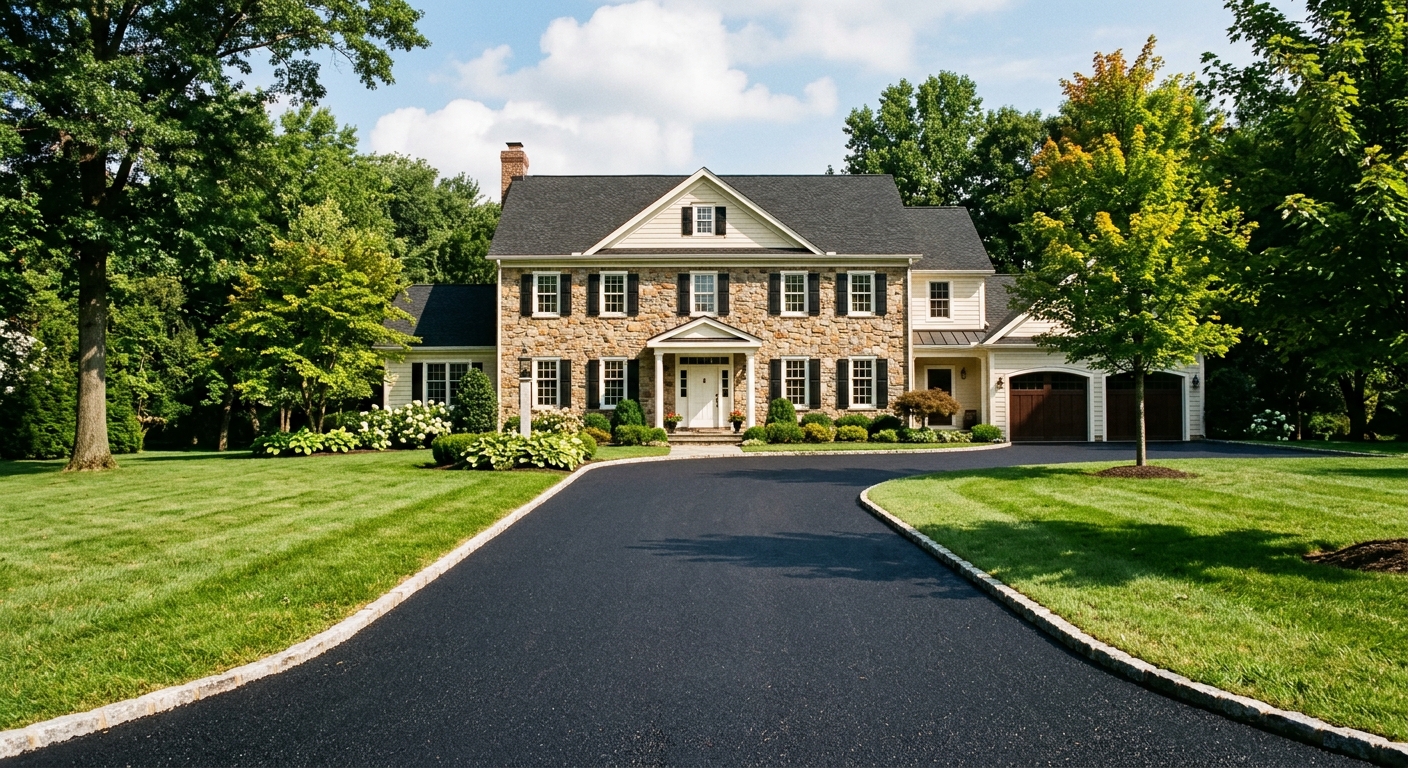
Hopewell paving prices by scope — 2026
In Hopewell, paving and resurfacing jobs are almost always for single-family homes—89.3% of residential properties fall into this category, and with a homeownership rate of 91.8% (U.S. Census Bureau, ACS 2024), most paving projects are owner-driven. It’s an investment in curb appeal, but also in function and longevity, especially given the region’s regular freeze-thaw cycles and the presence of shale subgrade. These local conditions mean that the real cost is not in the asphalt you see, but in the base and drainage you do not.
If you compare two driveway quotes that look $1,500 apart, odds are the difference is under the surface. Thicker base, proper base compaction for the local shale, and drainage correction dramatically affect long-term performance. Minor cracks and surface wear can be patched, but if the base has failed—or was never installed right during initial postwar construction—only a full replacement will hold up.
Below is what Hopewell homeowners can expect to pay in 2026, in both repair and full replacement scenarios.
| Service |
Best for |
Lifespan |
Price range |
| Asphalt — full replacement with new base |
failed base, structural cracking |
20–30 yrs |
$3,900–$10,000 |
| Asphalt overlay / resurfacing |
sound base, surface cracking only |
8–15 yrs |
$1,700–$5,000 |
| Sealcoating — single application |
preventive maintenance on sound asphalt |
2–4 yrs |
$225–$800 |
| Concrete — new installation |
long service life, low maintenance |
30–50 yrs |
$5,600–$13,500 |
| Crack filling and patching |
isolated cracks under a quarter inch |
1–3 yrs |
$200–$800 |
| Gravel driveway |
rural, budget, long runs |
5–10 yrs with upkeep |
$900–$3,500 |
Estimates for a typical Hopewell driveway. Square footage and base condition drive these figures more than material choice.
Choosing a paving company
In Hopewell, selecting a paving contractor is about far more than price. First, Pennsylvania requires Home Improvement Contractor (HIC) registration for any contract over $500—always verify at hic.attorneygeneral.gov. Ask for physical office details: a local mailing address beats a pickup truck with a burner phone. Long-term reliability shows in owned equipment (especially rollers and dump trucks), not just rented gear.
For a substantial investment, references should include jobs that are at least three years old, ideally in York County, where local climate and soils matter. Recent jobs prove nothing about how a driveway holds up through freeze-thaw cycles. Any reputable company should know their local aggregate and asphalt supplier by name—if they can’t, it’s likely they’re simply brokering the work, often at a markup with subpar oversight. Quarry haul distances impact actual scheduling in this area, so York County supply familiarity is a must.
- Verify HIC registration: hic.attorneygeneral.gov
- Confirm business address, not just a mobile number
- Ask if equipment is rented or owned
- Get references for jobs 3+ years old, in the area
- Request proof of workers’ compensation via WCAIS (wcais.pa.gov)
- Ask who their asphalt/aggregate supplier is
- Look for itemized written estimates (not lump-sum quotes)
- Check that contract language complies with the Home Improvement Consumer Protection Act (HICPA)
- Ask about base preparation and thicknesses for local shale
- Require clear timelines and warranty details
- Demand insurance certificates—general liability, at minimum
Red flags: Pushy, door-to-door “extra mix” offers, vague references, rentals picked up that morning, and refusal to name where material comes from. If their “deal” seems much cheaper than local market rates, expect shortcuts you’ll pay for down the road.
Caring for a new Hopewell driveway
The first job is always crack filling. In Hopewell’s climate, with regular freeze-thaw cycling, any open joint will channel water into the base, which then expands when frozen and destroys structure from below. Filling cracks early—ideally with hot, rubberized material—costs little and puts off major repairs by years. Keep the edges supported: unsupported asphalt crumbles fast, especially where driveways meet grass or landscape beds. Gravel shoulders or proper curbs work well.
Drainage is just as critical: clear all gutters and swales so water runs off, not under, your drive. Never allow dumpsters, jack stands, or lift points to sit on fresh pavement. Surface indentations shorten lifespan. For new asphalt, wait a minimum of two to three days in summer before light traffic; ideally, wait a week for full cure before parking heavy vehicles or making tight turns while stationary.
On ice: most store-bought salts are safe for asphalt, but on concrete, they accelerate surface scaling and rebar corrosion. There’s no perfect alternative—sand or calcium magnesium acetate are gentler but cost more. Plain gravel or grit can help traction without chemical risk. From personal experience: for most Hopewell winters, timely shoveling and patience beats chemical de-icers, particularly in the first 1–2 years after new paving.
Local soil, drainage and driveway lifespan
Hopewell is built over a shale subgrade. Unlike clay, shale drains modestly but fractures under repeated freeze-thaw cycles. This means that driveways need more base preparation—often thicker than the “minimum” found elsewhere. Without that, water migrates through, freezes, and heaves the pavement.
Many postwar driveways in York County were laid over minimal stone, because standards then allowed it. Thirty or forty years on, these bases often fail—not because of surface wear, but because water broke down what’s underneath. Compared to areas with glacial till or heavy clay, Hopewell driveways don’t heave as easily, but the problem here is base settlement and “alligator cracking” once pockets of shale fracture below.
Combine this with a 30-inch frost depth and regular freeze-thaw. The base and sub-base must be deep, well-compacted and well-drained if you expect 20–30 years from new blacktop. If your existing drive shows soft spots or chronic puddling, investing in a thicker base is the difference between a 10- and a 30-year lifespan.
If a neighbor two counties over says their paving cost less, odds are their soil wasn’t shale and their longevity will be worse.
What you need before paving in Hopewell
For most Hopewell homeowners, repaving an existing driveway—if you’re not expanding or changing the layout—typically does not require a building permit, unless you live within the City of York. In York City, a building permit applies for reconstruction, widening, or significant alterations. But don’t overlook the approach—the section that connects to the public road. For most state roads, PennDOT District 8 requires a Highway Occupancy Permit for any curb cut or approach work; township offices handle it for local roads.
Expanding a driveway or shifting it to add parking? Adding impervious surfaces can trigger runoff/stormwater review, even if no building permit is needed. And regardless of permit status, channeling runoff onto your neighbor’s property exposes you to civil liability (and can sour neighbor relations fast).
Every paving contract exceeding $500 must be written and comply with the Home Improvement Consumer Protection Act, including a clear three-day right to cancel and no insurance-deductible waivers. The contractor must carry valid workers’ compensation insurance—always check through WCAIS (wcais.pa.gov)—and should be HIC registered as verified at hic.attorneygeneral.gov. No one reputable should object to these steps.
Grading and water management on a Hopewell driveway
Nearly every long-term driveway failure I see in Hopewell starts with water. The minimum slope for drainage should be at least 2% (quarter inch per foot) away from the house or garage. Crowning—a high point in the center—can be used on long, crowned driveways, but most residential drives benefit from a single cross-slope to direct water off the surface immediately.
If your driveway slopes toward the home or garage, address this before paving—there is no fix afterward but to cut in a trench, channel drain, or rebuild. Where grade limits options, channel drains tied to daylight (sloping away to a safe outlet) or dry wells are standard fixes.
Hopewell’s shale holds less surface water than heavy clay, but poor drainage still sends water under the pavement—where freeze-thaw cycles at 12 °F winter temps push the base up and down until cracks appear. Once water ponds, each cycle does more damage. Proper base grading and compacted subgrade is the best defense.
Finally, Pennsylvania law doesn’t permit diversion of runoff onto neighboring lots just because your permit is in order. If the slope is too tight and your only “out” lands on someone else’s lawn, rethink the design.
The honest case for and against sealcoating
Here’s the truth: sealcoating is both overhyped and, in the right timing, genuinely useful. What it does is form a barrier that slows oxidation (keeps the asphalt binder from drying out), resists fuel and oil stains, and immediately refreshes appearance. It won’t, though, add an ounce of strength or repair underlying base problems—if your driveway is cracked through from beneath, no coating will save it.
The part almost nobody admits: sealcoating too often, especially every year, leads to layer buildup. This can actually make the surface crack and peel, shortening rather than extending lifespan. New asphalt should cure for six months to a year before the first treatment—sealing too soon traps volatiles and can weaken the surface. After that, a reasonable interval is every 2–4 years for Hopewell’s climate, depending on exposure and traffic.
Crack filling matters more than sealing—done first, it blocks the single biggest cause of base failure in York County’s freeze-thaw environment. When you do seal, ensure it’s a brush or squeegee application; cut-rate spray jobs often wash away or never get enough film thickness. If the price is suspiciously low—well below $225–$800—you’re probably getting watered-down sealer, barely brushed into place, or no prep on cracks.
Sealcoating is worthwhile, but only as one part of a bigger maintenance plan. For visible cracks, patch and fill first. And remember: no surface treatment resurrects a dead base.
Frequently asked questions — driveway paving in Hopewell
How much does it cost to widen a driveway?
Expanding a driveway in Hopewell usually falls under the same price ranges as a new install or overlay, depending on what you’re tying into. For an asphalt widening—say, adding a car-width to one side—you should expect costs to land between $1,700–$5,000 for an overlay if the base is solid, and up to $3,900–$10,000 for full-depth work with new base. The higher end covers the kind of extra stone base often needed in Hopewell’s shale soil, plus integration with existing pavement and any stormwater adjustments. Permitting may be triggered by an expansion, so plan for both county and township contacts, especially if the widened section changes surface water runoff patterns.
How much does a concrete driveway cost in Hopewell?
Concrete driveways are more expensive up front than asphalt, but in Hopewell—given local shale soils and pronounced freeze-thaw cycles—they often last much longer. A new concrete driveway typically runs $5,600–$13,500, with most jobs hitting around $9,000 depending on size, thickness, and finish. The higher end includes additional subgrade work, which is often needed here due to settlement risks in older postwar neighborhoods. While the initial investment is steep, routine sealing and minimal patching means your maintenance costs will be much lower over 30–50 years compared to blacktop.
Should I repair or replace my Hopewell driveway?
In Hopewell, first look at your driveway’s base—most postwar homes here are dealing with shale subgrade and old, thin stone bases. If cracks are isolated and less than a quarter inch wide, crack filling (usually in the $200–$800 range) and patching might buy you a few more years. But if you’re seeing “alligator cracking,” sunken areas, or multiple deep cracks, that’s usually a sign of base failure. In those cases, resurfacing with an overlay ($1,700–$5,000) can work only if the base is stable, but full replacement ($3,900–$10,000) is often the only fix if water or freeze-thaw cycles have caused underlying damage.
What kind of soil is under Hopewell driveways?
Most Hopewell driveways are built over shale, which is fractured bedrock rather than heavy clay or sand. Shale drains better than clay but tends to settle in waves and can be broken up by repeated freeze-thaw cycles—particularly important here with a frost depth of 30 inches. This soil means thicker, well-compacted base stone is needed for new work, and many older driveways suffer from base issues that’re invisible until you start seeing cracks or dips. If a neighbor’s driveway lasted longer across county lines, their soil was probably different.
How do I verify a paving contractor in Pennsylvania?
In Pennsylvania—including Hopewell—the place to start is the HIC (Home Improvement Contractor) registration site: hic.attorneygeneral.gov. All legitimate contractors doing jobs of $500 or more must be registered there; ask for their number and check it yourself. For workers’ compensation insurance, confirm their coverage via the WCAIS system (wcais.pa.gov). Beyond paperwork, ask about owned equipment, get references from local work at least three years old, and don’t be afraid to ask for their aggregate or asphalt supplier’s name. A local business with a physical address and track record in York County is far preferable to a traveling crew.
Is sealcoating a scam?
No, but sealcoating is easy to oversell. In Hopewell, a quality sealcoating slows surface oxidation and keeps your asphalt looking nice—it doesn’t fix cracks or make a failing base solid again. Done right and spaced a few years apart (not annually), it’s a smart way to stretch life. Done poorly—meaning thin spray jobs or sealing new pavement before it has cured—it can damage the drive. If the price is way below $225–$800 for a typical Hopewell driveway, expect little benefit. The maintenance that matters more is early crack filling, which is what keeps water out of the base during our freeze-thaw cycles.
Can asphalt be laid in cold weather?
Asphalt can technically be placed in cold weather, but it’s rarely a good idea in Hopewell. Cold ground and air (especially near or below freezing) means the asphalt mix cools too quickly, preventing proper compaction and producing weak, ravel-prone surfaces. Most reputable contractors limit work to when daytime temps are above 50°F, ideally with well-warmed subgrade. If someone offers a winter deal far below $3,900–$10,000 for a “full job,” you’ll likely see premature cracking, ruts, and poor bonding—the savings won’t last long.
What does compaction in lifts mean?
Compaction in lifts means installing the stone base and asphalt in multiple layers (lifts), each of which is compacted separately before adding the next. In Hopewell, this is critical due to shale soils and freeze-thaw cycles that punish shortcuts. Proper lifts—typically two for new bases—ensure the whole driveway moves as one, sheds water properly, and holds up for decades. Skipping lifts or compacting only at the end often leads to wavy, sunken spots and early failure, making a higher-end investment in full replacement ($3,900–$10,000) worth every dollar.
Why are my driveway edges crumbling?
Crumbling edges almost always mean the sides of the driveway were left unsupported. In Hopewell, with our freeze-thaw climate and shale underlay, unsupported asphalt extends beyond the compacted base and flexes with each pass of a tire or winter frost. Over time, these “free edge” sections break up first. The repair solution is to cut back to solid, supported pavement and, ideally, add a gravel shoulder for future support. Patch repairs (range: $200–$800) will only buy a little time unless the whole edge is rebuilt with proper stone beneath.