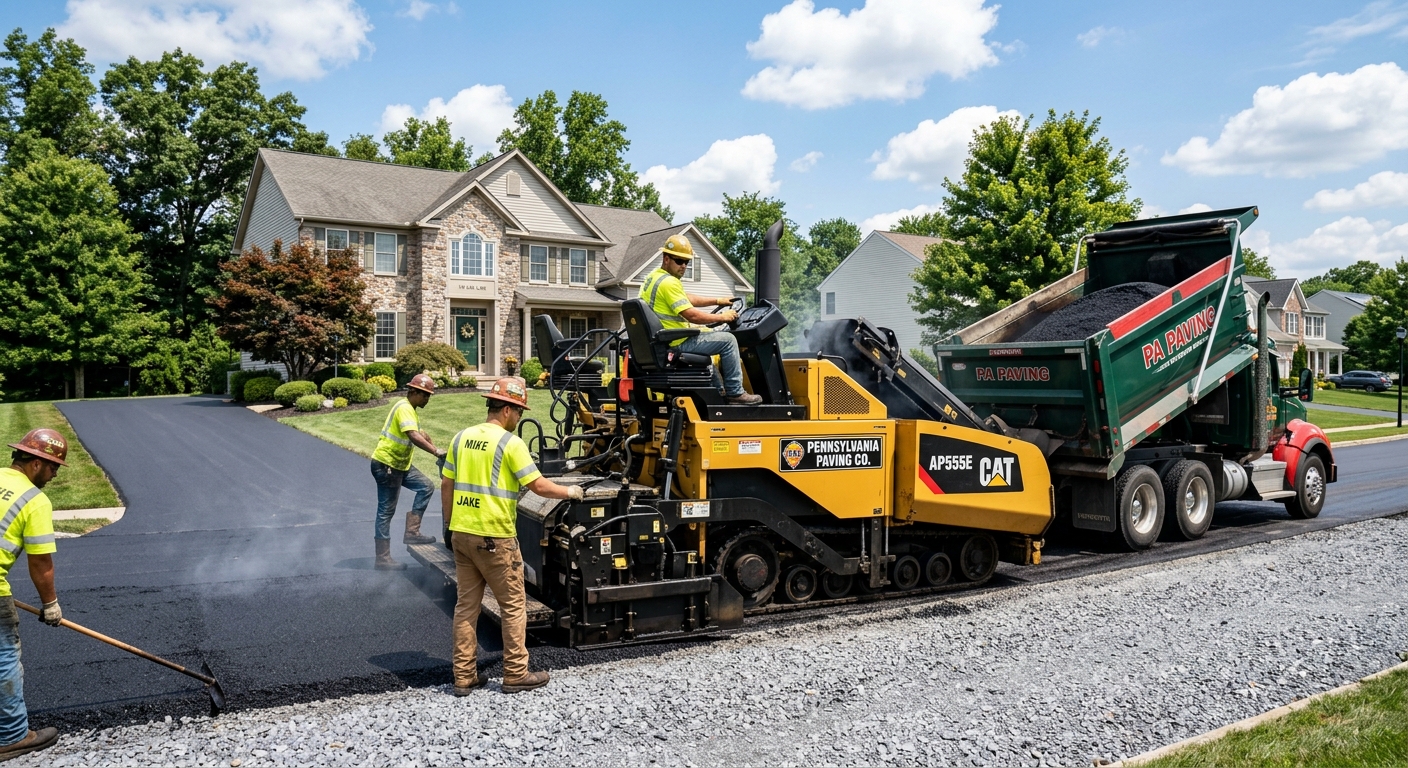
Driveway paving costs in Aston — 2026
Aston, like the rest of Delaware County, is a town of homeowners: 88.4% of residences are owner-occupied and 72.5% are single-family homes (U.S. Census Bureau, ACS 2024). Most driveways here are private property, not shared-access, so the condition and material of your driveway is not just a curb appeal issue—it's your maintenance responsibility. In southeastern Pennsylvania, freeze-thaw cycles and periods of heavy rain mean driveways fail from the ground up. Most of the price difference between two paving quotes comes from what gets buried: the depth and quality of the stone base, drainage measures, and whether the old material is actually removed. Asphalt, concrete, or gravel, the important costs are usually invisible once the crew leaves.
Expect price bands to reflect those hidden differences, not just the surface you see. An overlay is never as expensive as a base-out replacement, but it only lasts as long as the base beneath it is solid. Here’s what to expect for a typical Aston driveway:
| Service |
Best for |
Lifespan |
Price range |
| Asphalt — full replacement with new base |
failed base, structural cracking |
20–30 yrs |
$3,800–$9,800 |
| Asphalt overlay / resurfacing |
sound base, surface cracking only |
8–15 yrs |
$1,650–$4,900 |
| Sealcoating — single application |
preventive maintenance on sound asphalt |
2–4 yrs |
$225–$750 |
| Concrete — new installation |
long service life, low maintenance |
30–50 yrs |
$5,500–$13,000 |
| Crack filling and patching |
isolated cracks under a quarter inch |
1–3 yrs |
$200–$800 |
| Gravel driveway |
rural, budget, long runs |
5–10 yrs with upkeep |
$900–$3,500 |
Estimates for a typical Aston driveway. Square footage and base condition drive these figures more than material choice.
Aston's ground and what it means for paving
Much of Aston sits atop glacial till and compacted urban fill—the legacy of nearly a century of development in Delaware County. Glacial till is a mix of clay, sand, stone, and silt left behind by ancient glaciers. It drains poorly unless properly compacted and layered, and when saturated in spring or after a heavy storm, it can heave under freezing temperatures. That means the base below your driveway needs to be thicker than you might expect, often 6–8 inches of compacted stone, to prevent movement and cracking.
Older driveways in inner-ring suburbs like Upper Darby and Haverford—many built between 1920 and 1960—were typically installed with just a thin layer of asphalt or concrete over whatever dirt was present. Those standards didn't anticipate Pennsylvania's modern freeze-thaw patterns, so many now show sunken areas, drainage failures, or cracking at the edges. Without correcting the base, any resurfacing will only last a handful of years. Drainage must be managed—if runoff can't drain away from your driveway, especially on these fill soils, you're headed for early failure.
If you're evaluating a driveway in Aston that predates 1980, assume the base is minimal unless rebuilt. The underlying mix of tight, poorly-draining fill and 30-inch frost depth here means shortcuts under the surface never stay hidden for long.
Sealcoating: what it does and what it doesn't
Sealcoating gets billed as a cure-all, but here's what it actually delivers for an Aston homeowner. The material is a coal tar or asphalt emulsion designed to protect your driveway's surface from weather, oxygen, oil, and gas drips. A good sealcoating application protects the asphalt binder from breaking down and keeps water from seeping into hairline cracks. It will immediately revive the jet-black look of faded asphalt, which is why many prefer it aesthetically.
But there are limits: sealcoating does not add any structural strength or fix serious cracks, potholes, or sunken sections. If your base has failed or the driveway surface is crazed with alligator cracks, sealing will not turn back the clock. Worse, sealing too often leads to buildup—layers can peel and trap moisture, causing more harm than good. Never seal new asphalt in its first year, as it needs to cure and release oils.
A reasonable interval in Aston is every three to four years on older asphalt, or when water no longer beads on the surface. One thick, brushed-on layer is far superior to a cut-rate spray job, which can wear away within months. Crack filling prior to sealing is much more important than sealing for extending functional life, especially with Pennsylvania’s freeze-thaw cycles. Crack fill material physically blocks water from getting under the surface, which prevents base damage—sealcoating alone won’t do that.
A credible single sealcoating application in Aston costs $225–$750. If you see a much lower price, you’re probably getting watered-down material, or a spray so thin it won’t last a single winter.
How to vet a paving contractor in Aston
Choosing a contractor in Aston means more than comparing price tags. Delaware County lies in a dense, competitive market, and the difference between a quality driveway and one that fails early is hidden in the prep work and materials. Here’s what matters most:
- HIC registration number issued by the Pennsylvania Office of Attorney General (required over $500; verify at hic.attorneygeneral.gov)
- Proof of workers’ compensation coverage: check status in WCAIS (wcais.pa.gov)
- Written contract with clear estimate and warranty terms (mandatory by the Home Improvement Consumer Protection Act)
- List of driveways paved in Aston or nearby at least three years ago; call to ask how those have held up
- Verifiable business address (not just a mobile number or PO box)
- Owned paving equipment visible at their yard or onsite; avoid firms that rent day-to-day
- Can name their asphalt plant—Eddystone and South Philadelphia supply Delaware County, so any serious contractor knows their source
- No request for full payment up front; reputable operators stagger payments by progress
- No pressure for on-the-spot signatures to lock in a “deal”
- Explains local permit process (and approach permits) knowledgeably
- Uses clear, locally-sourced aggregate—no vague talk about “recycled” or “proprietary blend” stone for your base
- Public liability insurance proof, not just on request
Red flags: cash-only quotes, out-of-state plates, no written contract, references all younger than one year, or vague answers about material sources. These almost always signal a broker, not a pro.
Permits and approvals for paving in Aston
If you’re repaving an existing residential driveway in Aston—without expanding or changing its footprint—you generally do not need a building permit. This matches the rules enforced across much of Delaware County, including Upper Darby as noted in local guidelines. That saves time and hassle. However, the spot where your driveway meets the street—the driveway approach—often triggers a different approval. In Delaware County, approaches on state routes require a Highway Occupancy Permit from PennDOT District 6; for local roads, expect the township code office to handle it. This trips up many homeowners, so always check what agency governs your frontage before starting work.
Expanding your driveway’s width or adding new impervious surface can trigger stormwater review, since runoff management is regulated to avoid draining water onto a neighbor. Even without a permit, the law can hold a homeowner liable for redirecting stormwater—especially relevant with Aston’s mixed soils and compacted fill, which do not absorb runoff quickly.
For consumer protection, Pennsylvania requires that any paving contract over $500 be in writing under the Home Improvement Consumer Protection Act, and you have a three business-day right to cancel. Only use contractors registered as Home Improvement Contractors (verify at hic.attorneygeneral.gov) and confirm active workers’ compensation coverage in WCAIS (wcais.pa.gov)—both are mandatory in this trade for jobs within Aston.
Comparing materials in southeastern Pennsylvania
Pennsylvania’s climate—4800 heating degree days, moderate freeze-thaw, and humid summers—means that material choice matters, but installation details decide longevity. Asphalt’s strength is flexibility: it flexes with ground movement and repeated frosts, rarely cracks from thermal stress alone, and is easy to patch or resurface as needed. Expect 20–30 years if the base is right, with routine sealcoating ($225–$750 per pass every few years) to protect the binder.
Concrete driveways cost more upfront, $5,500–$13,000, but on a perfect install with careful salt management, they can last half a century. Most fail from salt-induced scaling, not cracking, because salt eats into the surface during freeze-thaw cycles—an outcome hard to avoid where snow and ice are routine. That’s why honest contractors will tell you: if you use salt on a concrete driveway, expect spalling. Avoiding salt or switching to calcium chloride helps, but most owners fall back on what’s available. Asphalt is forgiving when this happens; concrete isn’t.
Pavers and gravel have their places—pavers work when water management and premium appearance are needed, and specific stone blends in gravel are good for long rural runs, as long as you’re fine with more frequent maintenance.
| Option |
Installed cost |
Maintenance |
Freeze-thaw performance |
Lifespan |
| Asphalt — new install |
$3,800–$9,800 |
sealcoat every 3–4 yrs |
excellent, flexes |
20–30 yrs |
| Asphalt — overlay |
$1,650–$4,900 |
same |
good if base is sound |
+8–15 yrs |
| Concrete |
$5,500–$13,000 |
low, avoid de-icing salt |
fair, spalls with salt |
30–50 yrs |
| Pavers |
$8,700–$13,000 |
individual units replaceable |
good, settles gradually |
25–50 yrs |
| Gravel |
$900–$3,500 |
top-dress every 2–3 yrs |
excellent drainage |
indefinite with upkeep |
Overlay, patch or full replacement?
Most Aston homeowners only need to walk their driveway to tell what’s needed—if you know what to look for. Widespread “alligator” cracking, where the surface looks like reptile skin, means the stone base has failed: an overlay won’t last and money spent there is wasted. Single, straight cracks just signal normal aging; these can be filled and then sealed. Depressions (birdbaths) or low spots that collect water mean the subgrade is moving or compressing, which often requires excavation and patching. Crumbling at the driveway’s edges is typical in older Aston neighborhoods, often built without any edge support, and should be fixed with a proper repair—not just new asphalt on the crumbly area. Potholes mean water is eating away at your base and need deeper repair. If a contractor suggests an overlay without probing (with a probe rod or core sample), they’re more interested in selling an invoice than fixing the problem.
| What you see |
Likely cause |
Right fix |
Cost |
| Isolated cracks under 1/4 inch |
surface aging |
crack fill and seal |
$225–$750 |
| Alligator cracking over a wide area |
base failure |
full replacement |
$3,800–$9,800 |
| Depressions holding water |
subgrade movement |
excavate and rebuild that area |
$3,800–$6,000 |
| Crumbling edges |
no edge support |
edge repair, consider curbing |
$400–$1,500 |
| Potholes |
water into the base |
full-depth patch, then assess |
$250–$900 |
| Faded but sound surface |
oxidation only |
sealcoat |
$225–$750 |
Frequently asked questions — driveway paving in Aston
Are pavers worth the cost in southeastern Pennsylvania?
Pavers are the most expensive mainstream driveway option in Aston, with installed costs typically $8,700–$13,000. What you get is a surface that's both attractive and individually repairable. Unlike poured concrete or asphalt, pavers flex and "settle" with ground movement from freeze-thaw cycles, so they rarely crack the way rigid slabs do. In older neighborhoods or on lots with complicated drainage, they're easier to patch or reset if you ever have to access utilities below. But they do require occasional re-leveling and weed management between joints. For many homeowners, pavers are worth the cost if appearance and easy repair are priorities, but not if you’re counting on low first cost or have a very long driveway. In Aston, pavers make sense where budget allows and you value long-term curb appeal.
Is sealcoating a scam?
In Aston and all of southeastern Pennsylvania, sealcoating isn’t a scam—but the value depends entirely on your driveway’s condition. A quality sealcoat protects the asphalt binder from the region’s sun, water, and car drips, especially given Aston’s freeze-thaw cycles. But it won’t fix cracks, add structural strength, or “glue your driveway back together.” Done every 3–4 years for $225–$750, it’s worth it for sound, unbroken asphalt. However, if your drive is already broken up or the base is failing, sealcoating is just cosmetic. The only scam is fly-by-night contractors offering bargain spray jobs or pushing annual sealing when what you really need is patching or replacement. In short: right process, right frequency, right price—then sealcoating does its honest job.
What does sealcoating cost in Aston?
Single-pass sealcoating for an average Aston driveway ranges from $225–$750, depending on size and the amount of edge and crack prep needed. Smaller, narrow drives—common in mid-1900s Aston homes—are at the lower end. The price includes cleaning, prepping cracks, and brushing on a thick layer (far better than a spray). If you see a price much below that, it likely means thin, diluted material that will wear off within a year, especially after a Pennsylvania winter. Proper sealcoating, done every 3–4 years, keeps your driveway looking good and protects it from surface wear. For aged or rough base, investing in sealcoating won’t extend lifespan—you're better off considering patching or overlay.
Are door-to-door pavers a problem in Aston?
Yes, door-to-door pavers do show up in Aston and across Delaware County, often peddling leftover asphalt for fast "discount" jobs. They usually come right after a big paving project nearby. The issue is quality—these crews rarely prepare the base, often skip compaction, and almost never give you a written contract as required by the Pennsylvania Home Improvement Consumer Protection Act. If your contract is over $500, you must get written terms and their HIC registration (verify at hic.attorneygeneral.gov). Legitimate companies in Aston maintain a business address, use locally-sourced materials, and provide references from jobs several years old. If the price is well below $3,800 for a full replacement, be skeptical. Door-to-door pavers cut corners that only show up months or a year later.
Are there stormwater rules on paving in Aston?
Yes—expanding your driveway or adding impervious area in Aston can trigger stormwater requirements, especially in neighborhoods with tight lot lines and compacted fill underfoot. Even if a permit is not required for resurfacing the existing footprint, township code and Pennsylvania law prohibit directing water onto your neighbor's property. With glacial till soils and a 30-inch frost depth, runoff that can’t soak in may head straight to basements or public storm sewers, which is a problem in older sections of Aston. If you plan any driveway expansion, consult the local code office before starting; expect to pay more if you need to upgrade drainage, typically adding $1,000–$3,000 for minor site work. Responsible contractors will bring it up early—if not, ask directly.
How long does a driveway installation take?
Most full asphalt driveway replacements in Aston take 2–3 days start-to-finish, plus a few more days before you can park on it. Day one is typically removal and base prep (with time for compaction), day two is paving, and an extra day may be needed for cure, cleanup, or sealcoating down the line. Concrete takes longer: 1–2 days for forming and pouring, then several more days (sometimes up to a week) before you can safely drive on it due to cure time, especially in cool or humid weather. For overlays, expect 1–2 days at most. Faster schedules can mean corners are cut, especially in compaction between lifts. Pricewise, a typical Aston driveway replacement runs $3,800–$9,800 for asphalt and $5,500–$13,000 for concrete.
What does compaction in lifts mean?
In Aston and Delaware County, “compaction in lifts” means the contractor installs the stone base (and sometimes the asphalt itself) in multiple layers, usually 2–3 inches at a time, and thoroughly compacts each before adding more. This is critical on our local glacial till and urban fill soils—the lower layers need to be dense so they don’t settle over time, especially through freeze-thaw cycles. Lifts also ensure water drains correctly and prevent sunken tire ruts. For asphalt, the surface and base layers should both be compacted separately, not as one thick pour. Cutting corners here saves time but shortens your driveway’s life dramatically. Proper compaction in lifts is built into the price bands here; a “cheap” drive is often thin or poorly compacted, and problems show up within the first couple winters.
Why are my driveway edges crumbling?
Driveway edges crumble in Aston mostly because of a lack of support—older drives, especially those installed between 1920 and 1960, often have no curb or shoulder. Glacial till and fill soils don’t hold shape well when exposed, so as vehicles roll off or rainwater erodes the edge, chunks start to shear away. Once the edge starts to fall, water penetrates and freezes, hastening the process. The right fix is edge repair and sometimes adding a concrete curb or wedge to keep vehicles off the sides. Typical cost for edge repair here is $400–$1,500. Curbing is a bigger investment, but in older Aston neighborhoods it’s sometimes the only permanent solution.
What does an asphalt overlay cost in Aston?
An asphalt overlay (also called resurfacing) in Aston runs from $1,650–$4,900, with the most common jobs for mid-sized, owner-occupied driveways hitting the $3,300 mark. That covers basic crack repairs, tack coat, and a new surface course over a solid base. The price goes up if additional base work or drainage correction is needed. Overlays should only be considered when the underlying base is stable—if you see widespread “alligator” cracking or depressions, a full replacement is a better bet in the long run. An overlay can add 8–15 years when done right, but if the base is failing, you’ll be patching or redoing it far sooner.