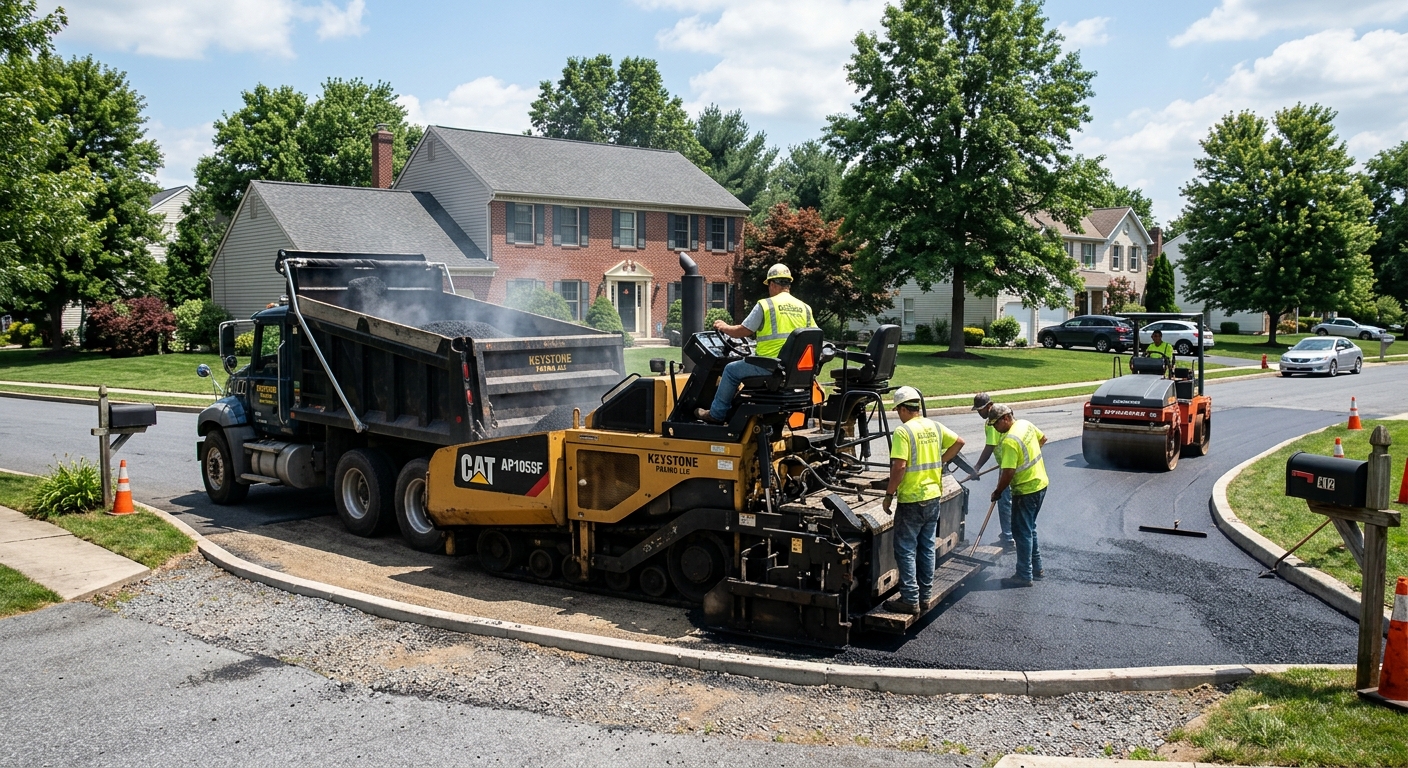
Moore paving prices by scope — 2026
In Moore, where 92.1% of households own their homes and over 82.7% are single-family, driveway paving is a widespread, necessary investment—not just a cosmetic upgrade. With our freeze-thaw winters and the Lehigh Valley’s limestone karst subgrade, many local driveways show damage from heaving and drainage issues. The real cost difference in paving often hides where you can’t see: in excavation, grading, and the supporting base layers. Two driveways may appear identical at the surface, but the one that lasts is the one built on properly prepared ground with correct drainage and adequate base thickness.
Most Moore driveways date from before 1980, which means substandard, thinned, or poorly drained bases are common culprits behind recurring cracking and settling. Local pricing reflects not just material, but the amount of groundwork done. The telling details—like compacted aggregate, layer depth, and edge treatment—are what drive cost and longevity. When comparing quotes, remember that what looks like a single line for “asphalt” can easily conceal corners cut beneath the surface, with failure showing years later.
| Service |
Best for |
Lifespan |
Price range |
| Asphalt — full replacement with new base |
failed base, structural cracking |
20–30 yrs |
$3,600–$9,300 |
| Asphalt overlay / resurfacing |
sound base, surface cracking only |
8–15 yrs |
$1,550–$4,600 |
| Sealcoating — single application |
preventive maintenance on sound asphalt |
2–4 yrs |
$200–$700 |
| Concrete — new installation |
long service life, low maintenance |
30–50 yrs |
$5,200–$12,500 |
| Crack filling and patching |
isolated cracks under a quarter inch |
1–3 yrs |
$200–$800 |
| Gravel driveway |
rural, budget, long runs |
5–10 yrs with upkeep |
$900–$3,500 |
Estimates for a typical Moore driveway. Square footage and base condition drive these figures more than material choice.
Grading and water management on a Moore driveway
On any Moore driveway, correct grading is what determines its lifespan—much more than how smooth the surface looks the day it’s paved. A proper driveway should slope away from all structures, with a minimum pitch of about 2% (one quarter-inch per foot), to shed water before it finds a way into the base. Common methods are a gentle crown—highest in the middle tapering to both sides—or a full cross-slope, depending on where you want runoff to go. If the driveway slopes toward a garage or house, you’re inviting leaks and frost heaves all winter.
Freeze-thaw cycles here amplify every flaw: water that ponds on the surface or seeps through cracks moves into the crushed stone base. Once it freezes, the expanding ice lifts and breaks the pavement from below. With the Lehigh Valley’s limestone karst subgrade, drainage gets even trickier—water can accumulate under the base, settling the surface over time. Where regrading the slope isn’t feasible (like a flat lot), trench or channel drains at the garage or across low spots intercept and redirect water safely. The outflow (“daylighting”) should be at the lowest point on your property, or into a dry well if allowed—never across a neighbor’s land. Redirecting water onto the adjoining lot exposes you to liability, regardless of permits or township lines. Good grading and thoughtful drainage work cost money up front and deliver peace of mind for decades.
Comparing paving estimates in Moore
In Moore, a homeowner needs to look past big, round numbers and make sure the estimate spells out every step. Any quote should clearly state the driveway’s measured square footage, the depth of excavation, and how disposed material will be handled. For base prep, demand both aggregate type—usually a local crushed stone here—and exact depth in inches. Compaction should happen in layers (“lifts”), not one go. Asphalt details matter: check for the number of courses (base and top) and compacted thickness, not loose measurements. Drainage should be discussed specifically: how the new driveway will handle water and where the runoff will go.
You also want edge treatment spelled out (tapered border, potential curbing), cleanup at lawn edges, a payment schedule that favors you (deposit only if required by law, balance on completion), and a written warranty with clear inclusions and exclusions. Most paving warranties in this market explicitly exclude cracking, which seems backward but is the norm—if you see “lifetime” without specifics, ask hard questions. The most common way Moore homeowners overpay? Accepting a single-line quote with no details, which means you’re paying for trust, not work.
| Line item |
What to look for |
Red flag if… |
| Area |
measured square footage stated |
eyeballed or absent |
| Excavation |
depth and disposal included |
'we'll pave over it' |
| Base |
aggregate type and depth in inches |
'proper base' |
| Compaction |
method, and done in lifts |
not mentioned |
| Asphalt |
courses and compacted depth |
'3 inches' unqualified |
| Drainage |
slope and water direction stated |
silent |
| Warranty |
what is covered and what is excluded |
verbal only |
| Payment |
modest deposit, balance on completion |
full cash up front |
Beyond replacement: layout changes
Driveway projects in Moore aren’t always a simple tear-out and replace. Many jobs are widenings for a second car, extending a run back to a detached garage or barn, or adding a parking pad or turnaround for safer street entry. If you’re replacing an old gravel lane with asphalt or concrete, the entire footprint where you pave new ground will need a fresh base installed and compacted over native Lehigh Valley subgrade—which, more often than not, needs careful grading for drainage. The seam between old and new driveway is a persistent weak spot and may develop premature cracking if not bonded and compacted carefully.
Any change to the driveway’s footprint, even a small extension, can trigger local impervious surface limits or setback rules. You may not be able to pave all the way to your property line, and Moore’s township code office may review layout changes that expand your lot coverage. Stormwater management comes into play once you expand hard surfaces—runoff may need to be controlled or captured. If your new or expanded driveway connects to a state route, a PennDOT District 5-0 approach permit is required; for local streets, approach permits come from the township.
Driveway permits, approaches and stormwater rules
In most Moore households, repaving an existing driveway in the same footprint does not require a building permit, especially outside the city limits—so you can skip that step and avoid unnecessary headaches. However, if you’re expanding the driveway or altering its path, some municipalities within Northampton County (like Bethlehem) may require a building or zoning permit. Where your driveway meets the public road—the approach or curb cut—a permit is typically needed, and this comes from PennDOT District 5-0 for state roads, or your township for local streets. Many homeowners skip this, but PennDOT governs state-maintained routes, not the township.
When expanding your driveway, keep in mind that any increase in impervious surface can trigger local stormwater requirements. Drainage design must ensure you’re not sending runoff onto your neighbor’s property, which could leave you open to liability, permit or not.
For bigger projects (contracts over $500), your contractor must be registered with the Pennsylvania Office of Attorney General’s Home Improvement Contractor registry (check at hic.attorneygeneral.gov). Workers’ compensation coverage is mandatory, and you can confirm coverage via WCAIS (wcais.pa.gov). Never hand over money or sign until you verify both; this protects you as much as the law.
Door-knocking crews and leftover material
In the Moore area, door-knocking paving crews are notorious for preying on quiet neighborhoods—especially where driveways are visible from the road and homes are spread out. The classic pitch is familiar to most locals: “We’ve got leftover asphalt from a job down the street, so you can get a deal if we do it today—but only if you pay cash.” Sometimes it’s a written price on a scrap of paper, other times it’s just a handshake. Trucks are often unmarked, with plates from an out-of-state or distant county. The “sealcoat” they offer is a quick oil spray, which looks good for a few weeks but offers almost no actual protection.
A saturated market like Lehigh Valley’s can attract these outfits because legitimate paving companies are easy to impersonate and neighbors are less likely to know who’s licensed and who’s not. The Pennsylvania Home Improvement Consumer Protection Act requires a written contract for jobs over $500 and gives you a three-business-day right to cancel—fitting protections against exactly these scams. Never give cash up front, never sign or agree to “extra material” sold at a steep discount, and don’t accept any reason not to provide written details, business registry proof, and insurance information. Remember: waiving your insurance deductible is illegal, and any contractor offering this is not on the level.
Take five minutes to check: look up the HIC registration (hic.attorneygeneral.gov), confirm insurance with WCAIS, and never pay more than a legally allowed deposit. These simple steps shut out 99% of the travelers and short-cutters looking for quick, easy money in Moore.
How to tell if the base is gone
If you want to know whether your Moore driveway needs resurfacing or a full tear-out, don’t just look at the top layer—get down and read the signs. Widespread alligator (block) cracking tells you the base is shot; the surface can’t flex, so it fractures in a pattern like reptile skin. If you only see a few straight, narrow cracks, it’s likely the surface aging out. Depressions or “birdbaths” where water stands tell you the subgrade is shifting—sometimes thanks to the Lehigh Valley’s unpredictable limestone and freeze-thaw cycles. Crumbling or broken edges are usually due to no proper edge support; over years, the pavement gives way under tires. Potholes mean water has reached the base and a patch alone won’t last.
Any contractor who offers an overlay without checking for these issues—sometimes by probing the base with a rod or even just studying existing cracks—hasn’t done due diligence. An overlay on a failed base is money gone. Know these cues, and you’ll avoid paying for work that solves nothing.
| What you see |
Likely cause |
Right fix |
Cost |
| Isolated cracks under 1/4 inch |
surface aging |
crack fill and seal |
$200–$700 |
| Alligator cracking over a wide area |
base failure |
full replacement |
$3,600–$9,300 |
| Depressions holding water |
subgrade movement |
excavate and rebuild that area |
$3,600–$5,700 |
| Crumbling edges |
no edge support |
edge repair, consider curbing |
$400–$1,500 |
| Potholes |
water into the base |
full-depth patch, then assess |
$250–$900 |
| Faded but sound surface |
oxidation only |
sealcoat |
$200–$700 |
Frequently asked questions — driveway paving in Moore
Does Moore have local asphalt plants?
There are several asphalt plants and aggregate suppliers just outside Moore, clustered around Bethlehem and Easton. Haul distances for paving crews are short, which means local driveway costs here are stable and you won’t see inflated prices for “out of area” transport—always a factor in more remote Pennsylvania townships. Most suppliers in the Lehigh Valley can deliver mix on demand during paving season. This means that when you’re quoted $3,600–$9,300 for a full asphalt replacement, it’s not being driven up by material scarcity, but by the labor and base preparation needed for each specific job.
What causes driveway cracks in Moore?
In Moore, the biggest culprit behind driveway cracks is our extreme freeze-thaw cycle. Water finds its way into even small surface breaks, seeps into the base, and then expands as it freezes—forcing pavement upward and apart. The Lehigh Valley’s limestone subgrade is also a factor; hidden voids or shifting ground can cause depressions after wet spells. Asphalt—especially when unsealed—ages from oxidation and UV, which dries it out and opens the door for new cracks. Most fixes are minor, like crack filling and sealcoating ($200–$700), unless cracks form a webbed pattern, which points to deep structural failure.
What does an asphalt overlay cost in Moore?
For Moore homes with a sound base and only surface-level cracks, an asphalt overlay is a budget-smart alternative to full replacement. The price for a typical overlay is $1,550–$4,600. The wide range depends on square footage, prep work, and whether the old surface needs milling or extensive patching first. If your existing driveway shows widespread base problems, it’s better to pay for a full tear-out, since overlays on a bad base fail quickly. Always insist the contractor inspects the base before quoting.
What slope does a driveway need for drainage?
A Moore driveway should have at least a 2% slope—meaning a quarter inch of fall per foot—to keep water from standing or flowing toward the house or garage. This minimum is backed by years of freeze-thaw damage witnessed on driveways that are too flat. On a 30-foot run, you’d want about eight inches of drop from top to bottom. In some cases, a gentle crown down the middle works best, pushing water off to each side. Proper grading reduces the risk of base movement and heaves, which keeps your maintenance costs—like full replacement at $3,600–$9,300—down down the road.
Should I repair or replace my Moore driveway?
If your Moore driveway has mostly narrow cracks and no sunken areas or “alligator” cracking, repairing with crack filling and sealcoating ($200–$700) is often enough. Widespread block cracking, several deep potholes, or depressed sections mean the base is no longer supporting the surface and replacement is the only answer. Since over 53% of Moore homes predate 1980, old and thin bases are common—so always have a contractor check the subgrade before making the call. An honest pro will tell you when repair is pointless.
Is gravel a cheaper option in Moore?
Gravel is the most affordable way to pave a long run or rural property in Moore, coming in at $900–$3,500 depending on length, width, and base prep. It handles freeze-thaw cycles better than thin asphalt and is easily topped up as needed. Many Lehigh Valley driveways started as gravel before being paved over decades later. Just be aware that local dust, rutting, and driveway maintenance are part of the package—factor in annual top-up and re-grading.
Do I need an approach permit where my driveway meets the road?
Yes—where your Moore driveway meets a state-maintained road, PennDOT District 5-0 issues the approach (curb cut) permit. For township-maintained streets, the local township office handles permits. Repaving the main drive itself inside your property lines usually does not require a permit (unless in Bethlehem or some stricter localities) but every new or altered approach legally does. Approach permits exist to protect drainage, utilities, and safe traffic entry—not just to add red tape. The process is straightforward but must be completed before the work starts.
What is the difference between crack filling and sealcoating?
Crack filling addresses specific, narrow cracks by pumping flexible sealant into each one, sealing water out of the base. Sealcoating, on the other hand, covers the entire surface with a thin protective layer, guarding against oxidation and minor water entry. In Moore, where the weather is rough on pavement, crack filling and sealcoating ($200–$700) are regular maintenance—think of them as preventive work to stretch the life of your asphalt, not repairs once major damage is underway.
When is the best time of year to pave in Moore?
The ideal paving window in Moore runs from late April through October, when average temperatures stay above 50°F and rain is less frequent. Asphalt needs warm conditions to compact and cure properly; trying to pave in cold weather risks premature cracking. Concrete faces similar issues: it can't cure properly below a certain temp. Scheduling in the spring or early fall also lets you see how the last winter affected drainage and surface damage. Many contractors book up early, so if you want work done early in the season—before the crunch—plan ahead and expect to see base replacement jobs in the $3,600–$9,300 range.