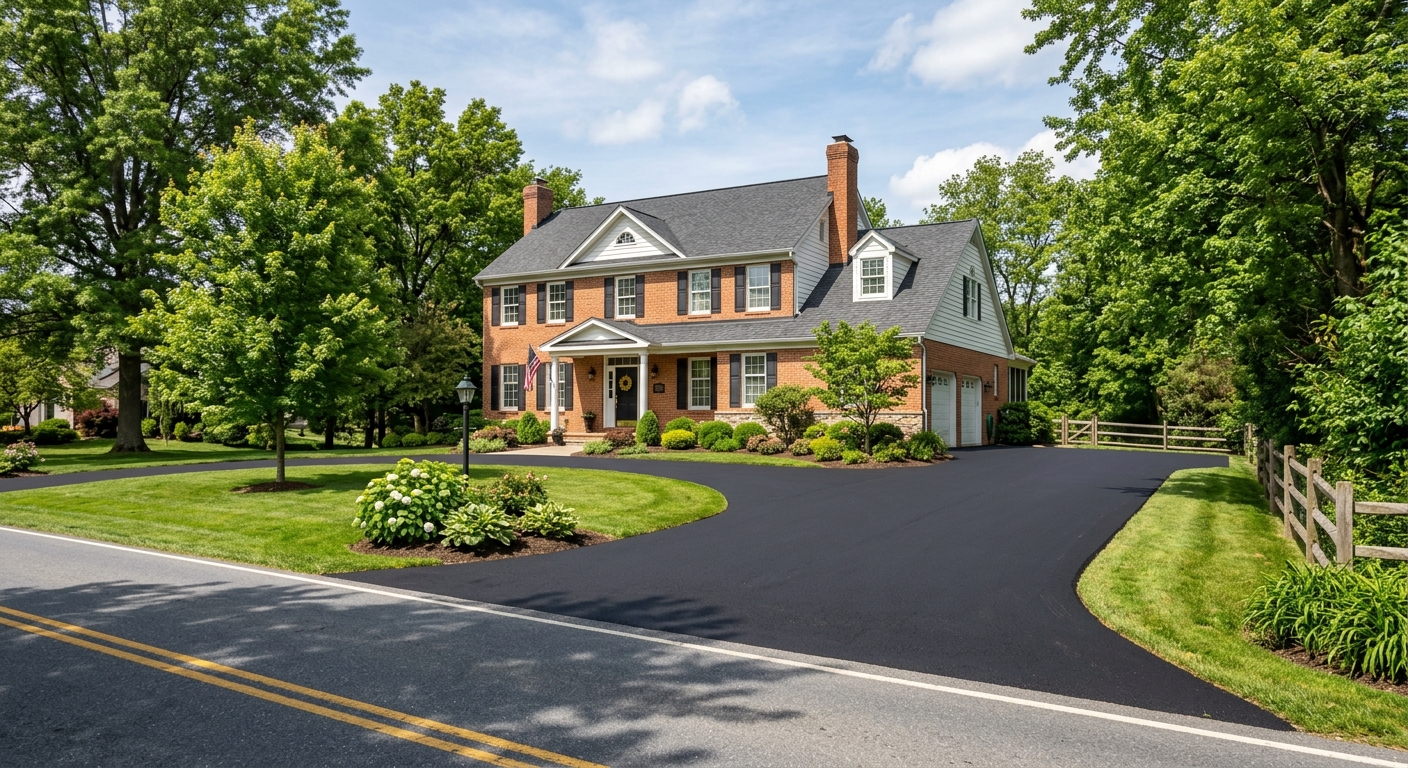
Newtown paving prices by scope — 2026
In Newtown, where 60.2% of the homes are single-family and the homeownership rate stands at 76.9% (U.S. Census Bureau, ACS 2024), driveway costs are a real factor for most residents. A driveway in Newtown is not a luxury—it’s a maintenance issue that comes with most detached houses here and one you can’t avoid indefinitely.
What you pay for paving in this region of Delaware County is especially sensitive to the underlying work. This is not just about what you see on top—if you’re comparing two quotes for a new driveway, understand that most of the price gap is underground. Delaware County sits on glacial till and compacted urban fill, which means your paving contractor needs to address soil stability and drainage or you’ll pay for it later. With our freeze-thaw cycles, a skimped base lets your investment crack, rut, and heave within a few winters. Adequate prep work is what buys you lifespan.
Below is a reference table for what Newtown homeowners can expect to pay for different paving projects in 2026. These figures are for a typical driveway—price ranges run wide because square footage and the condition of your current base drive the total more than your choice of surface material.
| Service |
Best for |
Lifespan |
Price range |
| Asphalt — full replacement with new base |
failed base, structural cracking |
20–30 yrs |
$3,800–$9,900 |
| Asphalt overlay / resurfacing |
sound base, surface cracking only |
8–15 yrs |
$1,650–$4,900 |
| Sealcoating — single application |
preventive maintenance on sound asphalt |
2–4 yrs |
$225–$750 |
| Concrete — new installation |
long service life, low maintenance |
30–50 yrs |
$5,500–$13,000 |
| Crack filling and patching |
isolated cracks under a quarter inch |
1–3 yrs |
$200–$800 |
| Gravel driveway |
rural, budget, long runs |
5–10 yrs with upkeep |
$900–$3,500 |
Estimates for a typical Newtown driveway. Square footage and base condition drive these figures more than material choice.
Choosing a paving company
Homeowners in Newtown should insist on thorough vetting when hiring a paving contractor, especially with Delaware County’s saturated Philadelphia metro market. First, check for Pennsylvania Home Improvement Contractor (HIC) registration if the job is over $500—verify this at hic.attorneygeneral.gov. Accept nothing less than a company with a verifiable, local business address: a PO Box or mobile number alone is not a good sign. In this line of work, someone using only rented equipment may not be around to stand behind their warranty. Any seasoned outfit should give you references, not just from last month, but from drives at least three years old—because even the worst paving looks fine on day one.
Local knowledge counts: Newtown contractors buy asphalt from plants in Eddystone or South Philadelphia. If a contractor can’t name their supply plant, you’re dealing with a broker or a crew who won’t be around after the final check clears.
- Verify HIC registration (hic.attorneygeneral.gov).
- Ask for proof of workers' compensation (WCAIS: wcais.pa.gov).
- Insist on a local, fixed business address.
- Check for owned, not just rented, paving equipment.
- Request references from jobs 3+ years old in Delaware County.
- Ask what asphalt plant supplies their material—should be Eddystone or South Philly.
- Only accept written contracts for jobs over $500 (required by law).
- Confirm 3-day right to cancel in the contract.
- Clarify who arranges permits if needed—township or PennDOT for approaches.
- Avoid up-front full payment; deposit and final payment is normal.
- Push for specifics: square footage, depth, materials, and compaction.
Red flags: refusal to give an address, supply references, or name their asphalt source; high-pressure for immediate commitment; cash-only deals; or offers to "waive your deductible"—which is not permitted under Pennsylvania law.
What's under the asphalt matters more than the asphalt
A long-lasting driveway in Newtown starts well below the surface. The assembly, from bottom up, is what carries the weight and holds up through our distinct southeastern Pennsylvania freeze-thaw cycle. Under the asphalt, the puzzle is: subgrade (existing soil), compacted aggregate base, and only on top, the asphalt layer. No amount of thickness in the asphalt itself can compensate for a weak or unprepared base beneath.
Glacial till and compacted urban fill, which are common subgrades across Delaware County, don’t drain water quickly. That’s a problem here: when saturated, water in the subgrade freezes, expands, and lifts the pavement—a process called frost heave. The slab buckles and cracks from below, not above. Our 30-inch frost depth means base and drainage matter more here than in a milder, drier place. A thick, poorly compacted or untested base will rut or shift; you just won’t see it until year three or four.
Where quotes go bad: crews skip digging out the old base and lay new asphalt over a failed one, or worse, on a thin, barely-compacted layer. They may rush in a single lift rather than compacting stone in layers. They don’t test base compaction and may not even specify what aggregate they use. All this is invisible when the trucks leave and obvious the winter after next.
Do not rely on verbal promises. Get these specs in writing: at least 6 inches (8 if heavy vehicles) of 2A modified crushed stone aggregate, mechanically compacted in two or more lifts; asphalt thickness of at least 2.5–3 inches after compaction; and confirmation that base was tested for density as part of the work.
What you need before paving in Newtown
Repaving an existing residential driveway in Newtown—without enlarging or changing its footprint—typically does not require a building permit, according to the standards followed in Delaware County municipalities outside Upper Darby Township. This is good news, as it saves paperwork and delays for most homeowners.
However, if you plan any work where your driveway meets a public road (the driveway approach), that portion almost always requires a specific permit. If the approach is onto a state route, PennDOT District 6 handles permits via a Highway Occupancy Permit. Approach work on municipal streets goes through your local township office. Don’t expect your paving contractor to handle this by default—ask specifically.
Adding new or more impervious surface—widening or adding a parking pad—can trigger more complicated approvals and may require stormwater management to prevent runoff onto neighbors or the public right-of-way. Even with “permit-free” projects, you are still liable if you create drainage problems.
Work only with contractors who can show active Pennsylvania HIC registration (verify at hic.attorneygeneral.gov) and provide a workers’ compensation certificate via the WCAIS system (wcais.pa.gov). All jobs over $500 require a written contract and offer a 3-day right to cancel—those are not optional, they’re Pennsylvania law.
Widening, extending or adding a parking pad
Project plans that go beyond swapping in fresh asphalt include widening driveways for a second car, extending the run to a detached garage, installing a turn-around, or paving a parking pad. These changes are common in Newtown’s older developments, where driveways were often sized for a single vehicle and today’s household needs have outgrown that layout.
Once you break the original footprint, you cross into new territory for both permits and construction. You’re building on undisturbed subgrade, which requires a correctly installed and thoroughly compacted new base—otherwise, the seam between old and new sections will crack as the soils settle at different rates. Adding surface area may also bump you against township impervious cover restrictions or stormwater management requirements, and minimum setbacks or buffer rules can dictate how close to the property line you get.
If you extend your approach into the roadway, you’ll need a separate permit from either your municipality or PennDOT District 6, depending on the road’s jurisdiction. This is on top of any potential stormwater reviews for substantial expansions. Don’t skip these steps: they protect you from surprise fines, unpermitted work tear-outs, and drainage headaches down the line.
Asphalt or concrete for a Newtown driveway?
In Newtown’s climate, your driveway’s ideal surface comes down to how you reconcile performance and upkeep over decades. Asphalt and concrete both work, but southeastern Pennsylvania’s humid summers and moderate freeze-thaw cycles (with a 14°F winter design temp) weigh heavily in the decision.
Asphalt is the workhorse here—it’s flexible, moves with frost, and hides minor settlement. That’s why most local drives are paved that way. Concrete is durable if it survives the first ten winters, but it is rigid. Exposure to de-icing salt, especially in a snow-prone county like Delaware, often causes spalling and surface scaling—long before the slab would otherwise fail. Unlike cracks, spalls can’t be patched invisibly. You must commit not to use salt-based de-icers—something few homeowners actually stick to through icy winters.
Asphalt is more forgiving: it can be patched and resurfaced with overlays for less than full replacement, and, provided you sealcoat every few years, will last 20–30 years. Concrete commands a bigger up-front spend, but you’re buying potential longevity—if you can avoid salt and rely only on sand or specialty “safe” de-icers.
Paver driveways and gravel are legitimate in some cases. Pavers cost more up front but let you replace a failed section without touching the rest; gravel is cheaper with excellent drainage, but maintenance and weed intrusion are ongoing.
| Option |
Installed cost |
Maintenance |
Freeze-thaw performance |
Lifespan |
| Asphalt — new install |
$3,800–$9,900 |
sealcoat every 3–4 yrs |
excellent, flexes |
20–30 yrs |
| Asphalt — overlay |
$1,650–$4,900 |
same |
good if base is sound |
+8–15 yrs |
| Concrete |
$5,500–$13,000 |
low, avoid de-icing salt |
fair, spalls with salt |
30–50 yrs |
| Pavers |
$8,800–$13,000 |
individual units replaceable |
good, settles gradually |
25–50 yrs |
| Gravel |
$900–$3,500 |
top-dress every 2–3 yrs |
excellent drainage |
indefinite with upkeep |
Newtown's ground and what it means for paving
Under much of Newtown and the older developments in Delaware County, your driveway sits atop glacial till and compacted urban fill. These soils aren’t forgiving: they hold water, which means frost heave is a persistent threat every winter. You’ll notice, especially in inner-ring suburbs built between 1920 and 1960, that many driveways were poured or laid with minimal preparation—sometimes straight onto whatever soil the builder found, often without a true aggregate base.
Those shortcuts might have been fine in a drier, more temperate place, but with our 14°F winter design temperature and a 30-inch frost depth, problems show up as settlement, alligator cracking, and “bird baths” that hold water. Glacial till in particular needs more stone base—six inches is a starting point, not a luxury—because it drains slowly, and every freeze means another cycle of expansion and contraction.
If you’re resurfacing, demand that cracks and drainage problems be addressed fully. For new driveways or major changes, don’t let any contractor talk you into a thin base or shortcutting compaction: with Newtown’s subgrade, you’re buying years of peace or paying for trouble.
Frequently asked questions — driveway paving in Newtown
How long before I can drive on a new asphalt driveway?
For Newtown homes, you should wait at least 3–7 days before driving a passenger vehicle on new asphalt, depending on temperature and humidity, with longer waits in cool, shaded yards. The idea is to give the surface time to cool and harden fully—summer installations may cure a bit faster. Heavy vehicles or trailers should stay off for at least two weeks if you want to avoid surface denting or rutting. During the first year, avoid parking in the same spot all the time and skip sharp turns or using jacks on the new surface. If you need to use your driveway right away, sometimes a thin temporary gravel path can help for emergencies. Most full asphalt replacements in Newtown run $3,800–$9,900, and that investment is protected by letting it cure up front.
What is the difference between crack filling and sealcoating?
Crack filling and sealcoating are both maintenance for Newtown driveways, but they solve different problems. Crack filling targets gaps, usually less than a quarter inch wide, and fills them with rubberized material to keep water from getting beneath the asphalt and causing more damage in freeze-thaw cycles. It’s best for isolated, early-stage cracks. Sealcoating, on the other hand, involves applying a liquid sealant over the whole asphalt surface—even if you’ve never had cracks—as a preventive against UV, oxidation, and minor water penetration. Sealcoating refreshes appearance and can help extend life, but it won’t fix any structural problem. A crack filling is quick, often $200–$800, while sealcoating on a typical drive is $225–$750. Both are smart, but don’t expect either to fix a failed base or deep damage.
Asphalt or concrete for a Newtown driveway?
For most Newtown homeowners, asphalt is the more practical route. With our moderate but real freeze-thaw cycling and a frost depth to 30 inches, asphalt simply handles ground movement better—it flexes, so it’s less likely to crack. Concrete lasts longer on paper, but here, de-icing salts and winter cycling can cause it to spall and lose surface integrity well before it “wears out.” That means unless you can reliably avoid all salt, the longest-lived concrete driveways are rare in Delaware County. Asphalt is up-front cheaper—$3,800–$9,900 for a typical replacement—and with periodic sealcoating and patching, serves most families well. Concrete drives cost more up front ($5,500–$13,000), but require a real commitment to salt-free winter care.
What slope does a driveway need for drainage?
Newtown driveways need at least a 2% slope—about a quarter inch drop per foot from the garage or house out to the street or designated drainage—to ensure water runs off and doesn’t sit or flow toward buildings. This is critical because Delaware County’s glacial till soils drain poorly, and any standing water quickly finds its way into subgrade freeze-thaw problems or even your foundation. A well-installed asphalt driveway (usually $3,800–$9,900 by local contractors) should always specify the slope in writing. Don’t let anyone talk you into flat or barely-graded work, no matter how neat it looks; you’ll regret it the first time it ices up or pools after a storm.
Is gravel a cheaper option in Newtown?
Gravel can be a practical and cost-effective choice, especially for long rural drives or lower-priority areas where looks aren’t everything. Typical gravel installation in Newtown runs $900–$3,500, plus periodic regrading and adding topstone every few years. The benefit: excellent drainage and zero frost heave worries on our glacial till soils. But you’re trading curb appeal and convenience—gravel tracks indoors, ruts with heavy use, and will need some hand-work every season. For urban or higher-end neighborhoods, gravel’s rarely preferred, but it gets the job done without breaking the budget.
How much does a concrete driveway cost in Newtown?
A new concrete driveway for a single-family home in Newtown will cost somewhere between $5,500–$13,000, with most projects landing close to the middle of that range. Variables include size, prep work, and finish style. Concrete comes with a higher up-front spend compared to asphalt, but brings a longer potential lifespan—sometimes 30 to 50 years—if you keep de-icing salts off it. In Delaware County’s climate, some spalling and surface flaking from road salts is likely, especially near the street. Concrete may be a smart investment for homeowners who prize long-term, low-maintenance finish and are willing to avoid salts in winter.
Why does my driveway have depressions that hold water?
Water-holding dips, or “bird baths,” form in Newtown driveways mostly due to poor base preparation or long-term settlement, common with our glacial till and fill subgrades. If the original contractor skimped on base depth or failed to compact the aggregate properly, the surface will settle unevenly over time, especially after freeze-thaw cycles. These wet spots are not just a nuisance—they accelerate asphalt breakdown and can create slip hazards in winter. Patch repairs can run $200–$800, but if depressions are widespread, a full resurface or even base replacement may be needed. Always demand written base specs on any new work so you’re not back at square one.
Are door-to-door pavers a problem in Newtown?
Yes—door-to-door pavers remain an issue, even in Newtown’s established neighborhoods. These crews often arrive after working a larger job nearby and offer “leftover material” at a supposed discount. The catch: they rarely offer a written contract, seldom have proper Pennsylvania HIC registration, and almost never stick around if your new drive cracks or crumbles. Jobs often involve minimal prep—just a quick overlay or thin coat that won’t last through the next winter. A quick-talking outfit offering a full driveway for less than $1,650–$4,900 should be treated as a major red flag. Stick with local, verifiable firms who provide references and documentation.
How do I verify a paving contractor in Pennsylvania?
For any paving project in Newtown or Delaware County, you should check two things: the contractor’s HIC registration and proof of current workers’ compensation. Start by verifying their state Home Improvement Contractor registration online at hic.attorneygeneral.gov—a legal requirement for contracts over $500. For workers’ comp coverage, ask for their certificate and check coverage status through Pennsylvania’s WCAIS system (wcais.pa.gov). Legitimate paving outfits will provide you with written references, a contract, and a copy of both—no pushback. If you get a price quote for a new drive in the $3,800–$9,900 range but no paperwork, walk away. This verification protects not just your investment but your insurance coverage if there’s ever an accident on your property.