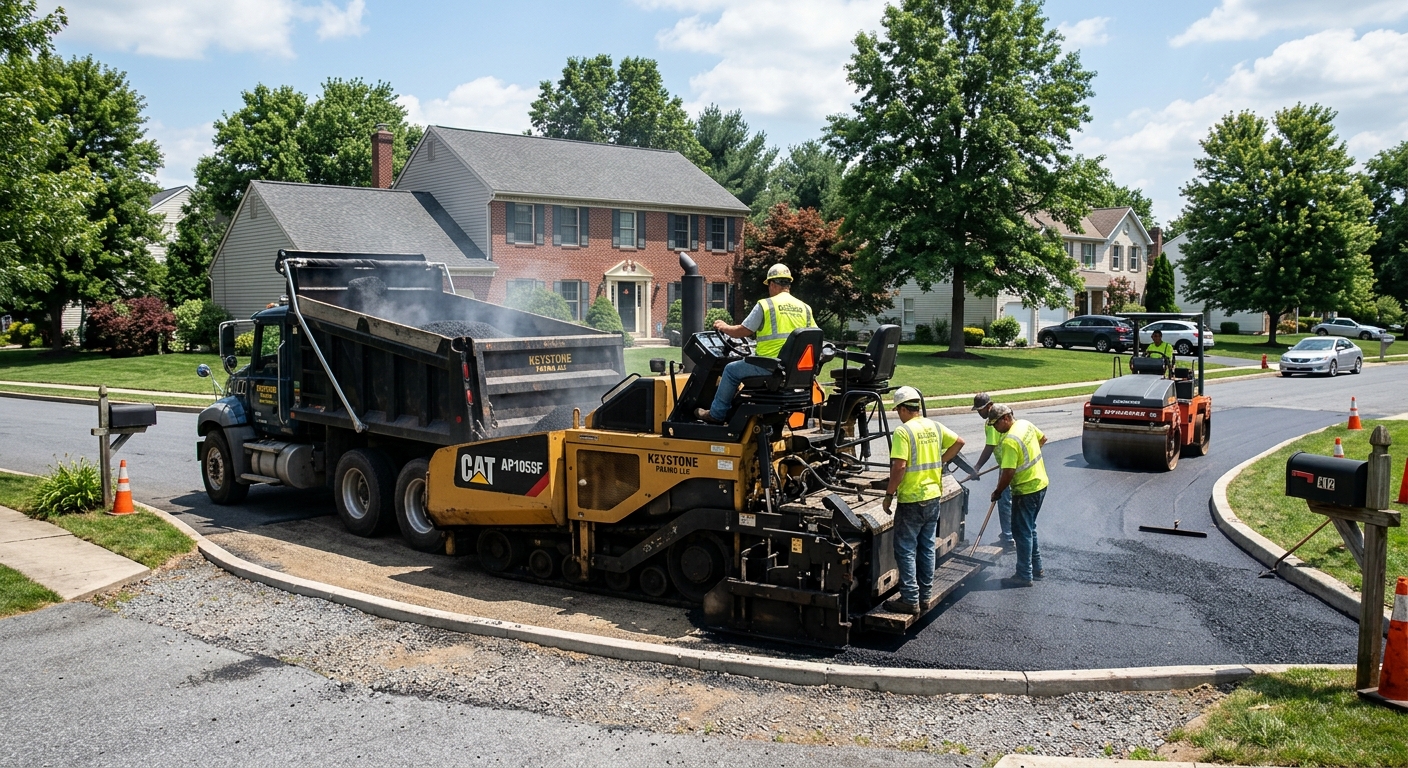
Driveway paving costs in Lehman — 2026
Lehman’s driveways are almost always attached to single-family homes, and over 88% of households here own, not rent (U.S. Census Bureau, ACS 2024). That means the cost of maintaining a driveway falls directly on the homeowner. Unlike smaller town lots, Pike County’s second-home developments and rural properties feature wide, sloped driveways—often over glacial till with rocks and unpredictable soil beneath. The brutal freeze-thaw cycles of the Poconos put every driveway’s base to the test.
When you get quotes for paving in Lehman, you’ll see as much as a twofold difference. What drives that? Most of it is invisible unless you’re standing in the excavation: the thickness, quality, and compaction of the stone base. A weak base means cracks in two winters, no matter what you see up top.
Asphalt and concrete differ not only up front, but in how they deal with the region’s snow, frost, and runoff. Below are realistic 2026 price ranges for common options—expect to be near the high end if you live down a long rural lane or need extra regrading due to steep terrain.
| Service |
Best for |
Lifespan |
Price range |
| Asphalt — full replacement with new base |
failed base, structural cracking |
20–30 yrs |
$3,300–$8,600 |
| Asphalt overlay / resurfacing |
sound base, surface cracking only |
8–15 yrs |
$1,450–$4,300 |
| Sealcoating — single application |
preventive maintenance on sound asphalt |
2–4 yrs |
$200–$650 |
| Concrete — new installation |
long service life, low maintenance |
30–50 yrs |
$4,800–$11,500 |
| Crack filling and patching |
isolated cracks under a quarter inch |
1–3 yrs |
$200–$800 |
| Gravel driveway |
rural, budget, long runs |
5–10 yrs with upkeep |
$900–$3,500 |
Estimates for a typical Lehman driveway. Square footage and base condition drive these figures more than material choice.
Getting thirty years out of a driveway
Longevity in Northeast PA starts with controlling water. The single best thing you can do for any driveway—especially with this region’s 36-inch frost depth and freeze-thaw swings—is to fill cracks before water seeps through to the base and starts frost heaving. Catching cracks early practically doubles the life of the surface and is much cheaper than letting water open up the structure below.
Keep the edges supported—every time a car drives off the edge or runs heavy mowers along the side, you risk breaking away support. Maintain positive drainage: water should flow off the driveway, not pool or run toward the house or into the joints between old and new pavement. Avoid parking point loads—jack stands, loaded dumpsters—on fresh pavement, especially in the first summer. For asphalt, wait a solid 2–3 days before parking, and about 2 weeks before turning wheels in place on a new surface, especially in hot weather.
De-icing is unavoidable here, but use salt sparingly on concrete, as it speeds up surface flaking (spalling). For asphalt, the bigger concern is rapid freeze-thaw cycling from repeated de-icing. Sand or calcium chloride are alternatives, but cost a bit more and don’t harm the actual surface. The Pocono winters are harsh—no surface is zero-maintenance, but catching water problems early is where you get extra years.
Widening, extending or adding a parking pad
Driveway expansions—whether widening for a second vehicle, extending toward a garage, or putting in a new parking pad—change the game versus a straight resurfacing. Once you add to the existing footprint, you’re building a new base from scratch over undisturbed, rocky subgrade. That’s more grading, more aggregate, and more trucking, especially out here where asphalt and stone come from Scranton or Lackawanna County and haul costs matter.
Every joint between old and new paving will always be a weak point that can open up first as things shift with frost. Expect a visible seam and plan on periodic sealant at that join. If you’re in a development or near a township boundary, check setback requirements before starting—these can limit how close you can pave to a property line. Lehman’s stormwater rules require that you do not direct runoff onto a neighbor’s lot, and expanding impervious surface can also mean township or county review.
If your driveway connects to a state route, PennDOT District 4 will require a Highway Occupancy Permit for the approach, and most Pike County townships want to review expansions for runoff and zoning. Details matter—no two yards in Lehman have the same slopes or soil.
Driveway permits, approaches and stormwater rules
In most Pike County townships, including Lehman, repaving a driveway in its exact existing footprint does not require a building or zoning permit. You can patch potholes or lay an overlay on your old base without calls to the township office—this saves both time and money. However, adding a new driveway, fully replacing the base, or widening/extending the paved area will typically trigger a land use or building permit, especially in Lackawaxen Township and areas overseen by the Pike County Office of Planning.
For any driveway that connects to a state route, PennDOT District 4, not the township, issues required Highway Occupancy Permits for the driveway approach. This catches many people off guard—and you will not pass final inspection without it.
If you increase the size of your driveway, you add impervious surface, which can trigger additional stormwater management requirements. No matter what zoning says, you cannot direct runoff onto a neighbor’s property without risking legal trouble or a forced regrade.
Before you hire, verify that your contractor holds an active Home Improvement Contractor (HIC) registration (check at hic.attorneygeneral.gov) and has valid workers’ compensation coverage (verify at wcais.pa.gov). Written contracts are mandatory over $500 by state law, and you get a three business-day cancellation right. Don’t skip the paperwork—it’s there for your protection.
Sealcoating: what it does and what it doesn't
Sealcoating in Lehman mostly does what it claims—it improves appearance and adds a sacrificial layer against oxidation, sun, and leaks from oil or fuel. For a driveway in good shape, a properly applied seal coat keeps the surface black, slows hairline crack development, and makes snow shoveling easier. It does not make an old or failing driveway last longer than its base allows.
What sealcoating doesn’t deliver is structural repair. It won’t fix a soft, broken, or alligatored driveway—at best, it will make problems less obvious for a season or two. When sealcoating is pushed as a cure-all by flyers or door-knockers, be skeptical.
Sealing too often causes its own problems. Layer after layer builds up, cracking and peeling in sheets. Applying sealant to new asphalt before it fully cures—that’s months, not weeks—locks in volatile oils and leads to soft, damaged spots. In Pike County, every 2–4 years is about right for active driveways, but never annually. First application should wait at least 90 days after paving.
Crack filling does more for your driveway than a sealcoat. Rout and clean cracks, fill them with proper hot-applied material, and reseal as needed. A quality sealcoat takes a few hours and requires manual edge work and a squeegee application. A suspiciously low quote (under $200–$650) may mean a diluted spray-on job, which does nothing but stain the surface.
Why you can't pave in February
You simply cannot pave or pour concrete in a Lehman winter and get a quality result—no professional even tries. Hot-mix asphalt must be laid while it’s still hot; in Pike County’s climate, the mix cools too fast from October to April, never compacts properly, and yields spongy, weak results that crumble with the first freeze. Regional plants supplying asphalt and aggregate from the Scranton area shut down in winter, so materials can't even be shipped in.
Concrete, for its part, is just as sensitive—below-freezing air and subgrade temperatures in winter (with local design lows of 4 °F and a frost depth of 36 inches) mean new pours freeze, scale, and chip before they ever cure out. Add the high snow and severe ice-dam exposure this region sees, and winter work simply fails.
Paving in Lehman runs from late April through October most years, with the most reliable windows in May–June and September–early October. Shoulder seasons are your best bet for scheduling flexibility and pricing—the mid-summer months are booked solid, and any crew willing to lay in late November is not using top materials or practices. There is no bargain worth a driveway ruined by poor timing.
Finding a legitimate paver in Pike County
In Pike County’s sparse rural market, the risk of hiring a “storm chaser” paver is real. Always check for a Home Improvement Contractor (HIC) registration at hic.attorneygeneral.gov—by law, all contracts over $500 must have one, and that’s most driveway jobs. Workers’ compensation coverage can be verified at the state’s WCAIS portal (wcais.pa.gov), protecting you from liability for on-site injuries.
Demand a local business address—contractors working out of trucks with out-of-county plates are a red flag here. A legitimate paver owns their own rollers, pavers and trucks, not just rented gear. They should be able to provide references from jobs three or more years ago: a new overlay may look perfect in photos, but only time shows how a base or seam holds up in Pike County’s harsh climate.
Ask where their asphalt and stone come from. All paving here relies on aggregate and hot-mix from the Scranton/Lackawanna County plants. If they can’t tell you their supplier by name, they’re not connected locally and may be reselling marked-up work.
- Check HIC registration at hic.attorneygeneral.gov
- Verify workers’ comp at wcais.pa.gov
- Require a written estimate and contract for all work
- Insist on a local Pike County business address
- Ask for three-year-old (or older) references
- Look for owned equipment, not all rentals
- Confirm supplier—must be from Scranton/Lackawanna area
- No deals for waiving your insurance deductible (illegal)
- No payment in full until complete and permitted (if needed)
- Ask how deep they build the aggregate base here—should be more than other areas
- No pressure to sealcoat new asphalt within the first month
- Check for a real office phone, not just a mobile number
Red flags: out-of-state plates, cash-only pricing, no paperwork, or offering to pave outside the legal season. Anyone vague about supplier, business address, or insurance is not someone to entrust with a driveway here.
Frequently asked questions — driveway paving in Lehman
Why are paving quotes in Lehman so different from each other?
The range of paving quotes in Lehman is mostly down to what’s happening below the surface, not just the size or look of your driveway. Contractors in Pike County are forced to contend with glacial till—rocky subsoil that requires far more base material and grading. One company may quote for a proper 8-inch compacted stone base; another might cut corners and lay only half that depth, leaving you vulnerable to cracks and frost heave after our Northeast PA winters. Add in the travel cost from Scranton-area plants, and rural properties can see a real price spread. Quotes for full asphalt with new base typically run $3,300–$8,600. If a bid seems much lower, ask what’s being omitted—cheap paving rarely lasts here.
Are pavers worth the cost in northeastern Pennsylvania?
Paver installations—interlocking bricks or concrete blocks—aren’t common in Lehman because they cost more up front than asphalt or plain poured concrete, and our freeze-thaw cycles can shift pavers if the base isn’t top-notch. Most local homes opt for asphalt or concrete because the climate demands a thicker, more stable base—especially as 91% of homes here are detached and see wide driveways. Asphalt is the middle ground, at $3,300–$8,600 for a full replacement, while concrete runs more—usually $4,800–$11,500—but lasts longer. Pavers suit some patios and walkways, but for driveways in this region’s climate, they only pay if you’re prepared for extra prep, ongoing joint sand, and snow maintenance.
How much does it cost to widen a driveway?
Widening a driveway in Lehman (for a second car or more parking) involves cutting new subgrade, bringing in additional aggregate, and more site grading—the rocky, sloped ground here means extra material and labor are unavoidable. For asphalt, you’re looking at $3,300–$8,600 for a complete new base if you expand significantly, but small additions or overlays can be less, in the $1,450–$4,300 bracket. The exact number depends on square footage and drainage needs. Any new impervious area might also require permit review or stormwater management. Budget at the middle-to-high end of these ranges unless you’re only adding a narrow strip on level ground.
What kind of soil is under Lehman driveways?
Pike County, including Lehman, sits on glacial till—think rocky, uneven soil with everything from sand to big stones mixed in. This subgrade demands a thicker, well-compacted stone base for any driveway, especially one expected to handle snow plow blades and freeze-thaw action. A basic rural asphalt drive may need 8 inches or more of compacted aggregate—half measures just don’t last in this climate. Cutting costs on base prep leads to cracks and settling in just a few winters. With full replacement, expect to pay in the $3,300–$8,600 range, which reflects just how much work goes under the surface.
What does compaction in lifts mean?
Compaction “in lifts” means building up the driveway base in thin, controlled layers—usually 2–4 inches deep at a time—then compacting each layer with a roller or plate until it’s dense and stable before the next layer goes on. Here in Lehman, with glacial till soils, this step is vital. Thick, loose lifts settle unevenly—especially after a wet winter—leading to dips, cracks, and eventual failure. Good crews build drives in lifts, giving you structural strength from the bottom up. For asphalt, you typically want at least 4–6 inches of compacted aggregate base built this way, plus the top lift of hot-mix. It’s one of the reasons a well-built drive costs more here—full replacement falls in the $3,300–$8,600 range, but you get decades, not just years, of smooth use.
How do I verify a paving contractor in Pennsylvania?
To verify a paving contractor in Pennsylvania, check that they hold a Home Improvement Contractor (HIC) registration with the Attorney General—search hic.attorneygeneral.gov for their number. Also confirm workers’ compensation coverage through the WCAIS portal (wcais.pa.gov), especially since accidents are a risk on uneven Pike County sites. Be wary if they don’t list a local business address in Pike, or won’t provide written estimates and old references. For a full asphalt job in Lehman, you’re likely spending $3,300–$8,600, so checking credentials is worth your time. Avoid any paver who hesitates on paperwork, as state law requires a contract for jobs over $500.
Is sealcoating a scam?
Sealcoating is not a scam, but it is widely oversold. In Lehman, a good sealcoat protects a driveway from sun, oil, and water, and revives the look of tired asphalt. But it won’t fix structural damage or extend the life of a failed driveway. The real scam is the “$99 special” or any contractor pushing yearly spray-only applications—those cut corners and add nothing but a slippery, peeling layer. For legitimate maintenance, most area driveways benefit from sealcoating every 2–4 years for $200–$650. More important is proper crack filling and drainage; sealing alone won’t stand up to Lehman’s harsh winters if the base is gone.
What causes concrete to spall or flake in Lehman?
Concrete spalling in Lehman is mostly the result of freeze-thaw cycles and salt exposure in winter. Water enters small surface cracks, then freezes and expands—chipping away at the surface year after year. Road salt, used for de-icing, speeds up the breakdown by reacting with the concrete and increasing moisture penetration. Pouring in the cold, using too much water in the mix, or failure to cure concrete properly are also common problems in Northeast PA. A good concrete drive, installed from late spring through early fall, typically costs $4,800–$11,500 here, and resists spalling when mixed, poured, and sealed correctly. It's why timing and workmanship really matter.
When is the best time of year to pave in Lehman?
The absolute best times for paving in Lehman are late spring (May–June) and early fall (September–early October). This is when temperatures let asphalt plants operate, and compaction is proper before the mix cools. Pike County’s climate—with winter lows well below freezing—means paving outside this window is asking for premature cracks and soft spots from poor curing. Most years, you can’t get hot-mix after October because local plants shut for winter. Scheduling your project in the shoulder seasons may also help you catch better pricing—jobs start at $3,300–$8,600 for a full replacement. Crews offering to pave much later are not working by professional standards.