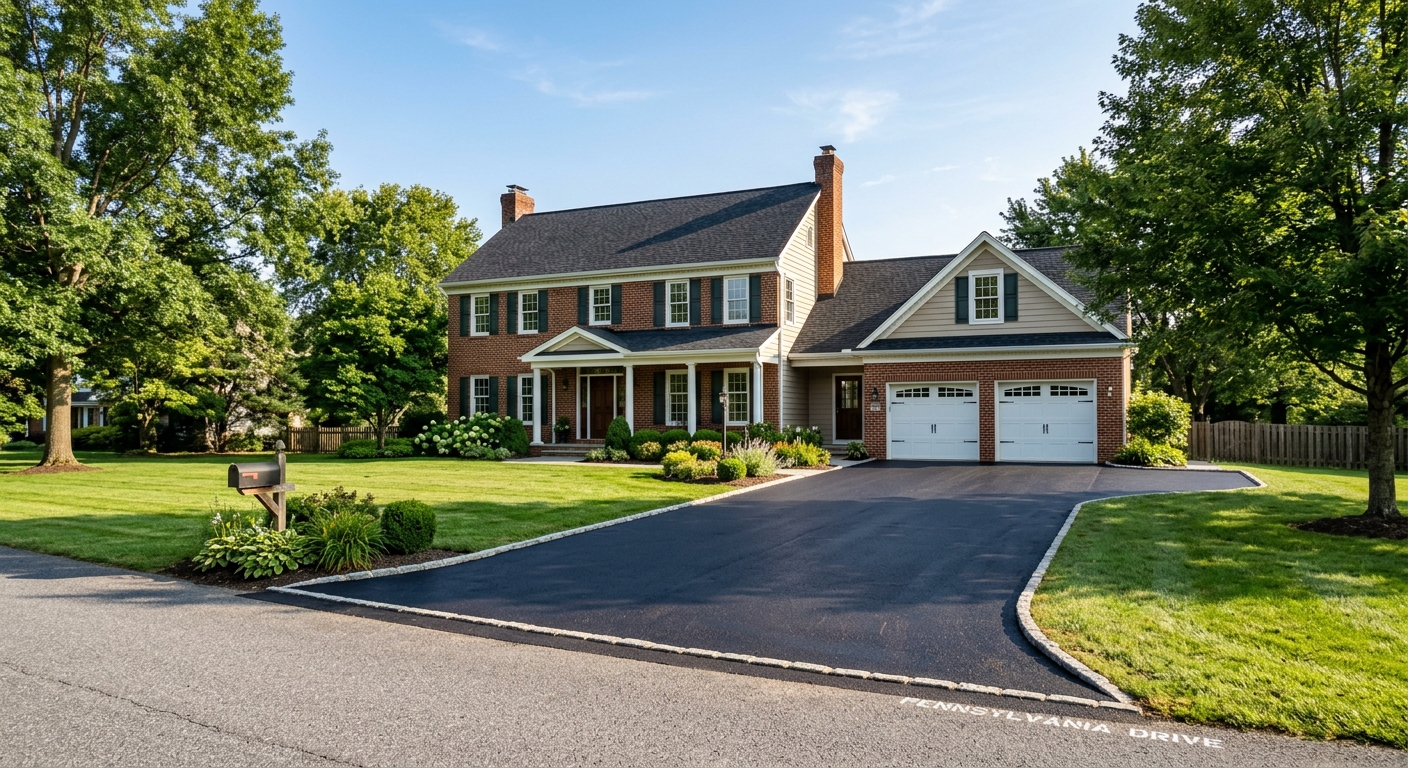
Upper Gwynedd paving prices by scope — 2026
In Upper Gwynedd, a driveway is a typical homeowner’s responsibility—over half the homes here are single-family (51.1%), and the homeownership rate is a high 76.9% (U.S. Census Bureau, ACS 2024). If you own in this area, your driveway is not just a patch of blacktop, but a significant asset—and it ages in ways that can’t always be seen from the surface. What drives most of the price difference between two paving estimates is below the top layer: the condition and construction of the base, the thoroughness of excavation, and proper site drainage.
In southeastern Pennsylvania, freeze-thaw cycles and silty clay or glacial till subgrade (typical of eastern Montgomery County) require a more robust build than what’s found in milder or drier climates. Cheap jobs often skip base prep, which is why two blacktops can look identical on day one but be worlds apart after a harsh winter. Whenever you see a surprisingly low price, it’s almost always coming out of the things you can’t check once the job is done.
| Service |
Best for |
Lifespan |
Price range |
| Asphalt — full replacement with new base |
failed base, structural cracking |
20–30 yrs |
$3,900–$10,000 |
| Asphalt overlay / resurfacing |
sound base, surface cracking only |
8–15 yrs |
$1,650–$5,000 |
| Sealcoating — single application |
preventive maintenance on sound asphalt |
2–4 yrs |
$225–$750 |
| Concrete — new installation |
long service life, low maintenance |
30–50 yrs |
$5,500–$13,500 |
| Crack filling and patching |
isolated cracks under a quarter inch |
1–3 yrs |
$200–$800 |
| Gravel driveway |
rural, budget, long runs |
5–10 yrs with upkeep |
$900–$3,500 |
Estimates for a typical Upper Gwynedd driveway. Square footage and base condition drive these figures more than material choice.
Numbers, not adjectives
If you’re comparing driveway estimates in Upper Gwynedd, insist on actual measurements and specifications. A quote should not read like an ad—it should read like a recipe. The most important variables in cost and lifespan are under the asphalt, not on top, and words like “high quality” or “heavy duty” mean nothing without numbers next to them. For this region, our humid summers, moderate freeze-thaw, and frost depth of 30 inches (see local code data) make proper excavation and a thicker base mandatory, especially on our silty clay or glacial till soils.
When someone says “we’ll put down three inches,” ask three inches of what? Is that post-compaction or loose? For asphalt, compaction reduces the thickness by about 20–25%, so two jobs promising “three inches” may deliver very different thicknesses.
What to insist on, in writing, in every job built to withstand Montgomery County’s conditions:
- Excavation depth (in inches) below finished grade
- Type and thickness of aggregate base (e.g., 6–8" of 2A modified stone)
- Compaction method for subgrade and base (vibratory roller or plate)
- Base installed in lifts, each compacted separately
- Asphalt binder course thickness (compacted)
- Asphalt surface course thickness (compacted)
- Mix designation for binder and surface (e.g., PennDOT 19mm binder, 9.5mm wearing)
- Edge treatment (tapered edge, stone shoulder, forms for concrete)
- Drainage slope and final grading to direct water off driveway
- Joint or seam type at connections to road or sidewalk (hot-tar joint, sawcut, etc.)
Driveway permits, approaches and stormwater rules
Most routine repaving and sealcoating jobs in Upper Gwynedd, if you’re not changing your driveway’s footprint, do not require a building permit. This is consistent with rules in surrounding Montgomery County townships—maintenance in the original layout avoids most red tape. However, if you are widening the driveway or touching the approach (the portion at the street), you’ll usually need a permit, and not from the place you might expect. In Montgomery Township, for example, the Public Works Department—not the building department—issues road occupancy permits for driveway approaches on township roads.
If your project increases the amount of impervious surface, even by a few feet, you might trigger stormwater management requirements. You cannot legally direct runoff onto a neighbor’s property, regardless of whether you have a permit. Good drainage design isn’t just code—it's protection against expensive water disputes.
Before hiring any paving contractor, verify that they are properly registered as a Home Improvement Contractor (HIC) through the Pennsylvania Office of Attorney General (hic.attorneygeneral.gov). Workers’ compensation insurance is required for all employers—check active coverage through WCAIS (wcais.pa.gov). These are enforceable consumer protections built into state law.
When paving can actually be done in Upper Gwynedd
In southeastern Pennsylvania, paving season isn’t a matter of personal preference—it’s governed by temperature, material supply, and what produces a long-lasting job. Hot-mix asphalt must be laid when both air and ground temperatures are warm enough. Below roughly 50°F, the mix cools too quickly to achieve proper compaction, leaving you with a brittle, porous surface that won’t survive even a few freeze-thaw cycles. Local asphalt plants—most supplied from along the I-276 and US 202 corridors—simply close for winter, so asphalt is unavailable for months.
Concrete is also limited: it cannot cure properly below freezing, and cold, wet springs or falls raise the risk of spalling and pop-outs. The winter design temperature here is 14°F, with regular freeze-thaw and wet, humid summers. All this means the genuine paving window in Upper Gwynedd is mid-April through October for asphalt, slightly longer for concrete if it can be protected.
Crews are busiest mid-summer. If you want to book a reputable company, target the spring or post-summer lull. Jobs booked out of season or from a contractor promising asphalt work “anytime, even late November” in our climate are waving a red flag—they’re either using subpar cold patch or cutting corners on prep and compaction.
The honest case for and against sealcoating
Sealcoating has its place, but it’s one of the most oversold services in Greater Philadelphia. Applied properly on aged but sound asphalt, it slows oxidation from the sun and guards against oil and chemical drips. It makes the driveway look fresh and dark, which is why realtors push it before listing a home. But there’s no structural benefit: sealcoating does not fill voids, it does not strengthen a soft or crumbling driveway, and it absolutely won’t “extend life” if the base is shot underneath.
What hardly anyone tells you: more is not better. Heavy, frequent sealing—especially spray-only—builds up layers that eventually dry out, crack, or peel. Sealing new asphalt before it’s fully cured (which takes months, not weeks) does more harm than good by trapping volatile oils. Realistically, sealcoating every 2–4 years is enough, and if the surface is still beading water and is free of hairline cracks, delay another year. The first application should only be made after the new pavement is fully cured.
Proper crack filling matters more. Filling cracks wider than a quarter inch with a hot-applied asphalt rubber prevents water intrusion, which is the main driver of base failure. A quality sealcoat—done with hand squeegee or heavy brush—costs $225–$750 for most driveways in Upper Gwynedd. If you’re quoted much less, expect a thin, hurried spray that does nothing for durability.
Comparing paving estimates in Upper Gwynedd
Reading a driveway paving quote in Upper Gwynedd, zero in on details and line items, not just bottom-line price. The quote should spell out measured square footage, so you’re paying for actual area, not a guess. Excavation and disposal details tell you if they’re removing soft layers or just paving over problems. The base should state aggregate type and thickness, and compaction needs to be mentioned—preferably in lifts, so each layer is stable. Both asphalt binder and surface courses should be listed with compacted depths. Pay attention to how the edges will be finished, and how the surface will be graded to shed water.
Cleanup, restoring the lawn edge, and a clear payment schedule—with a small deposit and balance on completion—are all best practice. Warranties are rare in this trade and typically exclude cracking, so know what’s actually being promised. If you get a one-line total with none of these terms, you can’t compare it to anything else, and it’s the easiest way to overpay for a “cosmetic” job that won’t last.
| Line item |
What to look for |
Red flag if… |
| Area |
measured square footage stated |
eyeballed or absent |
| Excavation |
depth and disposal included |
'we’ll pave over it' |
| Base |
aggregate type and depth in inches |
'proper base' |
| Compaction |
method, and done in lifts |
not mentioned |
| Asphalt |
courses and compacted depth |
'3 inches' unqualified |
| Drainage |
slope and water direction stated |
silent |
| Warranty |
what is covered and what is excluded |
verbal only |
| Payment |
modest deposit, balance on completion |
full cash up front |
Local soil, drainage and driveway lifespan
The glacial till and silty clay subgrade common to eastern Montgomery County, including Upper Gwynedd, pose unique challenges. Clay soil, in particular, traps water and expands and contracts through freeze-thaw cycles, leading to heaves and cracks. Glacial till drains somewhat better but demands careful compaction and a thicker stone base to resist rutting and settlement. In this area, skipping on base depth is a false savings: the region’s frost depth is 30 inches, and a “standard” shallow install will simply not hold up.
Older post-1945 subdivision driveways, especially those in areas like Abington and Upper Dublin, often show surface wear but have surprisingly sound stone bases—unless shortcuts were taken during mass development. In many cases, resurfacing is viable if the base was well done to start with. If you don’t know what’s under your own driveway, cutting a few cores before deciding on a repair approach can be the wisest money spent.
Driveway lifespan here isn’t about whether you use asphalt, concrete, or gravel—it’s about drainage, base depth, and soil movement. If your ground holds water, invest in proper grading and a base built for southeastern Pennsylvania, not “what we use down south.”
Frequently asked questions — driveway paving in Upper Gwynedd
What are the signs of a failing driveway base?
A failing base in Upper Gwynedd will typically present as widespread, deep alligator cracking, depressions that hold water after rain, and areas where the surface has settled or heaved noticeably from freeze-thaw cycles. If you notice cracks that return soon after patching or sealcoating, or your driveway flexes underfoot or under car tires, these are signals the underlying support is compromised. Potholes that keep reappearing, and drainage that leaves standing water, are strong indicators as well. At that stage, patching or a surface overlay is only a short-term fix—replacement with a new base is usually the right call, which in this market runs $3,900–$10,000 for a typical Upper Gwynedd single-family home.
Is sealcoating a scam?
Sealcoating isn’t a scam in itself when honestly applied at reasonable intervals—it slows oxidation, helps protect the surface from spills, and makes old asphalt look newer. However, in Upper Gwynedd and the wider Montgomery County market, it’s very common for homeowners to be pitched aggressive annual or semi-annual sealing services, which do more harm than good. Too much sealant causes peeling, and sealing fresh pavement before it cures traps oils. A valid application is every 2–4 years once the surface is fully compacted and dry. At $225–$750 for most driveways, you should get a hand-applied or thick squeegee job—inflated claims about "doubling your driveway life" are not realistic. The real scam is selling sealcoating as a structural treatment, or charging for a one-minute spray that’s worn off in six months.
Is an overlay worth it or should I start over?
In Upper Gwynedd, an overlay or resurfacing can be a cost-effective solution if your existing asphalt base is in good condition—meaning no widespread deep cracks, depressions, or water issues. If problems are mainly cosmetic or minor surface cracking, overlay gives you 8–15 years of renewed surface for $1,650–$5,000. But if the problems originate deeper—base settling, soft spots, or alligator cracking—an overlay will often fail within a few winters due to the freeze-thaw cycles and silty clay soils here. A reputable contractor should core the old driveway or probe the base before advising. If the base is compromised, biting the bullet on a full replacement is the only durable fix.
Can I cancel a paving contract I signed at my door?
Pennsylvania’s Home Improvement Consumer Protection Act gives Upper Gwynedd homeowners the right to cancel a home improvement contract—including driveway paving—within 3 business days of signing if it was negotiated at your home. This is designed to protect against high-pressure tactics and snap decisions. The contractor is required by law to give you written notice of this right. If you’ve already given a deposit, the company must refund it if you cancel within this period. For jobs over $500, a written contract is required by law too. Any outfit that won't provide this or pressures you to waive your cancellation right is breaking the rules.
How much does it cost to widen a driveway?
Widening a driveway in Upper Gwynedd is priced by the additional square footage, plus any extra excavation and base preparation your soil requires. Factor in approach permits if the area near the road will change—common in Montgomery County. For a typical single-car extension, expect to pay between $3,900–$10,000 if you’re replacing the whole driveway, with smaller widenings closer to the low end. Concrete is pricier, at $5,500–$13,500, but usually lasts longer with less upkeep. These prices account for the thicker stone base needed for our local glacial till and clay soils.
Can asphalt be laid in cold weather?
No—in Upper Gwynedd and all of southeastern Pennsylvania, hot-mix asphalt paving is a warm-season job. Local asphalt plants shut down in winter, and even if you could get the mix, cold weather (design target here is 14°F) means the surface cools before it can be properly compacted. This leaves it porous, weak, and short-lived. If a contractor offers paving in late November or over winter, you’re likely getting a temporary cold patch or a job that will fail early. Standard paving windows here are April through October. Prices don’t usually drop for off-season because quality material simply isn’t available—so there’s no real savings.
What is the difference between binder and surface course?
In an Upper Gwynedd driveway, “binder course” refers to the first, thicker lift of asphalt placed over the compacted stone base. It's coarser, designed for strength and to absorb movement. The “surface course” (sometimes called wearing course) is a finer mix laid over the binder, built for smoothness, tight compaction, and weather resistance. Both must be called out in the scope with compacted thickness—often 2–3 inches binder, then 1–1.5 inches surface. Good specs in Montgomery County are a must: you don’t want just one thick layer. Done right, this approach can give you 20–30 years at $3,900–$10,000. Skipping the binder is a shortcut that shortens life, especially with our freeze-thaw cycles.
How many freeze-thaw cycles does Upper Gwynedd get?
Southeastern Pennsylvania typically sees dozens of freeze-thaw cycles each winter, with temperatures often bouncing above and below freezing from November through March. In Upper Gwynedd, that repeated expansion and contraction is hard on driveways, particularly on our silty clay or glacial till soils, which trap water in the base. That’s why proper base prep and thicker stone are standard recommendations for this region—not just a luxury. Short-cutting those specs might save up front but guarantees early surface failure. Addressing this with a well-built asphalt drive costs $3,900–$10,000 in 2026, but prevents patchwork repairs down the road.
What does sealcoating cost in Upper Gwynedd?
In the Upper Gwynedd market, a single, proper sealcoating service for a typical residential driveway costs between $225–$750. Where you fall in that range depends on the length, width, and amount of handwork needed around borders or cracks. This includes true squeegee or brush applications—spray-and-go jobs are sometimes cheaper but much less effective. If you’re quoted much less, expect a thin coat that won’t last the season. Remember, if your base or surface needs substantial patching, patch those areas first; sealcoating is only preventative, not corrective, maintenance here.