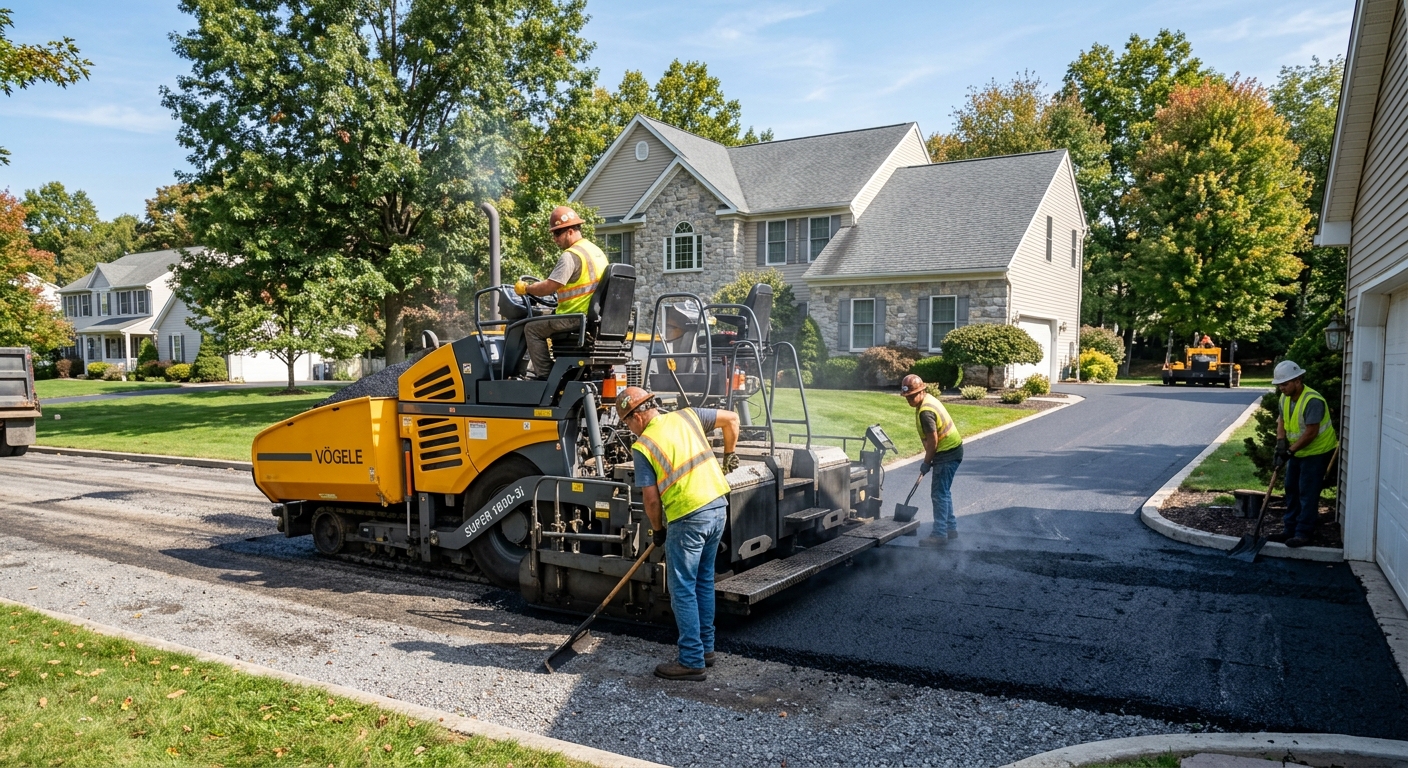
Driveway paving costs in North Fayette — 2026
In North Fayette, where 60.2% of homes are single-family and 76.3% are owner-occupied (U.S. Census Bureau, ACS 2024), a driveway is not just a curb appeal expense—it's a core part of your property’s function. Here, driveway paving costs are shaped as much by what lies beneath the surface as by the material you see. Our hillsides and climate, marked by harsh freeze-thaw cycles and native clay and shale soils, drive up the need for proper base preparation. It’s common to see two quotes for the “same” driveway differ by thousands—and most of that gap is explained by what the contractor does (or skips) under the asphalt or concrete, where you won’t see it until years later when the base heaves, cracks, or settles.
Don’t focus only on the surface material. In North Fayette, shortcuts under the asphalt are the number one reason driveways fail early. Here’s what you get for your money:
| Service |
Best for |
Lifespan |
Price range |
| Asphalt — full replacement with new base |
failed base, structural cracking |
20–30 yrs |
$3,700–$9,600 |
| Asphalt overlay / resurfacing |
sound base, surface cracking only |
8–15 yrs |
$1,600–$4,800 |
| Sealcoating — single application |
preventive maintenance on sound asphalt |
2–4 yrs |
$225–$750 |
| Concrete — new installation |
long service life, low maintenance |
30–50 yrs |
$5,300–$13,000 |
| Crack filling and patching |
isolated cracks under a quarter inch |
1–3 yrs |
$200–$800 |
| Gravel driveway |
rural, budget, long runs |
5–10 yrs with upkeep |
$900–$3,500 |
Estimates for a typical North Fayette driveway. Square footage and base condition drive these figures more than material choice.
The honest case for and against sealcoating
Sealcoating is often sold as a cure-all, but in North Fayette’s climate it’s best approached as preventive care, not a miracle fix. What a proper sealcoat does: It protects the asphalt binder from oxygen, sun, fuel, and oil stains that would otherwise degrade the surface layer. It improves appearance and can help maintain flexibility in younger pavement, fighting off brittle cracks.
But there are hard limits. Sealcoating does not restore structural strength to cracked, broken, or base-failed pavement. It will not fix alligator cracking or sinking. If a driveway is crumbling or waterlogged beneath, sealcoating is paint over rot. Worse, applying sealer more often than every few years leads to buildup—thick layers can crack, peel, or flake off, becoming unsightly fast. Sealing new asphalt before it has fully cured (generally 3–12 months, depending on weather) literally locks in oils that should evaporate, weakening the surface in the long run.
Every drive is different, but a healthy interval on a sound North Fayette driveway is every 3–4 years—not annually. Crack filling, when done properly with heated rubberized material (not cold patch or plain tar), does more to preserve your asphalt than any sealer. A good sealcoat is applied by brush or squeegee to fill low spots—not just sprayed on thin from a truck. Expect a proper job to run $225–$750 for a typical home; a suspiciously cheap job often means watered-down product, little prep, and zero crack repair. Demand details, or skip it.
Permits and approvals for paving in North Fayette
For most North Fayette homeowners, resurfacing or replacing a private driveway inside your own property lines usually does not require a building permit. That saves a call to the local office if you aren’t touching curbs, sidewalks, or expanding the footprint. But where your driveway meets the public road—known locally as the driveway approach—that’s a different story, especially if it connects with a state route. In Allegheny County, PennDOT District 11-0 issues Highway Occupancy Permits for any paved approach or modification at a public road tie-in. Addressing aprons or changing the entry slope? That’s likely a must.
Changing your driveway’s size, layout, or adding substantial new impervious surface can bring stormwater into play. North Fayette’s hilly topography means runoff is a concern, and it’s your legal and financial responsibility not to direct water onto your neighbor’s property—permit or not.
Any paving contractor you hire for work over $500 in Pennsylvania must hold a current Home Improvement Contractor (HIC) registration, which you can confirm at hic.attorneygeneral.gov. All employers, including paving crews, are required to maintain workers’ compensation insurance, checkable through WCAIS at wcais.pa.gov. Written contracts are not optional above $500, per state law, and you have a three-day window to review and cancel.
Local soil, drainage and driveway lifespan
The backbone of every North Fayette driveway is its subgrade. Here, expect shale and clay beneath your pavement—two soils with very different headaches. Heavy clay so common on Allegheny County hillsides holds water and swells with each freeze-thaw, causing driveways to heave and crack if the base isn’t thick and well-drained. Shale, on the other hand, doesn’t retain water the same way but is rarely uniform, which makes a consistent base depth and careful compaction even more critical.
Our frost depth stretches to 36 inches, and winter swings routinely drop to 8°F. In these conditions, any water held against or below the base is a wrecking force. Many postwar driveways in surrounding communities, especially those laid between 1945 and 1975, sit on undersized bases because old subdivision standards expected less traffic and lighter vehicles. As a result, aging blacktop in older North Fayette subdivisions often needs more than just a surface seal—it needs a structural overlay and sometimes a full rebase, not just cosmetic patching.
Bottom line: Without addressing the true soil—clay or shale—your driveway’s lifespan is cut in half.
The specifications to demand in writing
Most driveway replacements in North Fayette fail on what’s unseen: thin base, poor compaction, and shortcuts on asphalt thickness. Shopping by price alone only encourages these lapses. In our region’s freeze-thaw climate, only documented specs protect your investment.
A detailed quote should specify excavation depth, the material and depth of the stone base, how that base is compacted (and in how many “lifts” or layers), the thickness of both asphalt binder and surface courses measured after compaction (not just as spread), the exact asphalt mix used, and how the edges will be finished. When a contractor says “three inches,” ask: is that before or after compaction? Measured loose, three inches becomes less when rolled—leaving your driveway thin and at risk. Our clay and shale soils demand deeper bases than what works in milder climates.
- Excavation depth (inches below finished grade)
- Aggregate base material type and size (e.g., 2A modified crushed stone)
- Aggregate base depth (after compaction)
- Number of lifts and compaction method (mechanical plate, roller, etc.)
- Binder course depth (compacted inches)
- Surface course depth (compacted inches)
- Asphalt mix specification (e.g., PennDOT ID-2)
- Edge treatment (tapered, reinforced, or sealed)
- Transition detail at garage and roadway
- Drainage grading plan (minimum slope, direction)
If you can’t get these specs in writing, keep looking. Every piece shields you against hidden shortcuts.
Where the water goes
Water is the reason nearly every driveway in North Fayette cracks, settles, or heaves before its time. The minimum slope for surface runoff should be 2% (a quarter inch per foot), sending water away from your house and off the asphalt—not toward your garage or foundation. Our clay soils trap water between the stone base and the surface, making drainage the single most crucial part of design. Crowning the driveway (a subtle rise in the middle) helps, but for shorter driveways, a consistent cross-slope away from the house works better.
If your driveway slopes toward your structure, a trench drain or channel drain at the building’s edge is mandatory. When the land has nowhere for water to “daylight” (flow out on the surface), a dry well may be necessary—but this is complex in local clay soils, which percolate poorly.
The freeze-thaw cycle makes things worse. When water seeps beneath your driveway and freezes, it expands—lifting and cracking the entire section. Without good grading, even the thickest base cannot last.
Finally, don’t discharge water onto a neighbor’s property. North Fayette’s hilly topography and heavy clay create natural runoff paths, but channeling your water onto someone else is a liability—no permit protects you from a civil complaint.
Door-knocking crews and leftover material
North Fayette sits close enough to Pittsburgh that driveways get plenty of attention from traveling paving crews, especially in spring and summer. The classic pitches: “We have leftover material from a job up the road—big savings if we do yours right now.” “This price is today only.” Unmarked trucks with out-of-state plates are a red flag. If anyone demands cash up front, offers a verbal quote with no written scope, or pushes a quick spray sealant as a cure—even for cracked, sunken blacktop—walk away. Leftover hot asphalt simply doesn’t hold up well, especially in batches small enough for patchwork.
The truth: Allegheny County’s high contractor density means good operators don’t need door-to-door work. Pennsylvania’s Home Improvement Consumer Protection Act (HICPA) requires a written contract for any driveway job over $500, and you have the right to cancel any contract within three business days—no excuses, no penalties. Waiving your insurance deductible is illegal. These laws exist because paved driveways attract transient contractors whose work fails after a year, not a week.
In five minutes, you can check HIC registration at hic.attorneygeneral.gov and workers’ comp coverage at wcais.pa.gov. If a crew can’t or won’t show proof, or presses for an immediate decision, you’re not just risking a bad job—you’re giving up legal protection.
Frequently asked questions — driveway paving in North Fayette
Why are paving quotes in North Fayette so different from each other?
Most of the price difference between quotes in North Fayette comes down to what happens under the surface. Our clay and shale soils mean a proper driveway needs a deeper, well-compacted stone base than some neighboring counties. Some crews will quote a cheaper job by skimping on excavation, using less stone, or laying thinner asphalt—all things you won’t see until the first winter freeze lifts your new driveway. Factors like square footage, the old driveway’s condition, and site drainage also change the scope. For a full asphalt replacement with a new base, expect $3,700–$9,600 for most homes in this area. Always demand written specs, not just a price by the foot or “three inches of blacktop,” to protect your investment.
What is the difference between binder and surface course?
In every North Fayette asphalt driveway, the pavement is laid in layers for strength and durability. The binder course is the first asphalt layer above the stone base—thicker, coarser, and designed for structural strength to handle traffic loads. The surface course, also called the wearing course, is finer and smoother—it seals the driveway and gives you the finished appearance. Think of binder as muscle and surface as skin. Precise thickness varies, but a proper installation specifies each layer’s compacted depth in writing. If a quote says “three inches” but doesn’t break out binder and surface, ask for details. For a replacement driveway here, the total cost ranges from $3,700–$9,600, and it’s this layered approach that delivers a 20–30 year lifespan on our challenging soil.
What kind of soil is under North Fayette driveways?
North Fayette homes sit atop a mix of clay and shale subgrade. Heavy clay traps water and expands when frozen, causing heaving and cracks if your driveway doesn’t have a thick enough, well-drained base. Shale is common too—more stable when dry, but prone to shifting if undermined. These soils are less forgiving than sandy or loamy ground you might find just a county or two away. That’s why driveways here require deeper excavation and proper stone base. Without it, your asphalt or concrete will develop settlement, cracks, and low spots long before the end of its expected lifespan. For a sound base, expect a full asphalt replacement to run $3,700–$9,600.
How much does a concrete driveway cost in North Fayette?
Concrete driveways are popular in North Fayette for their long service life and low maintenance compared to asphalt. For a new installation, you’re looking at a total cost between $5,300–$13,000 depending mainly on driveway size, site grading, and decorative options. Concrete is sensitive to base prep—on our local clay and shale, proper compaction and drainage are non-negotiable to avoid cracking and frost heave. While the upfront cost is higher than asphalt, the 30–50 year lifespan means concrete can pay off in the long run around here, especially for homeowners who plan to stay put.
What are the signs of a failing driveway base?
In North Fayette, cracks wider than a quarter inch, spiderweb “alligator” cracking, sinking areas, or sections that puddle after rain are strong signs the base beneath your driveway is failing. Severe heaving in winter or fresh cracks appearing after spring thaw are also classic symptoms, and our heavy clay subgrade makes these problems more common. If new cracks reappear quickly after patching or sealing, the problem’s most likely structural. At this point, surface repairs like sealcoating or overlays will only buy you a little time. A full replacement with a new base—typically $3,700–$9,600—is usually needed to restore strength.
Do I need an approach permit where my driveway meets the road?
Yes—if your North Fayette driveway ties into a public road, especially a state route, the approach (or apron) is regulated. In Allegheny County, PennDOT District 11-0 handles Highway Occupancy Permits for any work at the road interface. Even if you’re not expanding, but simply updating or restoring the paved apron, you’ll need this permit. For work solely within your property lines where you aren’t changing the entrance or public sidewalk, permits are less often needed. But approach permits are strictly enforced, and skipping them can delay or derail your project. Budget for this step as part of your asphalt or concrete replacement, which typically falls between $3,700–$13,000.
Are pavers worth the cost in southwestern Pennsylvania?
Pavers can look great and offer flexibility, but in North Fayette’s freeze-thaw climate and heavy clay soil, they come with caveats. Proper paver installation demands substantial excavation, a deep, well-compacted gravel base, and precise edge restraint. Even then, pavers may shift for a few seasons before settling. Their cost generally exceeds poured concrete and is not included in the standard price bands here, so you’ll pay more than $13,000 for an average-size driveway. Pavers are a luxury item, best for homeowners who want a distinct look and are prepared to invest in ongoing maintenance. For most, concrete or asphalt delivers better value and fewer headaches in our local conditions.
How long before I can drive on a new asphalt driveway?
In North Fayette, after a new asphalt driveway is installed, you typically need to wait 2–5 days before driving on it—depending on weather and how heavy the use will be. Warm, dry conditions can speed up initial curing, but hot summer installs might need closer to five days. Parking heavy vehicles or leaving sharp turns in the same spot too soon can scar soft asphalt. After the surface has cured—usually several months—you can consider sealcoating (not right away; sealing trapped oils in fresh asphalt is a big mistake). For a full replacement with base, costing $3,700–$9,600, the few days’ wait is minor compared to years of trouble-free use.
Does sealcoating fix cracks?
Sealcoating does not fix cracks—it’s a preventive surface treatment, not a repair method. In North Fayette, where clay soils cause regular movement, any cracks or holes wider than hairline must be cleaned and filled with a hot rubberized asphalt filler before any sealcoat goes down. A sealcoat alone will not bond over gaps or stop water from getting in. Worse, thin spray-on jobs sometimes conceal flaws for a season, but the cracks come right back through. Expect to pay $225–$750 for a single sealcoating, but crack filling and patching need to be priced separately and done before sealing for best results.